Depar tment of Geogr aphy
GC Univer sity
Faisalabad

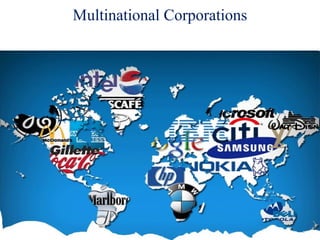
Multinational Corporations

Presented in class of :
Medam Mubashra
presented by: Muhammad Azaz
Multinational Corporations
1
Contents

Meaning
Meaning
 An

enterprise operating in several
countries but managed from one
(home) country.
 Generally, any company or group that
derives a quarter of its revenue from
operations outside of its home country
is considered a multinational
corporation.
Definition
“ Mr. Jacques Maisonrouge, president , IBM world
trade corporation describe MNCs”:





It operates in many countries at different levels
of economic development.
Its local subsidiaries are managed by nationals.
It maintains complete industrial organisation
including R&D facilities in several countries.
It has a multinational central management.
It has multinational stock ownership.
According to the ILO
“The essential nature of the
multinational enterprises lies
in the fact that its managerial
headquarters are located in
one country, while the
enterprise carries out
operations in a number of
other countries as well”.
HISTORY


Multinational business operation is not a new
concept.



The British east India company, Hudson’s bay
corporation and Royal Africa companies are
example of MNCs.



The post second world war period has
however, witnessed a changing hand in
colonialism and there emerged a new thrusts
for industrial and technological development
as well as rise of the USA as the largest
industrial power.
HISTORY




The Dutch East India Company was
the first multinational corporation in
the world and the first company to
issue stock.
The first modern multinational
corporation is generally thought to
be the East India Company. Many
corporations have offices, branches
or manufacturing plants in different
countries from where their original
and main headquarters is located.
Features of MNC
1. Big size
Objectives


To expand the business beyond the
boundaries of the home country.



Minimize cost of production, especially
labour cost.



Capture lucrative foreign market against
international competitors.



Avail of competitive advantage
internationally.
Objectives


Achieve greater efficiency by producing in
local market and then exporting the
products.



Make best use of technological advantages
by setting up production facilities abroad.



Establish an international corporate image.
Reasons for the Growth of MNCs
WORLD’S TOP MNCs:
Fortune Global 500 List 2011: Top
10
RANK

COMPANY

COUNTRY

FIELD

1

Wal-Mart Stores

 United States

Retail

2

Royal Dutch Shell

 Netherlands

Petroleum

3

Exxon Mobil

 United States

Petroleum

4

BP

 United Kingdom

Petroleum

5

Sinopec

 China

Petroleum

6

China National Petroleum

 China

Petroleum

7

State Grid

 China

Power

8

Toyota Motor

 Japan

Automobiles

9

Japan Post Holdings

 Japan

Diversified

10

Chevron

 United States

Petroleum
Fortune Global 500 2011: Country
wise:
RANK

COUNTRY

NUMBER OF
COMPANIES

1

 United States

133

2

 Japan

68

3

 China

61

4

 France

35

5

 Germany

34

6

 United Kingdom

30

7

 Switzerland

15

8

 South Korea

14

9

 Netherlands

12

10

 Canada

11
Favourable Impact of
MNCs
1. MNC,s create employment opportunities in the
host countries. It helps to create a pool of
managerial talent in the host country.
2. Helps removal of monopoly (domination)
and improve the quality of domestic made products.
3.

Promotes exports and reduce imports by
raising domestic productions.

4. Goods are made available at cheaper
due to economies of scale.

price
Favourable Impact of MNCs
5. Job and career opportunities at
home and abroad in connection with
overseas operations.
6. Encourages the world unity and all
resulting in world harmony .
7. Transfer of technology, capital and
entrepreneurship.
8. Greater availability of products for
local consumers.
Har mful ef fect of
MNCs
1. The host county is likely to lose its
economic sovereignty
2. The host nation may also experience some
loss of control over its own economy
3. Feeling that labour is being exploited by the
MNC/ Outsourcing
4. Lost of cultural moorings
5. The problem of Dumping
Example – Chinese products are priced low in
Indian market.
Few Examples of MNCs in Pakistan
Sony
LG and
Vodafone
Reebok many more
Ford Motors
British Petroleum
Futur e of MNCs
 Increasing

international competition.
 Global consumer awareness.
 Technological advancement.
 Reduction in friction among nations.
 World Business Community coming
together.
 Growing role of private sector inn
developing countries.
 Regional

economic Integration.
 Increase in the number of bilateral
treaties that promote FDI has increased
considerably.
 Privatization programmes.
THANK
S …..

Multinational corporations MNCs

  • 1.
    Depar tment ofGeogr aphy GC Univer sity Faisalabad Multinational Corporations Presented in class of : Medam Mubashra presented by: Muhammad Azaz
  • 2.
  • 3.
  • 4.
  • 5.
    Meaning  An enterprise operatingin several countries but managed from one (home) country.  Generally, any company or group that derives a quarter of its revenue from operations outside of its home country is considered a multinational corporation.
  • 6.
    Definition “ Mr. JacquesMaisonrouge, president , IBM world trade corporation describe MNCs”:     It operates in many countries at different levels of economic development. Its local subsidiaries are managed by nationals. It maintains complete industrial organisation including R&D facilities in several countries. It has a multinational central management. It has multinational stock ownership.
  • 7.
    According to theILO “The essential nature of the multinational enterprises lies in the fact that its managerial headquarters are located in one country, while the enterprise carries out operations in a number of other countries as well”.
  • 9.
    HISTORY  Multinational business operationis not a new concept.  The British east India company, Hudson’s bay corporation and Royal Africa companies are example of MNCs.  The post second world war period has however, witnessed a changing hand in colonialism and there emerged a new thrusts for industrial and technological development as well as rise of the USA as the largest industrial power.
  • 10.
    HISTORY   The Dutch EastIndia Company was the first multinational corporation in the world and the first company to issue stock. The first modern multinational corporation is generally thought to be the East India Company. Many corporations have offices, branches or manufacturing plants in different countries from where their original and main headquarters is located.
  • 11.
  • 12.
    Objectives  To expand thebusiness beyond the boundaries of the home country.  Minimize cost of production, especially labour cost.  Capture lucrative foreign market against international competitors.  Avail of competitive advantage internationally.
  • 13.
    Objectives  Achieve greater efficiencyby producing in local market and then exporting the products.  Make best use of technological advantages by setting up production facilities abroad.  Establish an international corporate image.
  • 14.
    Reasons for theGrowth of MNCs
  • 15.
  • 16.
    Fortune Global 500List 2011: Top 10 RANK COMPANY COUNTRY FIELD 1 Wal-Mart Stores  United States Retail 2 Royal Dutch Shell  Netherlands Petroleum 3 Exxon Mobil  United States Petroleum 4 BP  United Kingdom Petroleum 5 Sinopec  China Petroleum 6 China National Petroleum  China Petroleum 7 State Grid  China Power 8 Toyota Motor  Japan Automobiles 9 Japan Post Holdings  Japan Diversified 10 Chevron  United States Petroleum
  • 17.
    Fortune Global 5002011: Country wise: RANK COUNTRY NUMBER OF COMPANIES 1  United States 133 2  Japan 68 3  China 61 4  France 35 5  Germany 34 6  United Kingdom 30 7  Switzerland 15 8  South Korea 14 9  Netherlands 12 10  Canada 11
  • 19.
    Favourable Impact of MNCs 1.MNC,s create employment opportunities in the host countries. It helps to create a pool of managerial talent in the host country. 2. Helps removal of monopoly (domination) and improve the quality of domestic made products. 3. Promotes exports and reduce imports by raising domestic productions. 4. Goods are made available at cheaper due to economies of scale. price
  • 20.
    Favourable Impact ofMNCs 5. Job and career opportunities at home and abroad in connection with overseas operations. 6. Encourages the world unity and all resulting in world harmony . 7. Transfer of technology, capital and entrepreneurship. 8. Greater availability of products for local consumers.
  • 21.
    Har mful effect of MNCs 1. The host county is likely to lose its economic sovereignty 2. The host nation may also experience some loss of control over its own economy 3. Feeling that labour is being exploited by the MNC/ Outsourcing 4. Lost of cultural moorings 5. The problem of Dumping Example – Chinese products are priced low in Indian market.
  • 22.
    Few Examples ofMNCs in Pakistan Sony LG and Vodafone Reebok many more Ford Motors British Petroleum
  • 23.
    Futur e ofMNCs  Increasing international competition.  Global consumer awareness.  Technological advancement.  Reduction in friction among nations.  World Business Community coming together.  Growing role of private sector inn developing countries.
  • 24.
     Regional economic Integration. Increase in the number of bilateral treaties that promote FDI has increased considerably.  Privatization programmes.
  • 25.

Editor's Notes