In the 1600 and 1700 centuries, mercantilism stressed that countries should  simultaneously encourage exports and discourage imports .  Although mercantilism is an old theory it echoes (repeat) in modern politics and trade policies of many countries The neoclassical economist  Adam Smith , who developed the theory of absolute advantage, was the first to explain why  unrestricted free trade  is beneficial to a country. Two theories have been developed from Adam  Smith's absolute advantage theory.  First is the English neoclassical economist  David Ricardo's  comparative advantage .  Two Swedish economists,  Eli Hecksher and Bertil Ohlin , develop the second theory.
According to Wild, 2000, the trade theory that states that nations should accumulate financial wealth, usually in the form of gold, by  encouraging exports and discouraging imports  is called mercantilism
 
The Scottish economist  Adam Smith  developed the trade theory of absolute advantage in 1776 A country that has an absolute advantage  produces greater output of a good or service than other countries using the same amount of resources.  Smith stated that  tariffs and quotas should not restrict international trade Contrary to mercantilism Smith argued that a country should concentrate on production of goods in which it holds an absolute advantage. No country would then need to produce all the goods it consumed
 
Trade is between two countries Only two commodities are traded Free trade exists between the countries They only element of cost of production is labour.
Country A can produce 1,000 parts per hour with 200 workers.  Country B can produce 2,500 parts per hour with 200 workers.  Country C can produce 10,000 parts per hour with 200 workers.    _______has the absolute advantage.
According to the absolute advantage theory, international trade is a positive-sum game, because  there are gains for both countries to an exchange .  Unlike mercantilism this theory measures the  nation's wealth by  the  living standards of its people  and  not by gold  and silver.
If there is one country that does not have an absolute advantage in the production of any product, will there still be benefit to trade, and will trade even occur? The answer may be found in the extension of absolute advantage, the  theory of comparative advantage .
The most basic concept in the whole of international trade theory is the principle of comparative advantage, first introduced  by David Ricardo in 1817.  The principle of comparative advantage states that a country should specialize in producing and  exporting those products in which is has a  comparative, or relative cost,  advantage  compared with other countries and should  import  those goods in  which it has a comparative disadvantage.
law of  comparative advantage  refers to the ability of a country to produce a particular good or service at a lower  opportunity cost  than another party.
The  cost  of passing up the next best  choice  when making a  decision Eg: you have Rs.100. u can use this to buy either
The assumption that countries are driven only by the  maximization of production and consumption, and not by issues out of concern for workers  or consumers is a mistake.
History of Bertil ohlin:Between 1944 and 1967, Bertil Ohlin was the leader of the Swedish Liberal Party, and between 1944 and 1945 he was also the Secretary of Trade of the Swedish Government. Bertil Ohlin died in 1979.
The countries differ with respect to the availability of the factors of production.  They differ if one country, for example, has  many machines (capital) but few workers , while another  country has a lot of workers but few machines. According to the Heckscher-Ohlin theory, a country specializes in the  production of goods that it is particularly suited to produce Countries in which  capital is abundant  and workers are few  production of goods  in particular , require capital .
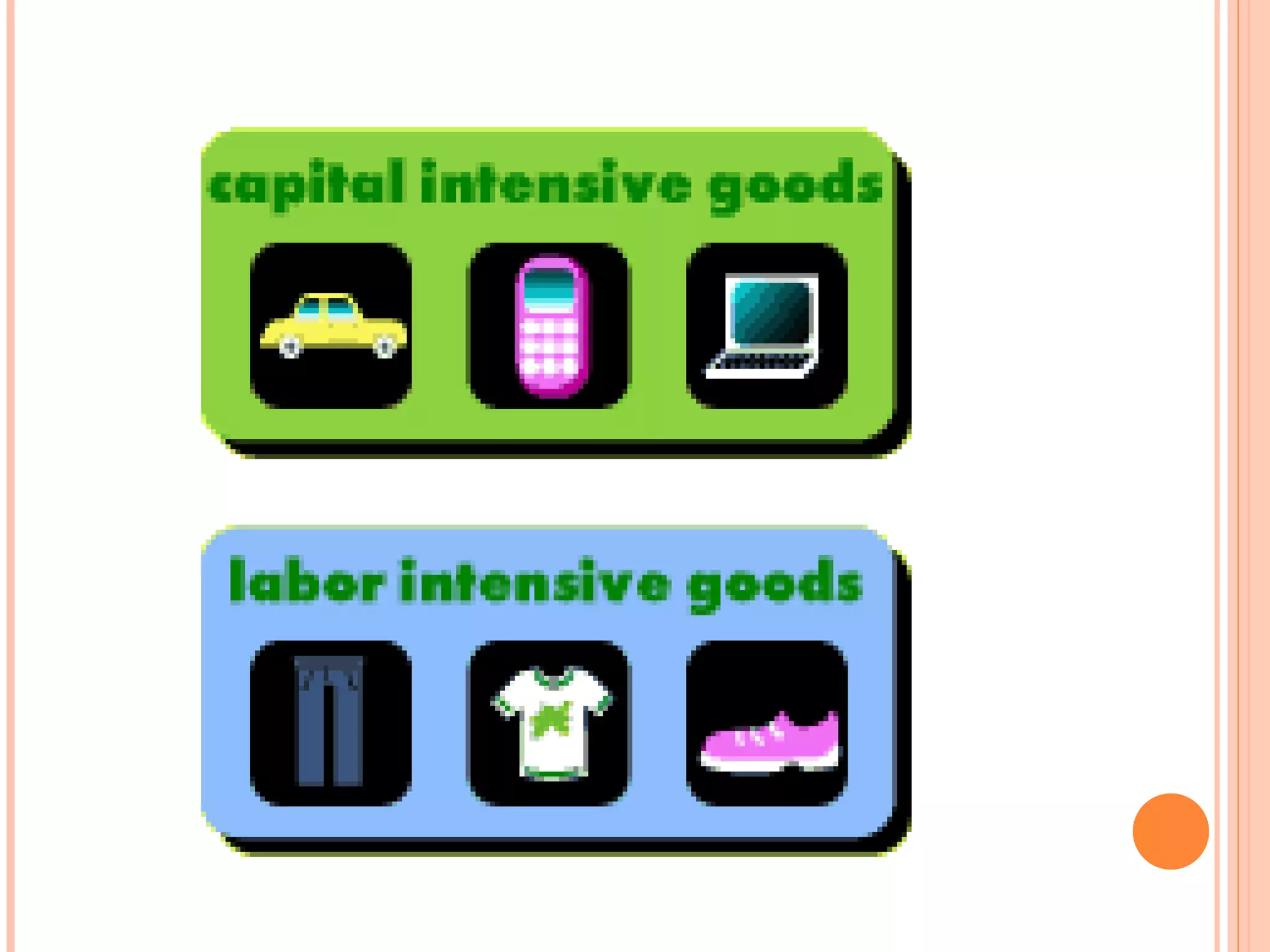
MACHINES AND WORKERS  The production of goods and services requires capital and workers. Some goods require  more capital  - technical equipment and machinery - and are called  capital intensive .  Examples of these goods are cars, computers, and cell phones . Other goods require less equipment to produce and rely  mostly on the efforts of the workers . These goods are  called  labor intensive .  Examples of these goods are shoes and textile products such as jeans .
 
 
The  product life-cycle theory  is an economic theory that was developed by  Raymond Vernon The intent of his International Product Life Cycle model (IPLC) was to  advance trade theory beyond David Ricardo’s static framework of comparative advantages .  the product life cycle - explain  how trade patterns change overtime.
MNC Manufactures Product in Developed Countries; Exports to Developing Countries MNC Moves Production to Developing Country; Begins Importing to Home Country Developing Country  Competitor Exports Product  To MNC Home Country;  Competes with MNC  Imports Developing Country Markets Remain Viable Target Markets for MNC; MNC Home Country Market Is Diminishing Sales Introduction  and Growth  Stages: Early  Maturity: Late Maturity Decline Time
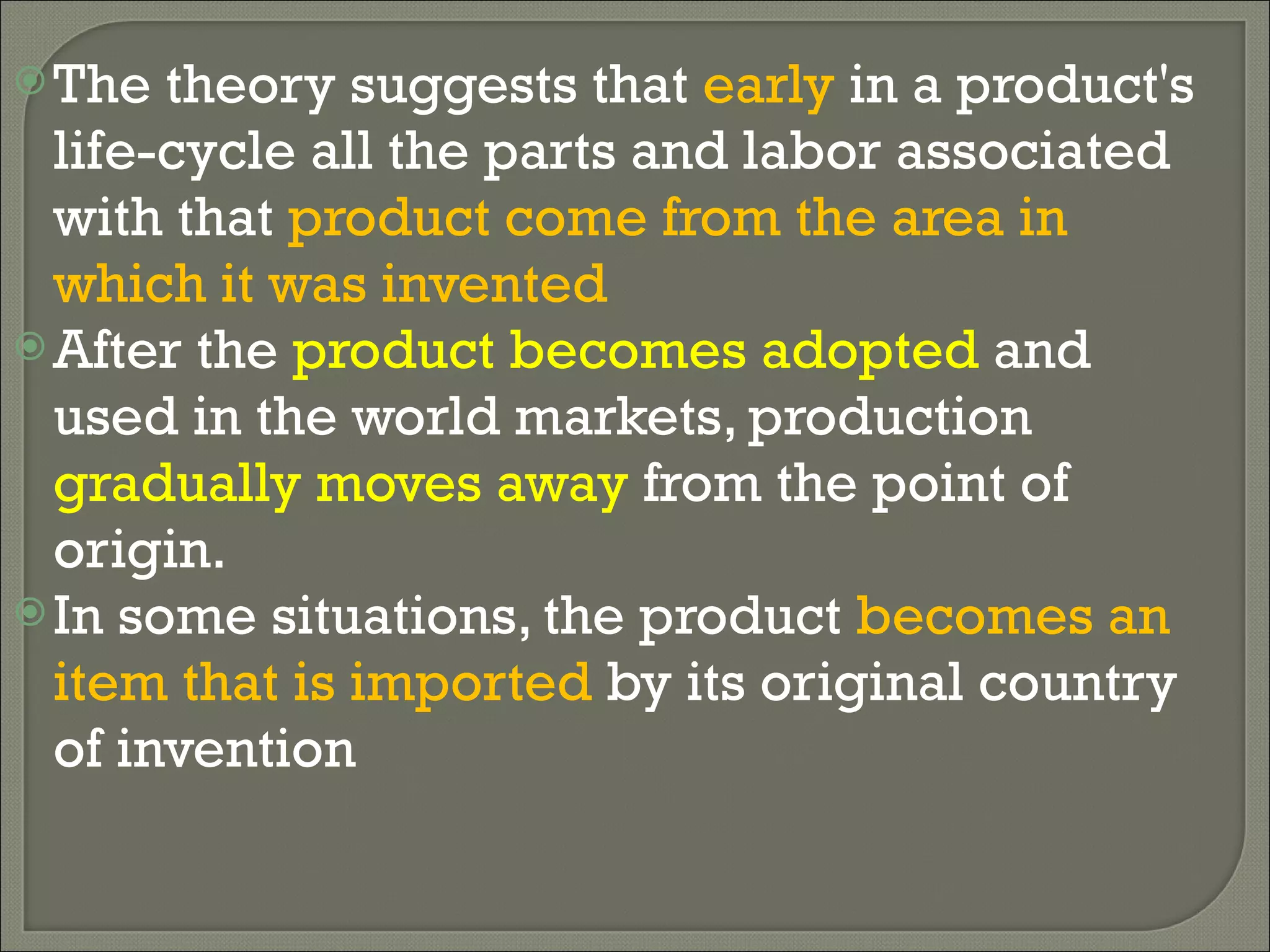
The theory suggests that  early  in a product's life-cycle all the parts and labor associated with that  product come from the area in which it was invented After the  product becomes adopted  and used in the world markets, production  gradually moves away  from the point of origin.  In some situations, the product  becomes an item that is imported  by its original country of invention
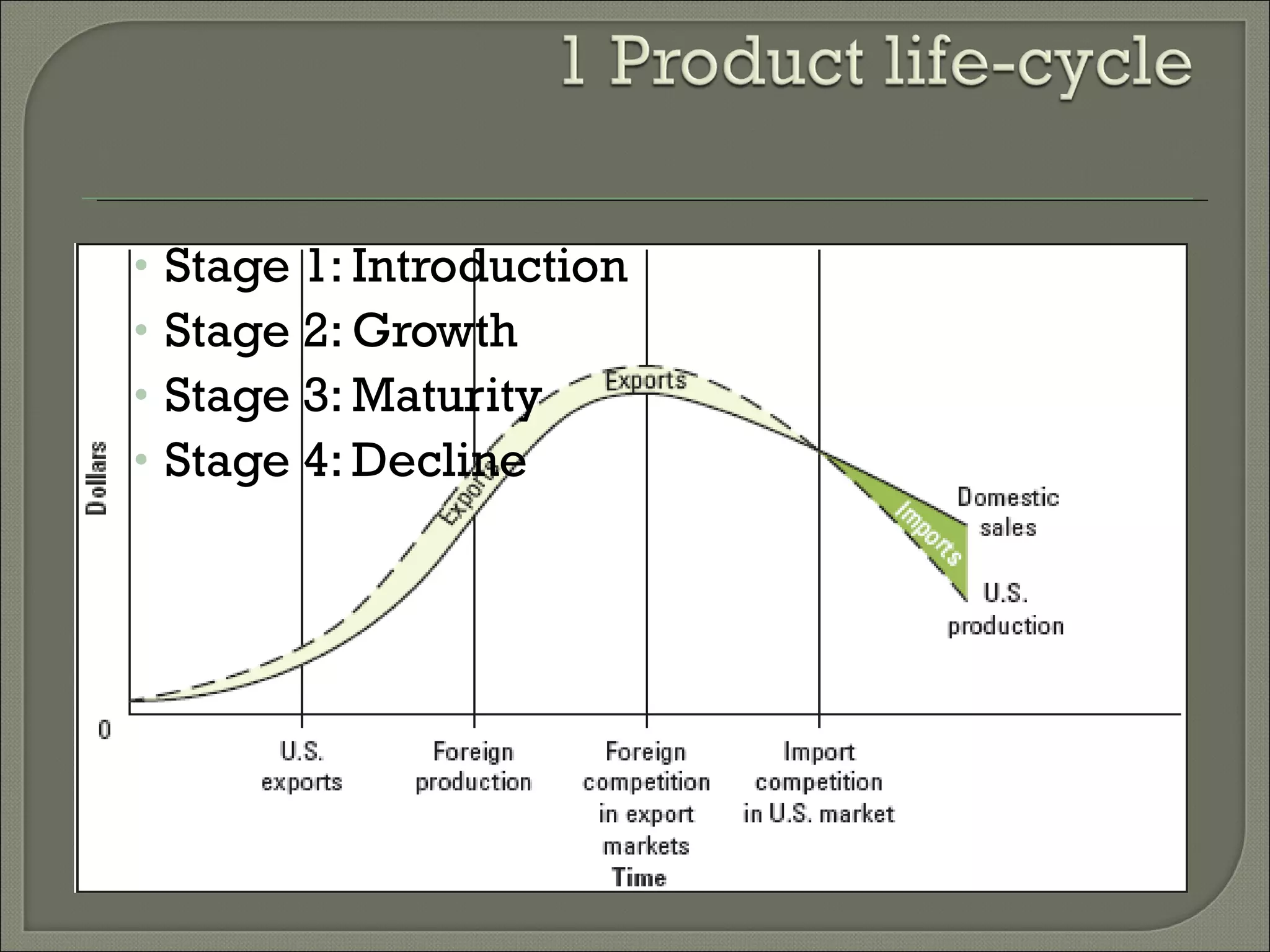
Stage 1: Introduction  Stage 2: Growth  Stage 3: Maturity  Stage 4: Decline
New products are  introduced to meet local  (i.e., national) needs, and new products are first  exported to similar countries , countries with similar needs, preferences, and incomes. (E.g., the IBM PCs were produced in the US and spread quickly throughout the industrialized countries.)
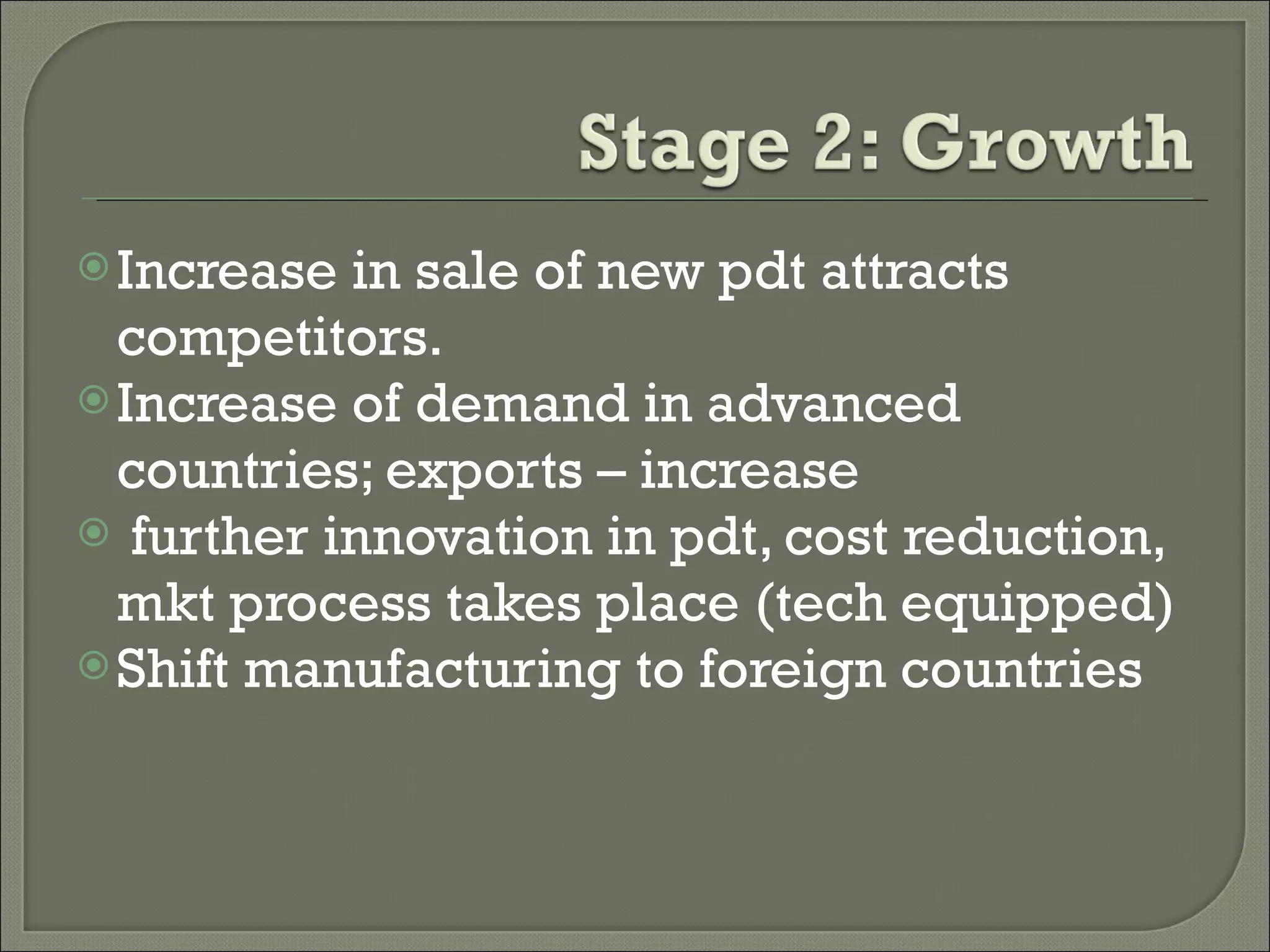
Increase in sale of new pdt attracts competitors. Increase of demand in advanced countries; exports – increase further innovation in pdt, cost reduction, mkt process takes place (tech equipped) Shift manufacturing to foreign countries
World wide pdtn;Export decline. Large scale of pdtn  Low cost pdtn – shift manufacturing to developing countries Tech become standard
Mks for the pdt concentrate in less developed countries as the customers in advanced countries shift their demand to further new pdts –thus pdtn in developing countries Original innovator becomes importer
PORTER'S DIAMOND OF NATIONAL ADVANTAGE
WHAT IS THE DIAMOND MODEL? The Diamond Model of Michael Porter for the competitive advantage of Nations offers a model that  can help understand the comparative position of a nation in global competition.
TRADITIONAL COUNTRY ADVANTAGES Traditionally, economic theory mentions the following factors for comparative advantage for regions or countries: 1.  Land 2. Location 3. Natural resources (minerals, energy) 4. Labor, and 5. Local population size.  Because these 5 factors can hardly influence…..
Porter says that sustained industrial growth has hardly ever been built on above mentioned basic inherited factors According to Porter, as a rule competitive advantage of nations is the outcome of  4 interlinked advanced factors and activities  in and between companies
 
PORTER used a diamond shaped diagram as a basis of a framework to illustrate the determinants of national advantage. The points of the diamond are described as follows ……..
1.FACTOR CONDITIONS Classical factors – land, labour, capital and org Porter emphasize education level of labour, quality of country infrastructure
2.DEMAND CONDITIONS
3.RELATED AND SUPPORTED INDUSTRIES Suppliers of raw mtls, market intermediaries, financial companies, consulting agencies, ancillary industries etc…. It competes and come with high input quality pdts
4. FIRM STG, STRUCTURE AND RIVALRY Continuouslyv improve pdt design, invest in R & D, HRD, Tech … High quality; low cost = export internationally Japan – electronic goods
 

Theories of international trade

  • 1.
  • 2.
    In the 1600and 1700 centuries, mercantilism stressed that countries should simultaneously encourage exports and discourage imports . Although mercantilism is an old theory it echoes (repeat) in modern politics and trade policies of many countries The neoclassical economist Adam Smith , who developed the theory of absolute advantage, was the first to explain why unrestricted free trade is beneficial to a country. Two theories have been developed from Adam Smith's absolute advantage theory. First is the English neoclassical economist David Ricardo's comparative advantage . Two Swedish economists, Eli Hecksher and Bertil Ohlin , develop the second theory.
  • 3.
    According to Wild,2000, the trade theory that states that nations should accumulate financial wealth, usually in the form of gold, by encouraging exports and discouraging imports is called mercantilism
  • 4.
  • 5.
    The Scottish economist Adam Smith developed the trade theory of absolute advantage in 1776 A country that has an absolute advantage produces greater output of a good or service than other countries using the same amount of resources. Smith stated that tariffs and quotas should not restrict international trade Contrary to mercantilism Smith argued that a country should concentrate on production of goods in which it holds an absolute advantage. No country would then need to produce all the goods it consumed
  • 6.
  • 7.
    Trade is betweentwo countries Only two commodities are traded Free trade exists between the countries They only element of cost of production is labour.
  • 8.
    Country A canproduce 1,000 parts per hour with 200 workers. Country B can produce 2,500 parts per hour with 200 workers. Country C can produce 10,000 parts per hour with 200 workers.   _______has the absolute advantage.
  • 9.
    According to theabsolute advantage theory, international trade is a positive-sum game, because there are gains for both countries to an exchange . Unlike mercantilism this theory measures the nation's wealth by the living standards of its people and not by gold and silver.
  • 10.
    If there isone country that does not have an absolute advantage in the production of any product, will there still be benefit to trade, and will trade even occur? The answer may be found in the extension of absolute advantage, the theory of comparative advantage .
  • 11.
    The most basicconcept in the whole of international trade theory is the principle of comparative advantage, first introduced by David Ricardo in 1817. The principle of comparative advantage states that a country should specialize in producing and exporting those products in which is has a comparative, or relative cost, advantage compared with other countries and should import those goods in which it has a comparative disadvantage.
  • 12.
    law of comparative advantage refers to the ability of a country to produce a particular good or service at a lower opportunity cost than another party.
  • 13.
    The cost of passing up the next best choice when making a decision Eg: you have Rs.100. u can use this to buy either
  • 14.
    The assumption thatcountries are driven only by the maximization of production and consumption, and not by issues out of concern for workers or consumers is a mistake.
  • 15.
    History of Bertilohlin:Between 1944 and 1967, Bertil Ohlin was the leader of the Swedish Liberal Party, and between 1944 and 1945 he was also the Secretary of Trade of the Swedish Government. Bertil Ohlin died in 1979.
  • 16.
    The countries differwith respect to the availability of the factors of production. They differ if one country, for example, has many machines (capital) but few workers , while another country has a lot of workers but few machines. According to the Heckscher-Ohlin theory, a country specializes in the production of goods that it is particularly suited to produce Countries in which capital is abundant and workers are few production of goods in particular , require capital .
  • 17.
    MACHINES AND WORKERS The production of goods and services requires capital and workers. Some goods require more capital - technical equipment and machinery - and are called capital intensive . Examples of these goods are cars, computers, and cell phones . Other goods require less equipment to produce and rely mostly on the efforts of the workers . These goods are called labor intensive . Examples of these goods are shoes and textile products such as jeans .
  • 18.
  • 19.
  • 20.
    The productlife-cycle theory is an economic theory that was developed by Raymond Vernon The intent of his International Product Life Cycle model (IPLC) was to advance trade theory beyond David Ricardo’s static framework of comparative advantages . the product life cycle - explain how trade patterns change overtime.
  • 21.
    MNC Manufactures Productin Developed Countries; Exports to Developing Countries MNC Moves Production to Developing Country; Begins Importing to Home Country Developing Country Competitor Exports Product To MNC Home Country; Competes with MNC Imports Developing Country Markets Remain Viable Target Markets for MNC; MNC Home Country Market Is Diminishing Sales Introduction and Growth Stages: Early Maturity: Late Maturity Decline Time
  • 22.
    The theory suggeststhat early in a product's life-cycle all the parts and labor associated with that product come from the area in which it was invented After the product becomes adopted and used in the world markets, production gradually moves away from the point of origin. In some situations, the product becomes an item that is imported by its original country of invention
  • 23.
    Stage 1: Introduction Stage 2: Growth Stage 3: Maturity Stage 4: Decline
  • 24.
    New products are introduced to meet local (i.e., national) needs, and new products are first exported to similar countries , countries with similar needs, preferences, and incomes. (E.g., the IBM PCs were produced in the US and spread quickly throughout the industrialized countries.)
  • 25.
    Increase in saleof new pdt attracts competitors. Increase of demand in advanced countries; exports – increase further innovation in pdt, cost reduction, mkt process takes place (tech equipped) Shift manufacturing to foreign countries
  • 26.
    World wide pdtn;Exportdecline. Large scale of pdtn Low cost pdtn – shift manufacturing to developing countries Tech become standard
  • 27.
    Mks for thepdt concentrate in less developed countries as the customers in advanced countries shift their demand to further new pdts –thus pdtn in developing countries Original innovator becomes importer
  • 28.
    PORTER'S DIAMOND OFNATIONAL ADVANTAGE
  • 29.
    WHAT IS THEDIAMOND MODEL? The Diamond Model of Michael Porter for the competitive advantage of Nations offers a model that can help understand the comparative position of a nation in global competition.
  • 30.
    TRADITIONAL COUNTRY ADVANTAGESTraditionally, economic theory mentions the following factors for comparative advantage for regions or countries: 1. Land 2. Location 3. Natural resources (minerals, energy) 4. Labor, and 5. Local population size. Because these 5 factors can hardly influence…..
  • 31.
    Porter says thatsustained industrial growth has hardly ever been built on above mentioned basic inherited factors According to Porter, as a rule competitive advantage of nations is the outcome of 4 interlinked advanced factors and activities in and between companies
  • 32.
  • 33.
    PORTER used adiamond shaped diagram as a basis of a framework to illustrate the determinants of national advantage. The points of the diamond are described as follows ……..
  • 34.
    1.FACTOR CONDITIONS Classicalfactors – land, labour, capital and org Porter emphasize education level of labour, quality of country infrastructure
  • 35.
  • 36.
    3.RELATED AND SUPPORTEDINDUSTRIES Suppliers of raw mtls, market intermediaries, financial companies, consulting agencies, ancillary industries etc…. It competes and come with high input quality pdts
  • 37.
    4. FIRM STG,STRUCTURE AND RIVALRY Continuouslyv improve pdt design, invest in R & D, HRD, Tech … High quality; low cost = export internationally Japan – electronic goods
  • 38.