
OVERVIEW
• What is MNC?
• History and Evolution of MNC
• MNC Structure
• Reasons for the establishment of MNCs
• Advantage and Disadvantage of MNC
• Criticism of MNC
• MNCs in India
• Trends of MNC in India
• Future of MNCs
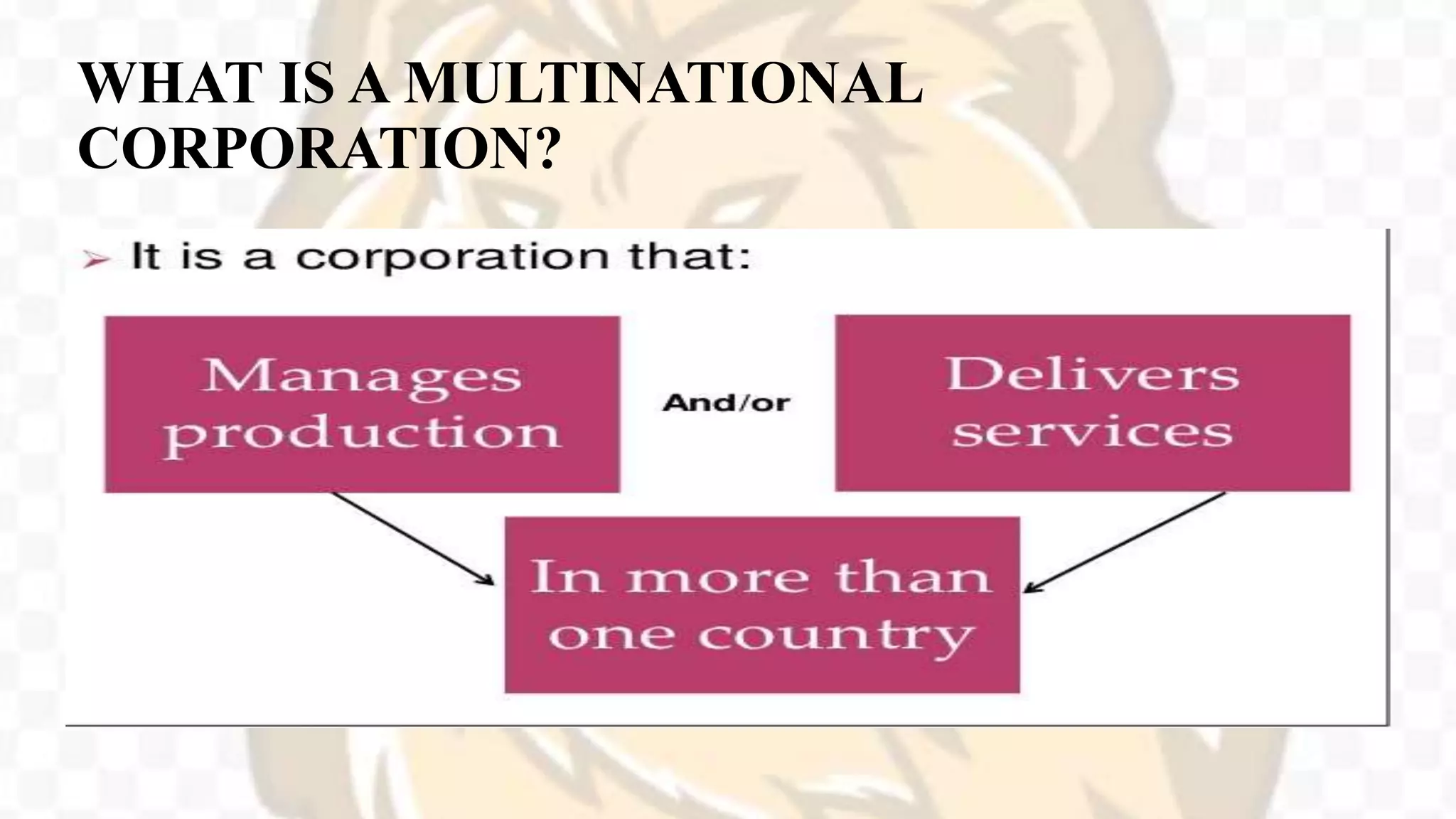
WHAT IS A MULTINATIONAL
CORPORATION?
DEFINITION
“Mr. Jacques Maison rouge, president , IBM world trade corporation describe MNCs”:
 It operates in many countries at different levels of economic development.
 Its local subsidiaries are managed by nationals.
 It maintains complete industrial organization including R&D facilities in several countries.
 It has a multinational central management.
 It has multinational stock ownership.
HISTORY AND EVOLUTION OF MNCs
These corporations originated early in the 20th century and expanded
after World War II.
 A multinational corporation developed new products in its native
country and manufactured them abroad.
 Almost all the earliest and largest multinational firms were either
American, Japanese, or West European.
During the last three decades, many smaller corporations have also
become multinational.
 Such enterprises maintain that they create employment, create wealth,
and improve technology in countries
MULTINATIONAL CORPORATION
STRUCTURE
REASONS FOR THE ESTABLISHMENT OF
MNCS
To increase market share.
 To secure cheaper premises and labor.
 Employment and Health & Safety Legislations in other countries may
be more relaxed.
 To avoid or minimize the amount of tax to be paid.
 To take advantage of government grants available.
 To save on costs of transporting goods to the market place.
 To develop an international brand
ADVANTAGES OF MNCS TO THE HOST
COUNTRY
Transfer of technology, capital and entrepreneurship.
 Increase in the investment level and thus, the income and employment
in the host country.
 Greater availability of products for local consumers.
 Increase in exports and decrease in imports.
ADVANTAGES OF MNCS TO THE HOME
COUNTRY
Acquisition of raw materials from abroad.
 Technology and management expertise acquired from competing in global
markets.
 Export of components and finished goods for assembly or distribution in
foreign markets.
 Inflow of income from overseas profits, royalties and management contracts.
DISADVANTAGES OF MNCS
Trade restrictions imposed at the government-level.
 Limited quantities (quotas) of imports.
 Effective management of a globally dispersed organization.
 Slow down in the growth of employment in home countries.
 Destroy competition and acquire monopoly.
FORTUNE GLOBAL 500 LIST 2021: TOP 10
RANK COMPANY COUNTRY FIELD
1 Wal-Mart Stores United States Retail
2 Sinopec China Petroleum
3 State Grid China Power
4 China National
Petroleum
China Petroleum
5 Royal Dutch Shell Netherlands Oil and gas
6 Saudi Aramco Saudi Arabia Petroleum
7 Volkswagen Germany Motor Vehicle
8 BP United Kingdom Petroleum
9 Amazon United States Retail
10 Toyota Motor Japan Automobiles
FORTUNE GLOBAL 500 2021: COUNTRY
WISE
RANK COUNTRY NUMBEROF
COMPANIES
1 United States 133
2 Japan 68
3 China 61
4 France 35
5 Germany 34
6 United Kingdom 30
7 Switzerland 15
8 South Korea 14
9 Netherlands 12
10 Canada 11
CRITICISM OF MNCS
 Creation of false needs in consumers.
 Interference and dominance in the internal affairs of sovereign nations.
 Invasive advertising and corporate lobbying.
 Creation of monopolies in the market and elimination of local competitors.
 Depletion of resources due to their continuous use by these corporations. Centralization of R&D
operations in their home country.
 Low consideration for human rights and welfare.
The problem of Dumping.
INDIAN COMPANIES IN FORTUNE GLOBAL
500 LIST 2021:
COUNTRY
RANK
COMPANY GLOBAL 500
RANK
CITY REVENUE
($ millions)
1 Indian Oil 98 New Delhi 68,837
2 Reliance
Industries
134 Mumbai 58,900
3 Bharat
Petroleum
272 Mumbai 34,102
4 State Bank of
India
292 Mumbai 32,450
5 Hindustan
Petroleum
336 Mumbai 28,593
6 Tata Motors 359 Mumbai 27,046
7 Oil & Natural Gas 361 Dehradun 26,945
8 Tata Steel 370 Mumbai 26,065
TRENDS OF MNCS IN INDIA
First MNC in India was the EAST INDIA Company. in 1600.
 American companies account for around 37% of the turnover of the top 20 firms operating in India.
 Oil companies and Infrastructure builders from the Middle East are also flocking in India to catch the
boom.
Increasing flocking of European Union companies to India.
 Finnish mobile handset manufacturing giant Nokia is the largest Multinational Corporation In India.
 Italian automobile giants like Fiat, Ford Motors, Piaggio etc. expanded their operations in India with
R&D wing attached.
 South Korean Electronics giants Samsung and LG Electronics and small and mid-segment car giant
Hyundai Motors are doing excellent business and using India as a hub for global delivery.
FUTURE OF MNCs
Increasing international competition.
Global consumer awareness.
Technological advancement.
Reduction in friction among nations.
World Business Community coming together.
Growing role of private sector in developing countries.
Regional economic Integration.
Increase in the number of bilateral treaties that promote FDI has increased considerably.
Multinational corporation

Multinational corporation

  • 2.
    OVERVIEW • What isMNC? • History and Evolution of MNC • MNC Structure • Reasons for the establishment of MNCs • Advantage and Disadvantage of MNC • Criticism of MNC • MNCs in India • Trends of MNC in India • Future of MNCs
  • 3.
    WHAT IS AMULTINATIONAL CORPORATION?
  • 4.
    DEFINITION “Mr. Jacques Maisonrouge, president , IBM world trade corporation describe MNCs”:  It operates in many countries at different levels of economic development.  Its local subsidiaries are managed by nationals.  It maintains complete industrial organization including R&D facilities in several countries.  It has a multinational central management.  It has multinational stock ownership.
  • 6.
    HISTORY AND EVOLUTIONOF MNCs These corporations originated early in the 20th century and expanded after World War II.  A multinational corporation developed new products in its native country and manufactured them abroad.  Almost all the earliest and largest multinational firms were either American, Japanese, or West European. During the last three decades, many smaller corporations have also become multinational.  Such enterprises maintain that they create employment, create wealth, and improve technology in countries
  • 7.
  • 8.
    REASONS FOR THEESTABLISHMENT OF MNCS To increase market share.  To secure cheaper premises and labor.  Employment and Health & Safety Legislations in other countries may be more relaxed.  To avoid or minimize the amount of tax to be paid.  To take advantage of government grants available.  To save on costs of transporting goods to the market place.  To develop an international brand
  • 9.
    ADVANTAGES OF MNCSTO THE HOST COUNTRY Transfer of technology, capital and entrepreneurship.  Increase in the investment level and thus, the income and employment in the host country.  Greater availability of products for local consumers.  Increase in exports and decrease in imports.
  • 10.
    ADVANTAGES OF MNCSTO THE HOME COUNTRY Acquisition of raw materials from abroad.  Technology and management expertise acquired from competing in global markets.  Export of components and finished goods for assembly or distribution in foreign markets.  Inflow of income from overseas profits, royalties and management contracts.
  • 11.
    DISADVANTAGES OF MNCS Traderestrictions imposed at the government-level.  Limited quantities (quotas) of imports.  Effective management of a globally dispersed organization.  Slow down in the growth of employment in home countries.  Destroy competition and acquire monopoly.
  • 12.
    FORTUNE GLOBAL 500LIST 2021: TOP 10 RANK COMPANY COUNTRY FIELD 1 Wal-Mart Stores United States Retail 2 Sinopec China Petroleum 3 State Grid China Power 4 China National Petroleum China Petroleum 5 Royal Dutch Shell Netherlands Oil and gas 6 Saudi Aramco Saudi Arabia Petroleum 7 Volkswagen Germany Motor Vehicle 8 BP United Kingdom Petroleum 9 Amazon United States Retail 10 Toyota Motor Japan Automobiles
  • 13.
    FORTUNE GLOBAL 5002021: COUNTRY WISE RANK COUNTRY NUMBEROF COMPANIES 1 United States 133 2 Japan 68 3 China 61 4 France 35 5 Germany 34 6 United Kingdom 30 7 Switzerland 15 8 South Korea 14 9 Netherlands 12 10 Canada 11
  • 14.
    CRITICISM OF MNCS Creation of false needs in consumers.  Interference and dominance in the internal affairs of sovereign nations.  Invasive advertising and corporate lobbying.  Creation of monopolies in the market and elimination of local competitors.  Depletion of resources due to their continuous use by these corporations. Centralization of R&D operations in their home country.  Low consideration for human rights and welfare. The problem of Dumping.
  • 17.
    INDIAN COMPANIES INFORTUNE GLOBAL 500 LIST 2021: COUNTRY RANK COMPANY GLOBAL 500 RANK CITY REVENUE ($ millions) 1 Indian Oil 98 New Delhi 68,837 2 Reliance Industries 134 Mumbai 58,900 3 Bharat Petroleum 272 Mumbai 34,102 4 State Bank of India 292 Mumbai 32,450 5 Hindustan Petroleum 336 Mumbai 28,593 6 Tata Motors 359 Mumbai 27,046 7 Oil & Natural Gas 361 Dehradun 26,945 8 Tata Steel 370 Mumbai 26,065
  • 18.
    TRENDS OF MNCSIN INDIA First MNC in India was the EAST INDIA Company. in 1600.  American companies account for around 37% of the turnover of the top 20 firms operating in India.  Oil companies and Infrastructure builders from the Middle East are also flocking in India to catch the boom. Increasing flocking of European Union companies to India.  Finnish mobile handset manufacturing giant Nokia is the largest Multinational Corporation In India.  Italian automobile giants like Fiat, Ford Motors, Piaggio etc. expanded their operations in India with R&D wing attached.  South Korean Electronics giants Samsung and LG Electronics and small and mid-segment car giant Hyundai Motors are doing excellent business and using India as a hub for global delivery.
  • 19.
    FUTURE OF MNCs Increasinginternational competition. Global consumer awareness. Technological advancement. Reduction in friction among nations. World Business Community coming together. Growing role of private sector in developing countries. Regional economic Integration. Increase in the number of bilateral treaties that promote FDI has increased considerably.

Editor's Notes

  • #3 May require more than one slide
  • #8 May require more than one slide
  • #9 May require more than one slide