Logistic
Regression
This course content is being actively
developed by Delta Analytics, a
501(c)3 Bay Area nonprofit that aims to
empower communities to leverage their
data for good.
Please reach out with any questions or
feedback to inquiry@deltanalytics.org.
Find out more about our mission here.
Delta Analytics builds technical capacity
around the world.
Quick Review
Regression
Continuous variable
Classificatio
n
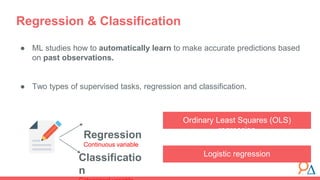
Regression & Classification
● ML studies how to automatically learn to make accurate predictions based
on past observations.
● Two types of supervised tasks, regression and classification.
Ordinary Least Squares (OLS)
regression
Logistic regression
● General Steps:
○ Split data into “training” and “test” sets.
○ Use regression/classification results from “training” set to predict“test” set
○ Compare “Predicted Y” to “Actual Y”
● Validation metrics (OLS):
** R^2 ** Adjusted R2 ** MSE
Predicted Y - Actual Y
Model’s Performance and Evaluation
● Ability to generalize to unseen data:
Source: Machine Learning Algorithms for Classification, Schapire (2016)
Module 3:
Logistic Regression
Overview of Logistic Regression:
Task
Model the probability that Y
belongs to a particular category
Performance
Measure
Accuracy, Misclassification Rate,
Precision, Recall. ROC Curve,
Confusion Matrix, etc.
Learning
Experience
Supervised
Source: Deep Learning Book - Chapter 5: Introduction to Machine Learning
Task
❏ Logistic Regression
❏ Task
❏ Dilemma using OLS
❏ Odds ratio
❏ Logit link function
❏ Probability thresholds
❏ Learning Experience
❏ Cost function
❏ Optimization process
❏ Performance
❏ Confusion Matrix
❏ ROC and AUC
Module Checklist
● A linear regression with variable(s) matrix X predicting target y is
formulated as:
SUM ( predictors j thru p (columns) of
the matrix X )
Beta (j), coefficient for the predictor xj ,
the j th column in variable matrix X
Beta (zero) intercept
● With linear regression, it is difficult to assign some observation value x
to some category value y.
● Example:
○ Predict college admissions using GRE, GPA, and college prestige
■ What would our output category value “College Admissions”
be?
Expected value (mean) of y given
variable matrix X
Task
Dilemma
using OLS
Task
Dilemma
using OLS
Houston we have a problema!!
Predicting College admission from gpa, gre
and school prestige
● We have a basic “binary” classification problem
○ 1 = admitted and 0 = rejected
● Keep in mind that the logistic regression is still solving for an expected
value. In the binary classification case this expected value is the
probability of one class:
● In regression syntax we would have:
Task
Dilemma
using OLS
Framing the idea in classification terms
Questions?
● There is a problem with this new equation: we want to estimate a
probability instead of a real number.
○ We need y to fall in the range [-infinity, infinity] for the regression to be
valid!
● Here is where the logit “link function” comes to our rescue!!
Task
Dilemma
using OLS
y to fall in the range [ -infinity, infinity ]
Estimate the probability instead of a real
number!!!
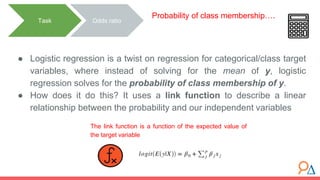
● Logistic regression is a twist on regression for categorical/class target
variables, where instead of solving for the mean of y, logistic
regression solves for the probability of class membership of y.
● How does it do this? It uses a link function to describe a linear
relationship between the probability and our independent variables
Task Odds ratio
Probability of class membership….
The link function is a function of the expected value of
the target variable
● What is our link function in the case of logistic regression?
● Our link function will use something called the odds ratio
Task Odds ratio
Modify regression equation…
The odds ratio of a probability p is a measure of how many
times more likely it is than the inverse case.
Questions?
Task Odds ratio
Probabilities of admittance by college prestige
Predicting college admission
Odds ratios of admittance by college prestige
In our example...
● If we put the odds ratio in place of the probability in the regression
equation, the range of odds ratio, our predicted value, is now
restricted to be in the range [0, infinity]
● And graphically will look like this:
Task Odds ratio
….. hmm something is missing ….
Modify regression equation…
● If we take the natural logarithm of a variable that falls between 0 and
infinity, we can actually transform it into a variable that falls between
the range negative infinity and infinity.
○ Why? Because taking the logarithm of fractions results in negative
numbers.
● And now our graph looks like:
Task
Logit link
function
… this is how it needs to look..
Modify regression equation…
● The combination of converting the probability to an odds ratio and
taking the logarithm of that is called the logit link function, and is
what regression uses to estimate probability:
● Graphically looks like this:
Task
Logit link
function
Houston we solved the problema!
Modify regression equation…
● Now that we have a probability, how do we actually classify the data?
● Choose a probability depending on the type of the classification problem
we’re solving for:
Task
Probability
thresholds
In this case, 0.5 is the
threshold probability.
Threshold can be adjusted by
model.
● Here is a classification example, where account balance is used to
predict the probability of default.
● Can you guess what is the correct classification method linear
regression (left) and logistic regression (right)?
Let’s check our understanding of
logistic regression
Task
Questions?
Learning Methodology
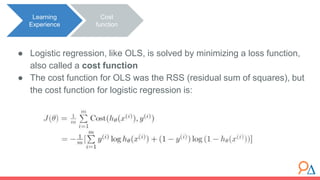
● Logistic regression, like OLS, is solved by minimizing a loss function,
also called a cost function
● The cost function for OLS was the RSS (residual sum of squares), but
the cost function for logistic regression is:
Cost
function
Learning
Experience
● Let’s break this down. We want to minimize the cost function, J
Cost
function
Learning
Experience
1. For each
classifier we’ve
predicted...
2. Add up the “cost” of the prediction, where h(x)
is the prediction and y is the actual classification
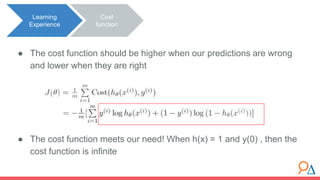
● The cost function should be higher when our predictions are wrong
and lower when they are right
● The cost function meets our need! When h(x) = 1 and y(0) , then the
cost function is infinite
Cost
function
Learning
Experience
Learning
Methodology
Source: Seeing Theory - Regression
● Like OLS, logistic
regression learns by
gradient descent to
minimize the cost function
● Reminder of gradient
descent from OLS
Optimization of
MSE:
Optimization
process
Questions?
Performance Metrics
Model
evaluation
Performance
Confusion Matrix
Imagine you are going to see your doctor and
you get an incorrect diagnosis
Source: Computing for the Social Sciences, University of Chicago
True Positive ( tp ): The cases in which the model
predicted "yes/positive", and the truth is also
“yes/positive."
True Negatives ( tn ): The cases in which the model
predicted "no/negative", and the truth is also
"no/negative."
False Positives ( fp ): The cases in which the model
predicted "yes/positive", and the truth is
"no/negative".
False Negatives ( fn ): The cases in which the model
predicted "no/negative", and the truth is
"yes/positive".
Model
evaluation
Performance
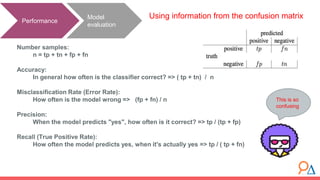
Using information from the confusion matrix
Number samples:
n = tp + tn + fp + fn
Accuracy:
In general how often is the classifier correct? => ( tp + tn) / n
Misclassification Rate (Error Rate):
How often is the model wrong => (fp + fn) / n
Precision:
When the model predicts "yes", how often is it correct? => tp / (tp + fp)
Recall (True Positive Rate):
How often the model predicts yes, when it's actually yes => tp / ( tp + fn)
This is so
confusing
Model
evaluation
Example
Performance
Can we predict if a congressmen/women is a
republican or democrat? Let’s use the 1984
United States Congressional Voting Records Database
Assume that we have set and run a logistic regression (gridsearch for hyperamaters), etc
and we got the following output:
Note: In this lecture, we are omitting other factors (class imbalance, how to
gridsearch hyperparameters, etc).
Now, evaluate the model => knowing that if we randomly choose from our dataset, 61 % of
the time you will guess /choose democrat (there are 267 democrats and 168 republicans in
the dataset)
Hmm?
?
Model
evaluation
Example
Performance
Here is the confusion matrix, let's calculate
some model performance indicators
Number of samples:
n = tp + tn + fp + fn => 49 +78 + 2 + 2 = 131
Accuracy:
In general how often is the classifier correct? => ( tp + tn) / n
=> (49+78) 131 => 0.9694 or 96.94%
Misclassification Rate (Error Rate):
How often is the model wrong => (fp + fn) / n => 4 / 131 => 0.03053 or 3.053%
Precision:
When the model predicts "yes", how often is it correct? => tp / (tp + fp)
=> 49 / (49 + 2) => 97.5%
Recall (True Positive Rate):
How often the model predicts yes, when it's actually yes => tp / ( tp + fn)
=> 49 / (49 + 2) => 97.5%
Now I
get it!
Model
evaluation
Performance
Other thresholds
What if instead of boosting the overall model accuracy, we want to improve a “class-specific”
accuracy?
● This can be the case when we want to increase sensitivity/recall => increase of the true
positive rate (TPR)
■ True Positive Rate = tp / ( tp + fn ) => 49 / (49 + 2) => 97.5%
● On the other hand, if we want to increase specificity we will need to increase the true
negative rate (TNR)
■ False Positive Rate = fp / ( fp + tn) => 2 / (2 + 78) => 2.5%
How do we accomplish this?
● Estimate a better model (achieve higher sensitivity and specificity)
● Use our existing model to meet one of these goals
○ Adjusting a threshold, or the cut-off point for classifying individuals as “democrats
Wait..
there is
more?!
Model
evaluation
Performance
ROC Curve
● We can graph across many combinations of thresholds, and then select a threshold level
at a point on which we are comfortable.
● The best approach is having domain knowledge on the benefits and costs of
making/considering a threshold (trade off).
● Receiving Operating Characteristic (ROC) visual way to inspect the performance of a
binary classifier
○ In a nutshell with a ROC curve we're measuring the “trade off” between the rate at
which the model correctly predicts something, with the rate at which the model
predicts something incorrectly.
○ As the class assignment threshold increases for the positive class, the false positive
rate and true positive rate necessarily increase.
How do we
select a
threshold?
Model
evaluation
Performance
ROC Curve Some
examples
por favor?
Source: yhat
Classifier is
making
completely
random
guesses
(50/50
chance)
Worse
than
guessing,
the blue
line is
below the
dotted
line
Mediocre
classifier,
lines that
show dips
Good Classifier, the
ideal scenario where
there is a 'hump
shaped' curve that is
continually increasing
A perfect classifier is
the one that shows a
perfect trade-off
between TPR and FPR
=> TPR of one and
FPR of zero
Model
evaluation
Performance
ROC Curve and AUC
ROC and AUC
from
Republican/De
mocrat case?
There is one more concept we should
know:
● Area under the curve or AUC, is the
amount of space underneath the
ROC curve.
● AUC shows how well the TPR and
FPR is looking in the aggregate.
● The greater the area under the
curve, shows the higher quality of
the model.
● The greater the area under the
curve, the higher the ratio of true
positives to false positives as the
threshold becomes more lenient
○ AUC = 0 => BAD
○ AUC = 1 => GOOD
✓ Logistic Regression
✓ Task
✓ Dilemma using OLS
✓ Odds ratio
✓ Logit link function
✓ Probability thresholds
✓ Learning Experience
✓ Cost function
✓ Optimization process
✓ Performance
✓ Confusion Matrix
✓ ROC and AUC
Module Checklist
Advanced
resources
● Textbooks
○ An Introduction to Statistical Learning with Applications in R (James, Witten, Hastie and
Tibshirani): Chapters 4.1, 4.2 4.3
● Online resources
○ Statistical learning: logistic regression - MACS 30100 - Perspectives on Computational
Modeling
○ Simple guide to confusion matrix terminology
○ A Simple Logistic Regression Implementation
● If you are interested in gridsearch of hyperparameters:
○ Tuning the hyper-parameters of an estimator
○ LogisticRegression (sklearn.linear_model)
Want to take this further? Here are some
resources we recommend:
Congrats! You finished the module!
Find out more about Delta’s machine learning for
good mission here.

Lecture 3.1_ Logistic Regression.pptx

  • 1.
  • 2.
    This course contentis being actively developed by Delta Analytics, a 501(c)3 Bay Area nonprofit that aims to empower communities to leverage their data for good. Please reach out with any questions or feedback to inquiry@deltanalytics.org. Find out more about our mission here. Delta Analytics builds technical capacity around the world.
  • 3.
  • 4.
    Regression Continuous variable Classificatio n Regression &Classification ● ML studies how to automatically learn to make accurate predictions based on past observations. ● Two types of supervised tasks, regression and classification. Ordinary Least Squares (OLS) regression Logistic regression
  • 5.
    ● General Steps: ○Split data into “training” and “test” sets. ○ Use regression/classification results from “training” set to predict“test” set ○ Compare “Predicted Y” to “Actual Y” ● Validation metrics (OLS): ** R^2 ** Adjusted R2 ** MSE Predicted Y - Actual Y Model’s Performance and Evaluation ● Ability to generalize to unseen data: Source: Machine Learning Algorithms for Classification, Schapire (2016)
  • 6.
  • 7.
    Overview of LogisticRegression: Task Model the probability that Y belongs to a particular category Performance Measure Accuracy, Misclassification Rate, Precision, Recall. ROC Curve, Confusion Matrix, etc. Learning Experience Supervised Source: Deep Learning Book - Chapter 5: Introduction to Machine Learning
  • 8.
  • 9.
    ❏ Logistic Regression ❏Task ❏ Dilemma using OLS ❏ Odds ratio ❏ Logit link function ❏ Probability thresholds ❏ Learning Experience ❏ Cost function ❏ Optimization process ❏ Performance ❏ Confusion Matrix ❏ ROC and AUC Module Checklist
  • 10.
    ● A linearregression with variable(s) matrix X predicting target y is formulated as: SUM ( predictors j thru p (columns) of the matrix X ) Beta (j), coefficient for the predictor xj , the j th column in variable matrix X Beta (zero) intercept ● With linear regression, it is difficult to assign some observation value x to some category value y. ● Example: ○ Predict college admissions using GRE, GPA, and college prestige ■ What would our output category value “College Admissions” be? Expected value (mean) of y given variable matrix X Task Dilemma using OLS
  • 11.
    Task Dilemma using OLS Houston wehave a problema!! Predicting College admission from gpa, gre and school prestige
  • 12.
    ● We havea basic “binary” classification problem ○ 1 = admitted and 0 = rejected ● Keep in mind that the logistic regression is still solving for an expected value. In the binary classification case this expected value is the probability of one class: ● In regression syntax we would have: Task Dilemma using OLS Framing the idea in classification terms Questions?
  • 13.
    ● There isa problem with this new equation: we want to estimate a probability instead of a real number. ○ We need y to fall in the range [-infinity, infinity] for the regression to be valid! ● Here is where the logit “link function” comes to our rescue!! Task Dilemma using OLS y to fall in the range [ -infinity, infinity ] Estimate the probability instead of a real number!!!
  • 14.
    ● Logistic regressionis a twist on regression for categorical/class target variables, where instead of solving for the mean of y, logistic regression solves for the probability of class membership of y. ● How does it do this? It uses a link function to describe a linear relationship between the probability and our independent variables Task Odds ratio Probability of class membership…. The link function is a function of the expected value of the target variable
  • 15.
    ● What isour link function in the case of logistic regression? ● Our link function will use something called the odds ratio Task Odds ratio Modify regression equation… The odds ratio of a probability p is a measure of how many times more likely it is than the inverse case. Questions?
  • 16.
    Task Odds ratio Probabilitiesof admittance by college prestige Predicting college admission Odds ratios of admittance by college prestige In our example...
  • 17.
    ● If weput the odds ratio in place of the probability in the regression equation, the range of odds ratio, our predicted value, is now restricted to be in the range [0, infinity] ● And graphically will look like this: Task Odds ratio ….. hmm something is missing …. Modify regression equation…
  • 18.
    ● If wetake the natural logarithm of a variable that falls between 0 and infinity, we can actually transform it into a variable that falls between the range negative infinity and infinity. ○ Why? Because taking the logarithm of fractions results in negative numbers. ● And now our graph looks like: Task Logit link function … this is how it needs to look.. Modify regression equation…
  • 19.
    ● The combinationof converting the probability to an odds ratio and taking the logarithm of that is called the logit link function, and is what regression uses to estimate probability: ● Graphically looks like this: Task Logit link function Houston we solved the problema! Modify regression equation…
  • 20.
    ● Now thatwe have a probability, how do we actually classify the data? ● Choose a probability depending on the type of the classification problem we’re solving for: Task Probability thresholds In this case, 0.5 is the threshold probability. Threshold can be adjusted by model.
  • 21.
    ● Here isa classification example, where account balance is used to predict the probability of default. ● Can you guess what is the correct classification method linear regression (left) and logistic regression (right)? Let’s check our understanding of logistic regression Task Questions?
  • 22.
  • 23.
    ● Logistic regression,like OLS, is solved by minimizing a loss function, also called a cost function ● The cost function for OLS was the RSS (residual sum of squares), but the cost function for logistic regression is: Cost function Learning Experience
  • 24.
    ● Let’s breakthis down. We want to minimize the cost function, J Cost function Learning Experience 1. For each classifier we’ve predicted... 2. Add up the “cost” of the prediction, where h(x) is the prediction and y is the actual classification
  • 25.
    ● The costfunction should be higher when our predictions are wrong and lower when they are right ● The cost function meets our need! When h(x) = 1 and y(0) , then the cost function is infinite Cost function Learning Experience
  • 26.
    Learning Methodology Source: Seeing Theory- Regression ● Like OLS, logistic regression learns by gradient descent to minimize the cost function ● Reminder of gradient descent from OLS Optimization of MSE: Optimization process Questions?
  • 27.
  • 28.
    Model evaluation Performance Confusion Matrix Imagine youare going to see your doctor and you get an incorrect diagnosis Source: Computing for the Social Sciences, University of Chicago True Positive ( tp ): The cases in which the model predicted "yes/positive", and the truth is also “yes/positive." True Negatives ( tn ): The cases in which the model predicted "no/negative", and the truth is also "no/negative." False Positives ( fp ): The cases in which the model predicted "yes/positive", and the truth is "no/negative". False Negatives ( fn ): The cases in which the model predicted "no/negative", and the truth is "yes/positive".
  • 29.
    Model evaluation Performance Using information fromthe confusion matrix Number samples: n = tp + tn + fp + fn Accuracy: In general how often is the classifier correct? => ( tp + tn) / n Misclassification Rate (Error Rate): How often is the model wrong => (fp + fn) / n Precision: When the model predicts "yes", how often is it correct? => tp / (tp + fp) Recall (True Positive Rate): How often the model predicts yes, when it's actually yes => tp / ( tp + fn) This is so confusing
  • 30.
    Model evaluation Example Performance Can we predictif a congressmen/women is a republican or democrat? Let’s use the 1984 United States Congressional Voting Records Database Assume that we have set and run a logistic regression (gridsearch for hyperamaters), etc and we got the following output: Note: In this lecture, we are omitting other factors (class imbalance, how to gridsearch hyperparameters, etc). Now, evaluate the model => knowing that if we randomly choose from our dataset, 61 % of the time you will guess /choose democrat (there are 267 democrats and 168 republicans in the dataset) Hmm? ?
  • 31.
    Model evaluation Example Performance Here is theconfusion matrix, let's calculate some model performance indicators Number of samples: n = tp + tn + fp + fn => 49 +78 + 2 + 2 = 131 Accuracy: In general how often is the classifier correct? => ( tp + tn) / n => (49+78) 131 => 0.9694 or 96.94% Misclassification Rate (Error Rate): How often is the model wrong => (fp + fn) / n => 4 / 131 => 0.03053 or 3.053% Precision: When the model predicts "yes", how often is it correct? => tp / (tp + fp) => 49 / (49 + 2) => 97.5% Recall (True Positive Rate): How often the model predicts yes, when it's actually yes => tp / ( tp + fn) => 49 / (49 + 2) => 97.5% Now I get it!
  • 32.
    Model evaluation Performance Other thresholds What ifinstead of boosting the overall model accuracy, we want to improve a “class-specific” accuracy? ● This can be the case when we want to increase sensitivity/recall => increase of the true positive rate (TPR) ■ True Positive Rate = tp / ( tp + fn ) => 49 / (49 + 2) => 97.5% ● On the other hand, if we want to increase specificity we will need to increase the true negative rate (TNR) ■ False Positive Rate = fp / ( fp + tn) => 2 / (2 + 78) => 2.5% How do we accomplish this? ● Estimate a better model (achieve higher sensitivity and specificity) ● Use our existing model to meet one of these goals ○ Adjusting a threshold, or the cut-off point for classifying individuals as “democrats Wait.. there is more?!
  • 33.
    Model evaluation Performance ROC Curve ● Wecan graph across many combinations of thresholds, and then select a threshold level at a point on which we are comfortable. ● The best approach is having domain knowledge on the benefits and costs of making/considering a threshold (trade off). ● Receiving Operating Characteristic (ROC) visual way to inspect the performance of a binary classifier ○ In a nutshell with a ROC curve we're measuring the “trade off” between the rate at which the model correctly predicts something, with the rate at which the model predicts something incorrectly. ○ As the class assignment threshold increases for the positive class, the false positive rate and true positive rate necessarily increase. How do we select a threshold?
  • 34.
    Model evaluation Performance ROC Curve Some examples porfavor? Source: yhat Classifier is making completely random guesses (50/50 chance) Worse than guessing, the blue line is below the dotted line Mediocre classifier, lines that show dips Good Classifier, the ideal scenario where there is a 'hump shaped' curve that is continually increasing A perfect classifier is the one that shows a perfect trade-off between TPR and FPR => TPR of one and FPR of zero
  • 35.
    Model evaluation Performance ROC Curve andAUC ROC and AUC from Republican/De mocrat case? There is one more concept we should know: ● Area under the curve or AUC, is the amount of space underneath the ROC curve. ● AUC shows how well the TPR and FPR is looking in the aggregate. ● The greater the area under the curve, shows the higher quality of the model. ● The greater the area under the curve, the higher the ratio of true positives to false positives as the threshold becomes more lenient ○ AUC = 0 => BAD ○ AUC = 1 => GOOD
  • 36.
    ✓ Logistic Regression ✓Task ✓ Dilemma using OLS ✓ Odds ratio ✓ Logit link function ✓ Probability thresholds ✓ Learning Experience ✓ Cost function ✓ Optimization process ✓ Performance ✓ Confusion Matrix ✓ ROC and AUC Module Checklist
  • 37.
  • 38.
    ● Textbooks ○ AnIntroduction to Statistical Learning with Applications in R (James, Witten, Hastie and Tibshirani): Chapters 4.1, 4.2 4.3 ● Online resources ○ Statistical learning: logistic regression - MACS 30100 - Perspectives on Computational Modeling ○ Simple guide to confusion matrix terminology ○ A Simple Logistic Regression Implementation ● If you are interested in gridsearch of hyperparameters: ○ Tuning the hyper-parameters of an estimator ○ LogisticRegression (sklearn.linear_model) Want to take this further? Here are some resources we recommend:
  • 39.
    Congrats! You finishedthe module! Find out more about Delta’s machine learning for good mission here.

Editor's Notes

  • #6 R^2 := R-Squared Statistical Measure Adjusted R^2 := Corrective R^2 Statistical Measure MSE := Mean Squared Error
  • #11 When we say “Category Value”, we mean non-numerical value (real integer or category) (e.g. 1,2,3 or “Cat”, “Dog”, “Dog”) Note: We do not use the x_i or y_i notation, but rather use term “some” value.
  • #12 College Admission is target (column) “admit”
  • #15 Let’s all do the Twist Logit Function
  • #16 Example Calculation For p=0.40, odds ratio(.40) = odds ratio(4/10) = (4/10) / (1- (4/10)) = (4/10) / (10/10-4/10) = (4/10) / (6/10) = 4/6 = ⅔ = .66...
  • #19 Logarithm of fractions examples Video
  • #22 Source: An Introduction to Statistical Learning