Child With a Limp
K. Kavindya M. Fernando
JMJ 1
Objectives
• Differential diagnosis
• History
• What to look for on examination of a
neonate, infant and child
• Investigate a child with a limp to rule out
serious conditions
• Difference between an ill and a well child
JMJ 2
DD
• Septic arthritis
• Irritable hip
• Developmental dysplasia of the hip (DDH)
• Perthes disease
• Slipped upper femoral epiphysis (SUFE)
• Osteomyelitis
• Occult trauma
• Neuromuscular causes
• Juvenile idiopathic arthritis
• Malignancy
JMJ 3
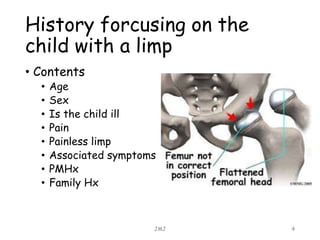
History forcusing on the
child with a limp
• Contents
• Age
• Sex
• Is the child ill
• Pain
• Painless limp
• Associated symptoms
• PMHx
• Family Hx
JMJ 4
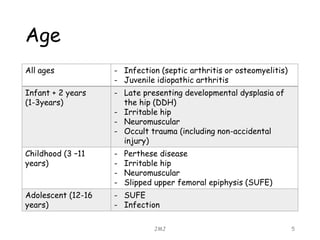
Age
All ages - Infection (septic arthritis or osteomyelitis)
- Juvenile idiopathic arthritis
Infant + 2 years
(1-3years)
- Late presenting developmental dysplasia of
the hip (DDH)
- Irritable hip
- Neuromuscular
- Occult trauma (including non-accidental
injury)
Childhood (3 –11
years)
- Perthese disease
- Irritable hip
- Neuromuscular
- Slipped upper femoral epiphysis (SUFE)
Adolescent (12-16
years)
- SUFE
- Infection
JMJ 5
JMJ 6
Sex
• Perthes much commoner in boys than girls
JMJ 7
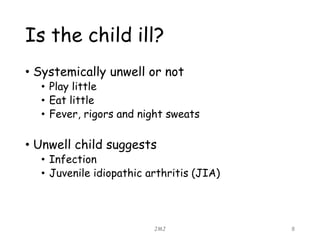
Is the child ill?
• Systemically unwell or not
• Play little
• Eat little
• Fever, rigors and night sweats
• Unwell child suggests
• Infection
• Juvenile idiopathic arthritis (JIA)
JMJ 8
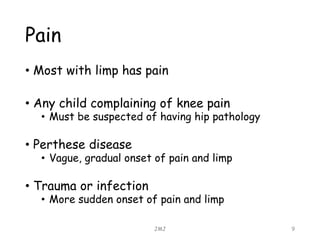
Pain
• Most with limp has pain
• Any child complaining of knee pain
• Must be suspected of having hip pathology
• Perthese disease
• Vague, gradual onset of pain and limp
• Trauma or infection
• More sudden onset of pain and limp
JMJ 9
Pain
• Classical hx of SUFE
• Is often a background of hip pain for weeks followed
by sudden increase in pain
• Transient synovitis of the hip
• Gives pain in groin
• Mimics septic arthritis
• Sinister causes of pain
• Gradual increase in pain
• Night pain+
• Not relieved by simple analgesia
JMJ 10
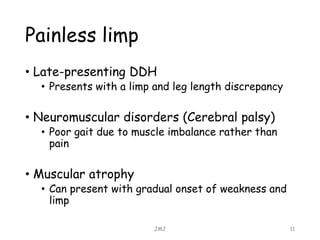
Painless limp
• Late-presenting DDH
• Presents with a limp and leg length discrepancy
• Neuromuscular disorders (Cerebral palsy)
• Poor gait due to muscle imbalance rather than
pain
• Muscular atrophy
• Can present with gradual onset of weakness and
limp
JMJ 11
Associated Symptoms
• Non accidental injuries – NAI
• Multiple joint pains & aches
• Suggestive of juvenile arthritis
• Recent Hx of URTI or otitis media
• Often found in patients with transient synovitis
JMJ 12
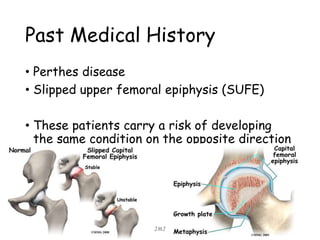
Past Medical History
• Perthes disease
• Slipped upper femoral epiphysis (SUFE)
• These patients carry a risk of developing
the same condition on the opposite direction
JMJ 13
Family History
• Perthes disease
• DDH
• Increase risk
JMJ 14
Examining a child
with a limp
General
Inspection
Gait
Standing
Fixed Flexion
Limb length discrepancy
Palpation
Movement
JMJ 15
General
• Systemic features of ill health
• Pyrexia
• Drowsiness
• Irritability
• Multiple joint problems – initially
• Suggesting juvenile idiopathic arthritis
• Neuromuscular examination
• Neuromuscular disorders
JMJ 16
Points towards infection
Inspection - Gait
• Antalgic gait
• Present in painful conditions
• Such as Perthes disease, or irritable hip
• Trendelenburg gait
• Present in a toddler with late DDH
• Neuromuscular disorders
• Gives variety of patterns of gait abnormalities
JMJ 17
Inspection - Gait
JMJ 18
Inspection - Standing
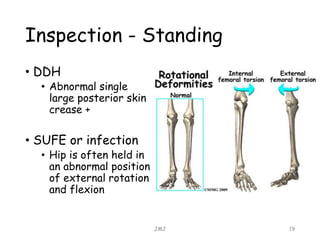
• DDH
• Abnormal single
large posterior skin
crease +
• SUFE or infection
• Hip is often held in
an abnormal position
of external rotation
and flexion
JMJ 19
Inspection – Fixed Flexion
• If Thomas test is positive
• A fixed flexion deformity)
• Suspect significant pathology
• Such as
• Advanced Perthes
• DDH
• SUFE
JMJ 20
Inspection – Limb Length
Discrepancy
• A short leg is typical of DDH
• Apparent shortening will be present
• If there is any fixed flexion deformity
JMJ 21
Palpation -
• Palpate any tender areas for
• Effusion , warmth and localized pain
• Osgood-Schlatter disease
• Tenderness over the tibial tubercle
• Hip joint cannot be palpated- it is a deep joint
• Osteochonritis or, meniscal tears in older
children
• Pain around knee joint
JMJ 22
Movement
• Loss of hip movements – indicates pathology
• DDH
• Results in loss of abduction compared with the other side
• Perthes disease
• Loss of abduction and flexion
• “complete loss of abduction is a worrying sign in Perthes as
this may indicate subluxation of the joint.”
• In septic arthritis – movements gives extreme pain
JMJ 23
Investigating a child
with a limp
Blood tests
X-rays
Ultrasound
Isotope bone scanning
Magnetic Resonance imaging (MRI)
JMJ 24
Blood tests
• Marked rise in WCC
• ESR ↑
• CRP ↑
• All are markedly increase in infections
• Mildly increase in inflammation
• Synovitis
• JIA
• Creatinine Kinase – raised in muscular dystrophy
JMJ 25
X- Rays
• Hip radiograph may shows
• Dislocated hip
• Perthes disease
• A slipped upper femoral epiphysis
• Evidence of infection (remember X-ray are
initially normal)
• A fracture
JMJ 26
If a SUFE is suspected, request a frog lateral X-ray
X- Rays
• If you are sure the problem is from the
knee the AP and lateral knee x-ray should
perform
• It may show
• Osgood- Schlatter disease
• Osteochondritis dissecans
• Fracture
JMJ 27
Ultrasound
• Very useful investigation
• It may show effusion in
• Septic arthritis
• Transient synovitis
• Perthes disease (early)
JMJ 28
Isotope bone scanning
• If hot- possible causes are
• Osteomyelitis
• Will show any seeding of infection
• Malignancy
JMJ 29
MRI
• Not the 1st line investigation
• But useful in
• Diagnosis of knee disorders
• Bone and soft tissue tumors
• Osteomyelitis
JMJ 30
Algorithm for the Ix
of a child with a limp,
JMJ 31
JMJ 32
History
Multiple joint
problems
JIA
Painful
Acute hot
swollen
joint
Knee pain Hip pain
Could still be
reffered from hip
X-ray knee
Osgood-
Schlatter
disease
Osteochond
ritis
Normal
Consider
MRI
Sports
injurirs
No pain
Examination
X-ray hip
Suspected
NM disorder
Reffer
peadiatrics
DDH
X-ray
Normal Abnormal
Perthes,
SUFE
JMJ 33
Normal
X- ray
USS
Inflammatory
markers
No effusion Effusion
Consider
bone scan
Osteomyelitis
Transient
synovitis
Septic
arthritis ↑
marker
Thank You!
JMJ 34

Child with a limp

  • 1.
    Child With aLimp K. Kavindya M. Fernando JMJ 1
  • 2.
    Objectives • Differential diagnosis •History • What to look for on examination of a neonate, infant and child • Investigate a child with a limp to rule out serious conditions • Difference between an ill and a well child JMJ 2
  • 3.
    DD • Septic arthritis •Irritable hip • Developmental dysplasia of the hip (DDH) • Perthes disease • Slipped upper femoral epiphysis (SUFE) • Osteomyelitis • Occult trauma • Neuromuscular causes • Juvenile idiopathic arthritis • Malignancy JMJ 3
  • 4.
    History forcusing onthe child with a limp • Contents • Age • Sex • Is the child ill • Pain • Painless limp • Associated symptoms • PMHx • Family Hx JMJ 4
  • 5.
    Age All ages -Infection (septic arthritis or osteomyelitis) - Juvenile idiopathic arthritis Infant + 2 years (1-3years) - Late presenting developmental dysplasia of the hip (DDH) - Irritable hip - Neuromuscular - Occult trauma (including non-accidental injury) Childhood (3 –11 years) - Perthese disease - Irritable hip - Neuromuscular - Slipped upper femoral epiphysis (SUFE) Adolescent (12-16 years) - SUFE - Infection JMJ 5
  • 6.
  • 7.
    Sex • Perthes muchcommoner in boys than girls JMJ 7
  • 8.
    Is the childill? • Systemically unwell or not • Play little • Eat little • Fever, rigors and night sweats • Unwell child suggests • Infection • Juvenile idiopathic arthritis (JIA) JMJ 8
  • 9.
    Pain • Most withlimp has pain • Any child complaining of knee pain • Must be suspected of having hip pathology • Perthese disease • Vague, gradual onset of pain and limp • Trauma or infection • More sudden onset of pain and limp JMJ 9
  • 10.
    Pain • Classical hxof SUFE • Is often a background of hip pain for weeks followed by sudden increase in pain • Transient synovitis of the hip • Gives pain in groin • Mimics septic arthritis • Sinister causes of pain • Gradual increase in pain • Night pain+ • Not relieved by simple analgesia JMJ 10
  • 11.
    Painless limp • Late-presentingDDH • Presents with a limp and leg length discrepancy • Neuromuscular disorders (Cerebral palsy) • Poor gait due to muscle imbalance rather than pain • Muscular atrophy • Can present with gradual onset of weakness and limp JMJ 11
  • 12.
    Associated Symptoms • Nonaccidental injuries – NAI • Multiple joint pains & aches • Suggestive of juvenile arthritis • Recent Hx of URTI or otitis media • Often found in patients with transient synovitis JMJ 12
  • 13.
    Past Medical History •Perthes disease • Slipped upper femoral epiphysis (SUFE) • These patients carry a risk of developing the same condition on the opposite direction JMJ 13
  • 14.
    Family History • Perthesdisease • DDH • Increase risk JMJ 14
  • 15.
    Examining a child witha limp General Inspection Gait Standing Fixed Flexion Limb length discrepancy Palpation Movement JMJ 15
  • 16.
    General • Systemic featuresof ill health • Pyrexia • Drowsiness • Irritability • Multiple joint problems – initially • Suggesting juvenile idiopathic arthritis • Neuromuscular examination • Neuromuscular disorders JMJ 16 Points towards infection
  • 17.
    Inspection - Gait •Antalgic gait • Present in painful conditions • Such as Perthes disease, or irritable hip • Trendelenburg gait • Present in a toddler with late DDH • Neuromuscular disorders • Gives variety of patterns of gait abnormalities JMJ 17
  • 18.
  • 19.
    Inspection - Standing •DDH • Abnormal single large posterior skin crease + • SUFE or infection • Hip is often held in an abnormal position of external rotation and flexion JMJ 19
  • 20.
    Inspection – FixedFlexion • If Thomas test is positive • A fixed flexion deformity) • Suspect significant pathology • Such as • Advanced Perthes • DDH • SUFE JMJ 20
  • 21.
    Inspection – LimbLength Discrepancy • A short leg is typical of DDH • Apparent shortening will be present • If there is any fixed flexion deformity JMJ 21
  • 22.
    Palpation - • Palpateany tender areas for • Effusion , warmth and localized pain • Osgood-Schlatter disease • Tenderness over the tibial tubercle • Hip joint cannot be palpated- it is a deep joint • Osteochonritis or, meniscal tears in older children • Pain around knee joint JMJ 22
  • 23.
    Movement • Loss ofhip movements – indicates pathology • DDH • Results in loss of abduction compared with the other side • Perthes disease • Loss of abduction and flexion • “complete loss of abduction is a worrying sign in Perthes as this may indicate subluxation of the joint.” • In septic arthritis – movements gives extreme pain JMJ 23
  • 24.
    Investigating a child witha limp Blood tests X-rays Ultrasound Isotope bone scanning Magnetic Resonance imaging (MRI) JMJ 24
  • 25.
    Blood tests • Markedrise in WCC • ESR ↑ • CRP ↑ • All are markedly increase in infections • Mildly increase in inflammation • Synovitis • JIA • Creatinine Kinase – raised in muscular dystrophy JMJ 25
  • 26.
    X- Rays • Hipradiograph may shows • Dislocated hip • Perthes disease • A slipped upper femoral epiphysis • Evidence of infection (remember X-ray are initially normal) • A fracture JMJ 26 If a SUFE is suspected, request a frog lateral X-ray
  • 27.
    X- Rays • Ifyou are sure the problem is from the knee the AP and lateral knee x-ray should perform • It may show • Osgood- Schlatter disease • Osteochondritis dissecans • Fracture JMJ 27
  • 28.
    Ultrasound • Very usefulinvestigation • It may show effusion in • Septic arthritis • Transient synovitis • Perthes disease (early) JMJ 28
  • 29.
    Isotope bone scanning •If hot- possible causes are • Osteomyelitis • Will show any seeding of infection • Malignancy JMJ 29
  • 30.
    MRI • Not the1st line investigation • But useful in • Diagnosis of knee disorders • Bone and soft tissue tumors • Osteomyelitis JMJ 30
  • 31.
    Algorithm for theIx of a child with a limp, JMJ 31
  • 32.
    JMJ 32 History Multiple joint problems JIA Painful Acutehot swollen joint Knee pain Hip pain Could still be reffered from hip X-ray knee Osgood- Schlatter disease Osteochond ritis Normal Consider MRI Sports injurirs No pain Examination X-ray hip Suspected NM disorder Reffer peadiatrics DDH X-ray Normal Abnormal Perthes, SUFE
  • 33.
    JMJ 33 Normal X- ray USS Inflammatory markers Noeffusion Effusion Consider bone scan Osteomyelitis Transient synovitis Septic arthritis ↑ marker
  • 34.