




Antipsychotics
K. Kavindya M. Fernando
JMJ 1
Contents
• 1st generation antipsychotics
• Second generation antipsychotics
• Clozapine
• Newer 2nd generation antipsychotics
• Intramuscular antipsychotics for rapid
tranquilization
• Depot 1st generation antipsychotics
• Depot 2nd generation antipsychotics
JMJ 2
First Generation
Antipsychotics
Chlorpromazine, Haloperidol, Pimozide,
Trifluoperazine
JMJ 3
Action
• Dopamine D2 post postynaptic receptor
antagonists
JMJ 4
Indications
• Schizophrenia
• Acute mania
• Sedation of agitated patients
• Agitated depression
• Psychotic depression
• Chlorpromazine
• Used as an antiemetic in palliative care
• Treatment of intractable hiccups
JMJ 5
Notes on administration
• Tx started at the lowest effective dose
• If response is inadequate,
• Dose is increased after 2 weeks
• Dose can increase upto maximum effective
dose
• If inadequate response after that, for at
least 6 weeks
• Change the medication
• Antipsychotics can administered once daily
JMJ 6
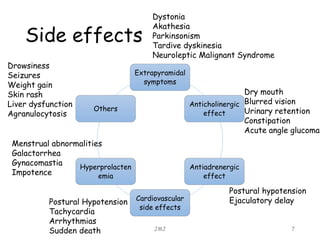
Side effects
Extrapyramidal
symptoms
Anticholinergic
effect
Antiadrenergic
effect
Cardiovascular
side effects
Hyperprolacten
emia
Others
JMJ 7
Dystonia
Akathesia
Parkinsonism
Tardive dyskinesia
Neuroleptic Malignant Syndrome
Dry mouth
Blurred vision
Urinary retention
Constipation
Acute angle glucoma
Postural hypotension
Ejaculatory delayPostural Hypotension
Tachycardia
Arrhythmias
Sudden death
Menstrual abnormalities
Galactorrhea
Gynacomastia
Impotence
Drowsiness
Seizures
Weight gain
Skin rash
Liver dysfunction
Agranulocytosis
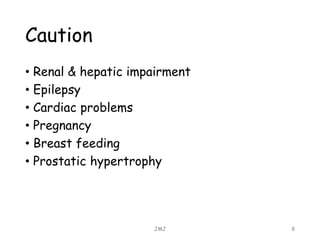
Caution
• Renal & hepatic impairment
• Epilepsy
• Cardiac problems
• Pregnancy
• Breast feeding
• Prostatic hypertrophy
JMJ 8
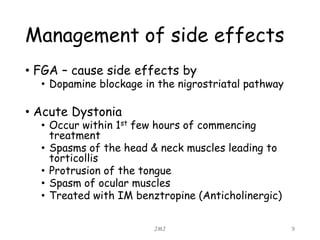
Management of side effects
• FGA – cause side effects by
• Dopamine blockage in the nigrostriatal pathway
• Acute Dystonia
• Occur within 1st few hours of commencing
treatment
• Spasms of the head & neck muscles leading to
torticollis
• Protrusion of the tongue
• Spasm of ocular muscles
• Treated with IM benztropine (Anticholinergic)
JMJ 9
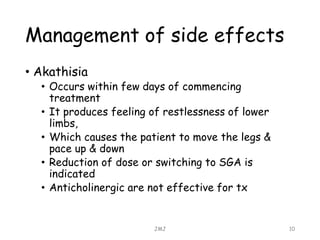
Management of side effects
• Akathisia
• Occurs within few days of commencing
treatment
• It produces feeling of restlessness of lower
limbs,
• Which causes the patient to move the legs &
pace up & down
• Reduction of dose or switching to SGA is
indicated
• Anticholinergic are not effective for tx
JMJ 10
Management of side effects
• Parkinsonism
• Drug induce parkinsonism
• If this occurs
• Add benzhexol
• Reduce dose, or
• Witch to SGA
JMJ 11
Management of side effects
• Tardive dyskinesia 1/2
• Caused by hypersensitivity of dopamine
receptors
• Generally occurs after a few months of
treatment
• SGA are less likely to cause tardive dyskinesia
• Involuntary movements of the tongue &
• Mouth, chewing & sucking movements,
• Grimacing & choreoathetoid movements
JMJ 12
Management of side effects
• Tardive dyskinesia 2/2
• Withdrawal of anticholinergic drugs &
• Slow reduction of the antipsychotics
• Clozapine is the best substitute
• Olanzapine or quetiapine may also be effective
• Tardive dyskinesia – often resistant to
treatment
JMJ 13
Management of side effects
• Neuroleptic Malignant Syndrome 1/2
• Rare, potentially fatal side effects
• Patients develop
• Fever
• Muscle rigidity
• Fluctuating level of consciousness
• Sympathetic overactivity
• CPK & WBC are elevated
• Antipsychotics- should stopped immediately
• Monitor- temp. pulse, BP
JMJ 14
Management of side effects
• Neuroleptic Malignant Syndrome 2/2
• Supportive management
• Best managed in ICU
• Specific treatment includes,
• Bromocriptine & dandrolene
• ECT also known to be effective
JMJ 15
Management of side effects
• Sedation
• Most FGA cause sedation initially,
• But become less with continued treatment
• Chlorpromazine is more sedating than
trifluroperazine or haloperidol
• Single night dose will reduce this
JMJ 16
Management of side effects
• Anticholinergic effects
• Can be problematic in the elderly
• Chlorpromazine > trifluoperazine or haloperidol
• If side effects are troublesome
• Discontinue medication
• Concurrent anticholinergic medication – benzhexol
• Switch to SGA
JMJ 17
Management of side effects
• Hyperprolactinaemia
• Dopamine antagonism in the pituitary
hypothalamic axis
• FGA more likely to cause this
• Can be asymptomatic
• Or cause menstrual irregularities, galactorrhoea,
gynaecomastia, erectile dysfunction
• If prolactin levels are high, change tx to
• Olanzapine, quetiapine, aripirazole or clozapine
JMJ 18
Management of side effects
• Sexual dysfunction
• Can occur with both FGA & SGA
• Decreased dopamine transmission,
hyperprolactenemia, anticholinergic effects &
alpha 1 receptor blockage – contribute to sexual
dysfunction
• Decreased libido, poor arousal
• Erectile dysfuction & ejaculatory difficulties
• Less sexual problems
• Aropiprazole, quetiapine, clozapine
JMJ 19
Second Generation
Antipsychotics
Amisulpride, Aripiprazole, Olanzapine, Risperidone,
Quetiapine, Ziprasidone
Clozapine is described in next section
JMJ 20
Action
• Antagonism at dopamine D2, D4 receptors
• (reduces positive symptoms of schizophrenia)
• 5HT 2A antagonists (reduces EPS)
• Acts at alpha 1 adrenergic and muscuranic
receptors
JMJ 21
Indications
• Schizophrenia
• Acute mania
• Prophylaxis of bipolar affective disorder
• Sedation of agitated patients
• Agitated depression
• Psychotic depression
JMJ 22
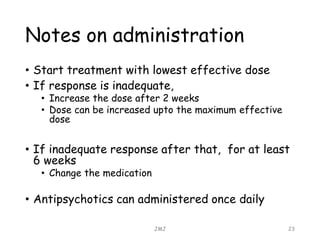
Notes on administration
• Start treatment with lowest effective dose
• If response is inadequate,
• Increase the dose after 2 weeks
• Dose can be increased upto the maximum effective
dose
• If inadequate response after that, for at least
6 weeks
• Change the medication
• Antipsychotics can administered once daily
JMJ 23
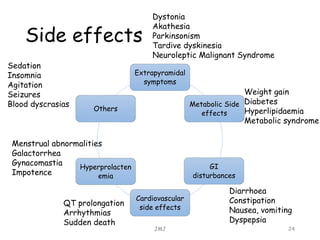
Side effects
Extrapyramidal
symptoms
Metabolic Side
effects
GI
disturbances
Cardiovascular
side effects
Hyperprolacten
emia
Others
JMJ 24
Dystonia
Akathesia
Parkinsonism
Tardive dyskinesia
Neuroleptic Malignant Syndrome
Weight gain
Diabetes
Hyperlipidaemia
Metabolic syndrome
Diarrhoea
Constipation
Nausea, vomiting
Dyspepsia
QT prolongation
Arrhythmias
Sudden death
Menstrual abnormalities
Galactorrhea
Gynacomastia
Impotence
Sedation
Insomnia
Agitation
Seizures
Blood dyscrasias
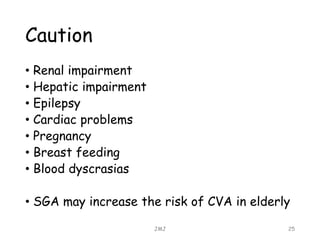
Caution
• Renal impairment
• Hepatic impairment
• Epilepsy
• Cardiac problems
• Pregnancy
• Breast feeding
• Blood dyscrasias
• SGA may increase the risk of CVA in elderly
JMJ 25
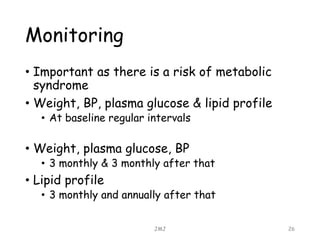
Monitoring
• Important as there is a risk of metabolic
syndrome
• Weight, BP, plasma glucose & lipid profile
• At baseline regular intervals
• Weight, plasma glucose, BP
• 3 monthly & 3 monthly after that
• Lipid profile
• 3 monthly and annually after that
JMJ 26
Management of side effects
• Weight gain
• Clozapine & olanzapine- highest risk of weight
gain
• Amisulpride, aripirazole & ziprasidone
• Less likely cause weight gain
• Life style modifications are indicated
JMJ 27
Management of side effects
• Diabetes, hyperlipidemia, metabolic
syndrome
• Increase cardiovascular mortality & morbidity,
because of the increased risk of weight gain &
metabolic syndrome
• Clozapine, olanzapine- have highest risk
• Aripiprazole, quetiapine & ziprasidone
• Lowest risk
JMJ 28
Clozapine
JMJ 29
Action
• Dopamine D2 antagonist
• Reduces positive symptoms of schizophrenia
• Serotonin 5HT2A antagonist
• Reduces EPS
• Binds to
• D4 receptors,
• Histamine H1 (weight gain & sedation),
• Alpha 1 adrenergic & muscuranic receptor
antagonist
JMJ 30
Indications
• Resistant schizophrenia
• Refractory mania
JMJ 31
Notes on administration
• Decision to commence should be taken by a
consultant
• Prior start – do following investigations
• Weight
• Serum lipids
• Fasting blood sugar
• Liver function tests
• Full blood count
• ECG
• echocardiogram
JMJ 32
Notes on administration
• Admit the patient to hospital to commence
clozapine
• High risk of hypotension after initial dose
• Starting dose – 12.5 nocte
• Monitor –
• BP, Temp, pulse – in 1st 6 hours
• Increase dose slowly by 12.5mg initialy
• Then 25 mg later,
• With an increase of 50-100mg/week
JMJ 33
Notes on administration
• Most respond to dose
• 300-450 mg/day
• Maximum dose – 900mg
• If tx stopped for more than 48 hours,
restart at 12.5mg
JMJ 34
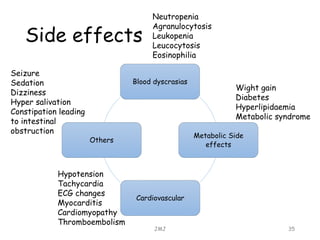
Side effects
Blood dyscrasias
Metabolic Side
effects
Cardiovascular
Others
JMJ 35
Neutropenia
Agranulocytosis
Leukopenia
Leucocytosis
Eosinophilia
Wight gain
Diabetes
Hyperlipidaemia
Metabolic syndrome
Hypotension
Tachycardia
ECG changes
Myocarditis
Cardiomyopathy
Thromboembolism
Seizure
Sedation
Dizziness
Hyper salivation
Constipation leading
to intestinal
obstruction
Contraindications
• History of myocarditis
• Neutropenia
• Agranulacytosis
• Bone marrow disorders
• Paralytic ileus
• Avoid during pregnancy and breastfeeding
JMJ 36
Monitoring
• As risk of agranulocytosis is highest during the
initial period
• Monitor FBC weekly  till 18 weeks
• 2 weekly  18 weeks to 1 year
• Monthly  thereafter
• If patient develops sore throat, fever or
infection
• Carry out FBC
• Monitor weight  monthly
• Fasting blood s.  3 monthly
• Serum lipids  6 monthly
JMJ 37
Management of side effects
• Neutropenia / agranulocytosis
• Total WBC - <3x10⁹/l
• Neutrophil count <1.5x 10⁹/l
• Eosinophil count > 4 x 10⁹/l
• Stop clozapine immediately
• Blood counts should be repeated daily
JMJ 38
Management of side effects
• Hypersalivation
• Troublesome side effect
• Use minimal effective dose
• Add anticholinergics such as
• Benzhexol
• Hyocine lozengers
JMJ 39
Management of side effects
• Fever
• Can be due to
• Infection precipitated by neutropenia
• Due to an inflammatory response
• May be indicative of myocarditis
JMJ 40
Intramuscular
Antipsychotics for
Rapid Tranquilization
FGA- Chlopramazine, haloperidol, Zuclopenthioxol acetate
SGA – Arpiprazole*, olanzapine, Ziprasidone*
*Not yet available in SL
JMJ 41
Chlorpromazine – deep IM
• Dose- 25 – 50 mg
• Every 6-8 hours
JMJ 42
Haloperidol (lactate)-
immediate release injection
• Dose- 5-10 mg
• Can repeat every 4-8 hourly
• Maximum dose in 24 hours – 18 mg
JMJ 43
Zuclopenthixol acetate
(clopixol acuphase)
• Dose- 5-10 mg
• Can repeat after 48 hours
• Maximum dose 400mg/episode
• Maximum 4 injections
JMJ 44
Olanzapine
• Dose- 5-10 mg
• Can repeat after 2 hours if necessary
• Maximum daily dose combined oral and
parenteral – 20 mg
• Maximum 3 injections daily for 3 days
JMJ 45
Aripiprazole
• Initially 5.25 – 15mg as a single dose (usual
dose 9.75mg)
• Repeat after 2 hours if necessary
• Maximum daily dose combined oral and
parenteral -30mg
• Maximum of 3 injections/day
JMJ 46
Ziprasidone
• Dose 10-20mg
• Can repeated 2 hourly
• Maximum dose 40 mg
• Should not administered for more than 3
consecutive days
JMJ 47
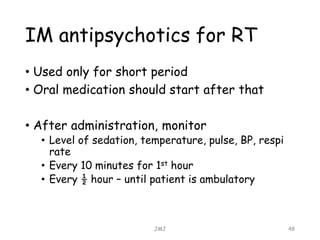
IM antipsychotics for RT
• Used only for short period
• Oral medication should start after that
• After administration, monitor
• Level of sedation, temperature, pulse, BP, respi
rate
• Every 10 minutes for 1st hour
• Every ½ hour – until patient is ambulatory
JMJ 48
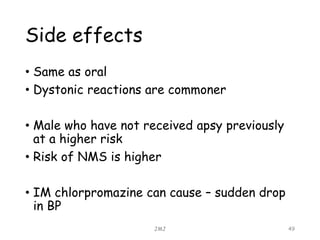
Side effects
• Same as oral
• Dystonic reactions are commoner
• Male who have not received apsy previously
at a higher risk
• Risk of NMS is higher
• IM chlorpromazine can cause – sudden drop
in BP
JMJ 49
Depot antipsychotics
JMJ 50
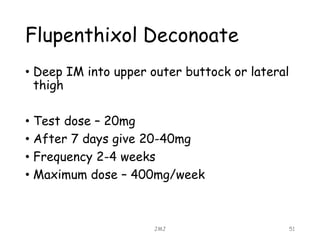
Flupenthixol Deconoate
• Deep IM into upper outer buttock or lateral
thigh
• Test dose – 20mg
• After 7 days give 20-40mg
• Frequency 2-4 weeks
• Maximum dose – 400mg/week
JMJ 51
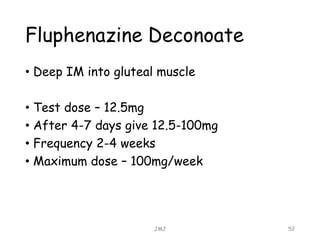
Fluphenazine Deconoate
• Deep IM into gluteal muscle
• Test dose – 12.5mg
• After 4-7 days give 12.5-100mg
• Frequency 2-4 weeks
• Maximum dose – 100mg/week
JMJ 52
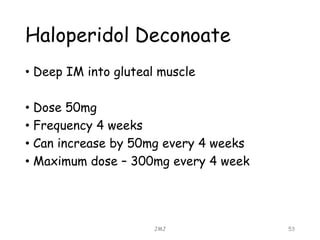
Haloperidol Deconoate
• Deep IM into gluteal muscle
• Dose 50mg
• Frequency 4 weeks
• Can increase by 50mg every 4 weeks
• Maximum dose – 300mg every 4 week
JMJ 53
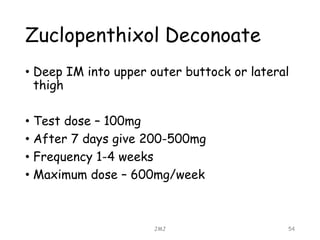
Zuclopenthixol Deconoate
• Deep IM into upper outer buttock or lateral
thigh
• Test dose – 100mg
• After 7 days give 200-500mg
• Frequency 1-4 weeks
• Maximum dose – 600mg/week
JMJ 54
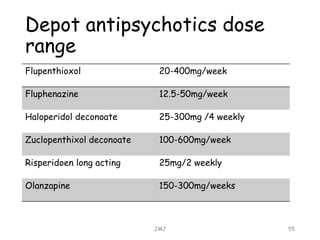
Depot antipsychotics dose
range
Flupenthioxol 20-400mg/week
Fluphenazine 12.5-50mg/week
Haloperidol deconoate 25-300mg /4 weekly
Zuclopenthixol deconoate 100-600mg/week
Risperidoen long acting 25mg/2 weekly
Olanzapine 150-300mg/weeks
JMJ 55
Thank You!
JMJ 56

Antipsychotics

  • 1.
  • 2.
    Contents • 1st generationantipsychotics • Second generation antipsychotics • Clozapine • Newer 2nd generation antipsychotics • Intramuscular antipsychotics for rapid tranquilization • Depot 1st generation antipsychotics • Depot 2nd generation antipsychotics JMJ 2
  • 3.
  • 4.
    Action • Dopamine D2post postynaptic receptor antagonists JMJ 4
  • 5.
    Indications • Schizophrenia • Acutemania • Sedation of agitated patients • Agitated depression • Psychotic depression • Chlorpromazine • Used as an antiemetic in palliative care • Treatment of intractable hiccups JMJ 5
  • 6.
    Notes on administration •Tx started at the lowest effective dose • If response is inadequate, • Dose is increased after 2 weeks • Dose can increase upto maximum effective dose • If inadequate response after that, for at least 6 weeks • Change the medication • Antipsychotics can administered once daily JMJ 6
  • 7.
    Side effects Extrapyramidal symptoms Anticholinergic effect Antiadrenergic effect Cardiovascular side effects Hyperprolacten emia Others JMJ7 Dystonia Akathesia Parkinsonism Tardive dyskinesia Neuroleptic Malignant Syndrome Dry mouth Blurred vision Urinary retention Constipation Acute angle glucoma Postural hypotension Ejaculatory delayPostural Hypotension Tachycardia Arrhythmias Sudden death Menstrual abnormalities Galactorrhea Gynacomastia Impotence Drowsiness Seizures Weight gain Skin rash Liver dysfunction Agranulocytosis
  • 8.
    Caution • Renal &hepatic impairment • Epilepsy • Cardiac problems • Pregnancy • Breast feeding • Prostatic hypertrophy JMJ 8
  • 9.
    Management of sideeffects • FGA – cause side effects by • Dopamine blockage in the nigrostriatal pathway • Acute Dystonia • Occur within 1st few hours of commencing treatment • Spasms of the head & neck muscles leading to torticollis • Protrusion of the tongue • Spasm of ocular muscles • Treated with IM benztropine (Anticholinergic) JMJ 9
  • 10.
    Management of sideeffects • Akathisia • Occurs within few days of commencing treatment • It produces feeling of restlessness of lower limbs, • Which causes the patient to move the legs & pace up & down • Reduction of dose or switching to SGA is indicated • Anticholinergic are not effective for tx JMJ 10
  • 11.
    Management of sideeffects • Parkinsonism • Drug induce parkinsonism • If this occurs • Add benzhexol • Reduce dose, or • Witch to SGA JMJ 11
  • 12.
    Management of sideeffects • Tardive dyskinesia 1/2 • Caused by hypersensitivity of dopamine receptors • Generally occurs after a few months of treatment • SGA are less likely to cause tardive dyskinesia • Involuntary movements of the tongue & • Mouth, chewing & sucking movements, • Grimacing & choreoathetoid movements JMJ 12
  • 13.
    Management of sideeffects • Tardive dyskinesia 2/2 • Withdrawal of anticholinergic drugs & • Slow reduction of the antipsychotics • Clozapine is the best substitute • Olanzapine or quetiapine may also be effective • Tardive dyskinesia – often resistant to treatment JMJ 13
  • 14.
    Management of sideeffects • Neuroleptic Malignant Syndrome 1/2 • Rare, potentially fatal side effects • Patients develop • Fever • Muscle rigidity • Fluctuating level of consciousness • Sympathetic overactivity • CPK & WBC are elevated • Antipsychotics- should stopped immediately • Monitor- temp. pulse, BP JMJ 14
  • 15.
    Management of sideeffects • Neuroleptic Malignant Syndrome 2/2 • Supportive management • Best managed in ICU • Specific treatment includes, • Bromocriptine & dandrolene • ECT also known to be effective JMJ 15
  • 16.
    Management of sideeffects • Sedation • Most FGA cause sedation initially, • But become less with continued treatment • Chlorpromazine is more sedating than trifluroperazine or haloperidol • Single night dose will reduce this JMJ 16
  • 17.
    Management of sideeffects • Anticholinergic effects • Can be problematic in the elderly • Chlorpromazine > trifluoperazine or haloperidol • If side effects are troublesome • Discontinue medication • Concurrent anticholinergic medication – benzhexol • Switch to SGA JMJ 17
  • 18.
    Management of sideeffects • Hyperprolactinaemia • Dopamine antagonism in the pituitary hypothalamic axis • FGA more likely to cause this • Can be asymptomatic • Or cause menstrual irregularities, galactorrhoea, gynaecomastia, erectile dysfunction • If prolactin levels are high, change tx to • Olanzapine, quetiapine, aripirazole or clozapine JMJ 18
  • 19.
    Management of sideeffects • Sexual dysfunction • Can occur with both FGA & SGA • Decreased dopamine transmission, hyperprolactenemia, anticholinergic effects & alpha 1 receptor blockage – contribute to sexual dysfunction • Decreased libido, poor arousal • Erectile dysfuction & ejaculatory difficulties • Less sexual problems • Aropiprazole, quetiapine, clozapine JMJ 19
  • 20.
    Second Generation Antipsychotics Amisulpride, Aripiprazole,Olanzapine, Risperidone, Quetiapine, Ziprasidone Clozapine is described in next section JMJ 20
  • 21.
    Action • Antagonism atdopamine D2, D4 receptors • (reduces positive symptoms of schizophrenia) • 5HT 2A antagonists (reduces EPS) • Acts at alpha 1 adrenergic and muscuranic receptors JMJ 21
  • 22.
    Indications • Schizophrenia • Acutemania • Prophylaxis of bipolar affective disorder • Sedation of agitated patients • Agitated depression • Psychotic depression JMJ 22
  • 23.
    Notes on administration •Start treatment with lowest effective dose • If response is inadequate, • Increase the dose after 2 weeks • Dose can be increased upto the maximum effective dose • If inadequate response after that, for at least 6 weeks • Change the medication • Antipsychotics can administered once daily JMJ 23
  • 24.
    Side effects Extrapyramidal symptoms Metabolic Side effects GI disturbances Cardiovascular sideeffects Hyperprolacten emia Others JMJ 24 Dystonia Akathesia Parkinsonism Tardive dyskinesia Neuroleptic Malignant Syndrome Weight gain Diabetes Hyperlipidaemia Metabolic syndrome Diarrhoea Constipation Nausea, vomiting Dyspepsia QT prolongation Arrhythmias Sudden death Menstrual abnormalities Galactorrhea Gynacomastia Impotence Sedation Insomnia Agitation Seizures Blood dyscrasias
  • 25.
    Caution • Renal impairment •Hepatic impairment • Epilepsy • Cardiac problems • Pregnancy • Breast feeding • Blood dyscrasias • SGA may increase the risk of CVA in elderly JMJ 25
  • 26.
    Monitoring • Important asthere is a risk of metabolic syndrome • Weight, BP, plasma glucose & lipid profile • At baseline regular intervals • Weight, plasma glucose, BP • 3 monthly & 3 monthly after that • Lipid profile • 3 monthly and annually after that JMJ 26
  • 27.
    Management of sideeffects • Weight gain • Clozapine & olanzapine- highest risk of weight gain • Amisulpride, aripirazole & ziprasidone • Less likely cause weight gain • Life style modifications are indicated JMJ 27
  • 28.
    Management of sideeffects • Diabetes, hyperlipidemia, metabolic syndrome • Increase cardiovascular mortality & morbidity, because of the increased risk of weight gain & metabolic syndrome • Clozapine, olanzapine- have highest risk • Aripiprazole, quetiapine & ziprasidone • Lowest risk JMJ 28
  • 29.
  • 30.
    Action • Dopamine D2antagonist • Reduces positive symptoms of schizophrenia • Serotonin 5HT2A antagonist • Reduces EPS • Binds to • D4 receptors, • Histamine H1 (weight gain & sedation), • Alpha 1 adrenergic & muscuranic receptor antagonist JMJ 30
  • 31.
  • 32.
    Notes on administration •Decision to commence should be taken by a consultant • Prior start – do following investigations • Weight • Serum lipids • Fasting blood sugar • Liver function tests • Full blood count • ECG • echocardiogram JMJ 32
  • 33.
    Notes on administration •Admit the patient to hospital to commence clozapine • High risk of hypotension after initial dose • Starting dose – 12.5 nocte • Monitor – • BP, Temp, pulse – in 1st 6 hours • Increase dose slowly by 12.5mg initialy • Then 25 mg later, • With an increase of 50-100mg/week JMJ 33
  • 34.
    Notes on administration •Most respond to dose • 300-450 mg/day • Maximum dose – 900mg • If tx stopped for more than 48 hours, restart at 12.5mg JMJ 34
  • 35.
    Side effects Blood dyscrasias MetabolicSide effects Cardiovascular Others JMJ 35 Neutropenia Agranulocytosis Leukopenia Leucocytosis Eosinophilia Wight gain Diabetes Hyperlipidaemia Metabolic syndrome Hypotension Tachycardia ECG changes Myocarditis Cardiomyopathy Thromboembolism Seizure Sedation Dizziness Hyper salivation Constipation leading to intestinal obstruction
  • 36.
    Contraindications • History ofmyocarditis • Neutropenia • Agranulacytosis • Bone marrow disorders • Paralytic ileus • Avoid during pregnancy and breastfeeding JMJ 36
  • 37.
    Monitoring • As riskof agranulocytosis is highest during the initial period • Monitor FBC weekly  till 18 weeks • 2 weekly  18 weeks to 1 year • Monthly  thereafter • If patient develops sore throat, fever or infection • Carry out FBC • Monitor weight  monthly • Fasting blood s.  3 monthly • Serum lipids  6 monthly JMJ 37
  • 38.
    Management of sideeffects • Neutropenia / agranulocytosis • Total WBC - <3x10⁹/l • Neutrophil count <1.5x 10⁹/l • Eosinophil count > 4 x 10⁹/l • Stop clozapine immediately • Blood counts should be repeated daily JMJ 38
  • 39.
    Management of sideeffects • Hypersalivation • Troublesome side effect • Use minimal effective dose • Add anticholinergics such as • Benzhexol • Hyocine lozengers JMJ 39
  • 40.
    Management of sideeffects • Fever • Can be due to • Infection precipitated by neutropenia • Due to an inflammatory response • May be indicative of myocarditis JMJ 40
  • 41.
    Intramuscular Antipsychotics for Rapid Tranquilization FGA-Chlopramazine, haloperidol, Zuclopenthioxol acetate SGA – Arpiprazole*, olanzapine, Ziprasidone* *Not yet available in SL JMJ 41
  • 42.
    Chlorpromazine – deepIM • Dose- 25 – 50 mg • Every 6-8 hours JMJ 42
  • 43.
    Haloperidol (lactate)- immediate releaseinjection • Dose- 5-10 mg • Can repeat every 4-8 hourly • Maximum dose in 24 hours – 18 mg JMJ 43
  • 44.
    Zuclopenthixol acetate (clopixol acuphase) •Dose- 5-10 mg • Can repeat after 48 hours • Maximum dose 400mg/episode • Maximum 4 injections JMJ 44
  • 45.
    Olanzapine • Dose- 5-10mg • Can repeat after 2 hours if necessary • Maximum daily dose combined oral and parenteral – 20 mg • Maximum 3 injections daily for 3 days JMJ 45
  • 46.
    Aripiprazole • Initially 5.25– 15mg as a single dose (usual dose 9.75mg) • Repeat after 2 hours if necessary • Maximum daily dose combined oral and parenteral -30mg • Maximum of 3 injections/day JMJ 46
  • 47.
    Ziprasidone • Dose 10-20mg •Can repeated 2 hourly • Maximum dose 40 mg • Should not administered for more than 3 consecutive days JMJ 47
  • 48.
    IM antipsychotics forRT • Used only for short period • Oral medication should start after that • After administration, monitor • Level of sedation, temperature, pulse, BP, respi rate • Every 10 minutes for 1st hour • Every ½ hour – until patient is ambulatory JMJ 48
  • 49.
    Side effects • Sameas oral • Dystonic reactions are commoner • Male who have not received apsy previously at a higher risk • Risk of NMS is higher • IM chlorpromazine can cause – sudden drop in BP JMJ 49
  • 50.
  • 51.
    Flupenthixol Deconoate • DeepIM into upper outer buttock or lateral thigh • Test dose – 20mg • After 7 days give 20-40mg • Frequency 2-4 weeks • Maximum dose – 400mg/week JMJ 51
  • 52.
    Fluphenazine Deconoate • DeepIM into gluteal muscle • Test dose – 12.5mg • After 4-7 days give 12.5-100mg • Frequency 2-4 weeks • Maximum dose – 100mg/week JMJ 52
  • 53.
    Haloperidol Deconoate • DeepIM into gluteal muscle • Dose 50mg • Frequency 4 weeks • Can increase by 50mg every 4 weeks • Maximum dose – 300mg every 4 week JMJ 53
  • 54.
    Zuclopenthixol Deconoate • DeepIM into upper outer buttock or lateral thigh • Test dose – 100mg • After 7 days give 200-500mg • Frequency 1-4 weeks • Maximum dose – 600mg/week JMJ 54
  • 55.
    Depot antipsychotics dose range Flupenthioxol20-400mg/week Fluphenazine 12.5-50mg/week Haloperidol deconoate 25-300mg /4 weekly Zuclopenthixol deconoate 100-600mg/week Risperidoen long acting 25mg/2 weekly Olanzapine 150-300mg/weeks JMJ 55
  • 56.