SANDHIYA.R M.Sc
CLINICAL INSTRUCTOR
FAHS, CARE
MITRAL STENOSIS
DEFINITION
• Mitral stenosis is a condition of pathological narrowing of
mitral valve.
• Normal square area of mitral valve is 4-6 square cm.
When it is reduced to half of it, significant hemodynamic
changes take place
ETIOLOGY
• Commonest - Rheumatic heart disease
• Rare causes
1. Congenital – Parachute mitral valve
2. Lutembacher’s syndrome (ASD with congenital or
acquired mitral stenosis).
3. Infective endocarditis with large vegetations causing
obstruction.
4. Endomyocardial fibrosis.
5. Hurler’s syndrome.
6. Carcinoid –malignant.
7. Methysergide.
PATHOLOGY
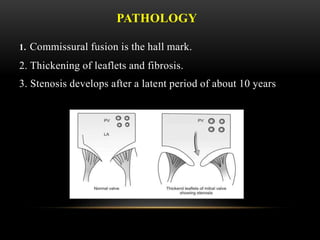
1. Commissural fusion is the hall mark.
2. Thickening of leaflets and fibrosis.
3. Stenosis develops after a latent period of about 10 years
HEMODYNAMICS OF MITRAL STENOSIS
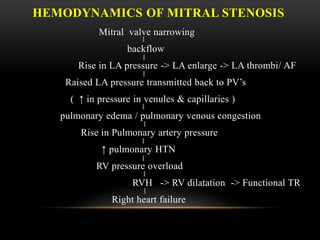
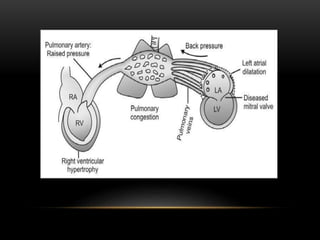
Mitral valve narrowing
backflow
Rise in LA pressure -> LA enlarge -> LA thrombi/ AF
Raised LA pressure transmitted back to PV’s
( ↑ in pressure in venules & capillaries )
pulmonary edema / pulmonary venous congestion
Rise in Pulmonary artery pressure
↑ pulmonary HTN
RV pressure overload
RVH -> RV dilatation -> Functional TR
Right heart failure
CLINICAL PICTURE
 SYMPTOMS
Develop 10-20 years after initial rheumatic insult.
• Dyspnea on exertion.
• Orthopnea, paroxysmal nocturnal dyspnea and
symptoms of acute pulmonary edema.
• Fatigue due to low cardiac output.
• Palpitation due to AF
• Hemoptysis due to various mechanisms
 SIGNS
I. Peripheral
II. Cardiovascular
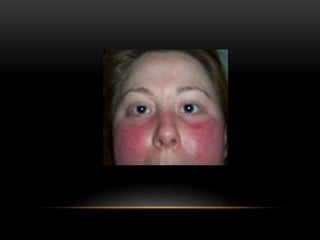
I. Peripheral: Mitral facies with malar flush, and small volume pulse,
Peripheral cyanosis.
II. Cardiovascular:
1. Tapping apical impulse.
2. Diastolic thrill may be present at the apex.
3. Parasternal heave due to RVH.
4. Auscultation
 Loud I sound at apex.
 Opening snap.
 Mid diastolic murmur at apex.
 Presystolic accentuation.
DIAGNOSTIC FEATURES
• Loud I sound at apex
• Opening snap
Low pitched rumbling mid diastolic murmur with
presystolic accentuation :best heard, with patient in left
lateral position with breath held in expiration
 DIFFERENTIAL DIAGNOSIS FOR CLINICAL PICTURE OF
MITRAL STENOSIS
1. LA myxoma,
2. Ball valve thrombus,
3. Cor triatriatum.
 DIFFERENTIAL DIAGNOSIS—FOR MID DIASTOLIC MURMUR
1. Mitral stenosis.
2. Tricuspid stenosis (murmur accentuating with inspiration)
3. Flow murmurs (caused by increased blood flow across the mitral or
tricuspid valve during diastole in the following)
• Mitral regurgitation
• Tricuspid regurgitation
• ASD
• VSD
• PDA.
4. Carey coomb’s murmur: In acute rheumatic mitral valvulitis –
functional murmur.
5. Austin Flint murmur: Occurs in free aortic incompetence;
functional murmur mid diastolic murmur at apex
 OTHER CONDITIONS CAUSING LOUD I SOUND
1. Tachycardia.
2. Hyperdynamic states (valve remains open at end diastole
and is
forcibly closed by hyper contractile LV).
 OTHER CONDITIONS CAUSING OPENING SNAP
Tricuspid stenosis, myxoma.
ASSESSMENTS IN MITRAL STENOSIS
1. Degree of stenosis (severity)
2. The mobility of mitral valve
3. Pulmonary hypertension
4. Presence of other lesions and dominance.
A. Degree of stenosis is assessed by:
1. S2 – OS interval which is inversely proportional to severity
Usual range of S2- OS interval is 0.08 – 0.12 sec; 0.06 and less
in severe.
2. Duration of murmur: It is directly proportional to severity:
longer the duration severe the stenosis.
3. Degree of LA enlargement in X-ray and ECG and by Echo.
4. Presence of pulmonary hypertension in pure MS.
B. Mobility of valve is denoted by:
1. Presence of loud I sound
2. Opening snap
3. Absence of valve calcification.
COMPLICATIONS
I. Complications of pulmonary venous congestion – PND, Acute
pulmonary edema, hemoptysis, PAH, Right heart failure
II. Complications of enlarged left atrium – AF, LA thrombus ,
dysphagia , emphysema.
III. Complications at valve level - Infective endocarditis - rare.
Causes of hemoptysis – rupture of bronchial vein, pulmonary
edema, pulmonary infarct, bronchitis, PHT.
INVESTIGATIONS
X – RAY CHEST :
Shows features
1. Straightening of left border of the heart
2. Features of pulmonary hypertension: Dilated MPA, narrowing of
peripheral pulmonary arteries.
3..Pulmonary edema: “bat’s wing appearance
4. LA enlargement seen as opacity within RA opacity.
ECG :
P pulmonale/P mitral; RVH with Rt axis deviation, atrial fibrillation;
biphasic P wave.
• P mitrale: P wave duration >120 ms; prominent notched P
• P pulmonale: Peaked P waves, amplitude >2.50 m V.
ECHO
Confirms the diagnosis:
• Asseses the severity
• Shows presence or absence of thrombus/calcification
• Shows other associated lesions if any
Also indicates mitral valve area, mitral valve morphology.
Echocardiographic mitral morphology score is derived from following
features:
1. Leaflet rigidity,
2. Leaflet thickening,
3. Valvular calcification, and
4. Subvalvular disease, each graded as 1+ to 4+; score >8 fare badly.
DOPPLER
Shows (1)pressure gradient across mitral valve and
(2) pulmonary artery pressure.
TEE
Transesophageal echocardiogram: Shows LA thrombus,
endocarditis.
CATHETERIZTION
Pressure gradient between LA & LV
MR severity
TREATMENT
MEDICAL:
• Treatment of cardiac failure
• Treatment of arrhythmia –atrial fibrillation
• Treatment of pulmonary edema
• Prophylaxis/treatment of infective endocarditis
• Secondary prophylaxis for rheumatic fever.
INTERVENTION
1. Timing—mild/moderate symptoms
2. MV area <1 cm2/m2
3. Delay worsens prognosis.
4. If patient is symptomatic despite medical treatment
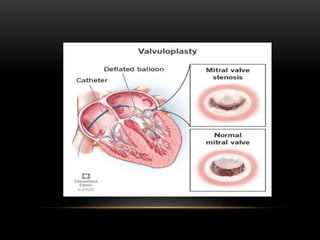
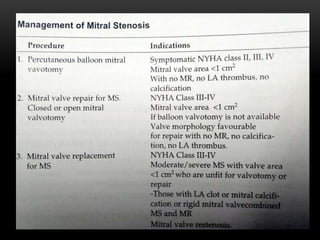
MITRAL BALLOON VALVULOPLASTY
Indications
• Significant symptoms class II-IV
• Isolated mitral stenosis
• No or trivial mitral regurgitation
• No calcification or rigidity of the valve- valve must be mobile
• Left atrium- free of thrombus
• Pulmonary hypertension 50-60 mm of Hg
• Valve area of,<1sq cm.
Complications of Balloon Valvuloplasty
• Mitral regurgitation
• Left to Rt shunt
• Thromboembolism
• Pericardial tamponade
• Myocardial infarction.
SURGERY FOR MITRAL STENOSIS
• Mitral valvotomy
• Closed valvotomy
• Open valvotomy
MITRAL VALVE REPLACEMENT
Indications
1. Restenosis
2. Severe advanced MS Valve area < 1sq cm (But patient must
have good LV function).
3. Class II, III, IV symptoms.
4. Severe MS unfit for valvotomy or valvuloplasty: calcified,
rigid valve
5. Severe associated MR, thickened fused chordae
6. Pulmonary artery systolic pressure of > 60-80 mm of Hg.
7. Recurrent thrombo embolic manifestations.
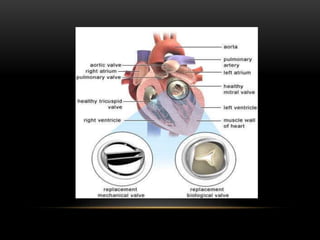
TYPES OF PROSTHETIC VALVES
MECHANICAL
Caged Ball valve: e.g. Starr-Edward valve:
Advantage—Good durability
Disadvantage—Bulky and space occupying.
• Complications
• Periprosthetic mitral regurgitation
• Hemolytic anemia
• Jaundice
• Thromboembolism
• Life long anticoagulation needed
• Infective endocarditis
• Paravalvular ring abscess.
• Tilting disc valve: e.g. St. Jude valve,
Björk-Shiley valve (not being used now)
BIOPROSTHETIC VALVE:
Autograft : from patient’s pericardium
Advantage–anticoagulant’s not so much necessary: disadvantage–not
durable: just 10 years or less
Porcine tissue–thromboembolism less
• COMPLICATIONS OF VALVE REPLACEMENT
• Restenosis
• Thromboembolic phenomenon
• Hemolytic anemia
• Mechanical or material defects of valve itself.
e.g., failure of closure or opening
MITRAL STENOSIS PATHOLOGY.pptx

MITRAL STENOSIS PATHOLOGY.pptx

  • 1.
  • 4.
    DEFINITION • Mitral stenosisis a condition of pathological narrowing of mitral valve. • Normal square area of mitral valve is 4-6 square cm. When it is reduced to half of it, significant hemodynamic changes take place
  • 5.
    ETIOLOGY • Commonest -Rheumatic heart disease • Rare causes 1. Congenital – Parachute mitral valve 2. Lutembacher’s syndrome (ASD with congenital or acquired mitral stenosis). 3. Infective endocarditis with large vegetations causing obstruction. 4. Endomyocardial fibrosis. 5. Hurler’s syndrome. 6. Carcinoid –malignant. 7. Methysergide.
  • 6.
    PATHOLOGY 1. Commissural fusionis the hall mark. 2. Thickening of leaflets and fibrosis. 3. Stenosis develops after a latent period of about 10 years
  • 7.
    HEMODYNAMICS OF MITRALSTENOSIS Mitral valve narrowing backflow Rise in LA pressure -> LA enlarge -> LA thrombi/ AF Raised LA pressure transmitted back to PV’s ( ↑ in pressure in venules & capillaries ) pulmonary edema / pulmonary venous congestion Rise in Pulmonary artery pressure ↑ pulmonary HTN RV pressure overload RVH -> RV dilatation -> Functional TR Right heart failure
  • 9.
    CLINICAL PICTURE  SYMPTOMS Develop10-20 years after initial rheumatic insult. • Dyspnea on exertion. • Orthopnea, paroxysmal nocturnal dyspnea and symptoms of acute pulmonary edema. • Fatigue due to low cardiac output. • Palpitation due to AF • Hemoptysis due to various mechanisms
  • 10.
     SIGNS I. Peripheral II.Cardiovascular I. Peripheral: Mitral facies with malar flush, and small volume pulse, Peripheral cyanosis. II. Cardiovascular: 1. Tapping apical impulse. 2. Diastolic thrill may be present at the apex. 3. Parasternal heave due to RVH. 4. Auscultation  Loud I sound at apex.  Opening snap.  Mid diastolic murmur at apex.  Presystolic accentuation.
  • 12.
    DIAGNOSTIC FEATURES • LoudI sound at apex • Opening snap Low pitched rumbling mid diastolic murmur with presystolic accentuation :best heard, with patient in left lateral position with breath held in expiration
  • 13.
     DIFFERENTIAL DIAGNOSISFOR CLINICAL PICTURE OF MITRAL STENOSIS 1. LA myxoma, 2. Ball valve thrombus, 3. Cor triatriatum.  DIFFERENTIAL DIAGNOSIS—FOR MID DIASTOLIC MURMUR 1. Mitral stenosis. 2. Tricuspid stenosis (murmur accentuating with inspiration) 3. Flow murmurs (caused by increased blood flow across the mitral or tricuspid valve during diastole in the following) • Mitral regurgitation • Tricuspid regurgitation • ASD • VSD • PDA.
  • 14.
    4. Carey coomb’smurmur: In acute rheumatic mitral valvulitis – functional murmur. 5. Austin Flint murmur: Occurs in free aortic incompetence; functional murmur mid diastolic murmur at apex  OTHER CONDITIONS CAUSING LOUD I SOUND 1. Tachycardia. 2. Hyperdynamic states (valve remains open at end diastole and is forcibly closed by hyper contractile LV).  OTHER CONDITIONS CAUSING OPENING SNAP Tricuspid stenosis, myxoma.
  • 15.
    ASSESSMENTS IN MITRALSTENOSIS 1. Degree of stenosis (severity) 2. The mobility of mitral valve 3. Pulmonary hypertension 4. Presence of other lesions and dominance.
  • 16.
    A. Degree ofstenosis is assessed by: 1. S2 – OS interval which is inversely proportional to severity Usual range of S2- OS interval is 0.08 – 0.12 sec; 0.06 and less in severe. 2. Duration of murmur: It is directly proportional to severity: longer the duration severe the stenosis. 3. Degree of LA enlargement in X-ray and ECG and by Echo. 4. Presence of pulmonary hypertension in pure MS. B. Mobility of valve is denoted by: 1. Presence of loud I sound 2. Opening snap 3. Absence of valve calcification.
  • 17.
    COMPLICATIONS I. Complications ofpulmonary venous congestion – PND, Acute pulmonary edema, hemoptysis, PAH, Right heart failure II. Complications of enlarged left atrium – AF, LA thrombus , dysphagia , emphysema. III. Complications at valve level - Infective endocarditis - rare. Causes of hemoptysis – rupture of bronchial vein, pulmonary edema, pulmonary infarct, bronchitis, PHT.
  • 18.
    INVESTIGATIONS X – RAYCHEST : Shows features 1. Straightening of left border of the heart 2. Features of pulmonary hypertension: Dilated MPA, narrowing of peripheral pulmonary arteries. 3..Pulmonary edema: “bat’s wing appearance 4. LA enlargement seen as opacity within RA opacity. ECG : P pulmonale/P mitral; RVH with Rt axis deviation, atrial fibrillation; biphasic P wave. • P mitrale: P wave duration >120 ms; prominent notched P • P pulmonale: Peaked P waves, amplitude >2.50 m V.
  • 19.
    ECHO Confirms the diagnosis: •Asseses the severity • Shows presence or absence of thrombus/calcification • Shows other associated lesions if any Also indicates mitral valve area, mitral valve morphology. Echocardiographic mitral morphology score is derived from following features: 1. Leaflet rigidity, 2. Leaflet thickening, 3. Valvular calcification, and 4. Subvalvular disease, each graded as 1+ to 4+; score >8 fare badly.
  • 20.
    DOPPLER Shows (1)pressure gradientacross mitral valve and (2) pulmonary artery pressure. TEE Transesophageal echocardiogram: Shows LA thrombus, endocarditis. CATHETERIZTION Pressure gradient between LA & LV MR severity
  • 21.
    TREATMENT MEDICAL: • Treatment ofcardiac failure • Treatment of arrhythmia –atrial fibrillation • Treatment of pulmonary edema • Prophylaxis/treatment of infective endocarditis • Secondary prophylaxis for rheumatic fever.
  • 22.
    INTERVENTION 1. Timing—mild/moderate symptoms 2.MV area <1 cm2/m2 3. Delay worsens prognosis. 4. If patient is symptomatic despite medical treatment
  • 23.
    MITRAL BALLOON VALVULOPLASTY Indications •Significant symptoms class II-IV • Isolated mitral stenosis • No or trivial mitral regurgitation • No calcification or rigidity of the valve- valve must be mobile • Left atrium- free of thrombus • Pulmonary hypertension 50-60 mm of Hg • Valve area of,<1sq cm. Complications of Balloon Valvuloplasty • Mitral regurgitation • Left to Rt shunt • Thromboembolism • Pericardial tamponade • Myocardial infarction.
  • 25.
    SURGERY FOR MITRALSTENOSIS • Mitral valvotomy • Closed valvotomy • Open valvotomy MITRAL VALVE REPLACEMENT Indications 1. Restenosis 2. Severe advanced MS Valve area < 1sq cm (But patient must have good LV function). 3. Class II, III, IV symptoms. 4. Severe MS unfit for valvotomy or valvuloplasty: calcified, rigid valve 5. Severe associated MR, thickened fused chordae 6. Pulmonary artery systolic pressure of > 60-80 mm of Hg. 7. Recurrent thrombo embolic manifestations.
  • 26.
    TYPES OF PROSTHETICVALVES MECHANICAL Caged Ball valve: e.g. Starr-Edward valve: Advantage—Good durability Disadvantage—Bulky and space occupying. • Complications • Periprosthetic mitral regurgitation • Hemolytic anemia • Jaundice • Thromboembolism • Life long anticoagulation needed • Infective endocarditis • Paravalvular ring abscess. • Tilting disc valve: e.g. St. Jude valve, Björk-Shiley valve (not being used now)
  • 27.
    BIOPROSTHETIC VALVE: Autograft :from patient’s pericardium Advantage–anticoagulant’s not so much necessary: disadvantage–not durable: just 10 years or less Porcine tissue–thromboembolism less • COMPLICATIONS OF VALVE REPLACEMENT • Restenosis • Thromboembolic phenomenon • Hemolytic anemia • Mechanical or material defects of valve itself. e.g., failure of closure or opening