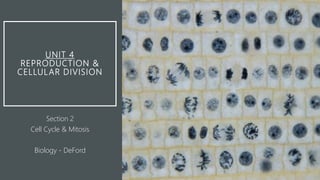
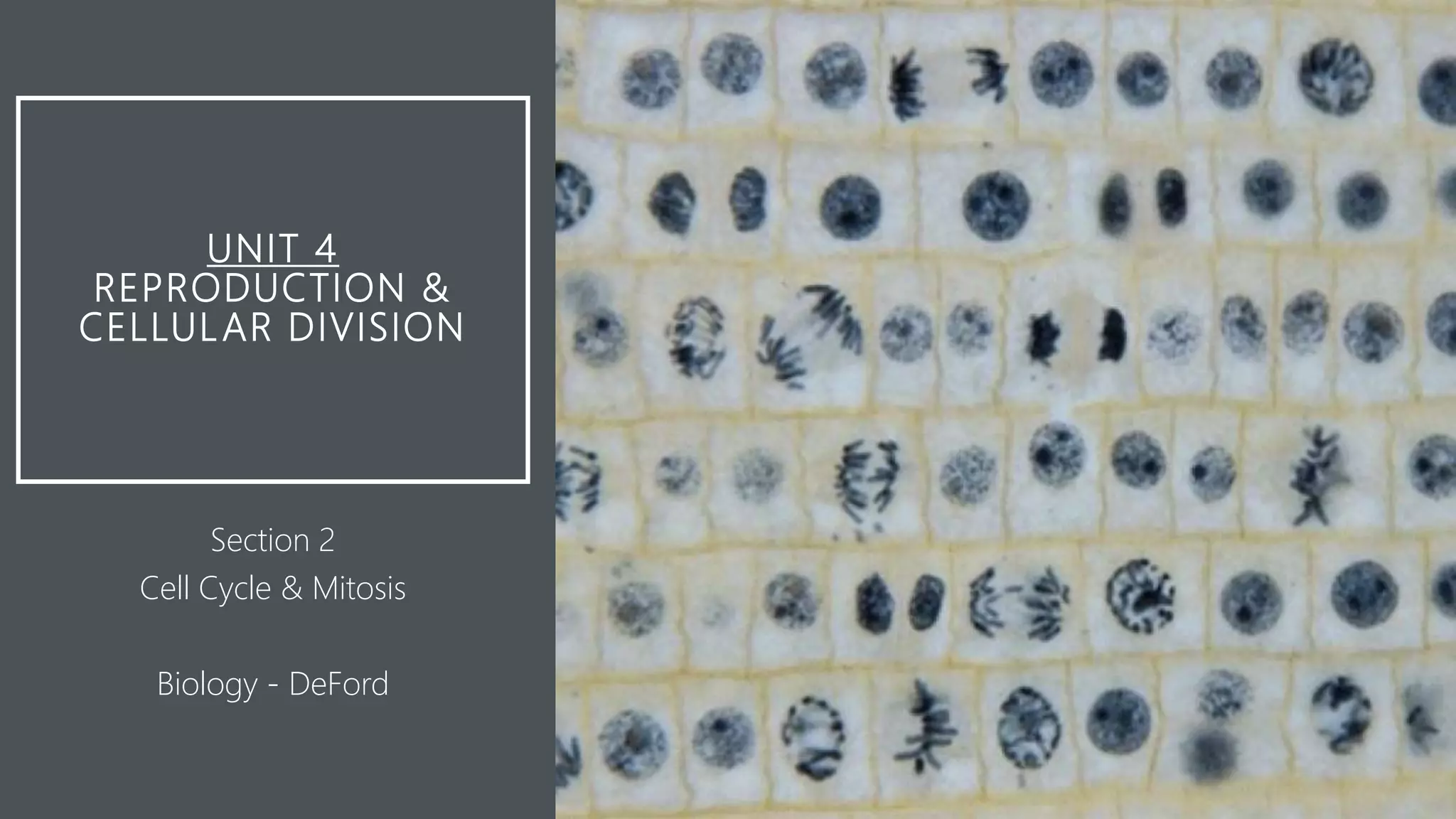
UNIT 4
REPRODUCTION &
CELLULAR DIVISION
Section 2
Cell Cycle & Mitosis
Biology - DeFord
CELLULAR DIVISION
Cellular division is the process by which a cell divides into
two new daughter cells. Cell division occurs:
 to keep cells from becoming too large, solving the following
issues:
o the larger a cell becomes, the more demands the cell
places on its DNA
o the larger a cell becomes, the less efficient it is in moving
nutrients and waste materials across its cell membrane
 to replace damaged, lost, or dead cells
 so that the organism may grow and develop
DNA
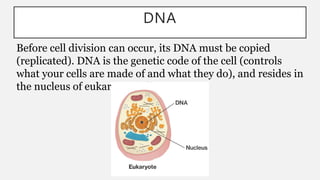
Before cell division can occur, its DNA must be copied
(replicated). DNA is the genetic code of the cell (controls
what your cells are made of and what they do), and resides in
the nucleus of eukaryotic cells.
DNA
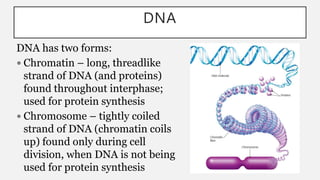
DNA has two forms:
 Chromatin – long, threadlike
strand of DNA (and proteins)
found throughout interphase;
used for protein synthesis
 Chromosome – tightly coiled
strand of DNA (chromatin coils
up) found only during cell
division, when DNA is not being
used for protein synthesis
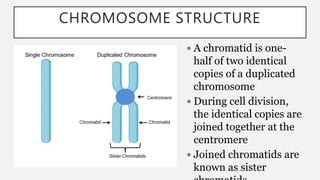
CHROMOSOME STRUCTURE
 A chromatid is one-
half of two identical
copies of a duplicated
chromosome
 During cell division,
the identical copies are
joined together at the
centromere
 Joined chromatids are
known as sister
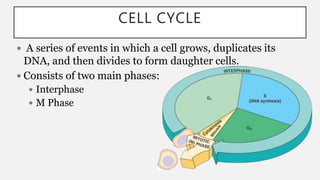
CELL CYCLE
 A series of events in which a cell grows, duplicates its
DNA, and then divides to form daughter cells.
 Consists of two main phases:
 Interphase
 M Phase
INTERPHASE
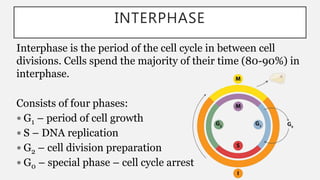
Interphase is the period of the cell cycle in between cell
divisions. Cells spend the majority of their time (80-90%) in
interphase.
Consists of four phases:
 G1 – period of cell growth
 S – DNA replication
 G2 – cell division preparation
 G0 – special phase – cell cycle arrest
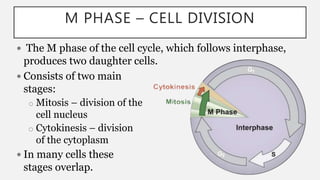
M PHASE – CELL DIVISION
 The M phase of the cell cycle, which follows interphase,
produces two daughter cells.
 Consists of two main
stages:
o Mitosis – division of the
cell nucleus
o Cytokinesis – division
of the cytoplasm
 In many cells these
stages overlap.
MITOSIS
 Type of asexual reproduction for unicellular organisms
 Somatic (body) cells undergo mitosis to replace lost,
damaged or dead cells and for multicellular organism
growth
 Consists of four subphases (PMAT)
o Prophase
o Metaphase
o Anaphase
o Telophase
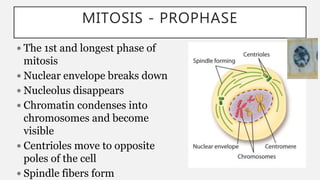
MITOSIS - PROPHASE
 The 1st and longest phase of
mitosis
 Nuclear envelope breaks down
 Nucleolus disappears
 Chromatin condenses into
chromosomes and become
visible
 Centrioles move to opposite
poles of the cell
 Spindle fibers form
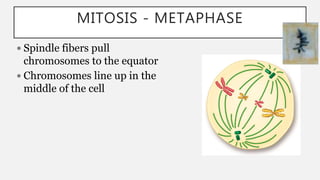
MITOSIS - METAPHASE
 Spindle fibers pull
chromosomes to the equator
 Chromosomes line up in the
middle of the cell
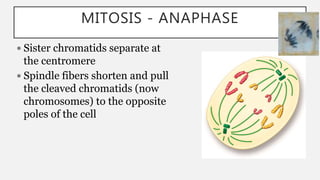
MITOSIS - ANAPHASE
 Sister chromatids separate at
the centromere
 Spindle fibers shorten and pull
the cleaved chromatids (now
chromosomes) to the opposite
poles of the cell
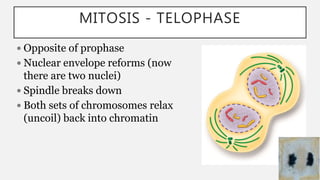
MITOSIS - TELOPHASE
 Opposite of prophase
 Nuclear envelope reforms (now
there are two nuclei)
 Spindle breaks down
 Both sets of chromosomes relax
(uncoil) back into chromatin
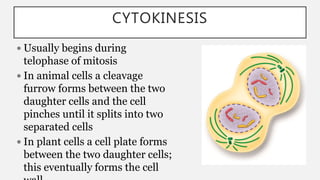
CYTOKINESIS
 Usually begins during
telophase of mitosis
 In animal cells a cleavage
furrow forms between the two
daughter cells and the cell
pinches until it splits into two
separated cells
 In plant cells a cell plate forms
between the two daughter cells;
this eventually forms the cell

BU4.2 Cell Cycle & Mitosis

  • 1.
    UNIT 4 REPRODUCTION & CELLULARDIVISION Section 2 Cell Cycle & Mitosis Biology - DeFord
  • 2.
    CELLULAR DIVISION Cellular divisionis the process by which a cell divides into two new daughter cells. Cell division occurs:  to keep cells from becoming too large, solving the following issues: o the larger a cell becomes, the more demands the cell places on its DNA o the larger a cell becomes, the less efficient it is in moving nutrients and waste materials across its cell membrane  to replace damaged, lost, or dead cells  so that the organism may grow and develop
  • 3.
    DNA Before cell divisioncan occur, its DNA must be copied (replicated). DNA is the genetic code of the cell (controls what your cells are made of and what they do), and resides in the nucleus of eukaryotic cells.
  • 4.
    DNA DNA has twoforms:  Chromatin – long, threadlike strand of DNA (and proteins) found throughout interphase; used for protein synthesis  Chromosome – tightly coiled strand of DNA (chromatin coils up) found only during cell division, when DNA is not being used for protein synthesis
  • 5.
    CHROMOSOME STRUCTURE  Achromatid is one- half of two identical copies of a duplicated chromosome  During cell division, the identical copies are joined together at the centromere  Joined chromatids are known as sister
  • 6.
    CELL CYCLE  Aseries of events in which a cell grows, duplicates its DNA, and then divides to form daughter cells.  Consists of two main phases:  Interphase  M Phase
  • 7.
    INTERPHASE Interphase is theperiod of the cell cycle in between cell divisions. Cells spend the majority of their time (80-90%) in interphase. Consists of four phases:  G1 – period of cell growth  S – DNA replication  G2 – cell division preparation  G0 – special phase – cell cycle arrest
  • 8.
    M PHASE –CELL DIVISION  The M phase of the cell cycle, which follows interphase, produces two daughter cells.  Consists of two main stages: o Mitosis – division of the cell nucleus o Cytokinesis – division of the cytoplasm  In many cells these stages overlap.
  • 9.
    MITOSIS  Type ofasexual reproduction for unicellular organisms  Somatic (body) cells undergo mitosis to replace lost, damaged or dead cells and for multicellular organism growth  Consists of four subphases (PMAT) o Prophase o Metaphase o Anaphase o Telophase
  • 10.
    MITOSIS - PROPHASE The 1st and longest phase of mitosis  Nuclear envelope breaks down  Nucleolus disappears  Chromatin condenses into chromosomes and become visible  Centrioles move to opposite poles of the cell  Spindle fibers form
  • 11.
    MITOSIS - METAPHASE Spindle fibers pull chromosomes to the equator  Chromosomes line up in the middle of the cell
  • 12.
    MITOSIS - ANAPHASE Sister chromatids separate at the centromere  Spindle fibers shorten and pull the cleaved chromatids (now chromosomes) to the opposite poles of the cell
  • 13.
    MITOSIS - TELOPHASE Opposite of prophase  Nuclear envelope reforms (now there are two nuclei)  Spindle breaks down  Both sets of chromosomes relax (uncoil) back into chromatin
  • 14.
    CYTOKINESIS  Usually beginsduring telophase of mitosis  In animal cells a cleavage furrow forms between the two daughter cells and the cell pinches until it splits into two separated cells  In plant cells a cell plate forms between the two daughter cells; this eventually forms the cell

Editor's Notes

  • #3 Right now as you are listening and taking notes, many of the cells in your body are growing, dividing, and dying. Old cells on the soles of your feet and on the palms of your hands are being shed and replaced, cuts and bruises are healing, and your intestines are producing millions of new cells each second. As a cell grows, its surface area/volume ratio decreases (recall our lab and textbook reading). At some point in its growth, its surface area/volume ratio becomes so small that its surface area is too small to supply its raw materials to its volume. At this point, the cell cannot get larger and survive. Diffusion (movement of those materials) is fast and efficient over short distances; it becomes slow and inefficient over larger distances. Cells need enough DNA to support the protein needs of the cell (DNA is the genetic code of the cell that tells the cell which proteins to make). Larger cells need more proteins, thus more DNA…but as a cell increases in size, no extra DNA is made. Not enough protein results in apoptosis (programmed cell death). New cells are produced as tadpoles become frogs, as an ivy vine grows and wraps around a garden trellis, as you grew in size from a baby to the young adult your are…remember, you began with a single fertilized egg cell called a zygote!
  • #6 Still focused on eukaryotes!
  • #8 G1 – cells grow in size and performs normal cell functions (synthesize new proteins and organelles). S – new DNA is synthesized as the chromosomes are replicated (duplicated). By the end of S, the cell contains twice as much DNA as it did at the beginning of the phase. G2 – organelles and molecules needed for cell division are produced; cell takes inventory and makes sure it is ready for division. G0 – cells leave the cell cycle; perform normal functions but do not divide. May be temporary or permanent. Nerve and Heart cells are permanently in G0, as are skeletal muscle cells.
  • #12 Ask volunteers to identify each of the following structures: centriole, centromere, chromosome, chromatid
  • #13 What would happen if one of the duplicated chromosomes did not separate correctly during this phase? The daughter cells would not have the correct genetic information.