MEIOSIS
1
Fertilization occurs when the nucleus of a male
reproductive cell combines with the nucleus of a
female reproductive cell
The reproductive cells are called gametes
In animals, the male gamete is the sperm
cell and the female gamete is the ovum
In flowering plants, the male gamete is a cell in the
pollen grain and the female gamete is an egg cell
in the ovule
When the male and female gametes combine,
the resulting cell is called a zygote
2Fertilization
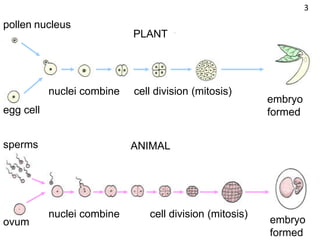
pollen nucleus
egg cell
nuclei combine cell division (mitosis)
embryo
formed
PLANT
sperms
ovum
nuclei combine cell division (mitosis)
embryo
formed
ANIMAL
3
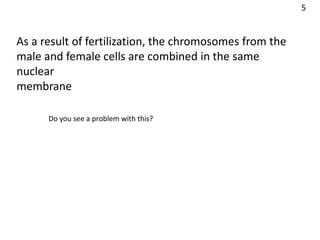
As a result of fertilization, the chromosomes from the
male and female cells are combined in the same
nuclear
membrane
Do you see a problem with this?
5
The problem is that if the full complement of male and
female chromosomes combine, the zygote and
embryo would have twice as many chromosomes
as its parents
If 46 male chromosomes combined with 46 female
chromosomes, the offspring would have 92 chromosomes
in their cells
And the next generation would have 184 chromosomes,
and so on
In fact, when the gametes are formed, the number of
chromosomes is halved so that the zygote ends up with
the same number of chromosomes as its parents.
6
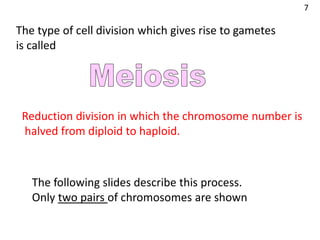
The type of cell division which gives rise to gametes
is called
Reduction division in which the chromosome number is
halved from diploid to haploid.
The following slides describe this process.
Only two pairs of chromosomes are shown
7
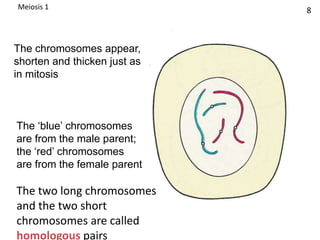
The chromosomes appear,
shorten and thicken just as
in mitosis
The ‘blue’ chromosomes
are from the male parent;
the ‘red’ chromosomes
are from the female parent
The two long chromosomes
and the two short
chromosomes are called
homologous pairs
8Meiosis 1
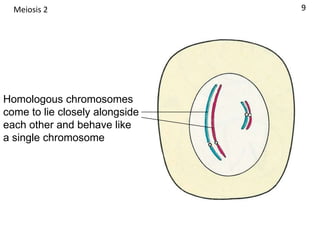
Homologous chromosomes
come to lie closely alongside
each other and behave like
a single chromosome
9Meiosis 2
The nuclear membrane
disappears
A spindle forms
At this stage it is the
chromosomes (and not
the chromatids) which are
separated
The cell starts to constrict
10Meiosis 3
One long chromosome
and one short chromosome
go to either end of the
dividing cell
So the cells now contain
only two, rather than four
chromosomes
By this time the chromatids
have become clear
11Meiosis 4
Two new spindles form, at
right angles to the original
spindle
At this stage, it is the
chromatids which
separate and pass to
opposite ends of the
cells
The cell constricts in the plane
at right angles to the first constriction
12Meiosis 5
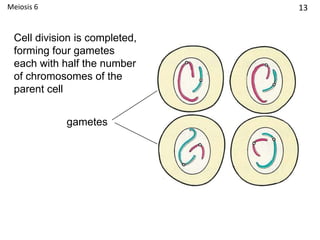
Cell division is completed,
forming four gametes
each with half the number
of chromosomes of the
parent cell
gametes
13Meiosis 6
The number of chromosomes in the body cells is called
the diploid number
The number of chromosomes in the gametes is called
the haploid number (half the diploid number)
The diploid number in human cells is 46. The haploid
number in the gametes is 23
14
23
46
46
23
23
23
23
23 46
sperm
mother
cell
ovum
mother
cell
sperms produced
by meiosis
fertilization
zygote
ova produced by meiosis
but only one develops to
maturity
15
46 46
46 46
46 46 4646
46 46 46 46
4646
46 46
4646
Cell division continues by
mitosis, so all the cells will
contain 46 chromosomes early embryo
16

Powerpoint meiosis

  • 1.
  • 2.
  • 3.
    Fertilization occurs whenthe nucleus of a male reproductive cell combines with the nucleus of a female reproductive cell The reproductive cells are called gametes In animals, the male gamete is the sperm cell and the female gamete is the ovum In flowering plants, the male gamete is a cell in the pollen grain and the female gamete is an egg cell in the ovule When the male and female gametes combine, the resulting cell is called a zygote 2Fertilization
  • 4.
    pollen nucleus egg cell nucleicombine cell division (mitosis) embryo formed PLANT sperms ovum nuclei combine cell division (mitosis) embryo formed ANIMAL 3
  • 5.
    As a resultof fertilization, the chromosomes from the male and female cells are combined in the same nuclear membrane Do you see a problem with this? 5
  • 6.
    The problem isthat if the full complement of male and female chromosomes combine, the zygote and embryo would have twice as many chromosomes as its parents If 46 male chromosomes combined with 46 female chromosomes, the offspring would have 92 chromosomes in their cells And the next generation would have 184 chromosomes, and so on In fact, when the gametes are formed, the number of chromosomes is halved so that the zygote ends up with the same number of chromosomes as its parents. 6
  • 7.
    The type ofcell division which gives rise to gametes is called Reduction division in which the chromosome number is halved from diploid to haploid. The following slides describe this process. Only two pairs of chromosomes are shown 7
  • 8.
    The chromosomes appear, shortenand thicken just as in mitosis The ‘blue’ chromosomes are from the male parent; the ‘red’ chromosomes are from the female parent The two long chromosomes and the two short chromosomes are called homologous pairs 8Meiosis 1
  • 9.
    Homologous chromosomes come tolie closely alongside each other and behave like a single chromosome 9Meiosis 2
  • 10.
    The nuclear membrane disappears Aspindle forms At this stage it is the chromosomes (and not the chromatids) which are separated The cell starts to constrict 10Meiosis 3
  • 11.
    One long chromosome andone short chromosome go to either end of the dividing cell So the cells now contain only two, rather than four chromosomes By this time the chromatids have become clear 11Meiosis 4
  • 12.
    Two new spindlesform, at right angles to the original spindle At this stage, it is the chromatids which separate and pass to opposite ends of the cells The cell constricts in the plane at right angles to the first constriction 12Meiosis 5
  • 13.
    Cell division iscompleted, forming four gametes each with half the number of chromosomes of the parent cell gametes 13Meiosis 6
  • 14.
    The number ofchromosomes in the body cells is called the diploid number The number of chromosomes in the gametes is called the haploid number (half the diploid number) The diploid number in human cells is 46. The haploid number in the gametes is 23 14
  • 15.
    23 46 46 23 23 23 23 23 46 sperm mother cell ovum mother cell sperms produced bymeiosis fertilization zygote ova produced by meiosis but only one develops to maturity 15
  • 16.
    46 46 46 46 4646 4646 46 46 46 46 4646 46 46 4646 Cell division continues by mitosis, so all the cells will contain 46 chromosomes early embryo 16