MEIOSIS
Formation of gametes, division of the
sex cell (egg and sperm)
(Readapted from Slideshare):
1. Jay Swan
2. Karl Pointer
3. Mbrown
Chromosome Matching
 In humans, somatic cells (body cells) have:
• 23 pairs of homologous chromosomes
and
• one member of each pair from each
parent.
 The human sex chromosomes (Gonosomes)
X and Y differ in size and genetic
composition.
 The other 22 pairs of chromosomes are
autosomes with the same size and genetic
composition.
• Homologous chromosomes are matched in:
• Similar length,
• Centromere (attaches sister chromatids together)
position
• gene locations (locus).

• A locus (plural, loci) is the position of a gene.
• Different versions or variations (alleles) of a
gene may be found at the same locus on
maternal and paternal chromosomes.
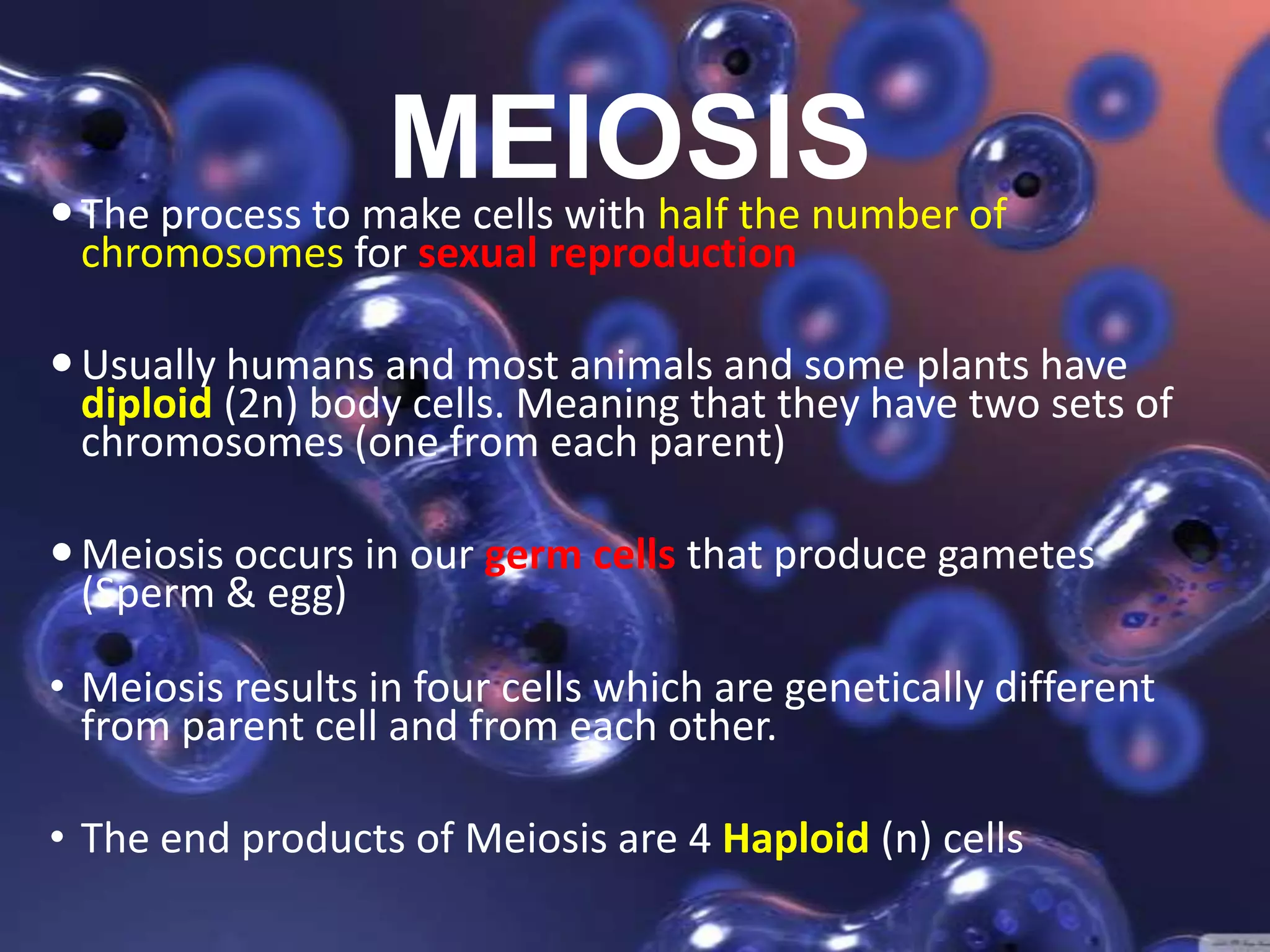
MEIOSIS

 The process to make cells with half the number of
chromosomes for sexual reproduction
 Usually humans and most animals and some plants have
diploid (2n) body cells. Meaning that they have two sets of
chromosomes (one from each parent)
 Meiosis occurs in our germ cells that produce gametes
(Sperm & egg)
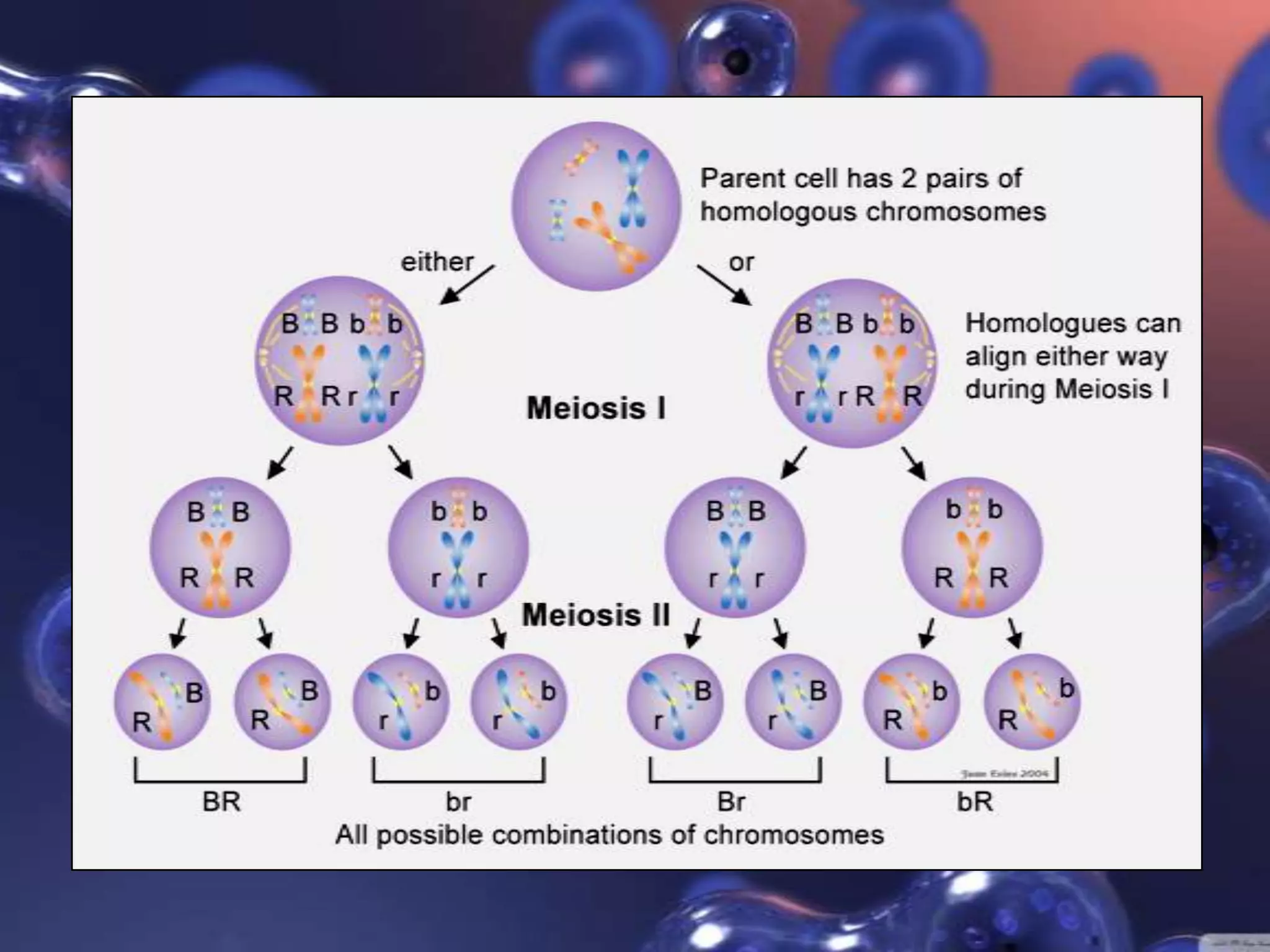
• Meiosis results in four cells which are genetically different
from parent cell and from each other.
• The end products of Meiosis are 4 Haploid (n) cells
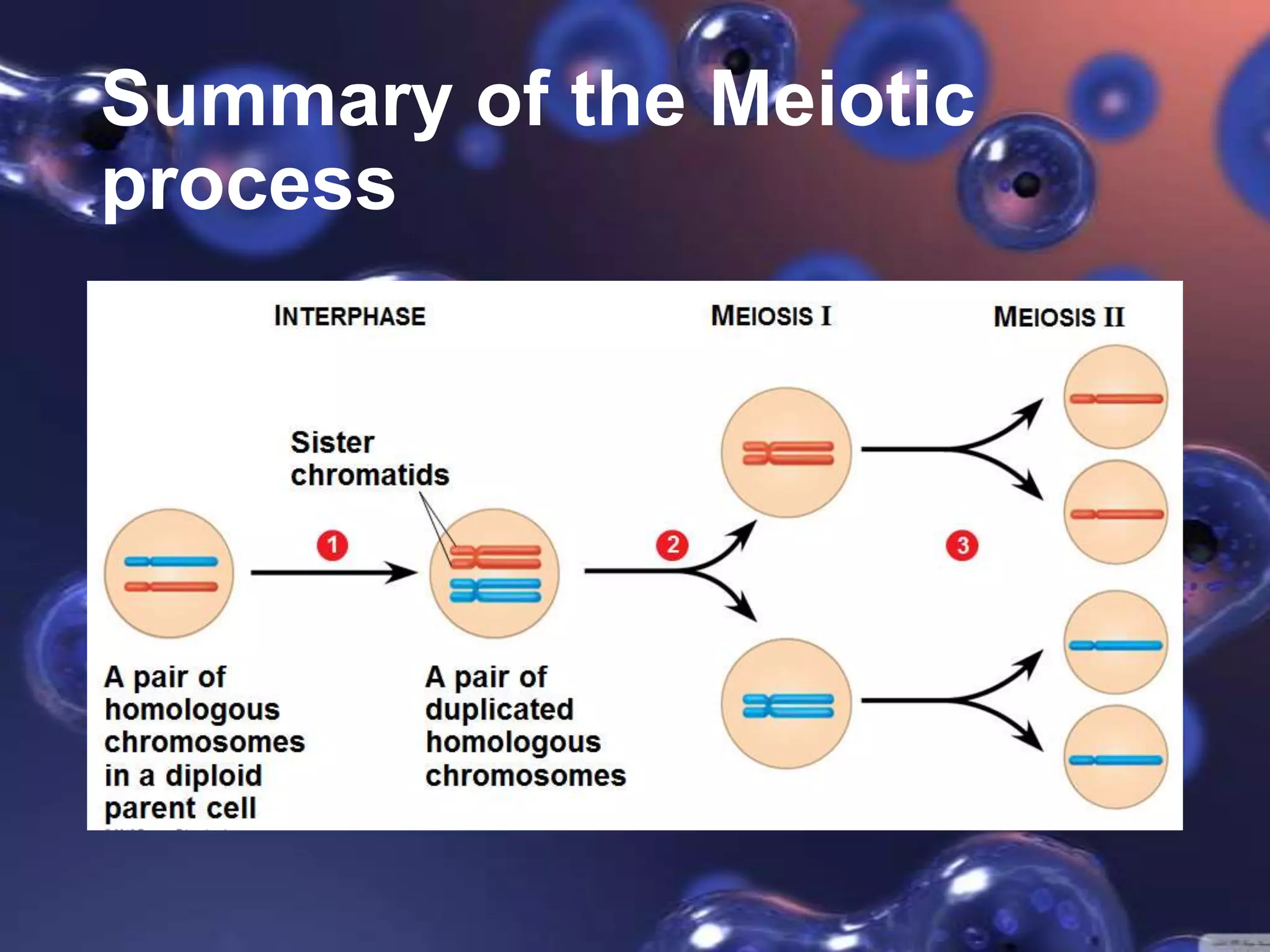
 Meiosis is a process that converts diploid
nuclei to haploid nuclei.
• Diploid cells have 2 sets of chromosomes.
• Haploid cells have 1 set of chromosomes.
• Meiosis occurs in the sex organs,
producing gametes—sperm and eggs.
 Fertilization is the fusion of a sperm and egg
cell.

 The zygote has a diploid chromosome
number, one set from each parent.
Why do we need
Meiosis?
It is the fundamental basis of sexual reproduction
Two haploid (n) gametes are brought together
through fertilization to form a diploid (2n) zygote
If egg and sperm had the same number of
chromosomes as other body cells then the
offspring would have too many chromosomes.
Meiosis must reduce the chromosome number by half
(n)
Fertilization then restores the 2n number
Summary of the Meiotic
process
MEIOSIS has two distinct
stages
MEIOSIS I consisting of 5
phases:

 Interphase I, Prophase I,
Metaphase I, Anaphase I,
Telophase I.
 MEIOSIS II consisting of 4 phases
 Prophase II, Metaphase II,
Anaphase II, Telophase II.
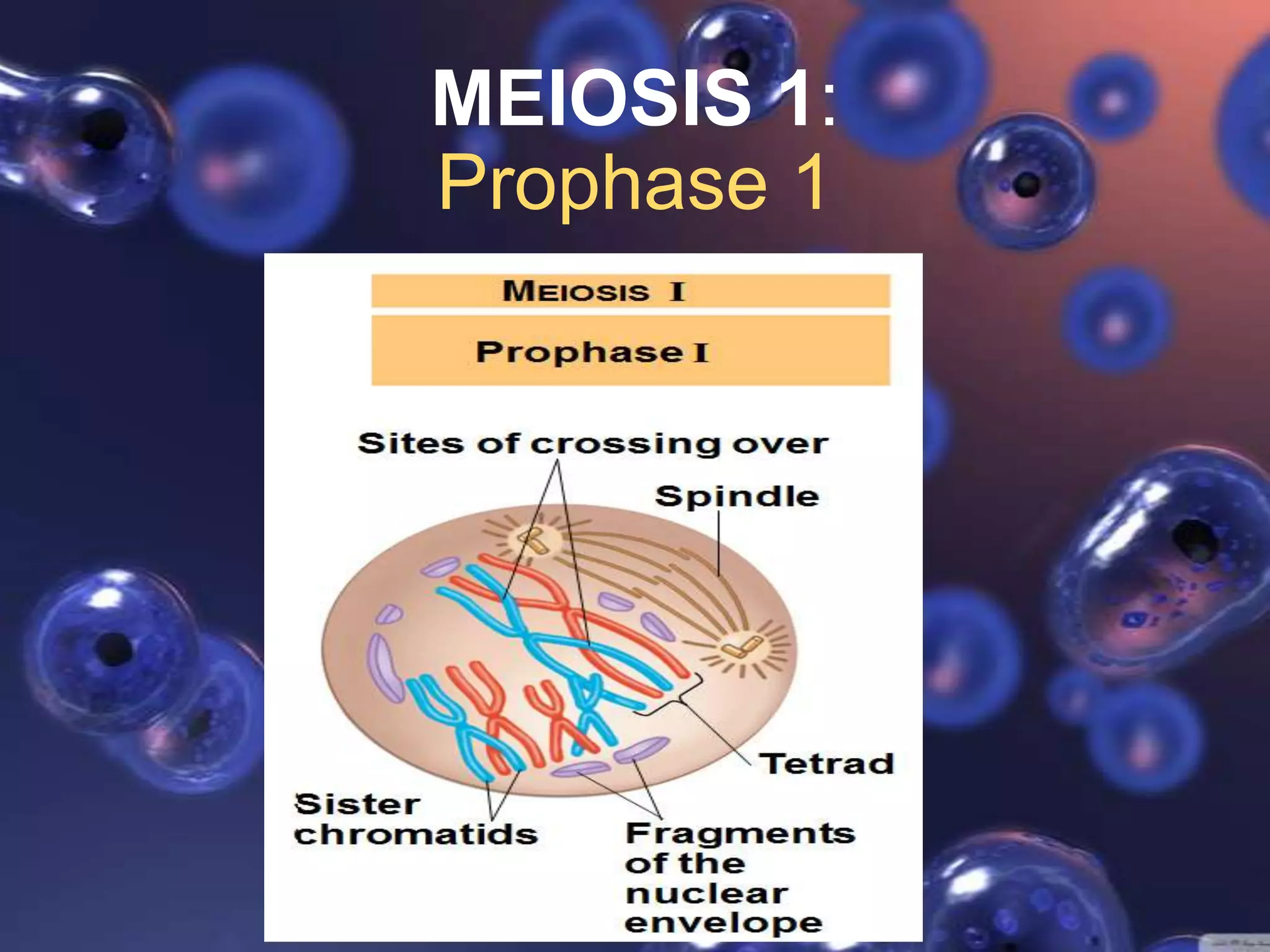
MEIOSIS 1:
Interphase
 Cell build up
energy
 DNA Replication
(to make
duplicated
chromosomes
 Cell doesn’t
change
structurally.
MEIOSIS 1:
Prophase 1
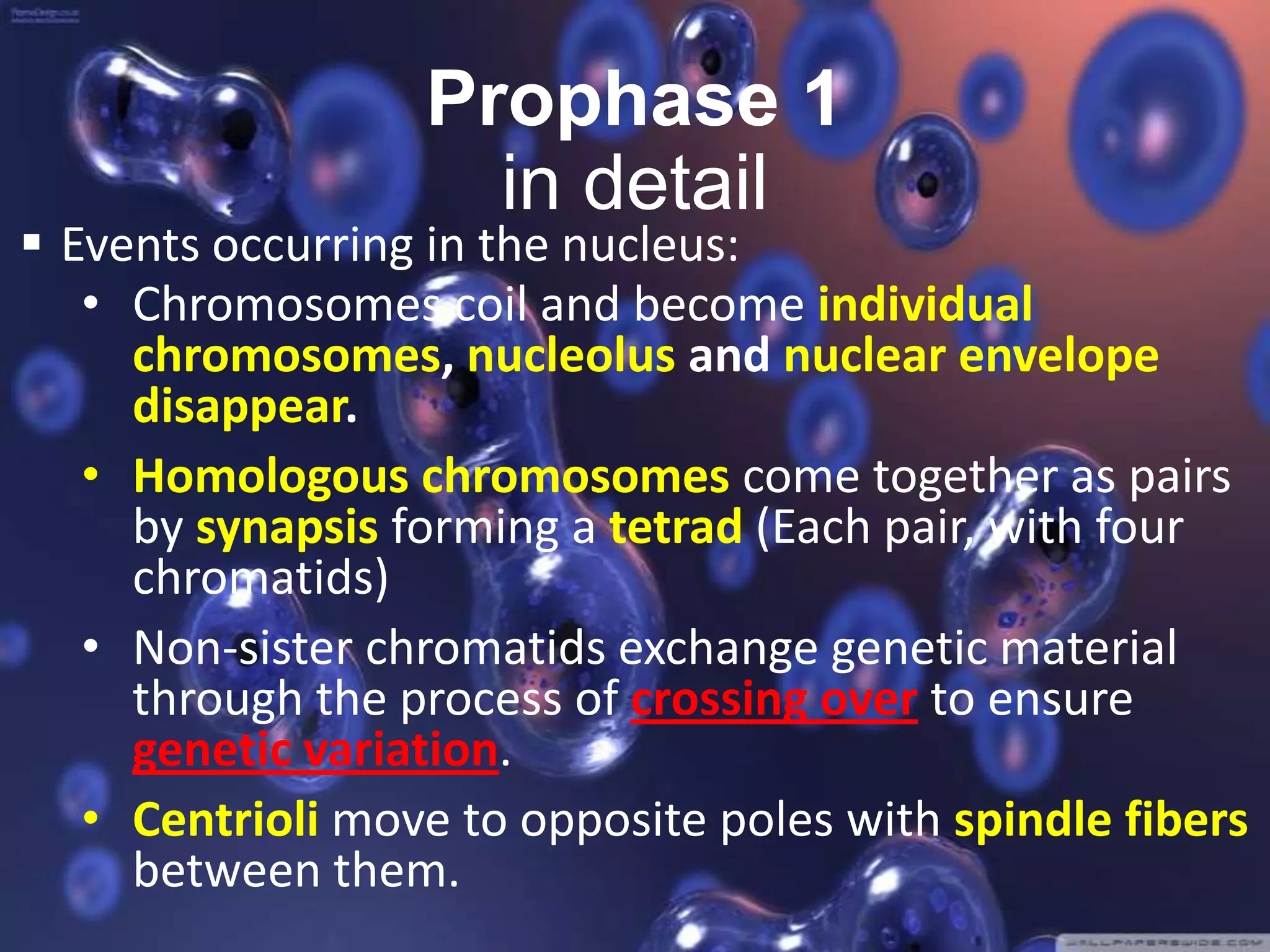
Prophase 1
in detail

 Events occurring in the nucleus:
• Chromosomes coil and become individual
chromosomes, nucleolus and nuclear envelope
disappear.
• Homologous chromosomes come together as pairs
by synapsis forming a tetrad (Each pair, with four
chromatids)
• Non-sister chromatids exchange genetic material
through the process of crossing over to ensure
genetic variation.
• Centrioli move to opposite poles with spindle fibers
between them.
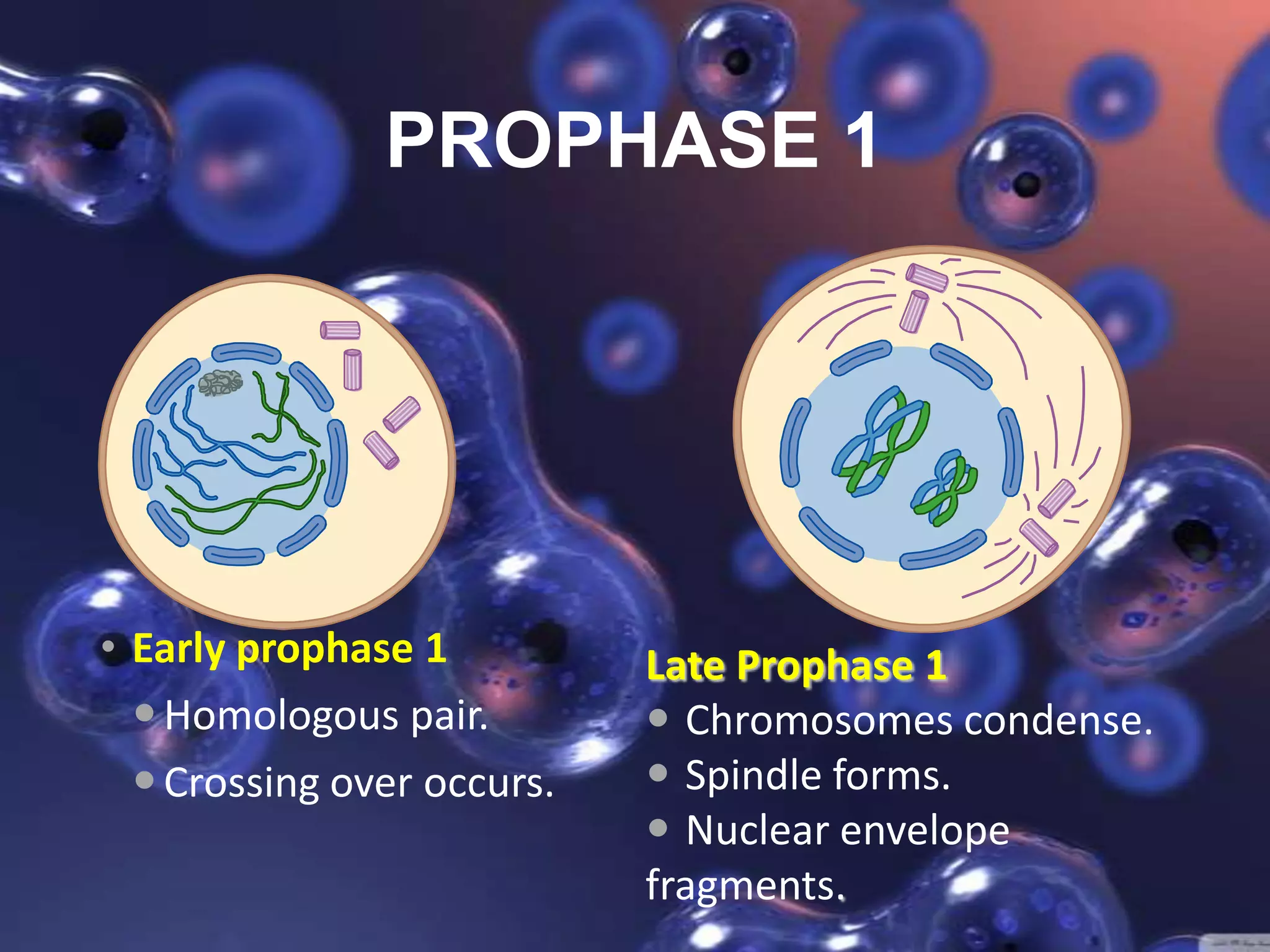
PROPHASE 1

• Early prophase 1
 Homologous pair.
 Crossing over occurs.

Late Prophase 1
 Chromosomes condense.
 Spindle forms.
 Nuclear envelope
fragments.
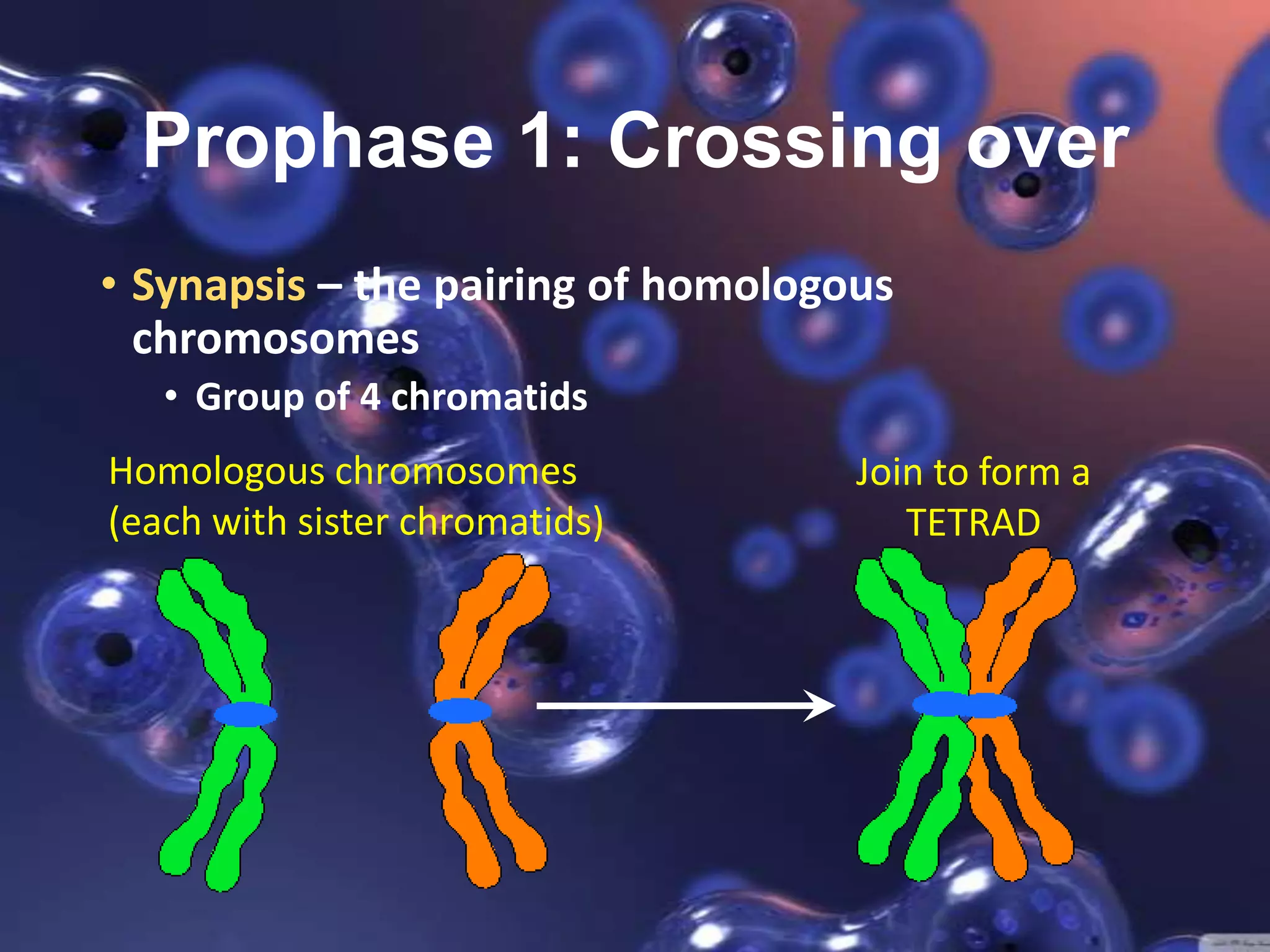
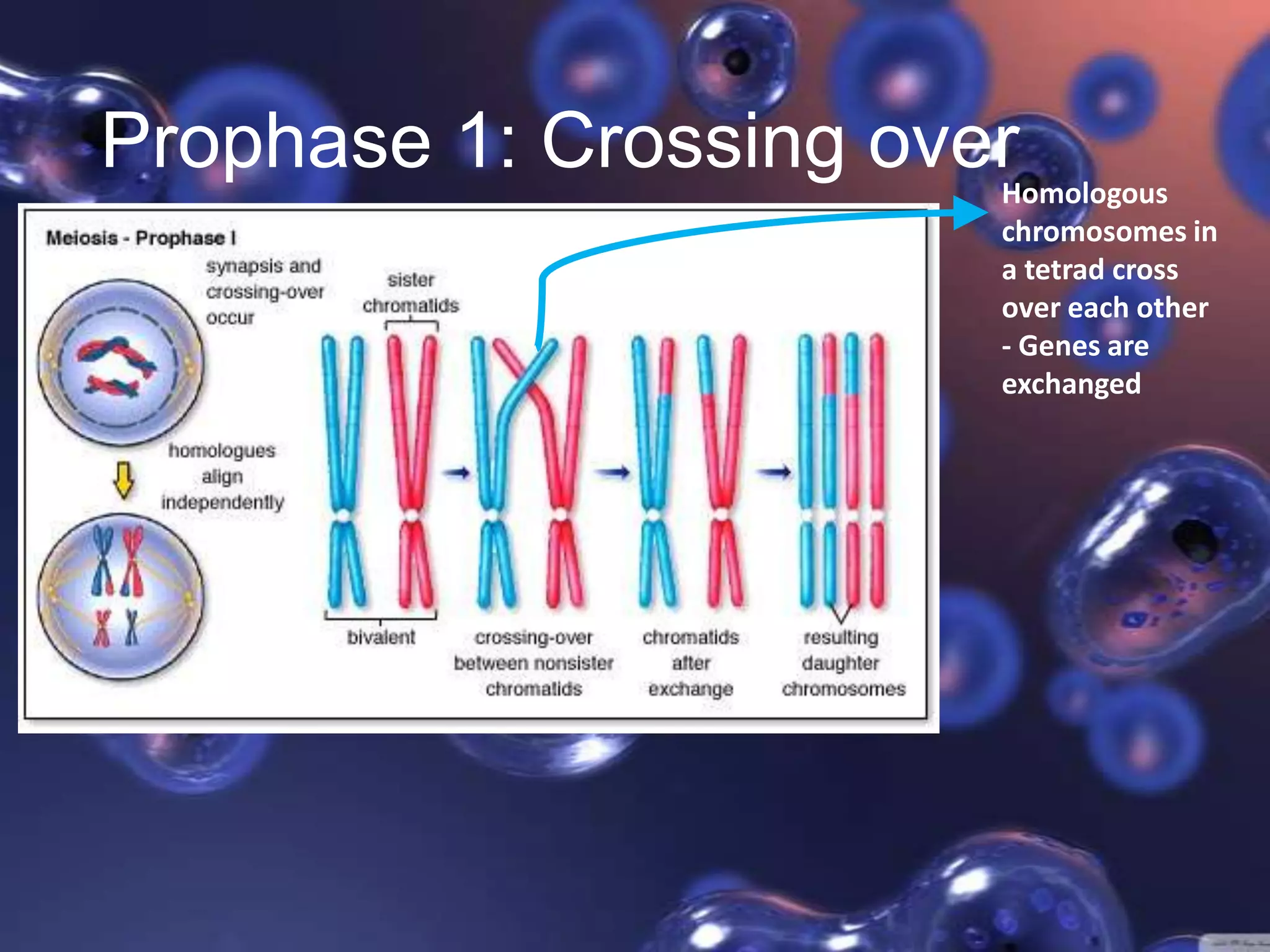
Prophase 1: Crossing over
• Synapsis – the pairing of homologous
chromosomes
• Group of 4 chromatids
Homologous chromosomes
(each with sister chromatids)

Join to form a
TETRAD
Prophase 1: Crossing over
Homologous
chromosomes in
a tetrad cross
over each other
- Genes are
exchanged
Crossing over
Metaphase I
Spindle fibre
attached to a
kinetochore

Metaphase
plate

 Homologous pairs of
chromosomes align along
the equator of the cell

 The two chromosomes
attach to one spindle
fiber by means of the
kinetochore of the
centromere.
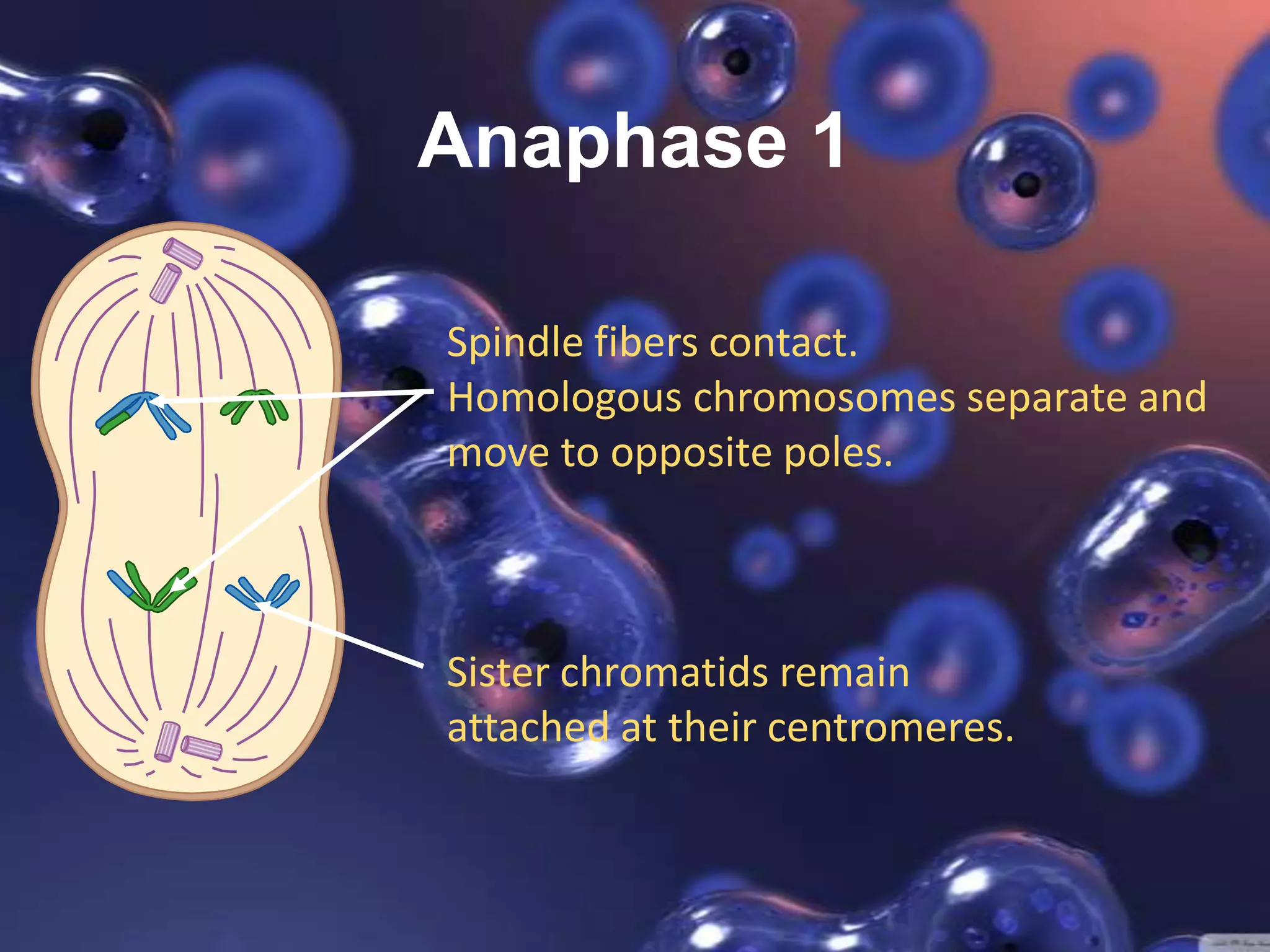
Anaphase 1
Spindle fibers contact.
Homologous chromosomes separate and
move to opposite poles.

Sister chromatids remain
attached at their centromeres.
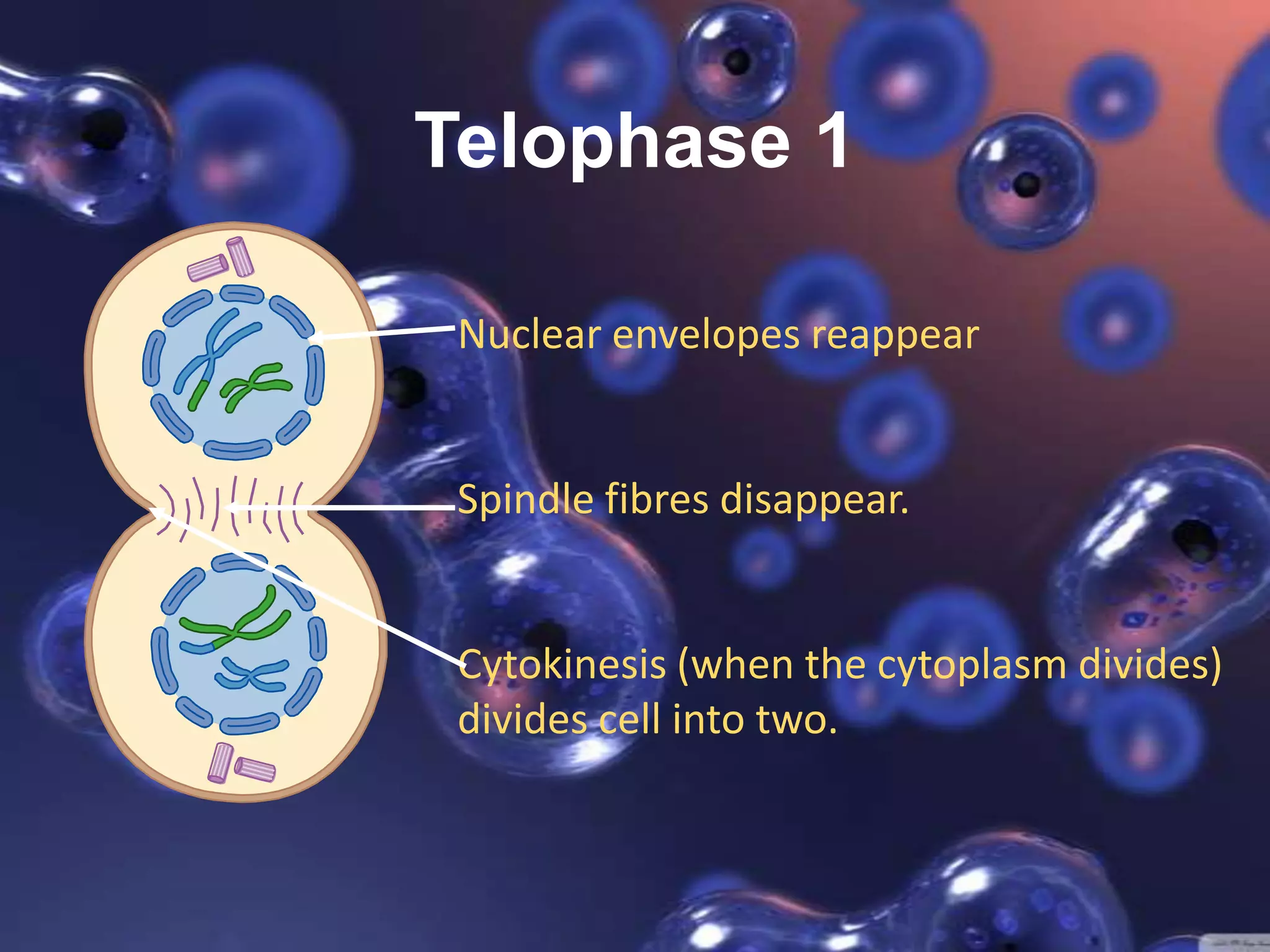
Telophase 1
Nuclear envelopes reappear

Spindle fibres disappear.

Cytokinesis (when the cytoplasm divides)
divides cell into two.
Telophase 1 and Cytokinesis
• Duplicated chromosomes have
reached the poles.
• A nuclear envelope and
nucleolus re-forms around
chromosomes.
• Each nucleus now has the
haploid number of
chromosomes.
• Cell invaginates forming a
cleavage furrow, which extends
to for 2 separate haploid cells.
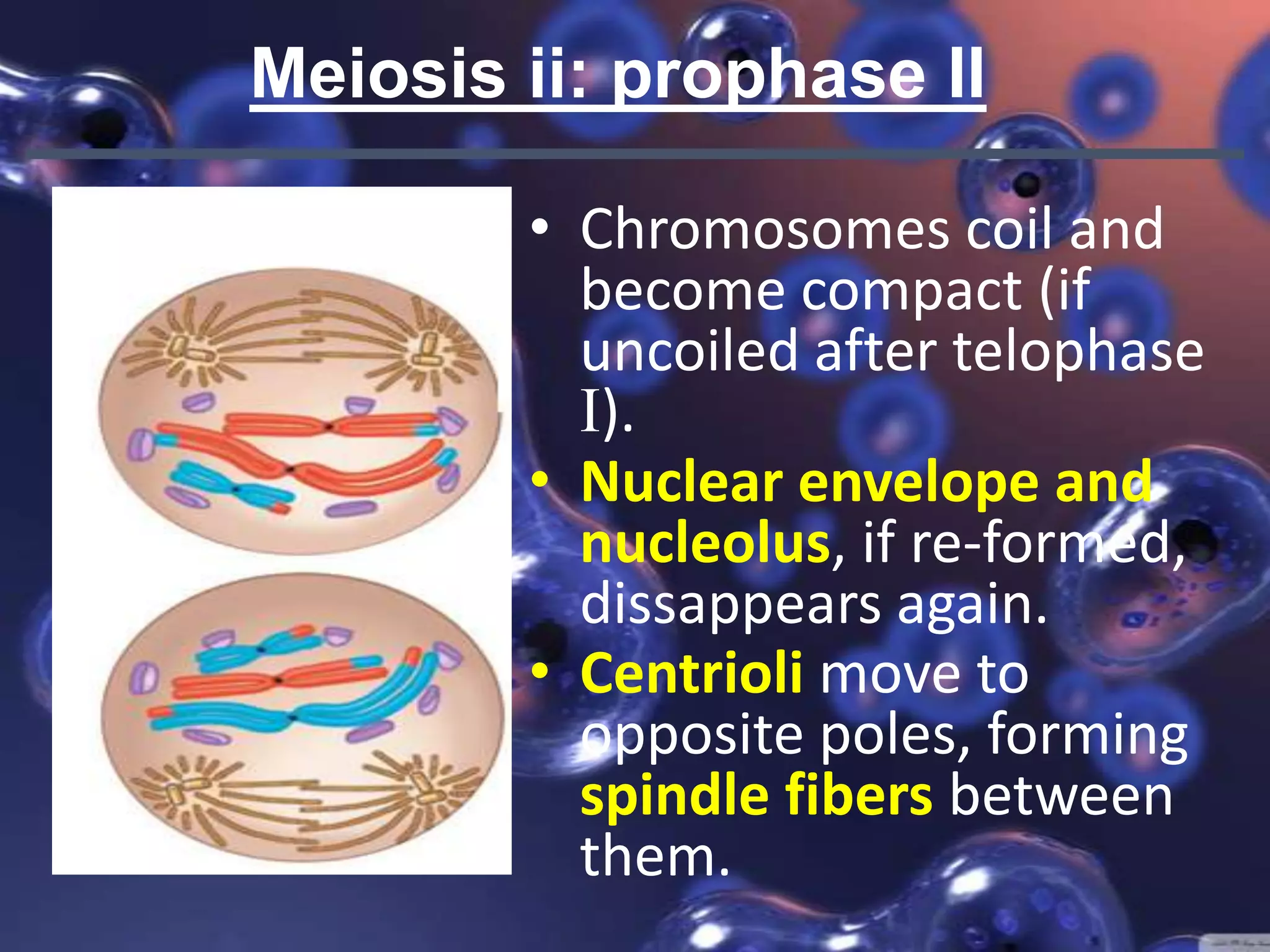
Meiosis ii: prophase II
• Chromosomes coil and
become compact (if
uncoiled after telophase
I).
• Nuclear envelope and
nucleolus, if re-formed,
dissappears again.
• Centrioli move to
opposite poles, forming
spindle fibers between
them.
Meiosis ii: metaphase II
• Individual duplicated
chromosomes align on the
equator.
• One chromosome per
spindle fiber attached by
means of kinetochore of
centromere.
• Centrioli has reached the
poles.
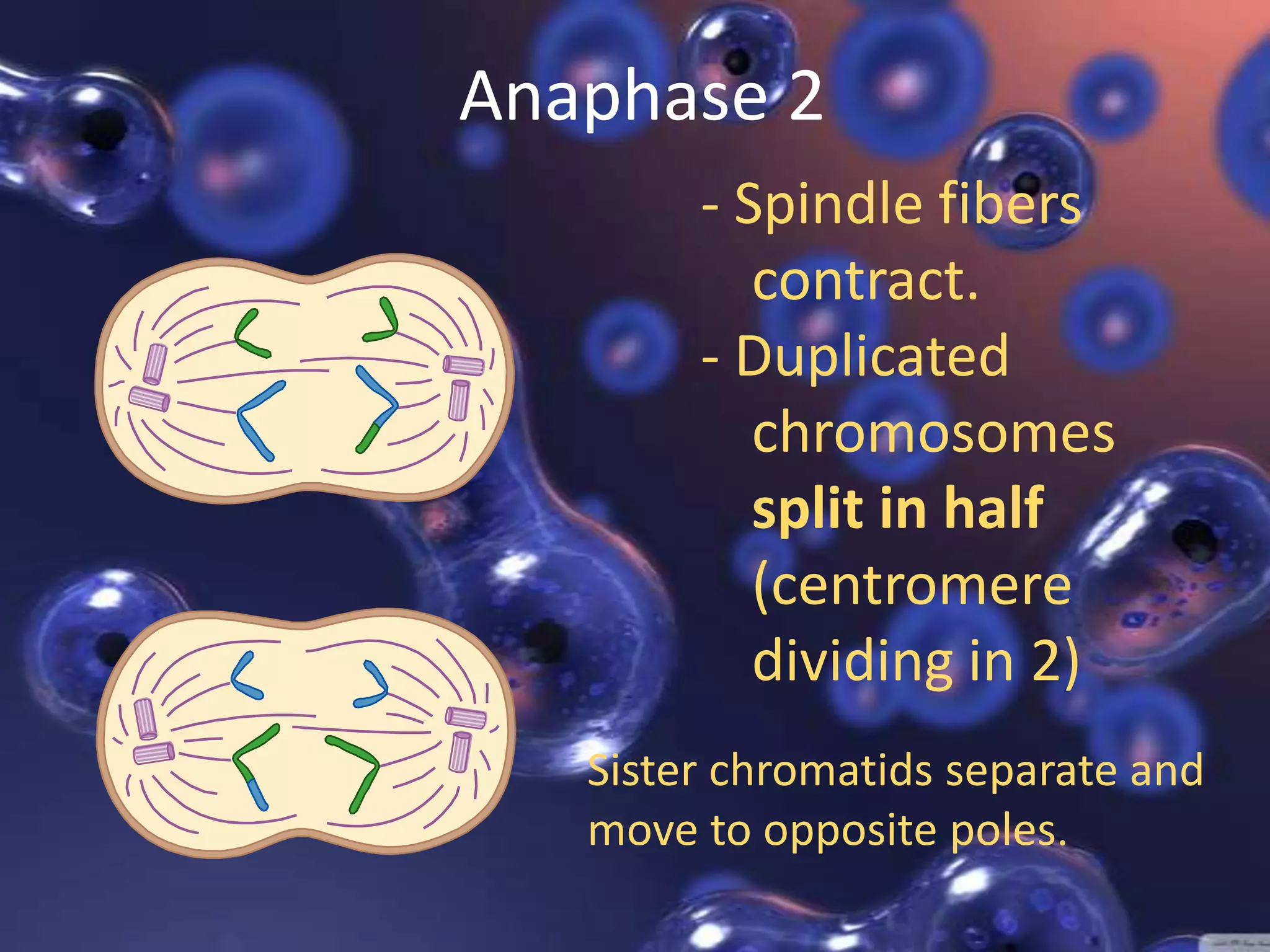
Anaphase 2
- Spindle fibers
contract.
- Duplicated
chromosomes
split in half
(centromere
dividing in 2)
Sister chromatids separate and
move to opposite poles.
Meiosis 2: Telophase 2
• Daughter chromosomes
has reached the poles.
• Two cells invaginate and
form 4 daughter haploid
cells (gametes)
• They uncoil and form
chromatin.
• Nuclear envelope and
nucleolus for around
chromatin again.
• Centrioli for centrosome.
MEOITIC DIVISION 2:
SUMMARY
Prophase II

Metaphase II

Anaphase II

Telophase II
and Cytokinesis
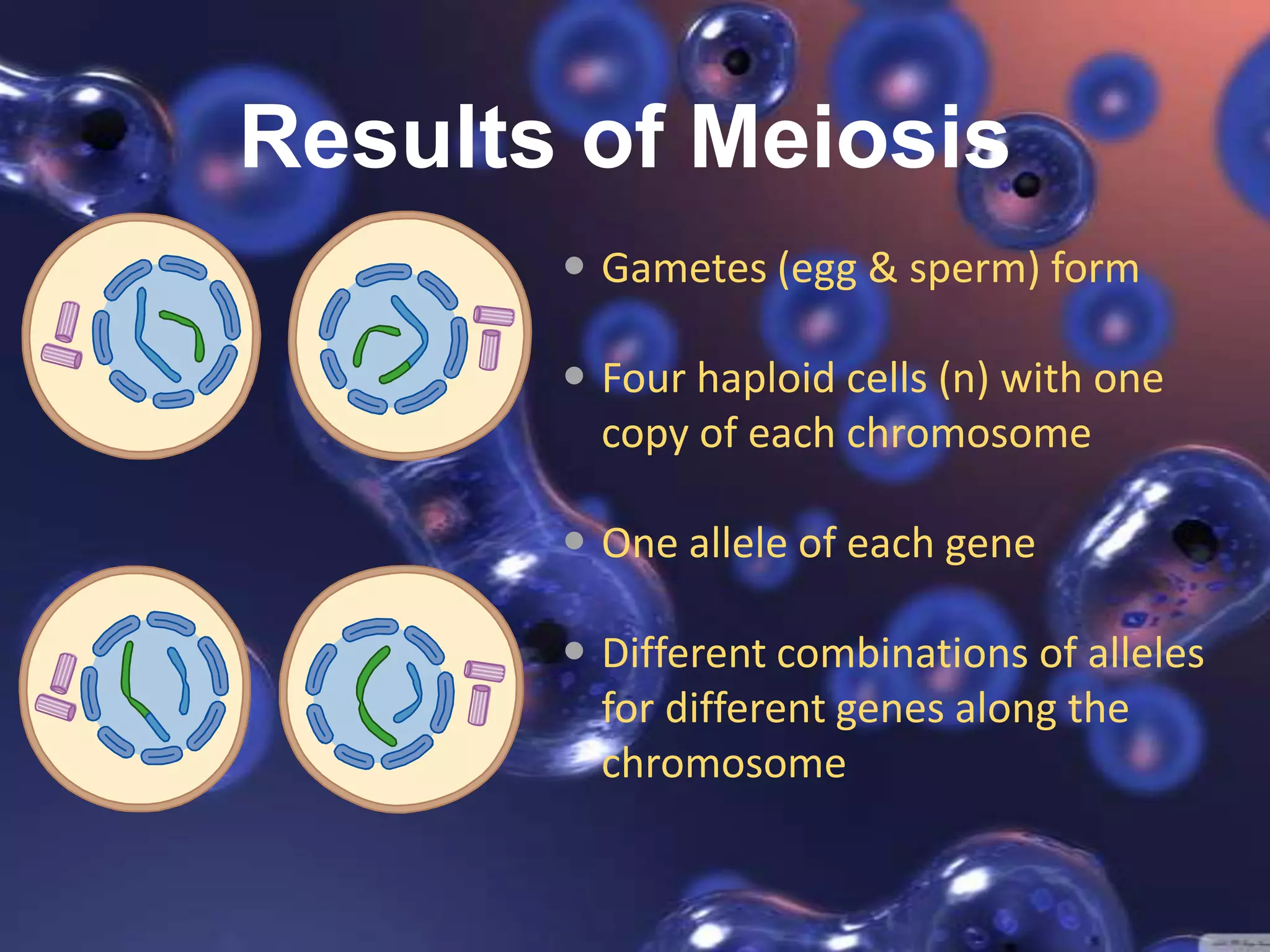
Results of Meiosis
 Gametes (egg & sperm) form
 Four haploid cells (n) with one
copy of each chromosome

 One allele of each gene
 Different combinations of alleles
for different genes along the
chromosome
When Chromosome number is
altered
 An extra copy of chromosome 21
causes Down syndrome or also known
as TRISOMY 21.
 A. Trisomy 21
• involves the inheritance of three
copies of chromosome 21 and
• is the most common human
chromosome abnormality.
 Trisomy 21 (Down Syndrome) produces a
characteristic set of symptoms, which include:
1. mental retardation,
characteristic facial features,

2. short stature,
3. heart defects,
4. susceptibility to respiratory infections,
leukemia, and Alzheimer’s disease, and
5. shortened life span.

 The incidence increases with the age of the
mother.
Bibliography
• Jackson, R., & Jackson, J. M. (2011). Henderson's
Dictionary of BIOLOGY (15th ed.). (E. Lawrence, Ed.)
(pp. 181-183). London: Pearson Education Limited.
• Livingstone, C. D., & Nobbe, M. E. (1998). The
Molecules of Life. Oxford: Biochemistry Department,
University of Oxford.
• Reece, J., Urry, L. A., Cane, M. L., Wasserman, S. A.,
Minrsky, P. V., & Jackson, R. B. (2011). Campbell Biology
(9th ed.). San Francisco: Pearson Benjamin Cummings.
• Urry, L. A., & Cane, M. L. (2011). The Molecular Basis of
Inheritance. In J. B. Reece, Campbell Biology (pp. 351370). San Francisco: Pearson Benjamin Cummings.

Meiosis 1 and 2

  • 1.
    MEIOSIS Formation of gametes,division of the sex cell (egg and sperm) (Readapted from Slideshare): 1. Jay Swan 2. Karl Pointer 3. Mbrown
  • 3.
    Chromosome Matching  Inhumans, somatic cells (body cells) have: • 23 pairs of homologous chromosomes and • one member of each pair from each parent.  The human sex chromosomes (Gonosomes) X and Y differ in size and genetic composition.  The other 22 pairs of chromosomes are autosomes with the same size and genetic composition.
  • 5.
    • Homologous chromosomesare matched in: • Similar length, • Centromere (attaches sister chromatids together) position • gene locations (locus). • A locus (plural, loci) is the position of a gene. • Different versions or variations (alleles) of a gene may be found at the same locus on maternal and paternal chromosomes.
  • 7.
    MEIOSIS  The processto make cells with half the number of chromosomes for sexual reproduction  Usually humans and most animals and some plants have diploid (2n) body cells. Meaning that they have two sets of chromosomes (one from each parent)  Meiosis occurs in our germ cells that produce gametes (Sperm & egg) • Meiosis results in four cells which are genetically different from parent cell and from each other. • The end products of Meiosis are 4 Haploid (n) cells
  • 9.
     Meiosis isa process that converts diploid nuclei to haploid nuclei. • Diploid cells have 2 sets of chromosomes. • Haploid cells have 1 set of chromosomes. • Meiosis occurs in the sex organs, producing gametes—sperm and eggs.  Fertilization is the fusion of a sperm and egg cell.  The zygote has a diploid chromosome number, one set from each parent.
  • 11.
    Why do weneed Meiosis? It is the fundamental basis of sexual reproduction Two haploid (n) gametes are brought together through fertilization to form a diploid (2n) zygote If egg and sperm had the same number of chromosomes as other body cells then the offspring would have too many chromosomes.
  • 13.
    Meiosis must reducethe chromosome number by half (n) Fertilization then restores the 2n number
  • 14.
    Summary of theMeiotic process
  • 15.
    MEIOSIS has twodistinct stages MEIOSIS I consisting of 5 phases:  Interphase I, Prophase I, Metaphase I, Anaphase I, Telophase I.  MEIOSIS II consisting of 4 phases  Prophase II, Metaphase II, Anaphase II, Telophase II.
  • 16.
    MEIOSIS 1: Interphase  Cellbuild up energy  DNA Replication (to make duplicated chromosomes  Cell doesn’t change structurally.
  • 17.
  • 18.
    Prophase 1 in detail Events occurring in the nucleus: • Chromosomes coil and become individual chromosomes, nucleolus and nuclear envelope disappear. • Homologous chromosomes come together as pairs by synapsis forming a tetrad (Each pair, with four chromatids) • Non-sister chromatids exchange genetic material through the process of crossing over to ensure genetic variation. • Centrioli move to opposite poles with spindle fibers between them.
  • 19.
    PROPHASE 1 • Earlyprophase 1  Homologous pair.  Crossing over occurs. Late Prophase 1  Chromosomes condense.  Spindle forms.  Nuclear envelope fragments.
  • 20.
    Prophase 1: Crossingover • Synapsis – the pairing of homologous chromosomes • Group of 4 chromatids Homologous chromosomes (each with sister chromatids) Join to form a TETRAD
  • 21.
    Prophase 1: Crossingover Homologous chromosomes in a tetrad cross over each other - Genes are exchanged
  • 22.
  • 23.
    Metaphase I Spindle fibre attachedto a kinetochore Metaphase plate  Homologous pairs of chromosomes align along the equator of the cell  The two chromosomes attach to one spindle fiber by means of the kinetochore of the centromere.
  • 24.
    Anaphase 1 Spindle fiberscontact. Homologous chromosomes separate and move to opposite poles. Sister chromatids remain attached at their centromeres.
  • 25.
    Telophase 1 Nuclear envelopesreappear Spindle fibres disappear. Cytokinesis (when the cytoplasm divides) divides cell into two.
  • 26.
    Telophase 1 andCytokinesis • Duplicated chromosomes have reached the poles. • A nuclear envelope and nucleolus re-forms around chromosomes. • Each nucleus now has the haploid number of chromosomes. • Cell invaginates forming a cleavage furrow, which extends to for 2 separate haploid cells.
  • 27.
    Meiosis ii: prophaseII • Chromosomes coil and become compact (if uncoiled after telophase I). • Nuclear envelope and nucleolus, if re-formed, dissappears again. • Centrioli move to opposite poles, forming spindle fibers between them.
  • 28.
    Meiosis ii: metaphaseII • Individual duplicated chromosomes align on the equator. • One chromosome per spindle fiber attached by means of kinetochore of centromere. • Centrioli has reached the poles.
  • 29.
    Anaphase 2 - Spindlefibers contract. - Duplicated chromosomes split in half (centromere dividing in 2) Sister chromatids separate and move to opposite poles.
  • 30.
    Meiosis 2: Telophase2 • Daughter chromosomes has reached the poles. • Two cells invaginate and form 4 daughter haploid cells (gametes) • They uncoil and form chromatin. • Nuclear envelope and nucleolus for around chromatin again. • Centrioli for centrosome.
  • 31.
    MEOITIC DIVISION 2: SUMMARY ProphaseII Metaphase II Anaphase II Telophase II and Cytokinesis
  • 32.
    Results of Meiosis Gametes (egg & sperm) form  Four haploid cells (n) with one copy of each chromosome  One allele of each gene  Different combinations of alleles for different genes along the chromosome
  • 34.
    When Chromosome numberis altered  An extra copy of chromosome 21 causes Down syndrome or also known as TRISOMY 21.  A. Trisomy 21 • involves the inheritance of three copies of chromosome 21 and • is the most common human chromosome abnormality.
  • 36.
     Trisomy 21(Down Syndrome) produces a characteristic set of symptoms, which include: 1. mental retardation, characteristic facial features, 2. short stature, 3. heart defects, 4. susceptibility to respiratory infections, leukemia, and Alzheimer’s disease, and 5. shortened life span.  The incidence increases with the age of the mother.
  • 37.
    Bibliography • Jackson, R.,& Jackson, J. M. (2011). Henderson's Dictionary of BIOLOGY (15th ed.). (E. Lawrence, Ed.) (pp. 181-183). London: Pearson Education Limited. • Livingstone, C. D., & Nobbe, M. E. (1998). The Molecules of Life. Oxford: Biochemistry Department, University of Oxford. • Reece, J., Urry, L. A., Cane, M. L., Wasserman, S. A., Minrsky, P. V., & Jackson, R. B. (2011). Campbell Biology (9th ed.). San Francisco: Pearson Benjamin Cummings. • Urry, L. A., & Cane, M. L. (2011). The Molecular Basis of Inheritance. In J. B. Reece, Campbell Biology (pp. 351370). San Francisco: Pearson Benjamin Cummings.