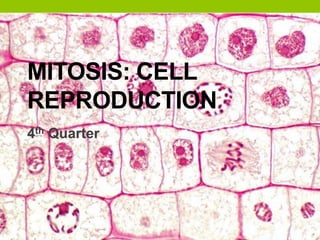
MITOSIS: CELL
REPRODUCTION
4th Quarter
Let’s recall!
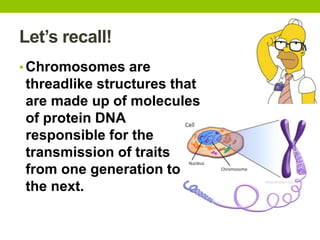
• Chromosomes are
threadlike structures that
are made up of molecules
of protein DNA
responsible for the
transmission of traits
from one generation to
the next.
Let’s recall!
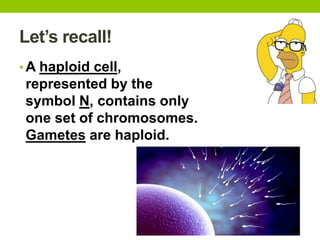
• A haploid cell,
represented by the
symbol N, contains only
one set of chromosomes.
Gametes are haploid.
Let’s recall!
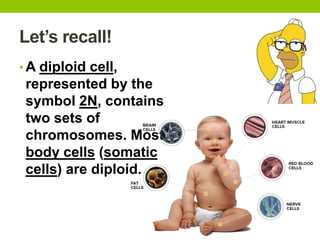
• A diploid cell,
represented by the
symbol 2N, contains
two sets of
chromosomes. Most
body cells (somatic
cells) are diploid.
Cell Parts Involved in Cell Division
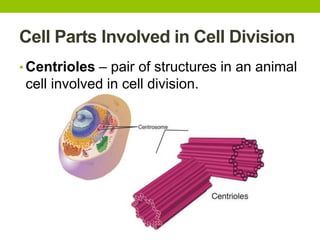
• Centrioles – pair of structures in an animal
cell involved in cell division.
Cell Parts Involved in Cell Division
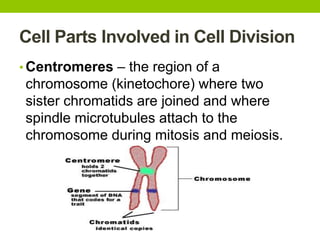
• Centromeres – the region of a
chromosome (kinetochore) where two
sister chromatids are joined and where
spindle microtubules attach to the
chromosome during mitosis and meiosis.
Cell Parts Involved in Cell Division
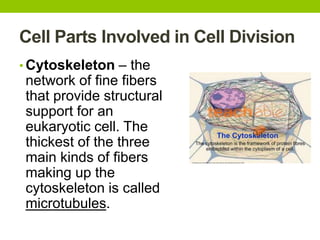
• Cytoskeleton – the
network of fine fibers
that provide structural
support for an
eukaryotic cell. The
thickest of the three
main kinds of fibers
making up the
cytoskeleton is called
microtubules.
Cell Parts Involved in Cell Division
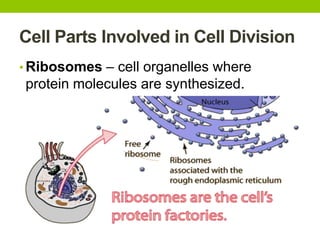
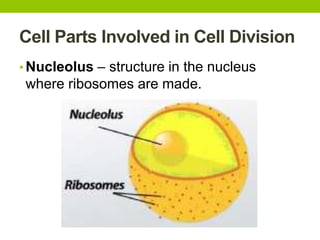
• Ribosomes – cell organelles where
protein molecules are synthesized.
Cell Parts Involved in Cell Division
• Nucleolus – structure in the nucleus
where ribosomes are made.
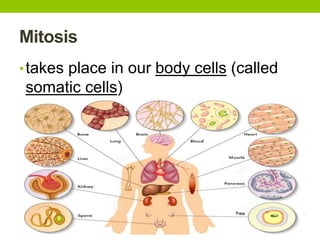
Mitosis
•takes place in our body cells (called
somatic cells)
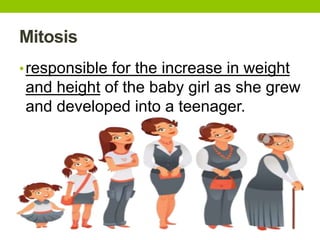
Mitosis
•responsible for the increase in weight
and height of the baby girl as she grew
and developed into a teenager.
Mitosis
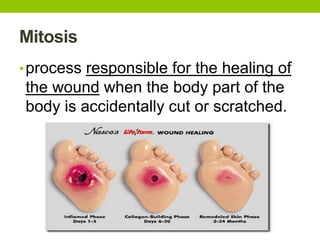
•process responsible for the healing of
the wound when the body part of the
body is accidentally cut or scratched.
Mitosis
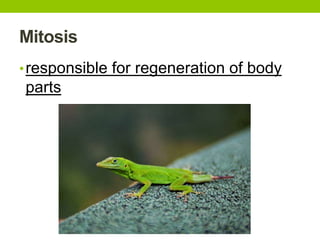
•responsible for regeneration of body
parts
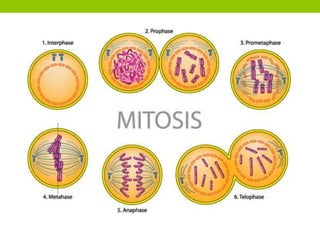
Mitosis
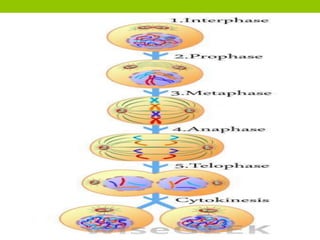
•involves the separation of two nuclear
chromosomes into two identical
daughter nuclei
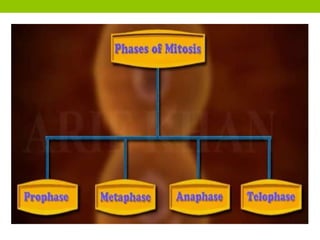
•divided into different stages, acronym
PMAT
Prophase
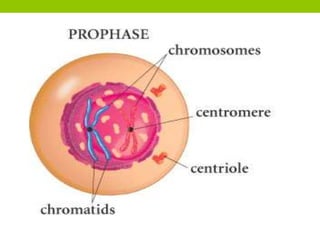
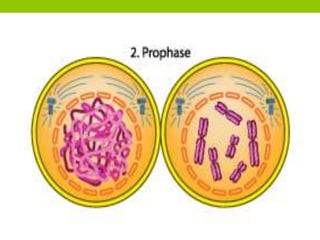
•formation of chromosomes with two
sister chromatids (double stranded
chromatins) connected at one point by
a centromere.
•nucleolus disappears; nuclear
membrane breaks down
•spindle fibers are formed
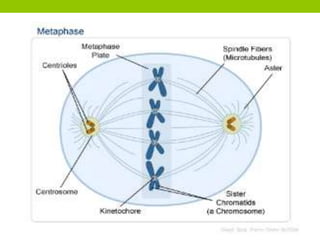
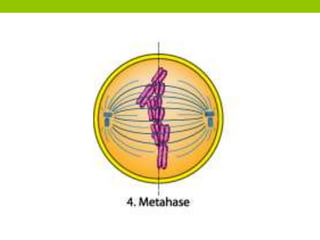
Metaphase
•chromatids align themselves at the
equator of the cell
•kinetochore – the structure that
attaches the chromatid to the spindle
fiber
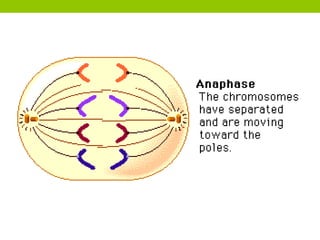
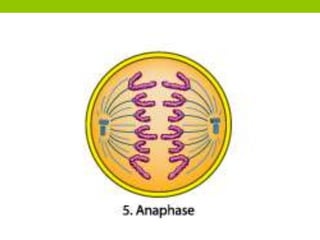
Anaphase
•kinetochore divide; four double-
stranded chromosomes become eight
single-stranded chromosomes.
•rod-shaped single stranded
chromosomes migrate to the poles
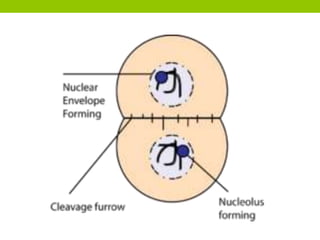
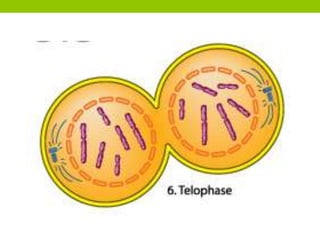
Telophase
•chromosome uncoil
•nucleoli and nuclear membrane
reappear
•spindle fibers disappear
•described as “reverse prophase”
Cytokinesis
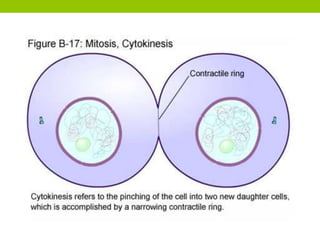
•produces 2 “daughter” cells with one
nucleus each, each daughter cell has
four-single stranded chromosomes
•may or may not occur
•if happens simultaneously with the last
stage of nuclear division and
uninucleate daughter cells are
produced.
Cytokinesis
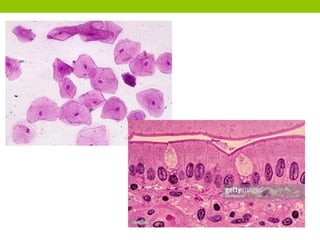
•epithelial cells on the inner linings of
your cheek and walls of your digestive
organs are uninucleate
•if does not follow nuclear division, cells
become multinucleate
•skeletal muscles are multinucleate
Synthesis
•Why is cell division important?
•What are the stages of mitosis?
•Describe what happens during
each stage.
Assignment:
•What happens when cell division
goes wrong? ½ crosswise
•Study for a quiz on Wednesday.
Topics: Cell Cycle and Mitosis
When Cell Division Goes Wrong
•Some cells complete cell cycle within
24 hours, while others may take years
before going through the process of
cell division.
•Your body has many different signals
that control how much and how often
your cells divide.
When Cell Division Goes Wrong
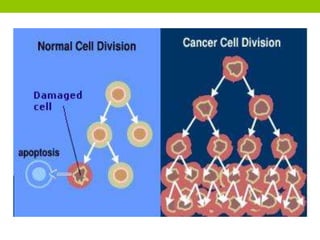
•Cell division may not always go on as
it normally should.
•Some cells may divide too fast, while
others may divide too slowly or not at
all.
•When cells divide faster than they
should, cancer may occur.
When Cell Division Goes Wrong
•When cells divide too slowly, wounds
may take a while to heal; and
damaged tissues are not repaired
soon enough.
•When cells cease to divide, as the
nerve cells in the brain, memory loss
results.
•As our cells grow old, so do we.
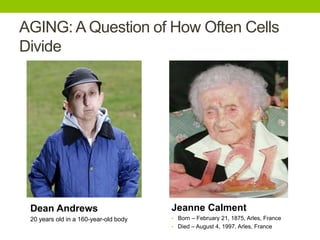
AGING: A Question of How Often Cells
Divide
Jeanne Calment
• Born – February 21, 1875, Arles, France
• Died – August 4, 1997, Arles, France
Dean Andrews
20 years old in a 160-year-old body
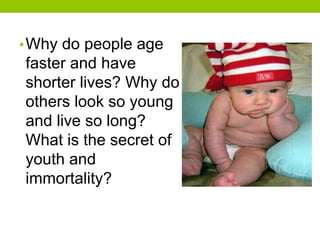
•Why do people age
faster and have
shorter lives? Why do
others look so young
and live so long?
What is the secret of
youth and
immortality?
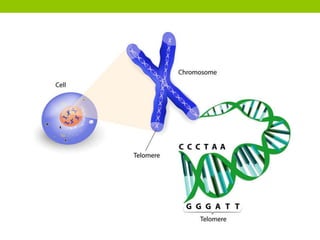
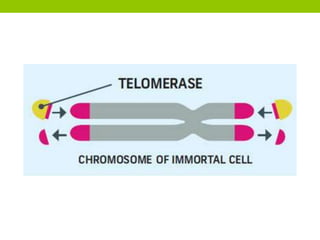
•It is believed that the secret to aging,
immortality and death is in the part of
the chromosome called “telomere” and
in the enzyme “telomerase”.
•Telomere – a special protective cap of
each chromosome that gets shorter
with each cell division.
•About 50 divisions, the telomere
become so short that the cell stops
dividing, meaning that the cells
become “old”, consequently may
malfunction or die altogether.
•Telomerase – an enzyme that
elongates chromosomes.
Telomerase
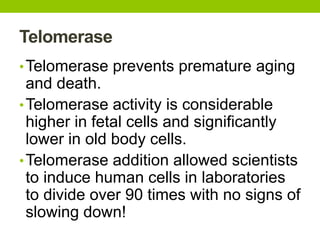
•Telomerase prevents premature aging
and death.
•Telomerase activity is considerable
higher in fetal cells and significantly
lower in old body cells.
•Telomerase addition allowed scientists
to induce human cells in laboratories
to divide over 90 times with no signs of
slowing down!
Telomerase
•Telomerase activity was found to be
10-20 times higher in cancer cells
compared to normal ones.
•Blocking telomerase activity can
prevent uncontrolled division of cancer
cells and arrest growth of tumors.
•Activating telomerase can improve the
quality of medical treatments like skin
grafts and bone marrow transplant.
•Progeria patients is closely associated
with very short and highly degraded
telomeres.
•Induction of telomerase activity in
these patients can rejuvenate their old
and dying cells.

Mitosis

  • 1.
  • 2.
    Let’s recall! • Chromosomesare threadlike structures that are made up of molecules of protein DNA responsible for the transmission of traits from one generation to the next.
  • 3.
    Let’s recall! • Ahaploid cell, represented by the symbol N, contains only one set of chromosomes. Gametes are haploid.
  • 4.
    Let’s recall! • Adiploid cell, represented by the symbol 2N, contains two sets of chromosomes. Most body cells (somatic cells) are diploid.
  • 5.
    Cell Parts Involvedin Cell Division • Centrioles – pair of structures in an animal cell involved in cell division.
  • 6.
    Cell Parts Involvedin Cell Division • Centromeres – the region of a chromosome (kinetochore) where two sister chromatids are joined and where spindle microtubules attach to the chromosome during mitosis and meiosis.
  • 7.
    Cell Parts Involvedin Cell Division • Cytoskeleton – the network of fine fibers that provide structural support for an eukaryotic cell. The thickest of the three main kinds of fibers making up the cytoskeleton is called microtubules.
  • 8.
    Cell Parts Involvedin Cell Division • Ribosomes – cell organelles where protein molecules are synthesized.
  • 9.
    Cell Parts Involvedin Cell Division • Nucleolus – structure in the nucleus where ribosomes are made.
  • 11.
    Mitosis •takes place inour body cells (called somatic cells)
  • 12.
    Mitosis •responsible for theincrease in weight and height of the baby girl as she grew and developed into a teenager.
  • 13.
    Mitosis •process responsible forthe healing of the wound when the body part of the body is accidentally cut or scratched.
  • 14.
  • 15.
    Mitosis •involves the separationof two nuclear chromosomes into two identical daughter nuclei •divided into different stages, acronym PMAT
  • 17.
    Prophase •formation of chromosomeswith two sister chromatids (double stranded chromatins) connected at one point by a centromere. •nucleolus disappears; nuclear membrane breaks down •spindle fibers are formed
  • 20.
    Metaphase •chromatids align themselvesat the equator of the cell •kinetochore – the structure that attaches the chromatid to the spindle fiber
  • 23.
    Anaphase •kinetochore divide; fourdouble- stranded chromosomes become eight single-stranded chromosomes. •rod-shaped single stranded chromosomes migrate to the poles
  • 26.
    Telophase •chromosome uncoil •nucleoli andnuclear membrane reappear •spindle fibers disappear •described as “reverse prophase”
  • 29.
    Cytokinesis •produces 2 “daughter”cells with one nucleus each, each daughter cell has four-single stranded chromosomes •may or may not occur •if happens simultaneously with the last stage of nuclear division and uninucleate daughter cells are produced.
  • 30.
    Cytokinesis •epithelial cells onthe inner linings of your cheek and walls of your digestive organs are uninucleate •if does not follow nuclear division, cells become multinucleate •skeletal muscles are multinucleate
  • 34.
    Synthesis •Why is celldivision important? •What are the stages of mitosis? •Describe what happens during each stage.
  • 35.
    Assignment: •What happens whencell division goes wrong? ½ crosswise •Study for a quiz on Wednesday. Topics: Cell Cycle and Mitosis
  • 36.
    When Cell DivisionGoes Wrong •Some cells complete cell cycle within 24 hours, while others may take years before going through the process of cell division. •Your body has many different signals that control how much and how often your cells divide.
  • 37.
    When Cell DivisionGoes Wrong •Cell division may not always go on as it normally should. •Some cells may divide too fast, while others may divide too slowly or not at all. •When cells divide faster than they should, cancer may occur.
  • 39.
    When Cell DivisionGoes Wrong •When cells divide too slowly, wounds may take a while to heal; and damaged tissues are not repaired soon enough. •When cells cease to divide, as the nerve cells in the brain, memory loss results. •As our cells grow old, so do we.
  • 42.
    AGING: A Questionof How Often Cells Divide Jeanne Calment • Born – February 21, 1875, Arles, France • Died – August 4, 1997, Arles, France Dean Andrews 20 years old in a 160-year-old body
  • 43.
    •Why do peopleage faster and have shorter lives? Why do others look so young and live so long? What is the secret of youth and immortality?
  • 44.
    •It is believedthat the secret to aging, immortality and death is in the part of the chromosome called “telomere” and in the enzyme “telomerase”. •Telomere – a special protective cap of each chromosome that gets shorter with each cell division.
  • 46.
    •About 50 divisions,the telomere become so short that the cell stops dividing, meaning that the cells become “old”, consequently may malfunction or die altogether. •Telomerase – an enzyme that elongates chromosomes.
  • 48.
    Telomerase •Telomerase prevents prematureaging and death. •Telomerase activity is considerable higher in fetal cells and significantly lower in old body cells. •Telomerase addition allowed scientists to induce human cells in laboratories to divide over 90 times with no signs of slowing down!
  • 49.
    Telomerase •Telomerase activity wasfound to be 10-20 times higher in cancer cells compared to normal ones. •Blocking telomerase activity can prevent uncontrolled division of cancer cells and arrest growth of tumors. •Activating telomerase can improve the quality of medical treatments like skin grafts and bone marrow transplant.
  • 50.
    •Progeria patients isclosely associated with very short and highly degraded telomeres. •Induction of telomerase activity in these patients can rejuvenate their old and dying cells.