MIS Group2
Slide 15-22
Content
 Short-RangeWireless Option
 Medium-Range Wireless Option
 Wide Area Wireless Network Types
 Wide Area Wireless Network Options
Short-Range Wireless Options
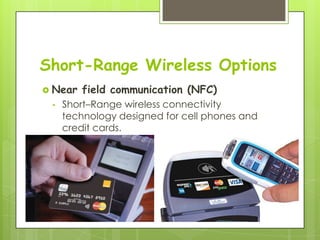
 Near   field communication (NFC)
 •   Short–Range wireless connectivity
     technology designed for cell phones and
     credit cards.
Short-Range Wireless Options
           (Con)
 Bluetooth
 •   Bluetooth is a wireless communications
     specification that describes how cell
     phones, computers, personal digital
     assistants, printers, and other electronic
     devices can be interconnected over
     distances of 10–30 feet at a rate of about 2
     Mbps.
Short-Range Wireless Options
           (Con)
 Ultra   wideband UWB
 •   Ultra wideband (UWB) is a wireless
     communications technology that transmits
     large amounts of digital data over short
     distances of up to 30 feet and very low
     power. Ultra wideband has the potential to
     replace Bluetooth’s 2 Mbps transmission
     speed with 400 Mbps rates for wirelessly
     connecting printers and other devices to
     desktop computers or enabling completely
     wireless home multimedia networks.
Short-Range Wireless Options
           (Con)
 Infrared   transmission
 •   Infrared transmission sends signals at a
     frequency of 300 GHz and above. Infrared
     transmission.
 •   requires line-of-sight transmission and short
     distances—such as a few yards.
Short-Range Wireless Options
           (Con)
 Zigbee
 •   Zigbee is a form of wireless communications
     frequently used in security systems and
     heating and cooling control systems.
     Zigbee is a relatively low-cost technology
     and requires little power, which allows
     longer life with smaller batteries.
Medium-Range Wireless
            Options
 Wi-Fi:
 •   is a popular technology that allows an
     electronic device to exchange
     data wirelessly, including high-speed
     Internet connections. The Wi-Fi
     Alliance defines Wi-Fi as any "wireless local
     area network (WLAN) products based on
     the IEEE 802.11
Medium-Range Wireless
          Options (Con)
 Wireless   Access Point:
 •   a wireless access point (WAP) is a device
     that allows wireless devices to connect to a
     wired network using Wi-Fi
 •   Have maximum range of about 300 feet
     outdoors and 100 feet within a dry-walled
     building
Wide Area Wireless Network
          Types
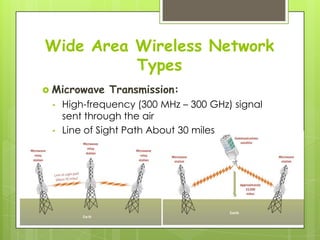
 Microwave   Transmission:
 •   High-frequency (300 MHz – 300 GHz) signal
     sent through the air
 •   Line of Sight Path About 30 miles
Wide Area Wireless Network
              Options
 3G   Wireless communications:
 •   3rd generation of mobile
     telecommunications technology standard.
 •   Support Wireless voice and broadband
     speed data communications in a mobile
     environment.
 •   Recent 3G releases, often
     denoted 3.5G and 3.75G
Wide Area Wireless Network
            Options (Con)
 4G   Wireless communications:
 •   Will provide increased data transmission rates in
     the 20-40 Mbps range
 WorldwideInteroperability for Microwave
 Access (WiMAX):
 •   Set of IEEE 802.16
 •   operates like Wi-Fi, only over greater
     distances and at faster transmission speeds.
 •   WiMAX can support data communications
     at a rate of 70 Mbps.
Mis chapter 6

Mis chapter 6

  • 1.
  • 2.
    Content  Short-RangeWireless Option Medium-Range Wireless Option  Wide Area Wireless Network Types  Wide Area Wireless Network Options
  • 3.
    Short-Range Wireless Options Near field communication (NFC) • Short–Range wireless connectivity technology designed for cell phones and credit cards.
  • 4.
    Short-Range Wireless Options (Con)  Bluetooth • Bluetooth is a wireless communications specification that describes how cell phones, computers, personal digital assistants, printers, and other electronic devices can be interconnected over distances of 10–30 feet at a rate of about 2 Mbps.
  • 5.
    Short-Range Wireless Options (Con)  Ultra wideband UWB • Ultra wideband (UWB) is a wireless communications technology that transmits large amounts of digital data over short distances of up to 30 feet and very low power. Ultra wideband has the potential to replace Bluetooth’s 2 Mbps transmission speed with 400 Mbps rates for wirelessly connecting printers and other devices to desktop computers or enabling completely wireless home multimedia networks.
  • 6.
    Short-Range Wireless Options (Con)  Infrared transmission • Infrared transmission sends signals at a frequency of 300 GHz and above. Infrared transmission. • requires line-of-sight transmission and short distances—such as a few yards.
  • 7.
    Short-Range Wireless Options (Con)  Zigbee • Zigbee is a form of wireless communications frequently used in security systems and heating and cooling control systems. Zigbee is a relatively low-cost technology and requires little power, which allows longer life with smaller batteries.
  • 8.
    Medium-Range Wireless Options  Wi-Fi: • is a popular technology that allows an electronic device to exchange data wirelessly, including high-speed Internet connections. The Wi-Fi Alliance defines Wi-Fi as any "wireless local area network (WLAN) products based on the IEEE 802.11
  • 9.
    Medium-Range Wireless Options (Con)  Wireless Access Point: • a wireless access point (WAP) is a device that allows wireless devices to connect to a wired network using Wi-Fi • Have maximum range of about 300 feet outdoors and 100 feet within a dry-walled building
  • 10.
    Wide Area WirelessNetwork Types  Microwave Transmission: • High-frequency (300 MHz – 300 GHz) signal sent through the air • Line of Sight Path About 30 miles
  • 11.
    Wide Area WirelessNetwork Options  3G Wireless communications: • 3rd generation of mobile telecommunications technology standard. • Support Wireless voice and broadband speed data communications in a mobile environment. • Recent 3G releases, often denoted 3.5G and 3.75G
  • 12.
    Wide Area WirelessNetwork Options (Con)  4G Wireless communications: • Will provide increased data transmission rates in the 20-40 Mbps range  WorldwideInteroperability for Microwave Access (WiMAX): • Set of IEEE 802.16 • operates like Wi-Fi, only over greater distances and at faster transmission speeds. • WiMAX can support data communications at a rate of 70 Mbps.