Technical Seminar 
LAKIREDDY BALI REDDY 
COLLEGE OF ENGINEERING 
(AUTONOMOUS) 
By 
Yaswanth G 
(12761A0412) 
ECE Dept.
Wireless Technology
Outline 
What is Wireless 
Characteristics of Wireless Communications 
Wireless Technologies 
Wireless Broadband Access (WBA) 
What is WiMAX 
WiMax Speed and Range 
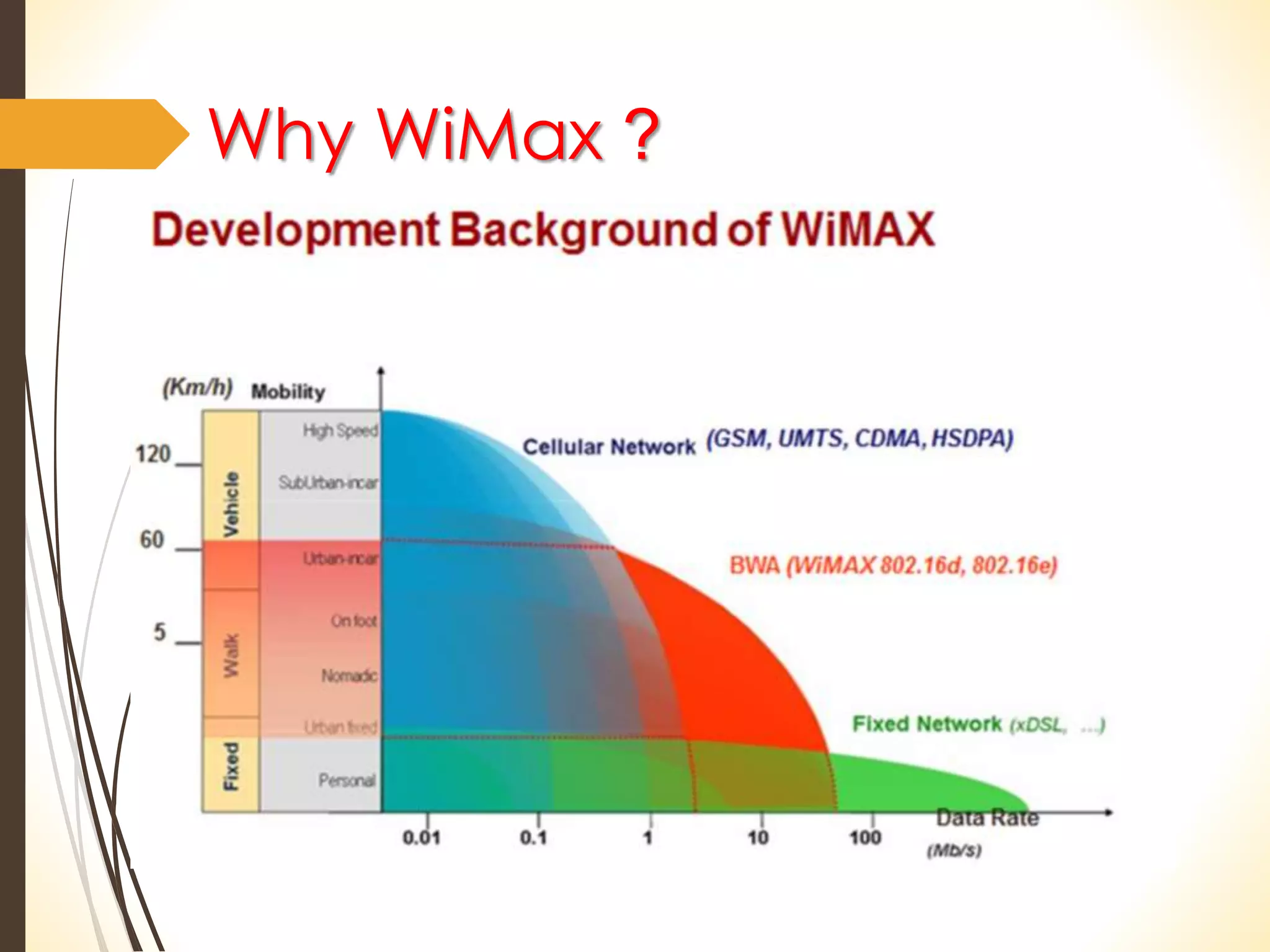
Why WiMax ? 
Comparisons 
WiMAX Vison & Advantages 
Conclusion
What is wireless ? 
 Wireless means transmitting signals using radio 
waves as the medium instead of wires 
 Wireless technologies are used for tasks as 
simple as switching off the television or as 
complex 
 Now wireless keyboards, PDAs, Lap’s and 
cellular phones have become part of our 
daily life.
Characteristics of Wireless Communications 
 Mobility: 
wireless 
communications system 
allows users to access 
information beyond 
their desk and conduct 
business from anywhere 
without having a wire 
connectivity
 Reachability: 
Wireless communications 
systems enable people to 
be better connected and 
reachable without any 
limitation of any location 
 Maintainability: 
Being a wireless system, you do no need to spend 
too much to maintain a wireless network setup.
 Simplicity: 
Wireless communication 
system are easy and fast to 
move in comparison of 
cabled network. Initial setup 
cost could be a bit high but 
other advantages 
overcome that high cost. 
 New Services: 
Wireless communications systems provide new 
smart services like SMS and MMS.
Wireless Network Topologies 
Point-to-point bridge: 
As you know a bridge is used to connect 
two networks. A point-to-point bridge 
interconnects two buildings having different 
networks
 Point-to-multipoint bridge 
This topology is used to connect three or 
more LANs that may be located on different 
floors in a building or across buildings.
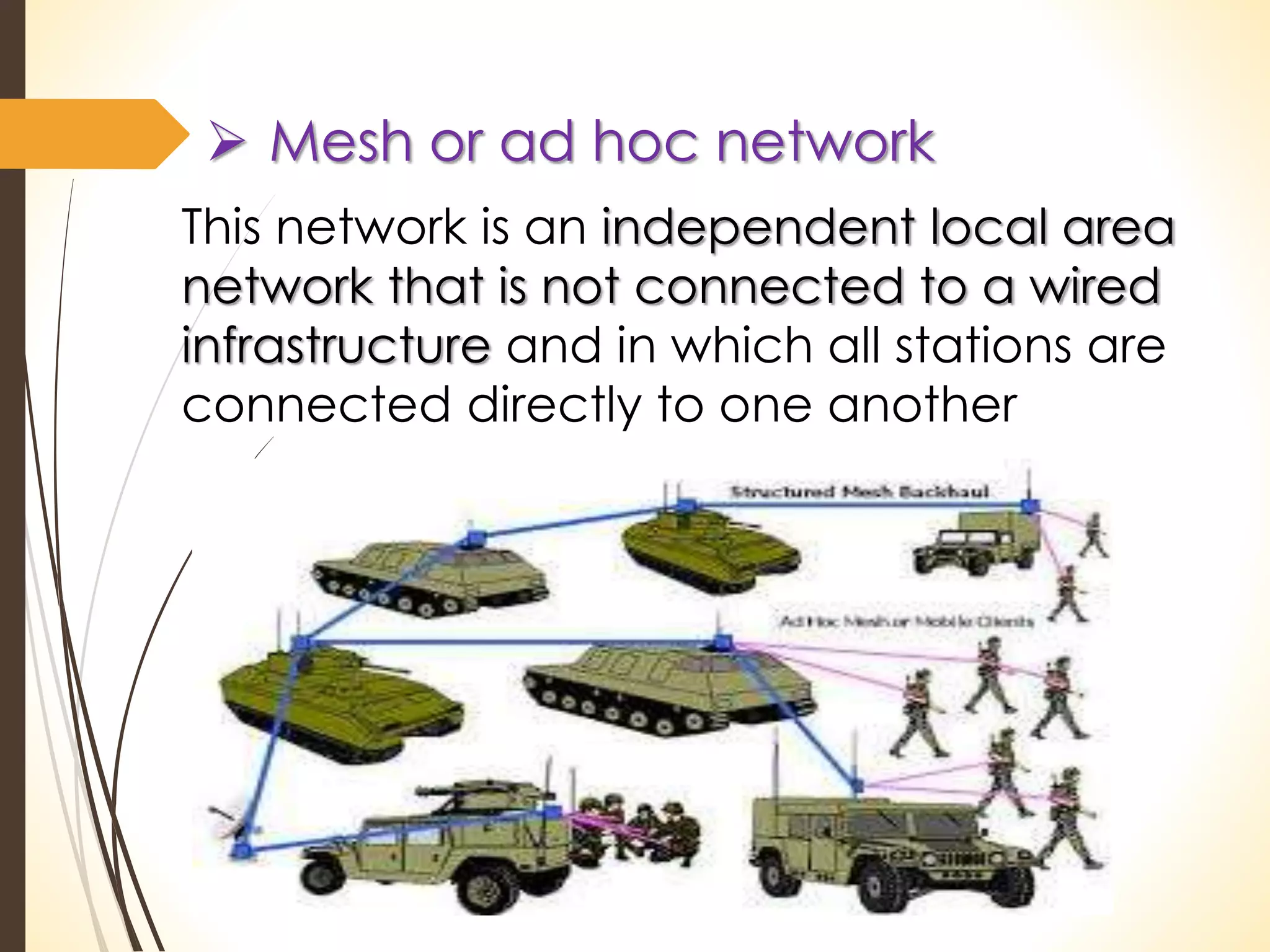
 Mesh or ad hoc network 
This network is an independent local area 
network that is not connected to a wired 
infrastructure and in which all stations are 
connected directly to one another
Wireless Technologies: 
Wireless technologies can be classified in 
different ways depending on their range. Each 
wireless technology is designed to serve a 
specific usage segment. 
o WIRELESS WIDE AREA NETWORK (WWAN) 
o WIRELESS PERSONAL AREA NETWORK (WPAN) 
o WIRELESS LOCAL AREA NETWORK (WLAN) 
o WIRELESS METROPOLITAN AREA NETWORK 
(WMAN)
 WIRELESS WIDE AREA NETWORK (WWAN): 
This network enables you to access the Internet 
via a wireless wide area network (WWAN) 
access card and a PDA(personal digital asst.) 
or laptop. 
Cellular and mobile networks based on CDMA 
and GSM are good examples of WWAN.
 WIRELESS PERSONAL AREA NETWORK (WPAN) 
These networks are very similar to WWAN 
except their range is very limited
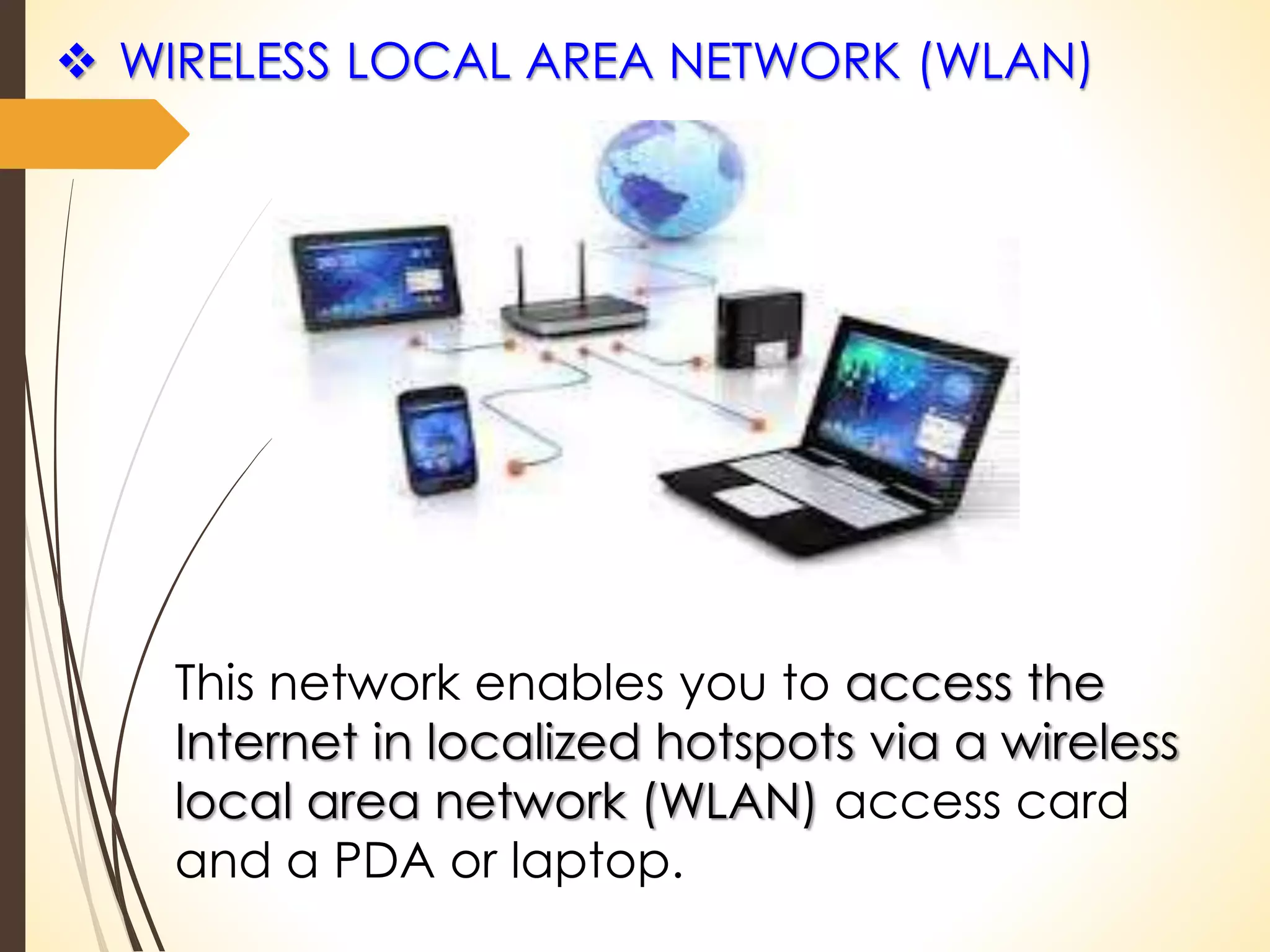
 WIRELESS LOCAL AREA NETWORK (WLAN) 
This network enables you to access the 
Internet in localized hotspots via a wireless 
local area network (WLAN) access card 
and a PDA or laptop.
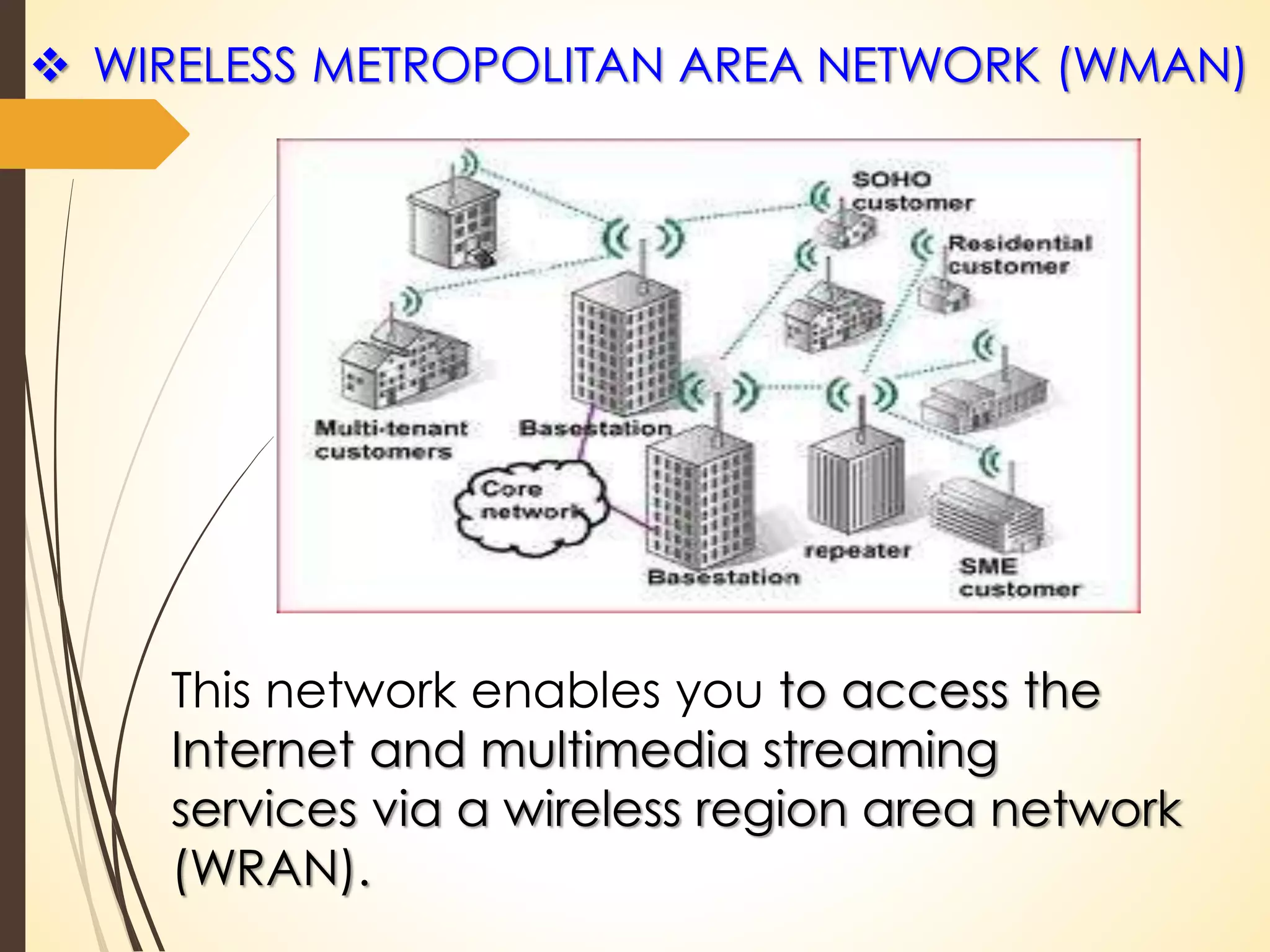
 WIRELESS METROPOLITAN AREA NETWORK (WMAN) 
This network enables you to access the 
Internet and multimedia streaming 
services via a wireless region area network 
(WRAN).
Issues with Wireless Networks: 
There are following three major issues with 
Wireless Networks 
• Quality of Service (QoS) 
• Security Risk 
• Reachable Range
Wireless Broadband Access (WBA): 
 Broadband wireless is a technology that promises 
high-speed connection over the air. 
 It uses radio waves to transmit and receive data 
directly to and from the potential users whenever 
they want it. 
• Technologies such as 3G, Wi-Fi, WiMAX and 
UWB(ultra wide band) work together to meet unique 
customer needs. 
• BWA(Broadband Wireless Access) offers an 
effective, complementary solution to wireline 
broadband, which has become globally recognized 
by a high percentage of the population.
What is ? 
 WiMax (Worldwide Interoperability for 
Microwave Access) is a wireless 
broadband technology, which supports 
point to multi-point (PMP) broadband 
wireless access 
 Based on Wireless MAN technology. 
 WiMax is basically term for Standard 
IEEE 802.16
Introduction to IEEE 802.16 Series 
Series Technical Field 
802.16 10-66 GHz, fixed broadband wireless 
access system air standard 
802.16a 2-11 GHz fixed broadband wireless 
access system air standard 
802.16c Supplementary provisions about the 
compatibility of 10-66 GHz fixed 
broadband wireless access system 
802.16d 2-11 GHz fixed wireless access system air 
standard 
802.16e 2-11 GHz fixed and mobile broadband 
wireless access system air standard 
802.16f Fixed broadband wireless access system 
in air interface 
802.16g Fixed and mobile broadband wireless 
access system air interface
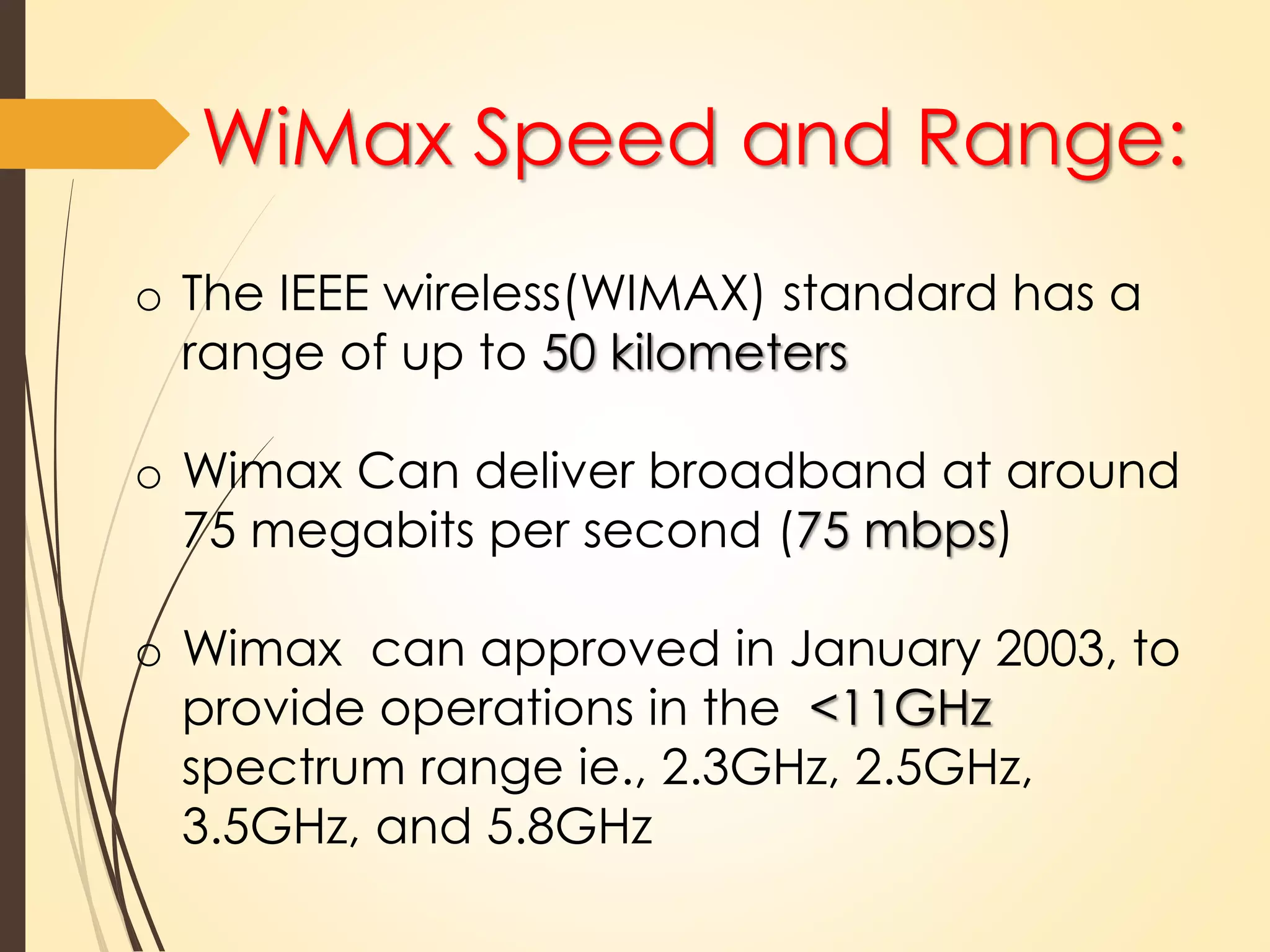
WiMax Speed and Range: 
o The IEEE wireless(WIMAX) standard has a 
range of up to 50 kilometers 
o Wimax Can deliver broadband at around 
75 megabits per second (75 mbps) 
o Wimax can approved in January 2003, to 
provide operations in the <11GHz 
spectrum range ie., 2.3GHz, 2.5GHz, 
3.5GHz, and 5.8GHz
Why WiMax ?
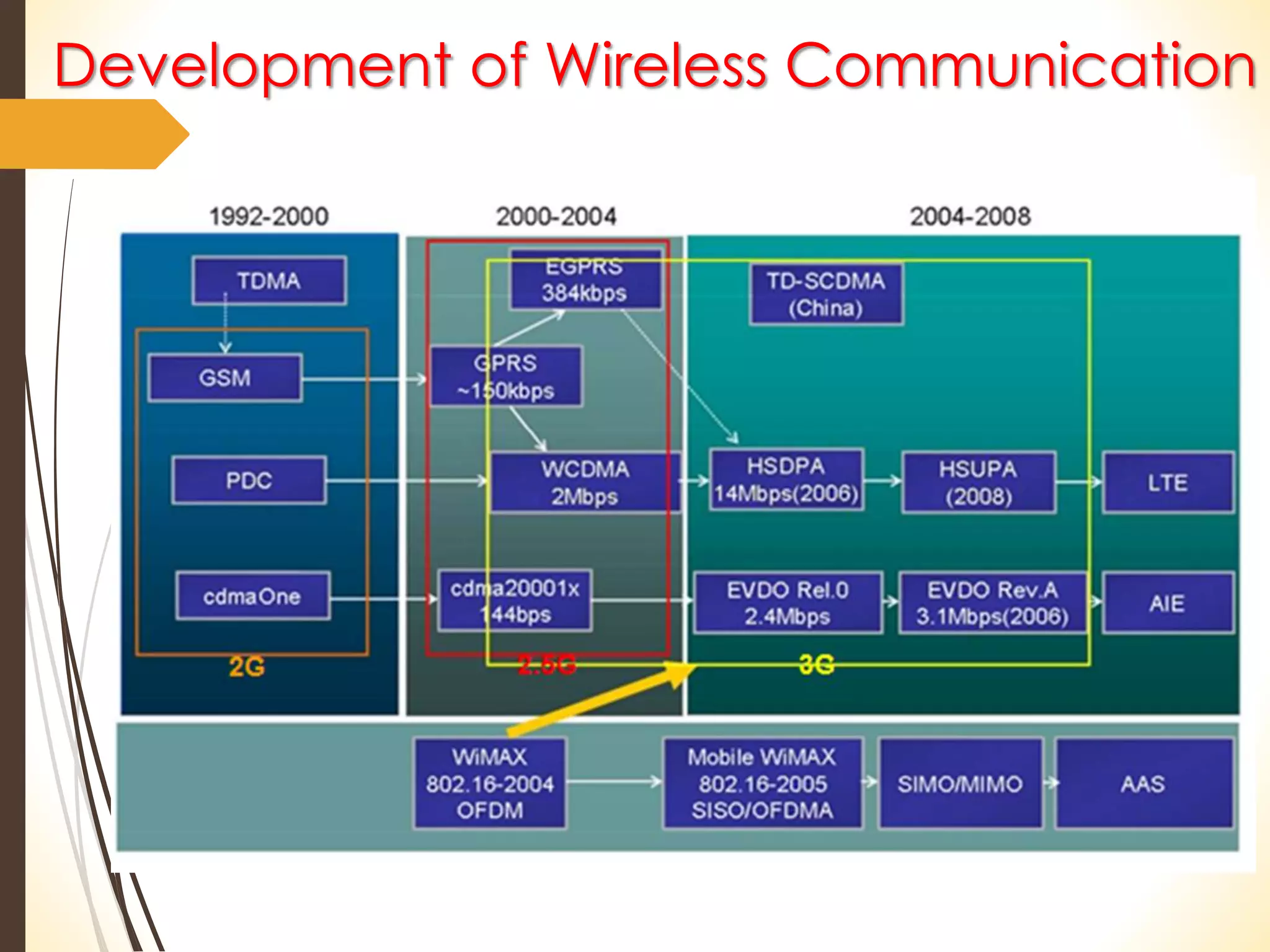
Development of Wireless Communication
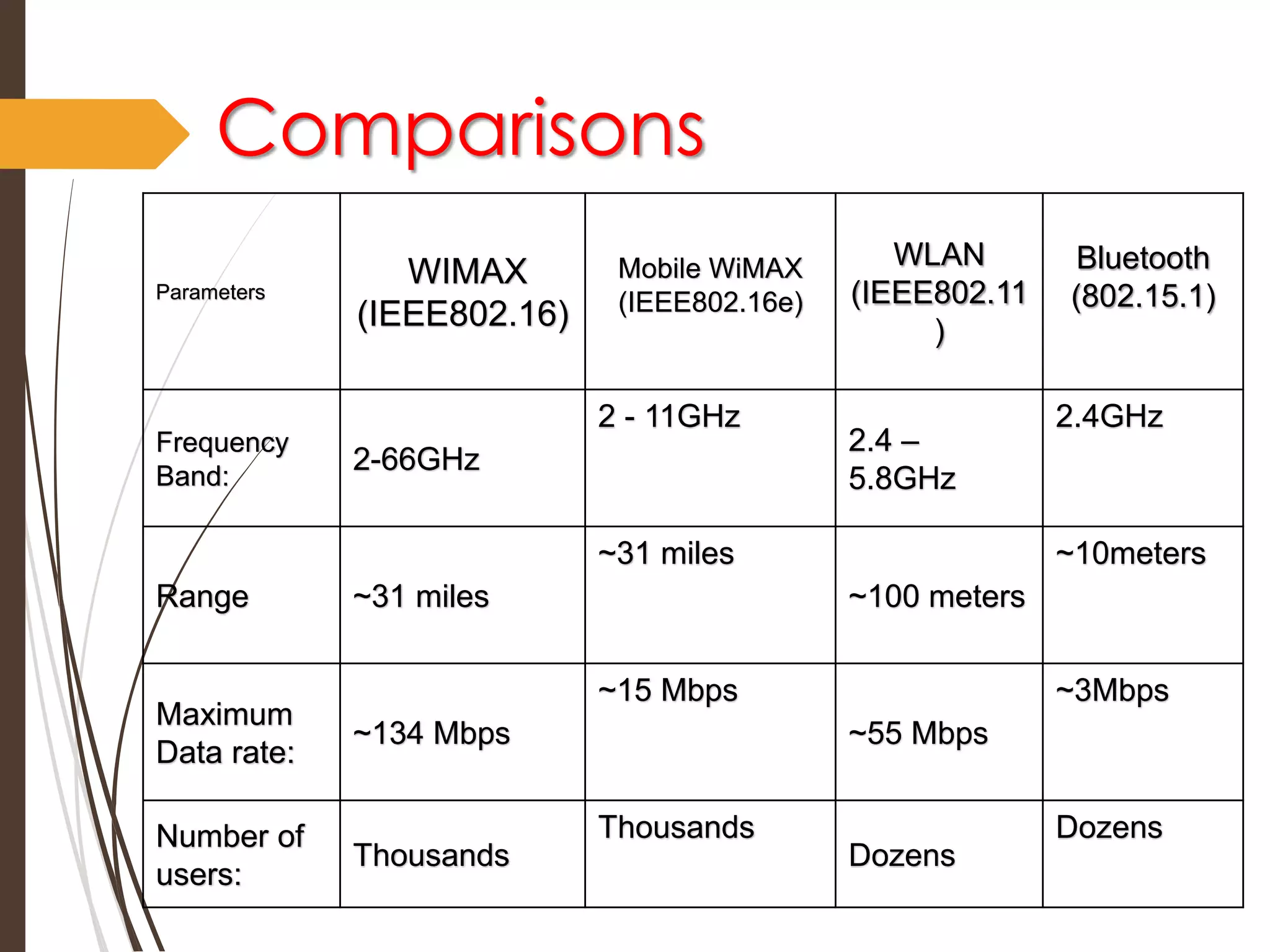
Comparisons 
Parameters 
WIMAX 
(IEEE802.16) 
Mobile WiMAX 
(IEEE802.16e) 
WLAN 
(IEEE802.11 
) 
Bluetooth 
(802.15.1) 
Frequency 
Band: 
2-66GHz 
2 - 11GHz 
2.4 – 
5.8GHz 
2.4GHz 
Range ~31 miles 
~31 miles 
~100 meters 
~10meters 
Maximum 
Data rate: 
~134 Mbps 
~15 Mbps 
~55 Mbps 
~3Mbps 
Number of 
users: 
Thousands 
Thousands 
Dozens 
Dozens
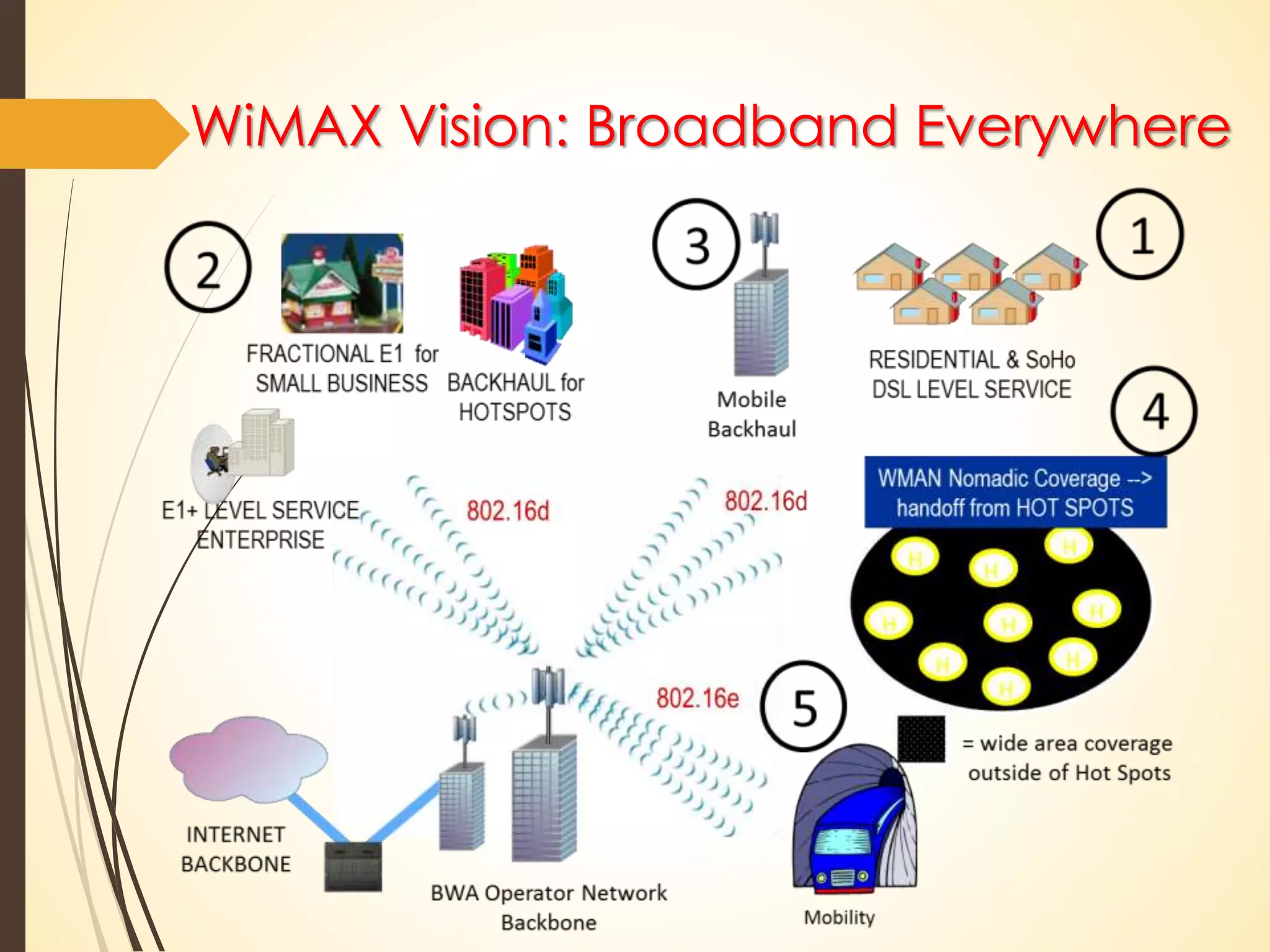
WiMAX Vision: Broadband Everywhere
WiMAX - Major Benefits 
o This technology offers a high speed, secure, 
sophisticate, last mile broadband service, 
and cheap solution to certain rural access 
zones. 
o In a fixed wireless communication, WiMAX 
can replace the telephone company's 
copper wire networks, the cable TV's coaxial 
cable infrastructure.
Conclusion 
WiMAX fills the gap between Wi-Fi and Cellular, 
thus providing vehicular mobility, and high 
service areas and data rates WiMAX 
developments have been rapidly moving 
forward
Wimax technology
Wimax technology

Wimax technology

  • 1.
    Technical Seminar LAKIREDDYBALI REDDY COLLEGE OF ENGINEERING (AUTONOMOUS) By Yaswanth G (12761A0412) ECE Dept.
  • 2.
  • 3.
    Outline What isWireless Characteristics of Wireless Communications Wireless Technologies Wireless Broadband Access (WBA) What is WiMAX WiMax Speed and Range Why WiMax ? Comparisons WiMAX Vison & Advantages Conclusion
  • 4.
    What is wireless?  Wireless means transmitting signals using radio waves as the medium instead of wires  Wireless technologies are used for tasks as simple as switching off the television or as complex  Now wireless keyboards, PDAs, Lap’s and cellular phones have become part of our daily life.
  • 5.
    Characteristics of WirelessCommunications  Mobility: wireless communications system allows users to access information beyond their desk and conduct business from anywhere without having a wire connectivity
  • 6.
     Reachability: Wirelesscommunications systems enable people to be better connected and reachable without any limitation of any location  Maintainability: Being a wireless system, you do no need to spend too much to maintain a wireless network setup.
  • 7.
     Simplicity: Wirelesscommunication system are easy and fast to move in comparison of cabled network. Initial setup cost could be a bit high but other advantages overcome that high cost.  New Services: Wireless communications systems provide new smart services like SMS and MMS.
  • 8.
    Wireless Network Topologies Point-to-point bridge: As you know a bridge is used to connect two networks. A point-to-point bridge interconnects two buildings having different networks
  • 9.
     Point-to-multipoint bridge This topology is used to connect three or more LANs that may be located on different floors in a building or across buildings.
  • 10.
     Mesh orad hoc network This network is an independent local area network that is not connected to a wired infrastructure and in which all stations are connected directly to one another
  • 11.
    Wireless Technologies: Wirelesstechnologies can be classified in different ways depending on their range. Each wireless technology is designed to serve a specific usage segment. o WIRELESS WIDE AREA NETWORK (WWAN) o WIRELESS PERSONAL AREA NETWORK (WPAN) o WIRELESS LOCAL AREA NETWORK (WLAN) o WIRELESS METROPOLITAN AREA NETWORK (WMAN)
  • 12.
     WIRELESS WIDEAREA NETWORK (WWAN): This network enables you to access the Internet via a wireless wide area network (WWAN) access card and a PDA(personal digital asst.) or laptop. Cellular and mobile networks based on CDMA and GSM are good examples of WWAN.
  • 13.
     WIRELESS PERSONALAREA NETWORK (WPAN) These networks are very similar to WWAN except their range is very limited
  • 14.
     WIRELESS LOCALAREA NETWORK (WLAN) This network enables you to access the Internet in localized hotspots via a wireless local area network (WLAN) access card and a PDA or laptop.
  • 15.
     WIRELESS METROPOLITANAREA NETWORK (WMAN) This network enables you to access the Internet and multimedia streaming services via a wireless region area network (WRAN).
  • 16.
    Issues with WirelessNetworks: There are following three major issues with Wireless Networks • Quality of Service (QoS) • Security Risk • Reachable Range
  • 17.
    Wireless Broadband Access(WBA):  Broadband wireless is a technology that promises high-speed connection over the air.  It uses radio waves to transmit and receive data directly to and from the potential users whenever they want it. • Technologies such as 3G, Wi-Fi, WiMAX and UWB(ultra wide band) work together to meet unique customer needs. • BWA(Broadband Wireless Access) offers an effective, complementary solution to wireline broadband, which has become globally recognized by a high percentage of the population.
  • 18.
    What is ?  WiMax (Worldwide Interoperability for Microwave Access) is a wireless broadband technology, which supports point to multi-point (PMP) broadband wireless access  Based on Wireless MAN technology.  WiMax is basically term for Standard IEEE 802.16
  • 19.
    Introduction to IEEE802.16 Series Series Technical Field 802.16 10-66 GHz, fixed broadband wireless access system air standard 802.16a 2-11 GHz fixed broadband wireless access system air standard 802.16c Supplementary provisions about the compatibility of 10-66 GHz fixed broadband wireless access system 802.16d 2-11 GHz fixed wireless access system air standard 802.16e 2-11 GHz fixed and mobile broadband wireless access system air standard 802.16f Fixed broadband wireless access system in air interface 802.16g Fixed and mobile broadband wireless access system air interface
  • 20.
    WiMax Speed andRange: o The IEEE wireless(WIMAX) standard has a range of up to 50 kilometers o Wimax Can deliver broadband at around 75 megabits per second (75 mbps) o Wimax can approved in January 2003, to provide operations in the <11GHz spectrum range ie., 2.3GHz, 2.5GHz, 3.5GHz, and 5.8GHz
  • 21.
  • 22.
  • 23.
    Comparisons Parameters WIMAX (IEEE802.16) Mobile WiMAX (IEEE802.16e) WLAN (IEEE802.11 ) Bluetooth (802.15.1) Frequency Band: 2-66GHz 2 - 11GHz 2.4 – 5.8GHz 2.4GHz Range ~31 miles ~31 miles ~100 meters ~10meters Maximum Data rate: ~134 Mbps ~15 Mbps ~55 Mbps ~3Mbps Number of users: Thousands Thousands Dozens Dozens
  • 24.
  • 25.
    WiMAX - MajorBenefits o This technology offers a high speed, secure, sophisticate, last mile broadband service, and cheap solution to certain rural access zones. o In a fixed wireless communication, WiMAX can replace the telephone company's copper wire networks, the cable TV's coaxial cable infrastructure.
  • 26.
    Conclusion WiMAX fillsthe gap between Wi-Fi and Cellular, thus providing vehicular mobility, and high service areas and data rates WiMAX developments have been rapidly moving forward