Introduction to
Computer Applications
Lecture # 12
Objective of Lecture
 Wired Network
 Wireless Network
 Infrared
 Bluetooth
 ZigBee
 Wi-Fi
Wired NETWORKS
 Wired networks, also called Ethernet networks is simply
a collection of two or more computers, printers, and
other devices linked by Ethernet cables.
 Ethernet is the fastest wired network protocol, with
connection speeds of 10 megabits per second (Mbps) to
100 Mbps or higher.
 Wired networks can also be used as part of other wired
and wireless networks.
 To connect a computer to a network with an Ethernet
cable, the computer must have an Ethernet adapter
(sometimes called a network interface card, or NIC).
Wireless NETWORKS
 The term wireless refers to the communication or
transmission of information over a distance without
requiring wires, cables or any other electrical conductors.
 Wireless communication is one of the important
mediums of transmission of data or information to other
devices.
 The Communication is set and the information is
transmitted through the air, without requiring any cables,
by using electromagnetic waves like radio frequencies,
infrared, satellite, etc.
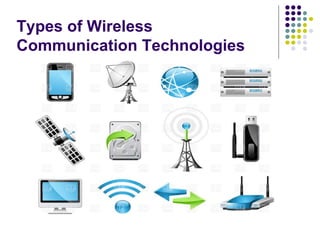
Types of Wireless
Communication Technologies
 In recent days, the wireless communication technology
has become an integral part of several types of
communication devices as it allows users to
communicate even from remote areas.
 The devices used for wireless communication are
 cordless telephones
 mobiles
 ZigBee technology
 wireless computer parts etc.
Types of Wireless
Communication Technologies
Wi-Fi
 Wi-Fi is a form of low-power wireless communication
used by many electronic devices such as laptops,
systems, smart phones, etc.
 In a Wi-Fi setup, a wireless router serves as the
communication hub.
 These networks are extremely limited in range due to
low power of transmissions allowing users to connect
only within close proximity to a router or signal repeater.
 Wi-Fi is common in home networking applications
which provides portability without any need of cables.
 Wi-Fi networks need to be secured with passwords for
security purposes in order not to be accessed by others
Wi-Fi
 Advantages
 Ease of Integration and Convenience – The wireless
nature of such networks allows users to access network
resources from nearly any convenient location.
 Mobility – With the emergence of public wireless
networks, users can access the internet even outside
their normal working environment.
 Expandability – Wireless networks are capable of
serving a suddenly-increased number of clients with the
existing equipment. In a wired network, additional clients
require additional wiring.
Wi-Fi
Disadvantages
 Range will be insufficient for a larger structure – and, in
order to increase its range, repeaters or additional
access points have to be purchased.
 The speed on most wireless networks will be slower than
the slowest common wired networks.
 Installation of an infrastructure-based wireless network is
a complex to set up.
Bluetooth Technology
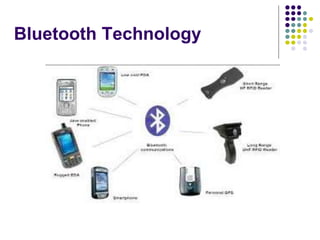
 Bluetooth technology allows you to connect a variety of
different electronic devices wirelessly to a system for the
transfer and sharing of data and this is the main function
of Bluetooth.
 Cell phones are connected to hands-free earpieces,
wireless keyboard, mouse and mike to laptops with the
help of Bluetooth as it transmits information from one
device to other device.
 Bluetooth technology has many functions, and it is used
most commonly in wireless communications’ market.
Bluetooth Technology
Features
 Bluetooth technology uses radio waves to communicate
between devices. Most of these radio waves have a
range of 15-50 feet.
 According to the official Bluetooth website, Bluetooth
uses a low-power signal with a maximum range of 50
feet with sufficient speed to enable transmission of data.
 The pairing process identifies and connects any two
devices to each other. It also prevents interference from
other non-paired Bluetooth devices in the area.
 It uses maximum power only when it is required, thus
preserving battery life.
ZigBee
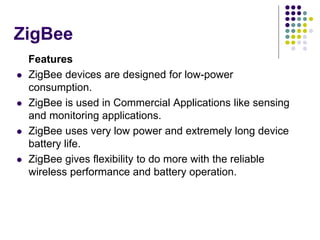
 ZigBee is a wireless communication standard designed
to address the unique needs of low-power, low-cost
wireless sensor, and control networks.
 ZigBee can be used almost anywhere, as it is easy to
implement and requires little power to operate.
 Zigbee has been developed looking into the needs of
the communication of data with a simple structure like
the data from the sensors.
ZigBee
Features
 ZigBee devices are designed for low-power
consumption.
 ZigBee is used in Commercial Applications like sensing
and monitoring applications.
 ZigBee uses very low power and extremely long device
battery life.
 ZigBee gives flexibility to do more with the reliable
wireless performance and battery operation.
Infrared
 Infrared is a media transmission system that transmits
data signals through light emitting diodes (LEDs) or
Lasers.
 Infrared is an electromagnetic energy at a wavelength
which is longer than that of the red light.
 The information cannot be travelled through obstacles in
an infrared system, but can be inhibited by light.
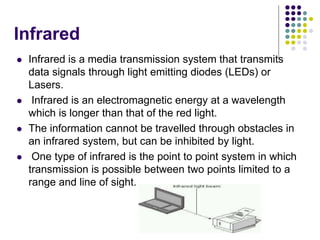
 One type of infrared is the point to point system in which
transmission is possible between two points limited to a
range and line of sight.
Difference between wired and
wireless
 The main difference between a wired and wireless data
communication infrastructure is the existence of physical
cabling.
 The same, or similar techniques are employed for both
types of data communication infrastructure in terms of
the core elements of essential network services.
Wired media
 A wired network uses
wires to communicate.
 Wired networks are easy
to set up and
troubleshoot.
 Wired networks make you
immobile.
 Wired networks prove
expensive when covering
a large area because of
the wiring and cabling.
Wireless media
 whereas a wireless network
uses radio waves.
 where wireless networks
are comparatively difficult to
set up, maintain, and
troubleshoot.
 while wireless ones provide
you with convenience of
movement.
 while wireless networks do
not involve this cost.
Difference between wired and
wireless
Difference between wired and
wireless
 Wired networks have better
transmission speeds than
wireless ones.
 In a wired network, a user
does not have to share
space with other users and
thus gets dedicated speeds
while in wireless networks,
the same connection may
be shared by multiple users.
 wireless networks have
lower transmission
speeds than Wired ones.
 while in wireless
networks, the same
connection may be
shared by multiple users.
Wired media Wireless media
Questions??

ITC_lec_12.ppt

  • 1.
  • 2.
    Objective of Lecture Wired Network  Wireless Network  Infrared  Bluetooth  ZigBee  Wi-Fi
  • 3.
    Wired NETWORKS  Wirednetworks, also called Ethernet networks is simply a collection of two or more computers, printers, and other devices linked by Ethernet cables.  Ethernet is the fastest wired network protocol, with connection speeds of 10 megabits per second (Mbps) to 100 Mbps or higher.  Wired networks can also be used as part of other wired and wireless networks.  To connect a computer to a network with an Ethernet cable, the computer must have an Ethernet adapter (sometimes called a network interface card, or NIC).
  • 4.
    Wireless NETWORKS  Theterm wireless refers to the communication or transmission of information over a distance without requiring wires, cables or any other electrical conductors.  Wireless communication is one of the important mediums of transmission of data or information to other devices.  The Communication is set and the information is transmitted through the air, without requiring any cables, by using electromagnetic waves like radio frequencies, infrared, satellite, etc.
  • 5.
    Types of Wireless CommunicationTechnologies  In recent days, the wireless communication technology has become an integral part of several types of communication devices as it allows users to communicate even from remote areas.  The devices used for wireless communication are  cordless telephones  mobiles  ZigBee technology  wireless computer parts etc.
  • 6.
  • 7.
    Wi-Fi  Wi-Fi isa form of low-power wireless communication used by many electronic devices such as laptops, systems, smart phones, etc.  In a Wi-Fi setup, a wireless router serves as the communication hub.  These networks are extremely limited in range due to low power of transmissions allowing users to connect only within close proximity to a router or signal repeater.  Wi-Fi is common in home networking applications which provides portability without any need of cables.  Wi-Fi networks need to be secured with passwords for security purposes in order not to be accessed by others
  • 8.
    Wi-Fi  Advantages  Easeof Integration and Convenience – The wireless nature of such networks allows users to access network resources from nearly any convenient location.  Mobility – With the emergence of public wireless networks, users can access the internet even outside their normal working environment.  Expandability – Wireless networks are capable of serving a suddenly-increased number of clients with the existing equipment. In a wired network, additional clients require additional wiring.
  • 9.
    Wi-Fi Disadvantages  Range willbe insufficient for a larger structure – and, in order to increase its range, repeaters or additional access points have to be purchased.  The speed on most wireless networks will be slower than the slowest common wired networks.  Installation of an infrastructure-based wireless network is a complex to set up.
  • 10.
    Bluetooth Technology  Bluetoothtechnology allows you to connect a variety of different electronic devices wirelessly to a system for the transfer and sharing of data and this is the main function of Bluetooth.  Cell phones are connected to hands-free earpieces, wireless keyboard, mouse and mike to laptops with the help of Bluetooth as it transmits information from one device to other device.  Bluetooth technology has many functions, and it is used most commonly in wireless communications’ market.
  • 11.
  • 12.
    Bluetooth Technology Features  Bluetoothtechnology uses radio waves to communicate between devices. Most of these radio waves have a range of 15-50 feet.  According to the official Bluetooth website, Bluetooth uses a low-power signal with a maximum range of 50 feet with sufficient speed to enable transmission of data.  The pairing process identifies and connects any two devices to each other. It also prevents interference from other non-paired Bluetooth devices in the area.  It uses maximum power only when it is required, thus preserving battery life.
  • 13.
    ZigBee  ZigBee isa wireless communication standard designed to address the unique needs of low-power, low-cost wireless sensor, and control networks.  ZigBee can be used almost anywhere, as it is easy to implement and requires little power to operate.  Zigbee has been developed looking into the needs of the communication of data with a simple structure like the data from the sensors.
  • 14.
    ZigBee Features  ZigBee devicesare designed for low-power consumption.  ZigBee is used in Commercial Applications like sensing and monitoring applications.  ZigBee uses very low power and extremely long device battery life.  ZigBee gives flexibility to do more with the reliable wireless performance and battery operation.
  • 15.
    Infrared  Infrared isa media transmission system that transmits data signals through light emitting diodes (LEDs) or Lasers.  Infrared is an electromagnetic energy at a wavelength which is longer than that of the red light.  The information cannot be travelled through obstacles in an infrared system, but can be inhibited by light.  One type of infrared is the point to point system in which transmission is possible between two points limited to a range and line of sight.
  • 16.
    Difference between wiredand wireless  The main difference between a wired and wireless data communication infrastructure is the existence of physical cabling.  The same, or similar techniques are employed for both types of data communication infrastructure in terms of the core elements of essential network services.
  • 17.
    Wired media  Awired network uses wires to communicate.  Wired networks are easy to set up and troubleshoot.  Wired networks make you immobile.  Wired networks prove expensive when covering a large area because of the wiring and cabling. Wireless media  whereas a wireless network uses radio waves.  where wireless networks are comparatively difficult to set up, maintain, and troubleshoot.  while wireless ones provide you with convenience of movement.  while wireless networks do not involve this cost. Difference between wired and wireless
  • 18.
    Difference between wiredand wireless  Wired networks have better transmission speeds than wireless ones.  In a wired network, a user does not have to share space with other users and thus gets dedicated speeds while in wireless networks, the same connection may be shared by multiple users.  wireless networks have lower transmission speeds than Wired ones.  while in wireless networks, the same connection may be shared by multiple users. Wired media Wireless media
  • 19.