& Infrared Technology Presented By: Nitin Rana  - 58 Pranav Priyadarshi-67 Prashant Kumar  -68 Prashant Priyam  -70 Priyank Suman  -71 Priyanka Kumari  -72
Name taken from the 10 th  century  King Herald Bluetooth King Bluetooth attached all Scandinavian people when they were torn apart due to wars and feuding lans.
Bluetooth was first developed in Scandinvia It is also able to unite differing industries  E.g. cell phone, computer, automotive markets
It was officially introduced in 1998 Basic purpose was to be a wire replacement technology
In 2003 the bluetooth 2.1 intorduced  In 2004 bluetooth 2.0+EDR  introduced Devices using BT+EDR entered in 2005
Bluetooth uses wireless protocol for the devices It forces devices to agree on When bits are sent How many will be sent at a time How devices can sure message received
It is short range wireless ,secure and international std. technology It provides communication between bluetooth enabled device. It uses radio waves that operates @2.4GHz
The master bluetooth device can communicate with  seven other bluetooth enabled device. Bluetooth 3.0 provides high speed connections It also supports VOIP technology
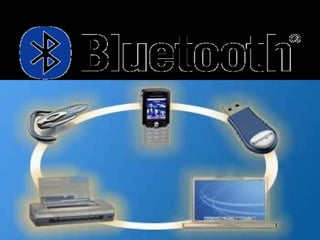
Typical bluetooth device consist of RS trenceiver, protocol stack and baseband It was able to connect computer with printer and other nodes
Bluetooth provides speed of 1-2 Mbps It can be used internally as well as externally Bluetooth enabled devices can change their frequency rapidly so they can be saved from external interference
For security it uses pin code and 128 encryption It uses AFH facility to  control interference AFH works within the spectrum to take advantage of the available frequency
Range of Bluetooth Class 3 radios – have a range of up to 1 meter or 3 feet Class 2 radios – most commonly found in mobile devices – have a range of 10 meters or 33 feet Class 1 radios – used primarily in industrial use cases – have a range of 100 meters or 300 feet
Bluetooth  technology operates in the unlicensed industrial, scientific and medical (ISM) band at 2.4 to 2.485 GHz, using a spread spectrum, frequency hopping, full-duplex signal at a nominal rate of 1600 hops/sec
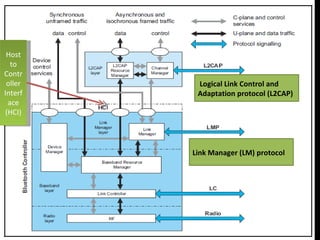
Logical Link Control and Adaptation protocol (L2CAP) Link Manager (LM) protocol Host to Controller Interface (HCI)
Advantage It is wireless technology It is safe and convenient Made networking portable It makes life easier
DISADVANTAGE Battery use Bluetooth  Internet speed is slow
 
Infrared technology It was established in 1993 Purpose was to provide wireless connectivity It allows point to point user access model Frequency id THz Communication is possible due to tansceiver
IR can be used over longer interconnections and has an applicability to local area networks (LANs) Maximum distance is 1mile Maximum bandwidth is 16 Mbps It is secure networking application In future it will be implemented in BANK,ATM, Credit Cards etc.
It is more reliable Some manufacturer provides IrDA port that allows wireless keyboard to communicate with PC Infrared signals defined by IrDA transmit through line of sight Standard originally data transmission rate  is 75Kbps for a distance up to 8 meter Now it is 4Mbps.


Bluetooth, Infrared

  • 1.
    & Infrared TechnologyPresented By: Nitin Rana - 58 Pranav Priyadarshi-67 Prashant Kumar -68 Prashant Priyam -70 Priyank Suman -71 Priyanka Kumari -72
  • 2.
    Name taken fromthe 10 th century King Herald Bluetooth King Bluetooth attached all Scandinavian people when they were torn apart due to wars and feuding lans.
  • 3.
    Bluetooth was firstdeveloped in Scandinvia It is also able to unite differing industries E.g. cell phone, computer, automotive markets
  • 4.
    It was officiallyintroduced in 1998 Basic purpose was to be a wire replacement technology
  • 5.
    In 2003 thebluetooth 2.1 intorduced In 2004 bluetooth 2.0+EDR introduced Devices using BT+EDR entered in 2005
  • 6.
    Bluetooth uses wirelessprotocol for the devices It forces devices to agree on When bits are sent How many will be sent at a time How devices can sure message received
  • 7.
    It is shortrange wireless ,secure and international std. technology It provides communication between bluetooth enabled device. It uses radio waves that operates @2.4GHz
  • 8.
    The master bluetoothdevice can communicate with seven other bluetooth enabled device. Bluetooth 3.0 provides high speed connections It also supports VOIP technology
  • 9.
    Typical bluetooth deviceconsist of RS trenceiver, protocol stack and baseband It was able to connect computer with printer and other nodes
  • 10.
    Bluetooth provides speedof 1-2 Mbps It can be used internally as well as externally Bluetooth enabled devices can change their frequency rapidly so they can be saved from external interference
  • 11.
    For security ituses pin code and 128 encryption It uses AFH facility to control interference AFH works within the spectrum to take advantage of the available frequency
  • 12.
    Range of BluetoothClass 3 radios – have a range of up to 1 meter or 3 feet Class 2 radios – most commonly found in mobile devices – have a range of 10 meters or 33 feet Class 1 radios – used primarily in industrial use cases – have a range of 100 meters or 300 feet
  • 13.
    Bluetooth  technology operatesin the unlicensed industrial, scientific and medical (ISM) band at 2.4 to 2.485 GHz, using a spread spectrum, frequency hopping, full-duplex signal at a nominal rate of 1600 hops/sec
  • 14.
    Logical Link Controland Adaptation protocol (L2CAP) Link Manager (LM) protocol Host to Controller Interface (HCI)
  • 15.
    Advantage It iswireless technology It is safe and convenient Made networking portable It makes life easier
  • 16.
    DISADVANTAGE Battery useBluetooth Internet speed is slow
  • 17.
  • 18.
    Infrared technology Itwas established in 1993 Purpose was to provide wireless connectivity It allows point to point user access model Frequency id THz Communication is possible due to tansceiver
  • 19.
    IR can beused over longer interconnections and has an applicability to local area networks (LANs) Maximum distance is 1mile Maximum bandwidth is 16 Mbps It is secure networking application In future it will be implemented in BANK,ATM, Credit Cards etc.
  • 20.
    It is morereliable Some manufacturer provides IrDA port that allows wireless keyboard to communicate with PC Infrared signals defined by IrDA transmit through line of sight Standard originally data transmission rate is 75Kbps for a distance up to 8 meter Now it is 4Mbps.
  • 21.
  • 22.
  • 23.
  • 24.
  • 25.
  • 26.
  • 27.
  • 28.
  • 29.
  • 30.

Editor's Notes

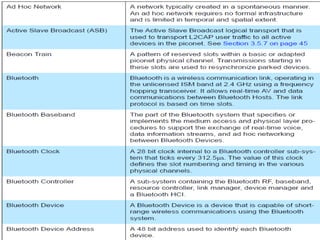
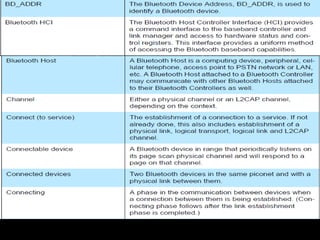
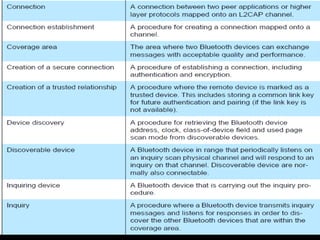
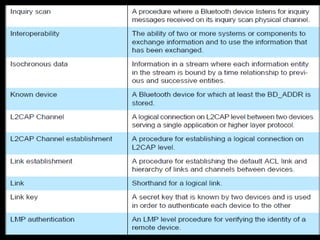
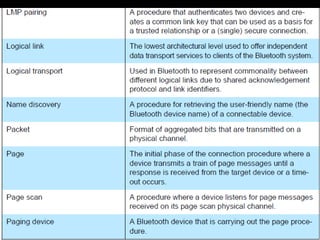
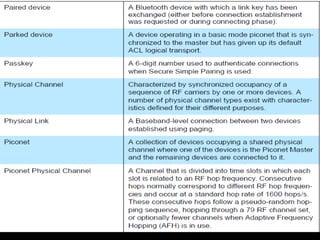
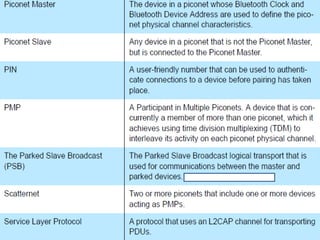
  • #15 The Bluetooth core system covers the four lowest layers and associated protocols defined by the Bluetooth specification as well as one common service layer protocol, the Service Discovery Protocol (SDP) and the overall profile requirements are specified in the Generic Access Profile (GAP). A complete Bluetooth application requires a number of additional service and higher layer Protocols. The lowest three layers are sometimes grouped into a subsystem known as the Bluetooth controller. This is a common implementation involving a standard physical communications interface between the Bluetooth controller and remainder of the Bluetooth system including the L2CAP, service and higher layers (known as the Bluetooth host.) Although this interface is optional the architecture is designed to allow for its existence and characteristics The Bluetooth core system protocols are the Radio (RF) protocol, Link Control (LC) protocol, Link Manager (LM) protocol and Logical Link Control and Adaptation protocol (L2CAP), all of which are fully defined in subsequent parts of the Bluetooth specification. In addition the Service Discovery Protocol (SDP) is a service layer protocol required by all Bluetooth applications.