“In The Name Of ALLAH,
 The Most Beneficent &
   The Most Merciful"
Wireless Presentation
What is Wireless?

The word wireless meaning
"having no wires”.
So wireless is a piece of technology
what does not require any wires.
The distances involved may be
short such as a few meters as
in television remote control, or long
like thousands or millions of
kilometers for radio communications.
Wireless Systems
 AM radio,
 FM radio,
 Satellite radio,
 Satellite TV,
 Satellite Internet access
 Broadcast TV
Wireless Networks History
In 1970, Norm Abramson, a professor of engineering at the
University of Hawaii, developed a radio-based communications
system known as ALOHANET.
This was the world’s first wireless packet-switched network,
which allows multiple devices to transmit and receive data
simultaneously.
Wireless Network Definition
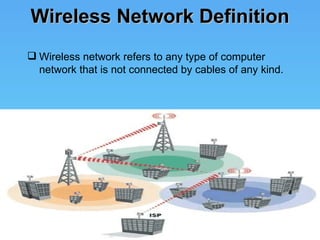
 Wireless network refers to any type of computer
  network that is not connected by cables of any kind.
Types Of Wireless
• WPANS (Wireless Personal
  Area Networks) :
 The two current technologies for wireless personal
  area networks are Infra Red (IR) and Bluetooth.
2.WLANS (Wireless Local
 Area Networks) :
 Allow users in a local area, such as a university
 campus or library, to form a network or gain access to
 the internet.
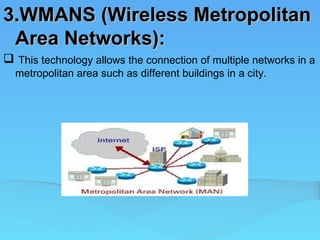
3.WMANS (Wireless Metropolitan
 Area Networks):
 This technology allows the connection of multiple networks in a
  metropolitan area such as different buildings in a city.
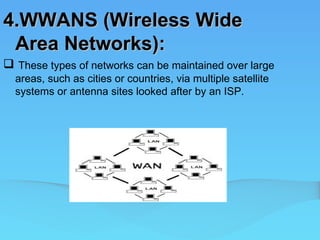
4.WWANS (Wireless Wide
 Area Networks):
 These types of networks can be maintained over large
  areas, such as cities or countries, via multiple satellite
  systems or antenna sites looked after by an ISP.
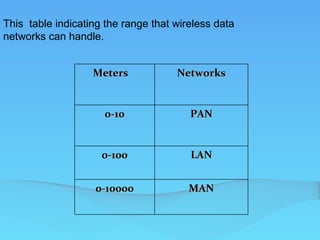
This table indicating the range that wireless data
networks can handle.


                   Meters            Networks


                     0-10               PAN


                     0-100              LAN


                   0-10000              MAN
Wireless Access Point
 In computer networking, a wireless access point (WAP)
  is a device that allows wireless devices to connect to a
  wired network using Wi-Fi, Bluetooth or related
  standards.
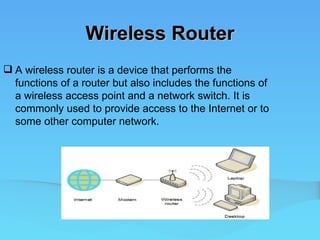
Wireless Router
 A wireless router is a device that performs the
  functions of a router but also includes the functions of
  a wireless access point and a network switch. It is
  commonly used to provide access to the Internet or to
  some other computer network.
Wireless Technology

 A technology, such as cell
  phones, that uses radio waves to
  transmit and receive data.
 It is used increasingly for data transmission.
 It is less costly then wire technology.
Wireless Communication

 Wireless communication refers to technology that
   transmits data over distances without the use of
   connecting wires.
 Basic types of wireless communication are
c) Radio transmission
d) Microwave transmission
e) Infrared waves
f) Light wave transmission
a) Radio Transmission

 It is the transmission of signals through free space by
 modulation of electromagnetic waves.
Radio Transmission

Advantages
 Easily generated
 Travel long distance
 Omni-directionally

Problems
 Frequency dependency
 Low bandwidth
b) Microwave Transmission
 Microwave transmission refers to the technology
  of transmitting information
 It the use of radio waves whose wavelengths are
  conveniently measured in small numbers of centimeter.
Microwave Transmission

Advantages
 Widely used for long distance
 Inexpensive

Problems
 Don’t pass trough building walls
 Weather and frequency dependency
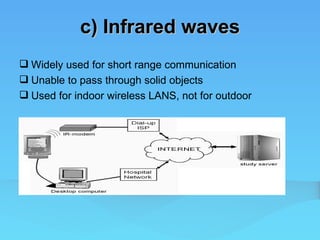
c) Infrared waves
 Widely used for short range communication
 Unable to pass through solid objects
 Used for indoor wireless LANS, not for outdoor
d) Light wave Transmission

 Unguided optical signals such as laser
 Connect two LANS in two buildings
 Unidirectional
The Benefits of Wireless
             Technology
 Internet access is fast
 Increased efficiency
 Reduced costs
 Greater Speed
 Cut the Wires, Cut the Cost
 Eliminate the Wires, Simplify Installations
 No wires, Convenience, flexible.
 Wireless components have become quite affordable.
 Save substantial time and energy
QUESTIONS?

Wireless Technology

  • 1.
    “In The NameOf ALLAH, The Most Beneficent & The Most Merciful"
  • 2.
  • 3.
    What is Wireless? Theword wireless meaning "having no wires”. So wireless is a piece of technology what does not require any wires. The distances involved may be short such as a few meters as in television remote control, or long like thousands or millions of kilometers for radio communications.
  • 4.
    Wireless Systems  AMradio,  FM radio,  Satellite radio,  Satellite TV,  Satellite Internet access  Broadcast TV
  • 5.
    Wireless Networks History In1970, Norm Abramson, a professor of engineering at the University of Hawaii, developed a radio-based communications system known as ALOHANET. This was the world’s first wireless packet-switched network, which allows multiple devices to transmit and receive data simultaneously.
  • 6.
    Wireless Network Definition Wireless network refers to any type of computer network that is not connected by cables of any kind.
  • 7.
  • 8.
    • WPANS (WirelessPersonal Area Networks) :  The two current technologies for wireless personal area networks are Infra Red (IR) and Bluetooth.
  • 9.
    2.WLANS (Wireless Local Area Networks) :  Allow users in a local area, such as a university campus or library, to form a network or gain access to the internet.
  • 10.
    3.WMANS (Wireless Metropolitan Area Networks):  This technology allows the connection of multiple networks in a metropolitan area such as different buildings in a city.
  • 11.
    4.WWANS (Wireless Wide Area Networks):  These types of networks can be maintained over large areas, such as cities or countries, via multiple satellite systems or antenna sites looked after by an ISP.
  • 12.
    This table indicatingthe range that wireless data networks can handle. Meters Networks 0-10 PAN 0-100 LAN 0-10000 MAN
  • 13.
    Wireless Access Point In computer networking, a wireless access point (WAP) is a device that allows wireless devices to connect to a wired network using Wi-Fi, Bluetooth or related standards.
  • 14.
    Wireless Router  Awireless router is a device that performs the functions of a router but also includes the functions of a wireless access point and a network switch. It is commonly used to provide access to the Internet or to some other computer network.
  • 15.
    Wireless Technology  Atechnology, such as cell phones, that uses radio waves to transmit and receive data.  It is used increasingly for data transmission.  It is less costly then wire technology.
  • 16.
    Wireless Communication  Wirelesscommunication refers to technology that transmits data over distances without the use of connecting wires.  Basic types of wireless communication are c) Radio transmission d) Microwave transmission e) Infrared waves f) Light wave transmission
  • 17.
    a) Radio Transmission It is the transmission of signals through free space by modulation of electromagnetic waves.
  • 18.
    Radio Transmission Advantages  Easilygenerated  Travel long distance  Omni-directionally Problems  Frequency dependency  Low bandwidth
  • 19.
    b) Microwave Transmission Microwave transmission refers to the technology of transmitting information  It the use of radio waves whose wavelengths are conveniently measured in small numbers of centimeter.
  • 20.
    Microwave Transmission Advantages  Widelyused for long distance  Inexpensive Problems  Don’t pass trough building walls  Weather and frequency dependency
  • 21.
    c) Infrared waves Widely used for short range communication  Unable to pass through solid objects  Used for indoor wireless LANS, not for outdoor
  • 22.
    d) Light waveTransmission  Unguided optical signals such as laser  Connect two LANS in two buildings  Unidirectional
  • 23.
    The Benefits ofWireless Technology  Internet access is fast  Increased efficiency  Reduced costs  Greater Speed  Cut the Wires, Cut the Cost  Eliminate the Wires, Simplify Installations  No wires, Convenience, flexible.  Wireless components have become quite affordable.  Save substantial time and energy
  • 24.