A Study and Analysis of Access to High Speed
Connection in Wireless Technology
1
K.DilipKumar, 2
A.Aravindhan
Abstract— Wireless telecommunication is the transfer of information between two or more computers or connected through the hotspot. Certain
distance only can travels the networks through one device to another device and will controls the remote device to the control. Such as the fixed
mobiles, portable devices, radio, cellular telephones and then personal digital assistants (PDA) and wireless networking .Wireless technology
improves the technology based and increasing the many organizations for the wide range purpose of telecommunications .Wireless is meter
reading protocol is the Zigbee protocol has been evolved through the database management system. Zigbee technology is a wireless network of
the low cost and then save the low data for the lower power consumption has been processed.
Keywords— Wireless networks, Bluetooth, Zigbee, Wireless ATM, High Speed LANs, Network Infrastructures, TCP Wireless Connections
——————————  ——————————
1 INTRODUCTION
Communication was from a base station to a node. Base station
has access to a downlink channel, whereas the nodes share the
uplink channels. Recently using the Wi-Fi alliance is the data
sharing information through the quality, mobility, power, saving
and security is based on the programs through the Wi-Fi protected
access points through the saving the connection through the
username and password is created for the Wi-Fi connections. Wi-
Fi connections are very fast processing and can download the
images, videos, text, music etc., These connections will get
through the Cables, modems, data cards. Cables will connects
through the landline telephone signals are using the networks.
Some of the designing products are using the machine to machine
products are controls are using programming source code formats.
Through internet connections we can share the data’s from one
device to another device. Use-full to configure the remotely over
a Bluetooth connections. Before performing remote configuration
using Bluetooth module with your computer, the major challenges
of wireless communication providers are to balance the load on
the network for effective and efficient use of applications, during
all the particular locations. The set of nodes connected by
wireless links that form arbitrary wireless network topologies
without the use of any centralized access point. The mobile
communication systems and the wireless communications
technologies have been improving very fast day by day.
2 LITERATURE REVIEW
In the near future, Wireless Local Area Networks (WLANs) are
expected to constitute one of the largest segments in the market
for wireless products Wireless Local Area Networks will
facilitate ubiquitous communications and location independent
computing in restricted spatial domains such as offices,
factories, enterprise facilities, hospitals, and campuses. In such
environments, WLANs will complement and expand the coverage
areas of existing wired networks [2]. The main attractions of
WLANs include: cost effectiveness, ease of installation,
flexibility, and tether-less access to the information infrastructure,
and support for computing through station mobility [3]. One
particular advantage of WLANs is the fact that they can be
quickly installed in an Ad Hoc configuration by non technical
personnel, without preplanning and without a supporting
backbone network accurate and synchronized clock time is
crucial in many sensor network applications, particularly due to
the collaborative nature of sensor networks [6]. For example, in
target tracking applications, sensor nodes need both the location
and the time when the target is sensed to correctly determine the
target moving direction and speed [7]. For PCs with Bluetooth
capability and running Windows, click Bluetooth devices in the
system tray at the bottom right of your computer screen [1].
3 WIRELESS NETWORKS
The networks provide wireless access to IP-based applications,
and service continuity in light of intersystem mobility. Integration
of the networks infrastructure network achieved through the
management system for component attached to each network
3.1 RFID (Radio Frequency Identification)
 Micro chip
 Antenna
 Case
 Battery
The size of the chip depends mostly on the Antenna. Its size and
form is dependent on the frequency the tag is using. The size of a
tag also depends on its area of use. It can range from less than a
millimeter for implants to the size of a book in container logistic.
In addition to the micro chip, some tags also have rewritable
memory attached where the tag can store updates between reading
cycles or new data like serial numbers.
3.2 NFC (Near Field Communication)
NFC operates in a frequency range centered on 13.56 MHz and
offers a data transmission rate of up to 424 kb/s within a distance
of approximately 10 centimeters. In contrast to the conventional
contactless technology in this frequency range communications
between NFC capable devices can be active-active (peer-to-peer)
————————————————
 1K.Dilip kumar ,Second Year, Master of Computer Applications in
Er.Perumal Manimekalai College of Engineering, Hosur, Tamil
nadu.PH.NO:.8098413746. E-mail: dilipkumar1167@mail.com
 2A.Aravindhan, Second Year, master of computer application in ER.
Er.Perumal Manimekalai College Of. Engineering in Hosur,Tamil nadu ,
PH-9597072006 E-mail-aravinmenon000@gmail.com
International Journal of Scientific & Engineering Research Volume 9, Issue 4, April-2018
ISSN 2229-5518
20
IJSER © 2018
http://www.ijser.org
IJSER
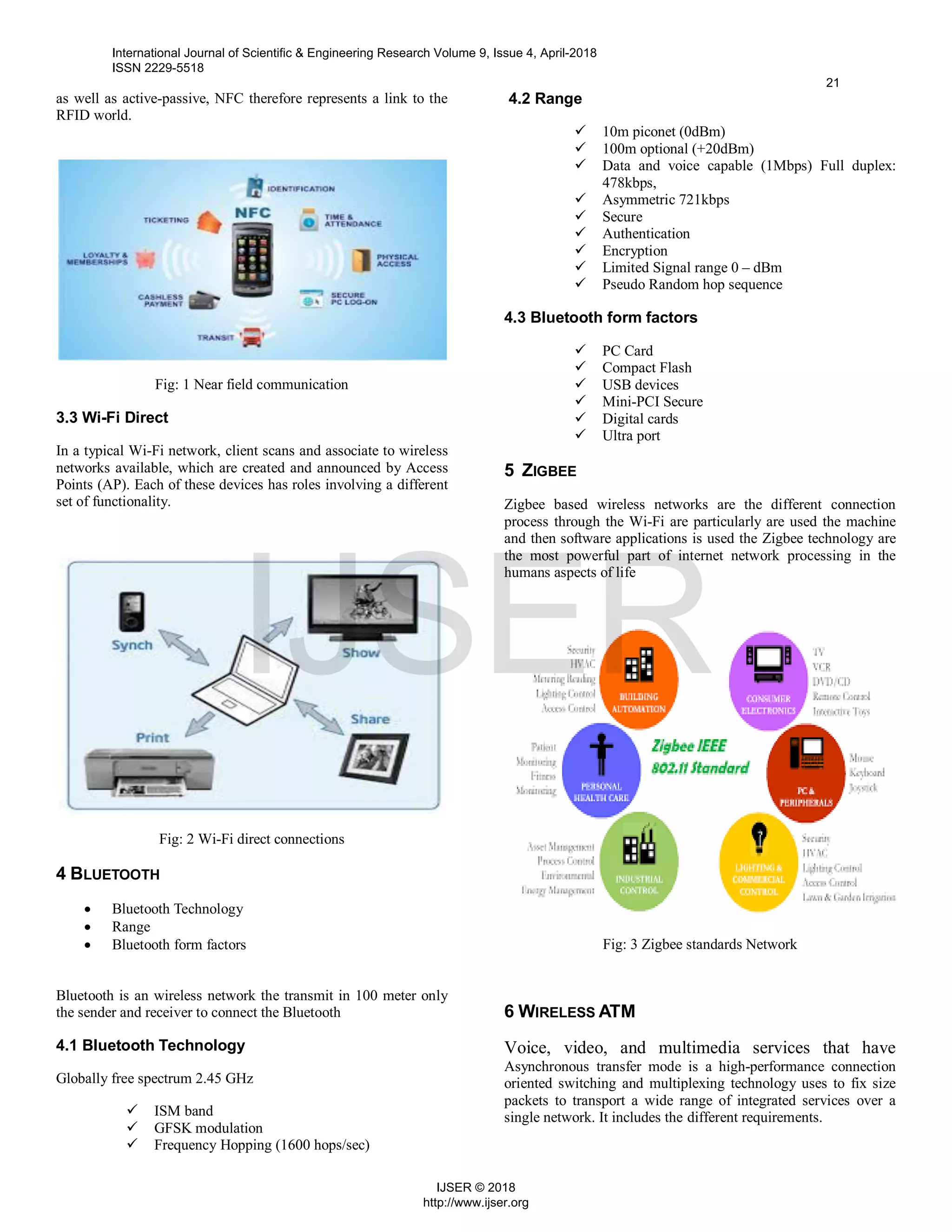
as well as active-passive, NFC therefore represents a link to the
RFID world.
Fig: 1 Near field communication
3.3 Wi-Fi Direct
In a typical Wi-Fi network, client scans and associate to wireless
networks available, which are created and announced by Access
Points (AP). Each of these devices has roles involving a different
set of functionality.
Fig: 2 Wi-Fi direct connections
4 BLUETOOTH
 Bluetooth Technology
 Range
 Bluetooth form factors
Bluetooth is an wireless network the transmit in 100 meter only
the sender and receiver to connect the Bluetooth
4.1 Bluetooth Technology
Globally free spectrum 2.45 GHz
 ISM band
 GFSK modulation
 Frequency Hopping (1600 hops/sec)
4.2 Range
 10m piconet (0dBm)
 100m optional (+20dBm)
 Data and voice capable (1Mbps) Full duplex:
478kbps,
 Asymmetric 721kbps
 Secure
 Authentication
 Encryption
 Limited Signal range 0 – dBm
 Pseudo Random hop sequence
4.3 Bluetooth form factors
 PC Card
 Compact Flash
 USB devices
 Mini-PCI Secure
 Digital cards
 Ultra port
5 ZIGBEE
Zigbee based wireless networks are the different connection
process through the Wi-Fi are particularly are used the machine
and then software applications is used the Zigbee technology are
the most powerful part of internet network processing in the
humans aspects of life
Fig: 3 Zigbee standards Network
6 WIRELESS ATM
Voice, video, and multimedia services that have
Asynchronous transfer mode is a high-performance connection
oriented switching and multiplexing technology uses to fix size
packets to transport a wide range of integrated services over a
single network. It includes the different requirements.
International Journal of Scientific & Engineering Research Volume 9, Issue 4, April-2018
ISSN 2229-5518
21
IJSER © 2018
http://www.ijser.org
IJSER
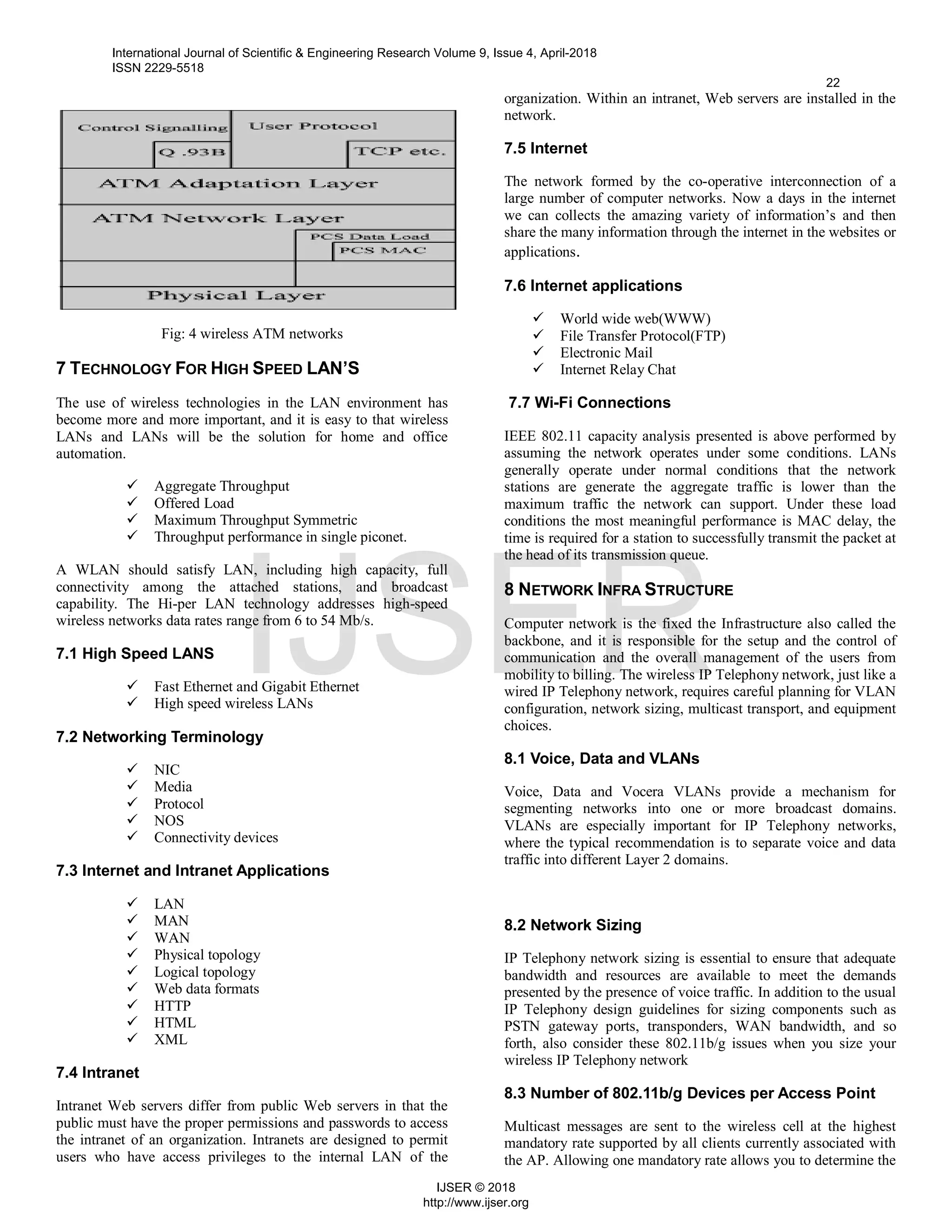
Fig: 4 wireless ATM networks
7 TECHNOLOGY FOR HIGH SPEED LAN’S
The use of wireless technologies in the LAN environment has
become more and more important, and it is easy to that wireless
LANs and LANs will be the solution for home and office
automation.
 Aggregate Throughput
 Offered Load
 Maximum Throughput Symmetric
 Throughput performance in single piconet.
A WLAN should satisfy LAN, including high capacity, full
connectivity among the attached stations, and broadcast
capability. The Hi-per LAN technology addresses high-speed
wireless networks data rates range from 6 to 54 Mb/s.
7.1 High Speed LANS
 Fast Ethernet and Gigabit Ethernet
 High speed wireless LANs
7.2 Networking Terminology
 NIC
 Media
 Protocol
 NOS
 Connectivity devices
7.3 Internet and Intranet Applications
 LAN
 MAN
 WAN
 Physical topology
 Logical topology
 Web data formats
 HTTP
 HTML
 XML
7.4 Intranet
Intranet Web servers differ from public Web servers in that the
public must have the proper permissions and passwords to access
the intranet of an organization. Intranets are designed to permit
users who have access privileges to the internal LAN of the
organization. Within an intranet, Web servers are installed in the
network.
7.5 Internet
The network formed by the co-operative interconnection of a
large number of computer networks. Now a days in the internet
we can collects the amazing variety of information’s and then
share the many information through the internet in the websites or
applications.
7.6 Internet applications
 World wide web(WWW)
 File Transfer Protocol(FTP)
 Electronic Mail
 Internet Relay Chat
7.7 Wi-Fi Connections
IEEE 802.11 capacity analysis presented is above performed by
assuming the network operates under some conditions. LANs
generally operate under normal conditions that the network
stations are generate the aggregate traffic is lower than the
maximum traffic the network can support. Under these load
conditions the most meaningful performance is MAC delay, the
time is required for a station to successfully transmit the packet at
the head of its transmission queue.
8 NETWORK INFRA STRUCTURE
Computer network is the fixed the Infrastructure also called the
backbone, and it is responsible for the setup and the control of
communication and the overall management of the users from
mobility to billing. The wireless IP Telephony network, just like a
wired IP Telephony network, requires careful planning for VLAN
configuration, network sizing, multicast transport, and equipment
choices.
8.1 Voice, Data and VLANs
Voice, Data and Vocera VLANs provide a mechanism for
segmenting networks into one or more broadcast domains.
VLANs are especially important for IP Telephony networks,
where the typical recommendation is to separate voice and data
traffic into different Layer 2 domains.
8.2 Network Sizing
IP Telephony network sizing is essential to ensure that adequate
bandwidth and resources are available to meet the demands
presented by the presence of voice traffic. In addition to the usual
IP Telephony design guidelines for sizing components such as
PSTN gateway ports, transponders, WAN bandwidth, and so
forth, also consider these 802.11b/g issues when you size your
wireless IP Telephony network
8.3 Number of 802.11b/g Devices per Access Point
Multicast messages are sent to the wireless cell at the highest
mandatory rate supported by all clients currently associated with
the AP. Allowing one mandatory rate allows you to determine the
International Journal of Scientific & Engineering Research Volume 9, Issue 4, April-2018
ISSN 2229-5518
22
IJSER © 2018
http://www.ijser.org
IJSER
rate at which multicast packets will be sent. In networks where
you expect a wide utilization of the push to talk or Broadcast
function, you may want to set higher rates to mandatory, so as to
allow multicast packets to be sent at higher rate.
9 TCP WIRELESS CONNECTIONS
Network model that we assume for impact of wireless network
on TCP performance is cellular network. Mobile hosts are
assumed to be directly connected to an access point or base
station which in turn is connected to the backbone wireless
internet through a network. The nature of network model used is
independent of the specific type of wireless network. Wireless
networks.
 Congestion loss
 Error loss
Connections are considered the discussions are assumed to be
between a mobile host in the wireless network and a static host in
the backbone Internet. Mobile hosts will be expected to
predominantly communicating with backbone servers rather than
with other mobile hosts within the same wireless network or other
wireless networks
9.1 TCP Wireless Applications
 TCP mechanisms
 Indirect TCP
 Snooping TCP
 Mobile TCP
 Fast retransmit/recovery
 Transmission freezing
 Selective retransmission
 Transaction oriented TCP
9.2 Random Losses
A fundamental wireless network is the presence of random
wireless losses specially effective bit of error rates in wireless
networks are significantly higher network because of higher host
mobility, multipath disconnections due to coverage limitations,
etc. Although the higher rates in wireless networks inherently
degrade the performance experienced by connections traversing
such networks, they cause an even more severe degradation in the
throughput of connections using TCP as the transport protocol.
As described in the previous section, TCP multiplicatively
decreases its congestion window upon experiencing losses. The
decrease is performed because TCP assumes that all losses in the
network are due to congestion, and such a multiplicative decrease
is essential to avoid congestion collapse in the event of
congestion. losses. TCP observes random wireless losses, it
wrongly interprets such losses as congestion losses, and cuts
down its window, thus reducing the throughput of the connection.
10 CONCLUSION
Wireless communication networks have covered a variety of
topics ranging from physical layer performance limits to
scheduling policies and medium access control proto cols, as well
as the newly emerging paradigm of energy transfer and
cooperation that occur in addition or simultaneous with
information transfer for such networks. Models and results under
a variety of network structures, those with single and multiple
hops as well as small and large scale have been addressed. We
have also presented models for total energy consumption models,
processing costs, to further adapt the network operation and
improve its performance. The possible improvement therein is
closely tied to the efficiency of energy transfer and hence to the
device and circuit technologies, connecting the theory again to the
real world wireless networks lie not only in advancements in
various layers of network design
REFERENCES
[1] Bluetooth SIGWeb site:http://www.bluetooth.org
[2] T.S.Rappaport, Wireless Communications: Principles and Practice,Upper
Saddle River, New Jersey
[3] J.Birnbaum,Pervasive information systems, Communications of the ACM,
[4] T.Berners-Lee, R. Fielding,U. C.Irvine,andL.Masinter,Uniform Resource
Identifiers
[5] Bluetooth,Specificationof the Bluetoothsystem. www.bluetooth.com,
[6] WWW.idc-online.com/technical
[7] Abbassi,A.A.andYounis,M.(2007).“ A Wireless Networks.” Computer
Communication.
[8] http://www.ti.com/product/cc250
[10] http://zigbee.org.
[11] http://www.google.com/nearfieldcommunication
[12]https://www.google.co.in/imgres?imgurl=https%3A%2F%2Fi1.wp.com/
wi-fi-direct-and-how-does-it-work.
International Journal of Scientific & Engineering Research Volume 9, Issue 4, April-2018
ISSN 2229-5518
23
IJSER © 2018
http://www.ijser.org
IJSER

A study-and-analysis-of-access-to-high-speed-connection-in-wireless-technology

  • 1.
    A Study andAnalysis of Access to High Speed Connection in Wireless Technology 1 K.DilipKumar, 2 A.Aravindhan Abstract— Wireless telecommunication is the transfer of information between two or more computers or connected through the hotspot. Certain distance only can travels the networks through one device to another device and will controls the remote device to the control. Such as the fixed mobiles, portable devices, radio, cellular telephones and then personal digital assistants (PDA) and wireless networking .Wireless technology improves the technology based and increasing the many organizations for the wide range purpose of telecommunications .Wireless is meter reading protocol is the Zigbee protocol has been evolved through the database management system. Zigbee technology is a wireless network of the low cost and then save the low data for the lower power consumption has been processed. Keywords— Wireless networks, Bluetooth, Zigbee, Wireless ATM, High Speed LANs, Network Infrastructures, TCP Wireless Connections ——————————  —————————— 1 INTRODUCTION Communication was from a base station to a node. Base station has access to a downlink channel, whereas the nodes share the uplink channels. Recently using the Wi-Fi alliance is the data sharing information through the quality, mobility, power, saving and security is based on the programs through the Wi-Fi protected access points through the saving the connection through the username and password is created for the Wi-Fi connections. Wi- Fi connections are very fast processing and can download the images, videos, text, music etc., These connections will get through the Cables, modems, data cards. Cables will connects through the landline telephone signals are using the networks. Some of the designing products are using the machine to machine products are controls are using programming source code formats. Through internet connections we can share the data’s from one device to another device. Use-full to configure the remotely over a Bluetooth connections. Before performing remote configuration using Bluetooth module with your computer, the major challenges of wireless communication providers are to balance the load on the network for effective and efficient use of applications, during all the particular locations. The set of nodes connected by wireless links that form arbitrary wireless network topologies without the use of any centralized access point. The mobile communication systems and the wireless communications technologies have been improving very fast day by day. 2 LITERATURE REVIEW In the near future, Wireless Local Area Networks (WLANs) are expected to constitute one of the largest segments in the market for wireless products Wireless Local Area Networks will facilitate ubiquitous communications and location independent computing in restricted spatial domains such as offices, factories, enterprise facilities, hospitals, and campuses. In such environments, WLANs will complement and expand the coverage areas of existing wired networks [2]. The main attractions of WLANs include: cost effectiveness, ease of installation, flexibility, and tether-less access to the information infrastructure, and support for computing through station mobility [3]. One particular advantage of WLANs is the fact that they can be quickly installed in an Ad Hoc configuration by non technical personnel, without preplanning and without a supporting backbone network accurate and synchronized clock time is crucial in many sensor network applications, particularly due to the collaborative nature of sensor networks [6]. For example, in target tracking applications, sensor nodes need both the location and the time when the target is sensed to correctly determine the target moving direction and speed [7]. For PCs with Bluetooth capability and running Windows, click Bluetooth devices in the system tray at the bottom right of your computer screen [1]. 3 WIRELESS NETWORKS The networks provide wireless access to IP-based applications, and service continuity in light of intersystem mobility. Integration of the networks infrastructure network achieved through the management system for component attached to each network 3.1 RFID (Radio Frequency Identification)  Micro chip  Antenna  Case  Battery The size of the chip depends mostly on the Antenna. Its size and form is dependent on the frequency the tag is using. The size of a tag also depends on its area of use. It can range from less than a millimeter for implants to the size of a book in container logistic. In addition to the micro chip, some tags also have rewritable memory attached where the tag can store updates between reading cycles or new data like serial numbers. 3.2 NFC (Near Field Communication) NFC operates in a frequency range centered on 13.56 MHz and offers a data transmission rate of up to 424 kb/s within a distance of approximately 10 centimeters. In contrast to the conventional contactless technology in this frequency range communications between NFC capable devices can be active-active (peer-to-peer) ————————————————  1K.Dilip kumar ,Second Year, Master of Computer Applications in Er.Perumal Manimekalai College of Engineering, Hosur, Tamil nadu.PH.NO:.8098413746. E-mail: dilipkumar1167@mail.com  2A.Aravindhan, Second Year, master of computer application in ER. Er.Perumal Manimekalai College Of. Engineering in Hosur,Tamil nadu , PH-9597072006 E-mail-aravinmenon000@gmail.com International Journal of Scientific & Engineering Research Volume 9, Issue 4, April-2018 ISSN 2229-5518 20 IJSER © 2018 http://www.ijser.org IJSER
  • 2.
    as well asactive-passive, NFC therefore represents a link to the RFID world. Fig: 1 Near field communication 3.3 Wi-Fi Direct In a typical Wi-Fi network, client scans and associate to wireless networks available, which are created and announced by Access Points (AP). Each of these devices has roles involving a different set of functionality. Fig: 2 Wi-Fi direct connections 4 BLUETOOTH  Bluetooth Technology  Range  Bluetooth form factors Bluetooth is an wireless network the transmit in 100 meter only the sender and receiver to connect the Bluetooth 4.1 Bluetooth Technology Globally free spectrum 2.45 GHz  ISM band  GFSK modulation  Frequency Hopping (1600 hops/sec) 4.2 Range  10m piconet (0dBm)  100m optional (+20dBm)  Data and voice capable (1Mbps) Full duplex: 478kbps,  Asymmetric 721kbps  Secure  Authentication  Encryption  Limited Signal range 0 – dBm  Pseudo Random hop sequence 4.3 Bluetooth form factors  PC Card  Compact Flash  USB devices  Mini-PCI Secure  Digital cards  Ultra port 5 ZIGBEE Zigbee based wireless networks are the different connection process through the Wi-Fi are particularly are used the machine and then software applications is used the Zigbee technology are the most powerful part of internet network processing in the humans aspects of life Fig: 3 Zigbee standards Network 6 WIRELESS ATM Voice, video, and multimedia services that have Asynchronous transfer mode is a high-performance connection oriented switching and multiplexing technology uses to fix size packets to transport a wide range of integrated services over a single network. It includes the different requirements. International Journal of Scientific & Engineering Research Volume 9, Issue 4, April-2018 ISSN 2229-5518 21 IJSER © 2018 http://www.ijser.org IJSER
  • 3.
    Fig: 4 wirelessATM networks 7 TECHNOLOGY FOR HIGH SPEED LAN’S The use of wireless technologies in the LAN environment has become more and more important, and it is easy to that wireless LANs and LANs will be the solution for home and office automation.  Aggregate Throughput  Offered Load  Maximum Throughput Symmetric  Throughput performance in single piconet. A WLAN should satisfy LAN, including high capacity, full connectivity among the attached stations, and broadcast capability. The Hi-per LAN technology addresses high-speed wireless networks data rates range from 6 to 54 Mb/s. 7.1 High Speed LANS  Fast Ethernet and Gigabit Ethernet  High speed wireless LANs 7.2 Networking Terminology  NIC  Media  Protocol  NOS  Connectivity devices 7.3 Internet and Intranet Applications  LAN  MAN  WAN  Physical topology  Logical topology  Web data formats  HTTP  HTML  XML 7.4 Intranet Intranet Web servers differ from public Web servers in that the public must have the proper permissions and passwords to access the intranet of an organization. Intranets are designed to permit users who have access privileges to the internal LAN of the organization. Within an intranet, Web servers are installed in the network. 7.5 Internet The network formed by the co-operative interconnection of a large number of computer networks. Now a days in the internet we can collects the amazing variety of information’s and then share the many information through the internet in the websites or applications. 7.6 Internet applications  World wide web(WWW)  File Transfer Protocol(FTP)  Electronic Mail  Internet Relay Chat 7.7 Wi-Fi Connections IEEE 802.11 capacity analysis presented is above performed by assuming the network operates under some conditions. LANs generally operate under normal conditions that the network stations are generate the aggregate traffic is lower than the maximum traffic the network can support. Under these load conditions the most meaningful performance is MAC delay, the time is required for a station to successfully transmit the packet at the head of its transmission queue. 8 NETWORK INFRA STRUCTURE Computer network is the fixed the Infrastructure also called the backbone, and it is responsible for the setup and the control of communication and the overall management of the users from mobility to billing. The wireless IP Telephony network, just like a wired IP Telephony network, requires careful planning for VLAN configuration, network sizing, multicast transport, and equipment choices. 8.1 Voice, Data and VLANs Voice, Data and Vocera VLANs provide a mechanism for segmenting networks into one or more broadcast domains. VLANs are especially important for IP Telephony networks, where the typical recommendation is to separate voice and data traffic into different Layer 2 domains. 8.2 Network Sizing IP Telephony network sizing is essential to ensure that adequate bandwidth and resources are available to meet the demands presented by the presence of voice traffic. In addition to the usual IP Telephony design guidelines for sizing components such as PSTN gateway ports, transponders, WAN bandwidth, and so forth, also consider these 802.11b/g issues when you size your wireless IP Telephony network 8.3 Number of 802.11b/g Devices per Access Point Multicast messages are sent to the wireless cell at the highest mandatory rate supported by all clients currently associated with the AP. Allowing one mandatory rate allows you to determine the International Journal of Scientific & Engineering Research Volume 9, Issue 4, April-2018 ISSN 2229-5518 22 IJSER © 2018 http://www.ijser.org IJSER
  • 4.
    rate at whichmulticast packets will be sent. In networks where you expect a wide utilization of the push to talk or Broadcast function, you may want to set higher rates to mandatory, so as to allow multicast packets to be sent at higher rate. 9 TCP WIRELESS CONNECTIONS Network model that we assume for impact of wireless network on TCP performance is cellular network. Mobile hosts are assumed to be directly connected to an access point or base station which in turn is connected to the backbone wireless internet through a network. The nature of network model used is independent of the specific type of wireless network. Wireless networks.  Congestion loss  Error loss Connections are considered the discussions are assumed to be between a mobile host in the wireless network and a static host in the backbone Internet. Mobile hosts will be expected to predominantly communicating with backbone servers rather than with other mobile hosts within the same wireless network or other wireless networks 9.1 TCP Wireless Applications  TCP mechanisms  Indirect TCP  Snooping TCP  Mobile TCP  Fast retransmit/recovery  Transmission freezing  Selective retransmission  Transaction oriented TCP 9.2 Random Losses A fundamental wireless network is the presence of random wireless losses specially effective bit of error rates in wireless networks are significantly higher network because of higher host mobility, multipath disconnections due to coverage limitations, etc. Although the higher rates in wireless networks inherently degrade the performance experienced by connections traversing such networks, they cause an even more severe degradation in the throughput of connections using TCP as the transport protocol. As described in the previous section, TCP multiplicatively decreases its congestion window upon experiencing losses. The decrease is performed because TCP assumes that all losses in the network are due to congestion, and such a multiplicative decrease is essential to avoid congestion collapse in the event of congestion. losses. TCP observes random wireless losses, it wrongly interprets such losses as congestion losses, and cuts down its window, thus reducing the throughput of the connection. 10 CONCLUSION Wireless communication networks have covered a variety of topics ranging from physical layer performance limits to scheduling policies and medium access control proto cols, as well as the newly emerging paradigm of energy transfer and cooperation that occur in addition or simultaneous with information transfer for such networks. Models and results under a variety of network structures, those with single and multiple hops as well as small and large scale have been addressed. We have also presented models for total energy consumption models, processing costs, to further adapt the network operation and improve its performance. The possible improvement therein is closely tied to the efficiency of energy transfer and hence to the device and circuit technologies, connecting the theory again to the real world wireless networks lie not only in advancements in various layers of network design REFERENCES [1] Bluetooth SIGWeb site:http://www.bluetooth.org [2] T.S.Rappaport, Wireless Communications: Principles and Practice,Upper Saddle River, New Jersey [3] J.Birnbaum,Pervasive information systems, Communications of the ACM, [4] T.Berners-Lee, R. Fielding,U. C.Irvine,andL.Masinter,Uniform Resource Identifiers [5] Bluetooth,Specificationof the Bluetoothsystem. www.bluetooth.com, [6] WWW.idc-online.com/technical [7] Abbassi,A.A.andYounis,M.(2007).“ A Wireless Networks.” Computer Communication. [8] http://www.ti.com/product/cc250 [10] http://zigbee.org. [11] http://www.google.com/nearfieldcommunication [12]https://www.google.co.in/imgres?imgurl=https%3A%2F%2Fi1.wp.com/ wi-fi-direct-and-how-does-it-work. International Journal of Scientific & Engineering Research Volume 9, Issue 4, April-2018 ISSN 2229-5518 23 IJSER © 2018 http://www.ijser.org IJSER