MODULE 2
Smart grid Communication
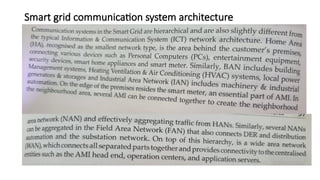
• The communication network in the smart grid has a hierarchical
structure consisting of the premises network :
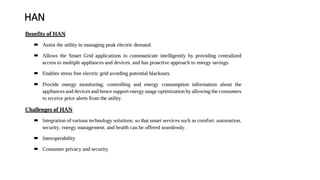
• HAN Home Area Network
• BAN Building Area Network
• IAN Industrial Area Network
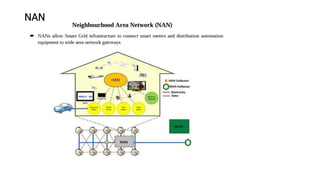
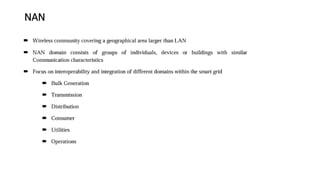
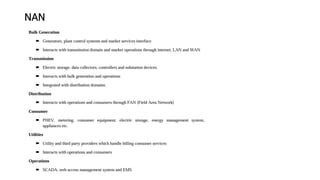
• NAN Neighbourhood Area Network
• FAN Field Area Network
• WAN Wide Area Network
Wireless
• Wireless means transmitting signals using radio waves
as the medium instead of wires.
• Wireless technologies are used for tasks as simple as
switching off the television or as complex as supplying
the sales force with information from an automated
enterprise application while in the field.
• Now cordless keyboards and mouse, PDAs, pagers and
digital and cellular phones have become part of our
daily life.
Wireless
Some of the inherent characteristics of wireless communications systems which
make it attractive for users, are given below −
• Mobility − A wireless communications system allows users to access
information beyond their desk and conduct business from anywhere without
having a wire connectivity.
• Reachability − Wireless communication systems enable people to be stay
connected and be reachable, regardless of the location they are operating from.
• Simplicity − Wireless communication system are easy and fast to deploy in
comparison of cabled network. Initial setup cost could be a bit high but other
advantages overcome that high cost.
• Maintainability − In a wireless system, you do not have to spend too much cost
and time to maintain the network setup.
• Roaming Services − Using a wireless network system, you can provide service
any where any time including train, buses, aeroplanes etc.
• New Services − Wireless communication systems provide various smart services
like SMS and MMS.
Information flows in Smart Grid
Two way information flow between
1. Sensors and electrical appliances to smart meters:
HAN - Wireless : ZigBee, 6LowPAN, Z-Wave - Wired: Powerline
communication - (Mostly) Unlicensed technologies ,WiFi, Bluetooth
2. Smart meters to utility’s data centre :
WAN, NAN - Internet, Cellular Technologies (2G,3G, 4G) -
(Mostly) Licensed technologies ,DSL ,Wi-Max
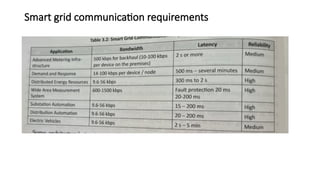
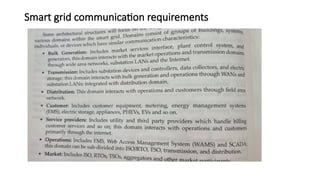
Smart grid communication requirements
Smart grid communication system architecture
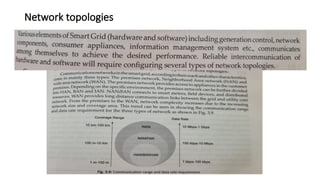
Network topologies
ZigBee
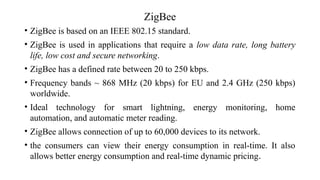
• ZigBee is based on an IEEE 802.15 standard.
• ZigBee is used in applications that require a low data rate, long battery
life, low cost and secure networking.
• ZigBee has a defined rate between 20 to 250 kbps.
• Frequency bands ~ 868 MHz (20 kbps) for EU and 2.4 GHz (250 kbps)
worldwide.
• Ideal technology for smart lightning, energy monitoring, home
automation, and automatic meter reading.
• ZigBee allows connection of up to 60,000 devices to its network.
• the consumers can view their energy consumption in real-time. It also
allows better energy consumption and real-time dynamic pricing.
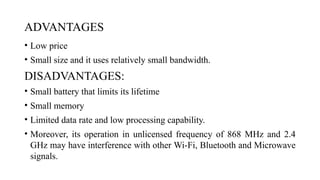
ADVANTAGES
• Low price
• Small size and it uses relatively small bandwidth.
DISADVANTAGES:
• Small battery that limits its lifetime
• Small memory
• Limited data rate and low processing capability.
• Moreover, its operation in unlicensed frequency of 868 MHz and 2.4
GHz may have interference with other Wi-Fi, Bluetooth and Microwave
signals.
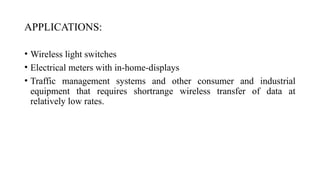
APPLICATIONS:
• Wireless light switches
• Electrical meters with in-home-displays
• Traffic management systems and other consumer and industrial
equipment that requires shortrange wireless transfer of data at
relatively low rates.
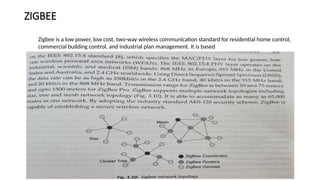
ZIGBEE
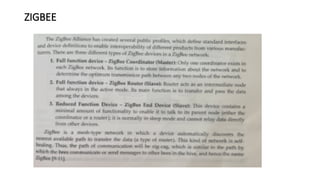
Zigbee is a low power, low cost, two-way wireless communication standard for residential home control,
commercial building control, and industrial plan management. It is based
ZIGBEE
Cellular Networks
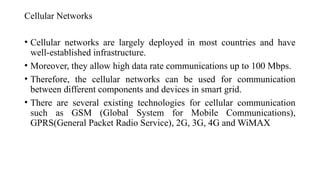
• Cellular networks are largely deployed in most countries and have
well-established infrastructure.
• Moreover, they allow high data rate communications up to 100 Mbps.
• Therefore, the cellular networks can be used for communication
between different components and devices in smart grid.
• There are several existing technologies for cellular communication
such as GSM (Global System for Mobile Communications),
GPRS(General Packet Radio Service), 2G, 3G, 4G and WiMAX
ADVANTAGES:
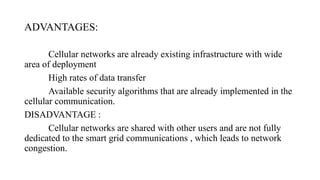
Cellular networks are already existing infrastructure with wide
area of deployment
High rates of data transfer
Available security algorithms that are already implemented in the
cellular communication.
DISADVANTAGE :
Cellular networks are shared with other users and are not fully
dedicated to the smart grid communications , which leads to network
congestion.
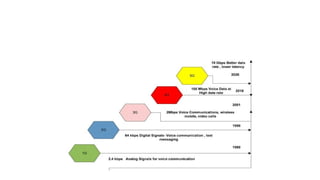
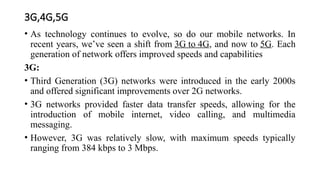
3G,4G,5G
• As technology continues to evolve, so do our mobile networks. In
recent years, we’ve seen a shift from 3G to 4G, and now to 5G. Each
generation of network offers improved speeds and capabilities
3G:
• Third Generation (3G) networks were introduced in the early 2000s
and offered significant improvements over 2G networks.
• 3G networks provided faster data transfer speeds, allowing for the
introduction of mobile internet, video calling, and multimedia
messaging.
• However, 3G was relatively slow, with maximum speeds typically
ranging from 384 kbps to 3 Mbps.
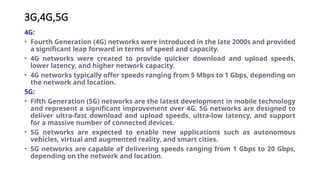
3G,4G,5G
4G:
• Fourth Generation (4G) networks were introduced in the late 2000s and provided
a significant leap forward in terms of speed and capacity.
• 4G networks were created to provide quicker download and upload speeds,
lower latency, and higher network capacity.
• 4G networks typically offer speeds ranging from 5 Mbps to 1 Gbps, depending on
the network and location.
5G:
• Fifth Generation (5G) networks are the latest development in mobile technology
and represent a significant improvement over 4G. 5G networks are designed to
deliver ultra-fast download and upload speeds, ultra-low latency, and support
for a massive number of connected devices.
• 5G networks are expected to enable new applications such as autonomous
vehicles, virtual and augmented reality, and smart cities.
• 5G networks are capable of delivering speeds ranging from 1 Gbps to 20 Gbps,
depending on the network and location.
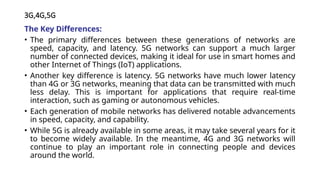
3G,4G,5G
The Key Differences:
• The primary differences between these generations of networks are
speed, capacity, and latency. 5G networks can support a much larger
number of connected devices, making it ideal for use in smart homes and
other Internet of Things (IoT) applications.
• Another key difference is latency. 5G networks have much lower latency
than 4G or 3G networks, meaning that data can be transmitted with much
less delay. This is important for applications that require real-time
interaction, such as gaming or autonomous vehicles.
• Each generation of mobile networks has delivered notable advancements
in speed, capacity, and capability.
• While 5G is already available in some areas, it may take several years for it
to become widely available. In the meantime, 4G and 3G networks will
continue to play an important role in connecting people and devices
around the world.
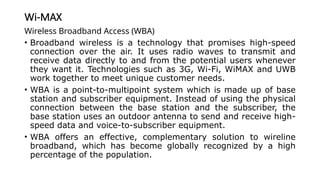
Wi-MAX
Wireless Broadband Access (WBA)
• Broadband wireless is a technology that promises high-speed
connection over the air. It uses radio waves to transmit and
receive data directly to and from the potential users whenever
they want it. Technologies such as 3G, Wi-Fi, WiMAX and UWB
work together to meet unique customer needs.
• WBA is a point-to-multipoint system which is made up of base
station and subscriber equipment. Instead of using the physical
connection between the base station and the subscriber, the
base station uses an outdoor antenna to send and receive high-
speed data and voice-to-subscriber equipment.
• WBA offers an effective, complementary solution to wireline
broadband, which has become globally recognized by a high
percentage of the population.
Wi-MAX
• Acronym for Worldwide Interoperability for Microwave
Access.
• Based on Wireless MAN technology.
• A wireless technology optimized for the delivery of IP centric
services over a wide area.
• A scalable wireless platform for constructing alternative and
complementary broadband networks.
• A certification that denotes interoperability of equipment built
to the IEEE 802.16 or compatible standard. The IEEE 802.16
Working Group develops standards that address two types of
usage models −
• A fixed usage model (IEEE 802.16-2004).
• A portable usage model (IEEE 802.16e).
WiMax
• WiMax (Worldwide Interoperability for Microwave Access) is a
wireless technology that provides high-throughput broadband
connections over long distances.
• WiMax can provide long distance communications beyond 16 km and
in some instances beyond 48 km at data transfer rates of 75 Mbps.
• WiMax can communicate out of sight via IEEE 802.16e and can
communicate with moving trucks or cars and data transfer rates up to
15 Mbps for mobile connections.
• It is optimised to support mobile devices moving up to a speed of 10
km/h.
• Even though it supports vehicles moving up to 120 km/h, its
performance degrades with the vehicle speed.
• It has the capability to maintain connection with stations moving at up
to 350 km/h
• It provides low latency
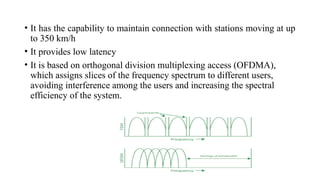
• It is based on orthogonal division multiplexing access (OFDMA),
which assigns slices of the frequency spectrum to different users,
avoiding interference among the users and increasing the spectral
efficiency of the system.
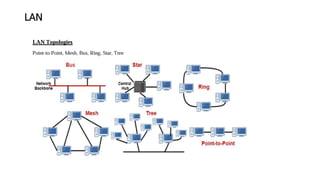
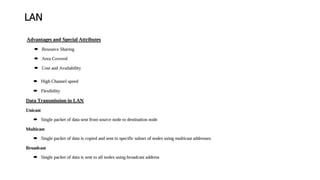
LAN
LAN
LAN
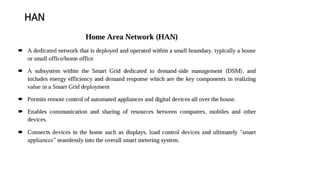
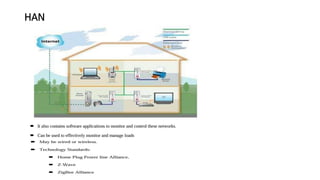
HAN
HAN
HAN
NAN
NAN
NAN
WiFi
• The IEEE suite of standards for wireless LANs, IEEE 802.11, is the
most commonly deployed wireless standard within homes.
• As such, the devices and integrated circuits (ICs) are relatively cheap,
making it an attractive solution.
• The data rate of WiFi ranges from 11 Mbps to 54 Mbps. It operates in
the 2.4 GHz band, and it has a range of 30–46m.
• Higher power consumption than ZigBee (WiFi ~ 700 mW, ZigBee ~
100 mW).
• Applications: Automatic meter reading (AMR), AMI -NAN, home
automation
RF Mesh
• RF (Radio Frequency) Mesh is a technology that allows meters and other sensing devices to
access the network by securely routing data via nearby meters and relay devices.
• RF-based mesh networks have emerged as the leading NAN (Neighborhood Area Network)
technology for smart metering applications .
• A mesh network forms a network topology by using mesh or star configurations.
• Any node not in direct communication range of its target destination will have its data
relayed by another node in the mesh
• . The electric system shall support two-way communication between the meter and the
electric utility. New technologies based on RF mesh networking promise an ideal solution
with high functionality and low cost.
• RF mesh networking of multiple sensors in a facility may enable industrial and commercial
customers to reduce energy costs through profiling energy usage and developing plans that
help to avoid demand charges, reduce energy consumption, and improve business processes
such as instantaneous and efficient control of HVAC and lighting systems.
Power Line Communication (PLC)
• Power line communication allows data exchange between devices
through electrical power lines.
• PLC is implemented by adding a modulated carrier signal to the power
cables.
• High data rate and capacity: 200 Mbps within homes, but low
bandwidth for NAN restricts usage.
• Since the power distribution system was originally intended for
transmission of AC power at typical frequencies of 50 or 60 Hz, power
wire circuits have only a limited ability to carry higher frequencies.
• There can be interference of communication signals with high order harmonics
produced by non-linear loads that is present in the grid such as rectifiers,
inverters, etc. In order to overcome this problem, advanced active filters should be
used.
• In smart grid applications, the plc is used in neighborhood area network
communication for connecting between smart meters and local data concentrator
(LDC).
Advantage :
• It is already established, wide-spread infrastructure that reduces installation costs.
Disadvantages :
• Presence of higher harmonics in the power lines that interfere with
communication signals and limited frequency of communication.
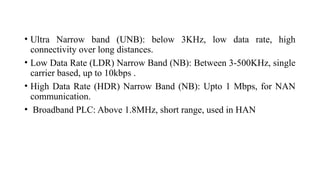
• Ultra Narrow band (UNB): below 3KHz, low data rate, high
connectivity over long distances.
• Low Data Rate (LDR) Narrow Band (NB): Between 3-500KHz, single
carrier based, up to 10kbps .
• High Data Rate (HDR) Narrow Band (NB): Upto 1 Mbps, for NAN
communication.
• Broadband PLC: Above 1.8MHz, short range, used in HAN
Digital PLC
• Homeplug is a power line communication technology using the power
line as a provider of electric current and the career of high speed
digital data at the same time.
• The infrastructure of the Homeplug is the power lines already
installed within the home, which makes no new wiring or cable
necessary.
• Customers can easily establish a high speed power line network by
simply plugging adapters into wall outlet into to the wall.
• Power line communication is a natural choice for the smart grid, since
it can reach AC outlet in the premises so that all electric devices can
be connected to achieve smart energy management.
DSL (Digital Subscriber Lines):
• High-speed digital data transmission technology that uses the wires of
the voice telephone network
• Frequency band: 0 - 2.208 Mhz.
• Inexpensive
• Scalable
• Poor data security
• High latency, same applications as PLC
BLUETOOTH
• The Bluetooth specification was designed for personal area networks
(PANs) and is, therefore, suitable for HANs.
• The specification supports functions such as mesh networking.
• it has large latency if many devices are in operation.
• It has a very short range of approximately 10 m and a low data rate of
1.5 Mbps.
• It operates in the 2.4 GHz band.
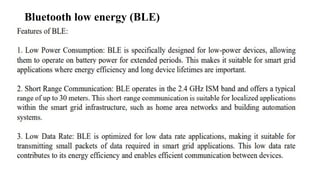
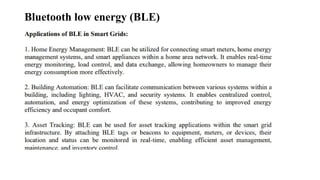
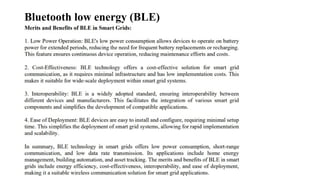
Bluetooth low energy (BLE)
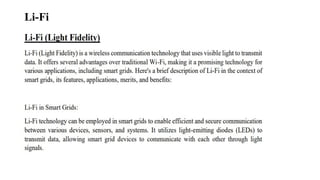
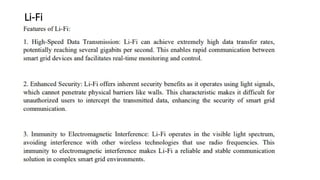
Li-Fi
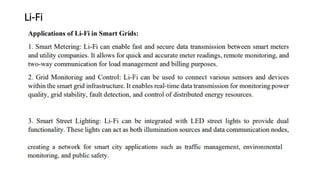
Li-Fi
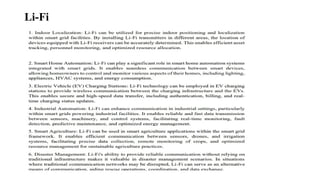
Li-Fi
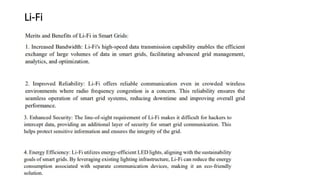
Li-Fi
Li-Fi
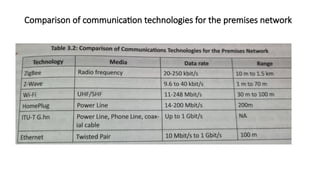
Comparison of communication technologies for the premises network
COMMUNICATION PROTOCOLS IN
SMART GRID
OSGP (Open Smart Grid Protocol):
• Open Smart Grid Protocol (OSGP) is a family of open
communication protocols that facilitate the exchange of
data and control messages between smart grid devices.
• These devices include smart meters, direct load control
(DLC) modules, solar panels, and gateways.
• OSGP is designed to be a reliable, efficient, and secure
communication protocol for the smart grid.
MEP (Multipurpose Expansion Port):
• MEP is a versatile communication interface that provides a
standardized way to connect and exchange data between
various smart grid devices.
• It offers a range of applications in the smart grid ecosystem,
enabling efficient data acquisition, device management, and
control capabilities.
DNP3 (Distributed Network
Protocol):
• DNP3 is a widely used protocol for communication between
supervisory control and data acquisition (SCADA) systems
and field devices, such as smart meters and distributed
energy resources (DERs).
• It is a robust and reliable protocol that can operate in harsh
environments.
Modbus:
• Modbus is a simple and versatile protocol that is commonly
used for communication between industrial controllers and
sensors.
• It is a popular choice for smart grid applications due to its
ease of implementation and wide range of supported
devices.
• It is based on master and slave protocol.
Zigbee (IEEE 802.15.4):
• ZigBee is a low-power, wireless communication protocol that
is well-suited for smart grid applications where low power
consumption and long range are important.
• It is often used for communication between smart meters,
smart appliances, and other low-power devices.
OpenADR (Open Automated Demand
Response):
• OpenADR is a standardized protocol for managing demand
response programs in smart grids.
• It allows utilities to send automated demand response
signals to smart appliances and other devices, enabling
them to reduce their energy consumption during peak
periods.
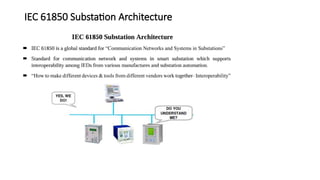
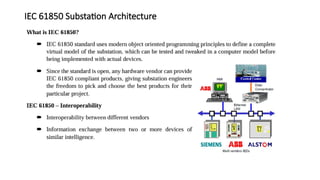
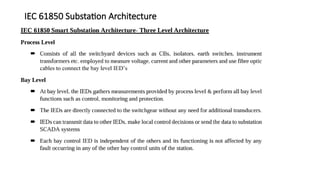
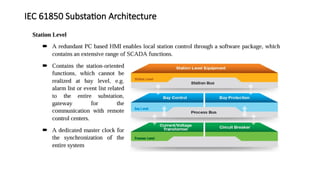
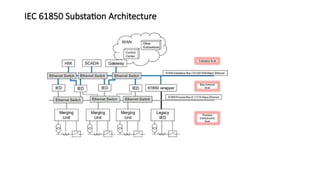
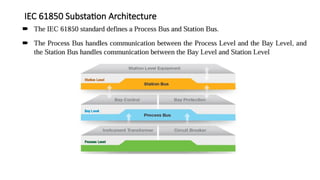
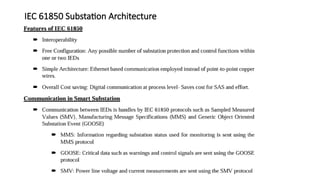
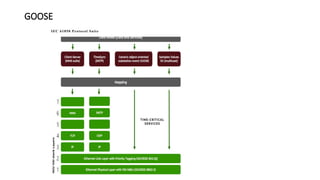
IEC 61850 Substation Architecture
• It is the international information model and protocol for DER
and distribution automation.
• Even when IEC 61850 is not used as the protocol, the IEC
61850 information model forms the basis of other protocols
used for communications with DER systems.
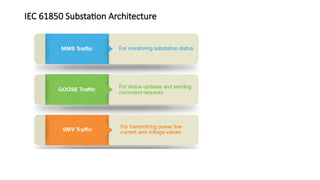
IEC 61850 Substation Architecture
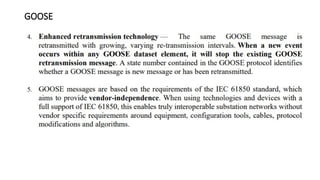
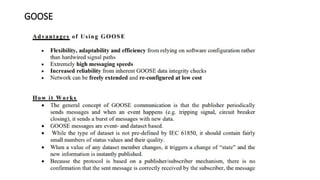
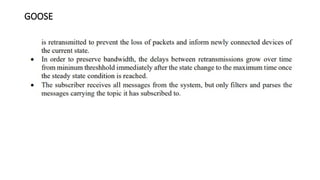
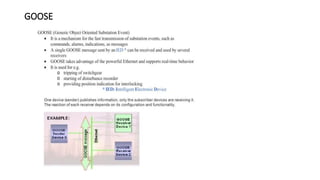
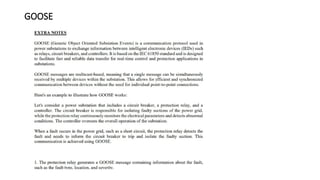
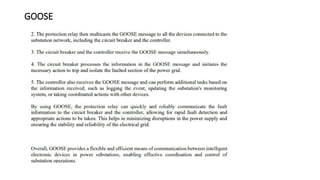
GOOSE
GOOSE
GOOSE
GOOSE
GOOSE
GOOSE
GOOSE
GOOSE
GOOSE
GOOSE
GOOSE
GOOSE
GOOSE
GOOSE

engineering MODULE 2 (2).pptx............................

  • 1.
  • 2.
    Smart grid Communication •The communication network in the smart grid has a hierarchical structure consisting of the premises network : • HAN Home Area Network • BAN Building Area Network • IAN Industrial Area Network • NAN Neighbourhood Area Network • FAN Field Area Network • WAN Wide Area Network
  • 3.
    Wireless • Wireless meanstransmitting signals using radio waves as the medium instead of wires. • Wireless technologies are used for tasks as simple as switching off the television or as complex as supplying the sales force with information from an automated enterprise application while in the field. • Now cordless keyboards and mouse, PDAs, pagers and digital and cellular phones have become part of our daily life.
  • 4.
    Wireless Some of theinherent characteristics of wireless communications systems which make it attractive for users, are given below − • Mobility − A wireless communications system allows users to access information beyond their desk and conduct business from anywhere without having a wire connectivity. • Reachability − Wireless communication systems enable people to be stay connected and be reachable, regardless of the location they are operating from. • Simplicity − Wireless communication system are easy and fast to deploy in comparison of cabled network. Initial setup cost could be a bit high but other advantages overcome that high cost. • Maintainability − In a wireless system, you do not have to spend too much cost and time to maintain the network setup. • Roaming Services − Using a wireless network system, you can provide service any where any time including train, buses, aeroplanes etc. • New Services − Wireless communication systems provide various smart services like SMS and MMS.
  • 5.
    Information flows inSmart Grid Two way information flow between 1. Sensors and electrical appliances to smart meters: HAN - Wireless : ZigBee, 6LowPAN, Z-Wave - Wired: Powerline communication - (Mostly) Unlicensed technologies ,WiFi, Bluetooth 2. Smart meters to utility’s data centre : WAN, NAN - Internet, Cellular Technologies (2G,3G, 4G) - (Mostly) Licensed technologies ,DSL ,Wi-Max
  • 6.
  • 7.
  • 8.
    Smart grid communicationsystem architecture
  • 9.
  • 10.
    ZigBee • ZigBee isbased on an IEEE 802.15 standard. • ZigBee is used in applications that require a low data rate, long battery life, low cost and secure networking. • ZigBee has a defined rate between 20 to 250 kbps. • Frequency bands ~ 868 MHz (20 kbps) for EU and 2.4 GHz (250 kbps) worldwide. • Ideal technology for smart lightning, energy monitoring, home automation, and automatic meter reading. • ZigBee allows connection of up to 60,000 devices to its network. • the consumers can view their energy consumption in real-time. It also allows better energy consumption and real-time dynamic pricing.
  • 11.
    ADVANTAGES • Low price •Small size and it uses relatively small bandwidth. DISADVANTAGES: • Small battery that limits its lifetime • Small memory • Limited data rate and low processing capability. • Moreover, its operation in unlicensed frequency of 868 MHz and 2.4 GHz may have interference with other Wi-Fi, Bluetooth and Microwave signals.
  • 12.
    APPLICATIONS: • Wireless lightswitches • Electrical meters with in-home-displays • Traffic management systems and other consumer and industrial equipment that requires shortrange wireless transfer of data at relatively low rates.
  • 13.
    ZIGBEE Zigbee is alow power, low cost, two-way wireless communication standard for residential home control, commercial building control, and industrial plan management. It is based
  • 14.
  • 15.
    Cellular Networks • Cellularnetworks are largely deployed in most countries and have well-established infrastructure. • Moreover, they allow high data rate communications up to 100 Mbps. • Therefore, the cellular networks can be used for communication between different components and devices in smart grid. • There are several existing technologies for cellular communication such as GSM (Global System for Mobile Communications), GPRS(General Packet Radio Service), 2G, 3G, 4G and WiMAX
  • 16.
    ADVANTAGES: Cellular networks arealready existing infrastructure with wide area of deployment High rates of data transfer Available security algorithms that are already implemented in the cellular communication. DISADVANTAGE : Cellular networks are shared with other users and are not fully dedicated to the smart grid communications , which leads to network congestion.
  • 18.
    3G,4G,5G • As technologycontinues to evolve, so do our mobile networks. In recent years, we’ve seen a shift from 3G to 4G, and now to 5G. Each generation of network offers improved speeds and capabilities 3G: • Third Generation (3G) networks were introduced in the early 2000s and offered significant improvements over 2G networks. • 3G networks provided faster data transfer speeds, allowing for the introduction of mobile internet, video calling, and multimedia messaging. • However, 3G was relatively slow, with maximum speeds typically ranging from 384 kbps to 3 Mbps.
  • 19.
    3G,4G,5G 4G: • Fourth Generation(4G) networks were introduced in the late 2000s and provided a significant leap forward in terms of speed and capacity. • 4G networks were created to provide quicker download and upload speeds, lower latency, and higher network capacity. • 4G networks typically offer speeds ranging from 5 Mbps to 1 Gbps, depending on the network and location. 5G: • Fifth Generation (5G) networks are the latest development in mobile technology and represent a significant improvement over 4G. 5G networks are designed to deliver ultra-fast download and upload speeds, ultra-low latency, and support for a massive number of connected devices. • 5G networks are expected to enable new applications such as autonomous vehicles, virtual and augmented reality, and smart cities. • 5G networks are capable of delivering speeds ranging from 1 Gbps to 20 Gbps, depending on the network and location.
  • 20.
    3G,4G,5G The Key Differences: •The primary differences between these generations of networks are speed, capacity, and latency. 5G networks can support a much larger number of connected devices, making it ideal for use in smart homes and other Internet of Things (IoT) applications. • Another key difference is latency. 5G networks have much lower latency than 4G or 3G networks, meaning that data can be transmitted with much less delay. This is important for applications that require real-time interaction, such as gaming or autonomous vehicles. • Each generation of mobile networks has delivered notable advancements in speed, capacity, and capability. • While 5G is already available in some areas, it may take several years for it to become widely available. In the meantime, 4G and 3G networks will continue to play an important role in connecting people and devices around the world.
  • 21.
    Wi-MAX Wireless Broadband Access(WBA) • Broadband wireless is a technology that promises high-speed connection over the air. It uses radio waves to transmit and receive data directly to and from the potential users whenever they want it. Technologies such as 3G, Wi-Fi, WiMAX and UWB work together to meet unique customer needs. • WBA is a point-to-multipoint system which is made up of base station and subscriber equipment. Instead of using the physical connection between the base station and the subscriber, the base station uses an outdoor antenna to send and receive high- speed data and voice-to-subscriber equipment. • WBA offers an effective, complementary solution to wireline broadband, which has become globally recognized by a high percentage of the population.
  • 22.
    Wi-MAX • Acronym forWorldwide Interoperability for Microwave Access. • Based on Wireless MAN technology. • A wireless technology optimized for the delivery of IP centric services over a wide area. • A scalable wireless platform for constructing alternative and complementary broadband networks. • A certification that denotes interoperability of equipment built to the IEEE 802.16 or compatible standard. The IEEE 802.16 Working Group develops standards that address two types of usage models − • A fixed usage model (IEEE 802.16-2004). • A portable usage model (IEEE 802.16e).
  • 23.
    WiMax • WiMax (WorldwideInteroperability for Microwave Access) is a wireless technology that provides high-throughput broadband connections over long distances. • WiMax can provide long distance communications beyond 16 km and in some instances beyond 48 km at data transfer rates of 75 Mbps. • WiMax can communicate out of sight via IEEE 802.16e and can communicate with moving trucks or cars and data transfer rates up to 15 Mbps for mobile connections. • It is optimised to support mobile devices moving up to a speed of 10 km/h. • Even though it supports vehicles moving up to 120 km/h, its performance degrades with the vehicle speed.
  • 24.
    • It hasthe capability to maintain connection with stations moving at up to 350 km/h • It provides low latency • It is based on orthogonal division multiplexing access (OFDMA), which assigns slices of the frequency spectrum to different users, avoiding interference among the users and increasing the spectral efficiency of the system.
  • 25.
  • 26.
  • 27.
  • 28.
  • 29.
  • 30.
  • 31.
  • 32.
  • 33.
  • 34.
    WiFi • The IEEEsuite of standards for wireless LANs, IEEE 802.11, is the most commonly deployed wireless standard within homes. • As such, the devices and integrated circuits (ICs) are relatively cheap, making it an attractive solution. • The data rate of WiFi ranges from 11 Mbps to 54 Mbps. It operates in the 2.4 GHz band, and it has a range of 30–46m. • Higher power consumption than ZigBee (WiFi ~ 700 mW, ZigBee ~ 100 mW). • Applications: Automatic meter reading (AMR), AMI -NAN, home automation
  • 35.
    RF Mesh • RF(Radio Frequency) Mesh is a technology that allows meters and other sensing devices to access the network by securely routing data via nearby meters and relay devices. • RF-based mesh networks have emerged as the leading NAN (Neighborhood Area Network) technology for smart metering applications . • A mesh network forms a network topology by using mesh or star configurations. • Any node not in direct communication range of its target destination will have its data relayed by another node in the mesh • . The electric system shall support two-way communication between the meter and the electric utility. New technologies based on RF mesh networking promise an ideal solution with high functionality and low cost. • RF mesh networking of multiple sensors in a facility may enable industrial and commercial customers to reduce energy costs through profiling energy usage and developing plans that help to avoid demand charges, reduce energy consumption, and improve business processes such as instantaneous and efficient control of HVAC and lighting systems.
  • 36.
    Power Line Communication(PLC) • Power line communication allows data exchange between devices through electrical power lines. • PLC is implemented by adding a modulated carrier signal to the power cables. • High data rate and capacity: 200 Mbps within homes, but low bandwidth for NAN restricts usage. • Since the power distribution system was originally intended for transmission of AC power at typical frequencies of 50 or 60 Hz, power wire circuits have only a limited ability to carry higher frequencies.
  • 37.
    • There canbe interference of communication signals with high order harmonics produced by non-linear loads that is present in the grid such as rectifiers, inverters, etc. In order to overcome this problem, advanced active filters should be used. • In smart grid applications, the plc is used in neighborhood area network communication for connecting between smart meters and local data concentrator (LDC). Advantage : • It is already established, wide-spread infrastructure that reduces installation costs. Disadvantages : • Presence of higher harmonics in the power lines that interfere with communication signals and limited frequency of communication.
  • 38.
    • Ultra Narrowband (UNB): below 3KHz, low data rate, high connectivity over long distances. • Low Data Rate (LDR) Narrow Band (NB): Between 3-500KHz, single carrier based, up to 10kbps . • High Data Rate (HDR) Narrow Band (NB): Upto 1 Mbps, for NAN communication. • Broadband PLC: Above 1.8MHz, short range, used in HAN
  • 39.
    Digital PLC • Homeplugis a power line communication technology using the power line as a provider of electric current and the career of high speed digital data at the same time. • The infrastructure of the Homeplug is the power lines already installed within the home, which makes no new wiring or cable necessary. • Customers can easily establish a high speed power line network by simply plugging adapters into wall outlet into to the wall. • Power line communication is a natural choice for the smart grid, since it can reach AC outlet in the premises so that all electric devices can be connected to achieve smart energy management.
  • 40.
    DSL (Digital SubscriberLines): • High-speed digital data transmission technology that uses the wires of the voice telephone network • Frequency band: 0 - 2.208 Mhz. • Inexpensive • Scalable • Poor data security • High latency, same applications as PLC
  • 41.
    BLUETOOTH • The Bluetoothspecification was designed for personal area networks (PANs) and is, therefore, suitable for HANs. • The specification supports functions such as mesh networking. • it has large latency if many devices are in operation. • It has a very short range of approximately 10 m and a low data rate of 1.5 Mbps. • It operates in the 2.4 GHz band.
  • 42.
  • 43.
  • 44.
  • 45.
  • 46.
  • 47.
  • 48.
  • 49.
  • 50.
  • 51.
    Comparison of communicationtechnologies for the premises network
  • 52.
  • 53.
    OSGP (Open SmartGrid Protocol): • Open Smart Grid Protocol (OSGP) is a family of open communication protocols that facilitate the exchange of data and control messages between smart grid devices. • These devices include smart meters, direct load control (DLC) modules, solar panels, and gateways. • OSGP is designed to be a reliable, efficient, and secure communication protocol for the smart grid.
  • 54.
    MEP (Multipurpose ExpansionPort): • MEP is a versatile communication interface that provides a standardized way to connect and exchange data between various smart grid devices. • It offers a range of applications in the smart grid ecosystem, enabling efficient data acquisition, device management, and control capabilities.
  • 55.
    DNP3 (Distributed Network Protocol): •DNP3 is a widely used protocol for communication between supervisory control and data acquisition (SCADA) systems and field devices, such as smart meters and distributed energy resources (DERs). • It is a robust and reliable protocol that can operate in harsh environments.
  • 56.
    Modbus: • Modbus isa simple and versatile protocol that is commonly used for communication between industrial controllers and sensors. • It is a popular choice for smart grid applications due to its ease of implementation and wide range of supported devices. • It is based on master and slave protocol.
  • 57.
    Zigbee (IEEE 802.15.4): •ZigBee is a low-power, wireless communication protocol that is well-suited for smart grid applications where low power consumption and long range are important. • It is often used for communication between smart meters, smart appliances, and other low-power devices.
  • 58.
    OpenADR (Open AutomatedDemand Response): • OpenADR is a standardized protocol for managing demand response programs in smart grids. • It allows utilities to send automated demand response signals to smart appliances and other devices, enabling them to reduce their energy consumption during peak periods.
  • 59.
    IEC 61850 SubstationArchitecture • It is the international information model and protocol for DER and distribution automation. • Even when IEC 61850 is not used as the protocol, the IEC 61850 information model forms the basis of other protocols used for communications with DER systems.
  • 60.
  • 61.
  • 62.
  • 63.
  • 64.
  • 65.
  • 66.
  • 67.
  • 68.
  • 69.
  • 70.
  • 71.
  • 72.
  • 73.
  • 74.
  • 75.
  • 76.
  • 77.
  • 78.
  • 79.
  • 80.
  • 81.
  • 82.
  • 83.
  • 84.