GUIDED BY: PREPARED BY:
Prof. S.D.GANDHI Vijay Yadav (140403111014)
Ravi chaudhri(140403111016)
Sankalchand Patel collage of engineering
Subject: wireless communication
Is-95 Stander Cdma
Content
 Introduction
IS-95 Interfaces
Multiple Access
 CDMA
 Forward CDMA Channel of IS-95A
 Overhead Channels
Overhead Channels
Access Channel
 Framing and Signaling on the Traffic Channel
 IS-95 Standard
 Forward CDMA Channel
 Reverse CDMA Channel
 Reference.
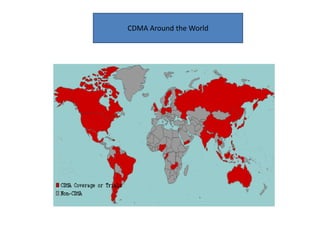
CDMA Around the World
IS 95 interface
• A interface (BSC-MSC) .. this interface is between the BSC and the
MSC. It Supports both the control plane and user plane.
• Abis interface (bts-bsc)—this is the interface between the BSC and
BTS. This is internal interface and generally proprietary.
• B interface (MSC-VLR) this interface is defined by TIA IS-41.
• C interface (MSC-HLR) this interface uses IS-41 messaging as well.
• D interface (HLR-VLR) – HLR-VLR signaling is based on IS-41 as
well. It sits on top of SS7.
• CDMA
– unique digital codes are used to differentiate subscribers
– codes are shared by both MS and BS
– all users share the same range of radio spectrum
• Benefits of CDMA:
– Capacity increases: 4 to 5 times (GSM)
– Improved call quality
– Simplified system planning
– Enhanced privacy
– Improved coverage characteristics
– Increased talk time for portables
– Bandwidth on demand
Multiple Access
• There are two CDMA common air interface standards:
– Cellular (824-894 MHz) - TIA/EIA/IS-95A
– PCS (1850-1990 MHz) - ANSI J-STD-008
They are very similar in their features, with exceptions of the
frequency plan, mobile identities, and related message fields.
• IS-95A
– 45 MHz spacing for forward & reverse channel
– Permissible frequency assignments are on 30 kHz increments
CDMA
• From BSS to MS
• It carries traffic, a pilot signal, and overhead information.
• Pilot is a spread but unmodulated
• Pilot and overhead channels establish the system timing and station identity.
• Pilot channel is also used in the mobile-assisted handoff (MAHO) process
as a signal strength reference.
Forward CDMA Channel of IS-95A
• There are three types of overhead channel in the forward link:
– pilot, is required in every station
– sync
– Paging
• Pilot channel
– pure short code with no additional cover or information content
– always code channel zero
– a demodulation reference for the mobile receivers and for handoff level
measurements
– carries no information
– all stations use the same short code, distinguished by the phase
Overhead Channels
• Paging channel
– used to communicate with MSs when they are not assigned to a traffic
channel
– successful accesses are normally followed by an assignment to a
dedicated traffic channel
– paging channel may run at either 4800 or 9600 bps
– each BS must have at least one paging channel per sector, on at least
one of the frequencies in use
Overhead Channels
• Access Channel provides communications from MS to BS when MS is not
using a Traffic Channel.
• All Access Channel use 4800 bps mode
• Access Channel Message:
– call origination
– response to pages
– orders
– Registrations
• Control of Access Channel transmission is accomplished through the
Access Parameter Message sent on the Paging Channel
Access Channel
• Both forward & reverse Traffic Channels use 20 ms frames.
• Frames can be sent at 9600, 4800, 2400, or 1200 bps
• Signaling
– blank-and-burst signaling:
• sent at 9600 bps
• replace one or more frames of primary traffic data
– dim-and-burst signaling:
• sent at 9600 bps
• sends both signaling and primary traffic data in a frame
• degradation in voice quality is essentially undetectable
Framing and Signaling on the Traffic Channel
• Forward Link
– Pilot Channel
– Sync Channel
– Paging Channels (max. 7)
– Traffic Channels
• Power Control Sub-Channel
• Reverse Link
– Access Channels
– Traffic Channels
IS-95 Standard
IS-95
CDMA is an access method.
IS-95 was the first ‘operating system’ to use CDMA
•Invented by Qualcomm
•Began production in 1995.
•At this point, this is still called 2G wireless.
•Known as a narrowband system.
Being supplanted by CDMA2000 (WCDMA) and UMTS, fully 3G
systems.
•They both use CDMA.
• Known as wideband systems.
IS-95 Vocoders
 IS-95 uses extremely advanced vocoders that use variable encoding rates just
like GSM.
 They operate at variable rates, up to a maximum of 9600 bps.
 At a minimum, it encodes 1200 bps, so that the phone doesn’t seem dead.
 The quality, though less than AMPS, is much higher than GSM, on average.
Operates in the same bandwidth as GSM:
•1850 to 1910 mhz mobile to base
•1930 – 1990 mhz base to mobile
Channels are 1.25 mhz
•3.75 mhz in CDMA 2000, 5 MHZ in UMTS
•Results in approximately only 48 forward/reverse channel pairs in IS-
95.
 Adjacent cell phone towers use the exact same channels as all other
towers.
•This is a major difference.
•Allows for much better frequency reuse and makes setting up a
cellular network much easier.
How IS-95 Works
• E Interface (MSC-MSC)– Inter MSC signaling is defined in IS-41.
• L interface (MSC-IWF) This interface allows the ability for circuit
switched data in second generation network.
• Um Interface (BS-MS) – This is the air interface between the mobile and
the network.
Reference
www.google.com
www.wikipedia.com
www.is95cmda.com
THANK YOU

Wireless communication is 95 stander cdma

  • 1.
    GUIDED BY: PREPAREDBY: Prof. S.D.GANDHI Vijay Yadav (140403111014) Ravi chaudhri(140403111016) Sankalchand Patel collage of engineering Subject: wireless communication Is-95 Stander Cdma
  • 2.
    Content  Introduction IS-95 Interfaces MultipleAccess  CDMA  Forward CDMA Channel of IS-95A  Overhead Channels Overhead Channels Access Channel  Framing and Signaling on the Traffic Channel  IS-95 Standard  Forward CDMA Channel  Reverse CDMA Channel  Reference.
  • 3.
  • 4.
    IS 95 interface •A interface (BSC-MSC) .. this interface is between the BSC and the MSC. It Supports both the control plane and user plane. • Abis interface (bts-bsc)—this is the interface between the BSC and BTS. This is internal interface and generally proprietary. • B interface (MSC-VLR) this interface is defined by TIA IS-41. • C interface (MSC-HLR) this interface uses IS-41 messaging as well. • D interface (HLR-VLR) – HLR-VLR signaling is based on IS-41 as well. It sits on top of SS7.
  • 5.
    • CDMA – uniquedigital codes are used to differentiate subscribers – codes are shared by both MS and BS – all users share the same range of radio spectrum • Benefits of CDMA: – Capacity increases: 4 to 5 times (GSM) – Improved call quality – Simplified system planning – Enhanced privacy – Improved coverage characteristics – Increased talk time for portables – Bandwidth on demand Multiple Access
  • 6.
    • There aretwo CDMA common air interface standards: – Cellular (824-894 MHz) - TIA/EIA/IS-95A – PCS (1850-1990 MHz) - ANSI J-STD-008 They are very similar in their features, with exceptions of the frequency plan, mobile identities, and related message fields. • IS-95A – 45 MHz spacing for forward & reverse channel – Permissible frequency assignments are on 30 kHz increments CDMA
  • 7.
    • From BSSto MS • It carries traffic, a pilot signal, and overhead information. • Pilot is a spread but unmodulated • Pilot and overhead channels establish the system timing and station identity. • Pilot channel is also used in the mobile-assisted handoff (MAHO) process as a signal strength reference. Forward CDMA Channel of IS-95A
  • 8.
    • There arethree types of overhead channel in the forward link: – pilot, is required in every station – sync – Paging • Pilot channel – pure short code with no additional cover or information content – always code channel zero – a demodulation reference for the mobile receivers and for handoff level measurements – carries no information – all stations use the same short code, distinguished by the phase Overhead Channels
  • 9.
    • Paging channel –used to communicate with MSs when they are not assigned to a traffic channel – successful accesses are normally followed by an assignment to a dedicated traffic channel – paging channel may run at either 4800 or 9600 bps – each BS must have at least one paging channel per sector, on at least one of the frequencies in use Overhead Channels
  • 10.
    • Access Channelprovides communications from MS to BS when MS is not using a Traffic Channel. • All Access Channel use 4800 bps mode • Access Channel Message: – call origination – response to pages – orders – Registrations • Control of Access Channel transmission is accomplished through the Access Parameter Message sent on the Paging Channel Access Channel
  • 11.
    • Both forward& reverse Traffic Channels use 20 ms frames. • Frames can be sent at 9600, 4800, 2400, or 1200 bps • Signaling – blank-and-burst signaling: • sent at 9600 bps • replace one or more frames of primary traffic data – dim-and-burst signaling: • sent at 9600 bps • sends both signaling and primary traffic data in a frame • degradation in voice quality is essentially undetectable Framing and Signaling on the Traffic Channel
  • 12.
    • Forward Link –Pilot Channel – Sync Channel – Paging Channels (max. 7) – Traffic Channels • Power Control Sub-Channel • Reverse Link – Access Channels – Traffic Channels IS-95 Standard
  • 13.
    IS-95 CDMA is anaccess method. IS-95 was the first ‘operating system’ to use CDMA •Invented by Qualcomm •Began production in 1995. •At this point, this is still called 2G wireless. •Known as a narrowband system. Being supplanted by CDMA2000 (WCDMA) and UMTS, fully 3G systems. •They both use CDMA. • Known as wideband systems.
  • 14.
    IS-95 Vocoders  IS-95uses extremely advanced vocoders that use variable encoding rates just like GSM.  They operate at variable rates, up to a maximum of 9600 bps.  At a minimum, it encodes 1200 bps, so that the phone doesn’t seem dead.  The quality, though less than AMPS, is much higher than GSM, on average.
  • 15.
    Operates in thesame bandwidth as GSM: •1850 to 1910 mhz mobile to base •1930 – 1990 mhz base to mobile Channels are 1.25 mhz •3.75 mhz in CDMA 2000, 5 MHZ in UMTS •Results in approximately only 48 forward/reverse channel pairs in IS- 95.  Adjacent cell phone towers use the exact same channels as all other towers. •This is a major difference. •Allows for much better frequency reuse and makes setting up a cellular network much easier. How IS-95 Works
  • 16.
    • E Interface(MSC-MSC)– Inter MSC signaling is defined in IS-41. • L interface (MSC-IWF) This interface allows the ability for circuit switched data in second generation network. • Um Interface (BS-MS) – This is the air interface between the mobile and the network.
  • 17.
  • 18.