UNIVERSITY OF SOUTHERN MINDANAO
CHAPTER 10: Psychosocial Development in
Middle Childhood
Niones, Dexter
James
Viado, Ria Czarina
Gabudao, Karyl
Insert Running Title 2
The Developing Self
• The cognitive growth that takes place during middle childhood
enables children to develop more complex concepts of themselves
and to gain in emotional understanding and control.
SELF-CONCEPT DEVELOPMENT: REPRESENTATIONAL SYSTEMS
at around age 7 or 8, children reach the third stage of self-
concept development. At this time judgments about the self
become more conscious, realistic, balanced, and comprehensive
as children form representational systems: broad, inclusive self-
concepts that integrate various aspects of the self
Insert Running Title 3
INDUSTRY VERSUS INFERIORITY
According to Erikson (1982), a major determinant of self-
esteem is children’s view of their capacity for productive work,
which develops in his fourth stage of psychosocial
development: industry versus inferiority
• In the event that children are unable to obtain the praise of
adults or peers in their lives, or lack motivation and self-
esteem, they may develop a feeling of low self-worth, and
thus develop a sense of inferiority
Insert Running Title 4
EMOTIONAL GROWTH
As children grow older, they are more aware of their own and
other people’s feelings. They can better regulate or control their
emotions and can respond to others’ emotional distress (Saarni,
Campos, Camras, & Witherington, 2006)
Children learn what makes them angry, fearful, or sad and how
other people react to displays of these emotions.
Children also start to understand conflicting emotions (Zajdel,
Bloom, Fireman, & arsen, 2013)
• By age 7 or 8, children typically are aware of feeling shame and
pride, and they have a clearer idea of the difference between
guilt and shame
Insert Running Title 5
The Child in the Family
To understand the child in the family, we need to look at the
family environment—its atmosphere and structure.
• FAMILY ATMOSPHERE
Parenting Issues: From Control to Coregulation
Control gradually shifts from parents to child.
Children begin to request certain types of experiences,
negotiate for desired objects, and communicate their shifting
needs to parents.
• Middle childhood brings a transitional stage of coregulation in
which parent and child share power
Insert Running Title 6
The Child in the Family
Children exposed to high levels of family conflict are more likely
to show a variety of responses that can include externalizing or
internalizing behaviors
Internalizing behaviors
• Include anxiety, fearfulness, and depression—anger turned
inward.
Externalizing behavior
• Include aggression, fighting, disobedience, and hostility—
anger turned outward
The Child in the Family
The influence of parental control strategies is shaped by the cultural
context in which it occurs.
We cannot say a particular parenting strategy is “good” or “bad”
without taking into account the culture in which it occurs.
Maternal Employment
In general, the more satisfied a mother is with her employment
status, the more effective she is likely to be as a parent
The Child in the Family
 There are relatively few differences in child well-being regardless
of whether children live with biological cohabitating families,
married/cohabitating stepfamilies, or blended families
-Family instability, however, may be harmful
Adjusting to Divorce
Divorce is stressful for children, children may not fully understand
what is happening.
Living in a One-Parent Family
 can result from divorce or separation, unwed parenthood, or
death
Living in a Cohabiting Family
Approximately 17 percent of births in the United States are to
cohabitating couples—in other words, unmarried partners living
together
The Child in the Family
Poverty and Parenting
Poverty can harm children’s development through a multitude of
pathways. Parents who live in poverty are likely to become anxious,
depressed, and irritable and thus may become less affectionate with
and responsive to their children.
FAMILY STRUCTURE
In earlier generations, the vast majority of children grew up in
families with two married parents. Today, although about 2 out of 3
children under 18 live with two married biological, adoptive, or
stepparents
11
Living in a Stepfamily
Most divorced parents eventually remarry, and many unwed
mothers marry men who were not the father of their children,
forming step-, or blended, families.
Living with Gay or Lesbian Parent
Being raised by same-sex couples.
Insert Running Title
12
Adoptive Families
Adoption is found in all cultures throughout history. It is not
only for infertile people; single people, older people, gay and
lesbian couples, and people who already have biological
children have become adoptive parents.
Insert Running Title
13
Sibling Relationships
The number of siblings in a family relationships
spacing, birth order, and gender often determine
roles and relationships.
Insert Running Title
14
The Child in the Peer Group
POSITIVE AND NEGATIVE EFFECTS OF PEER
RELATIONS
The peer group helps children learn how to adjust their needs
and desires to those of others, when to yield, and when to
stand firm. In comparing themselves to others their age,
children can gauge their abilities and gain a clearer sense of
self-efficacy.
Unfortunately, peer groups may also reinforce prejudice:
unfavorable attitudes toward outsiders, especially members of
certain racial or ethnic groups.
Insert Running Title
15
Gender and Peer Group
Boys and girls peer groups engage in different types of activities.
Groups of boys more consistently pursue gender-typed activities,
while those of girls are more likely to engage in cross-gender
activities, such as team sports
Popularity
Popularity is important in middle childhood. Schoolchildren whose
peers like them are likely to be well adjusted as adolescents.
Those who have trouble getting along with peers are more likely
to develop psychological problems, drop out of school, or become
delinquent.
Insert Running Title
16
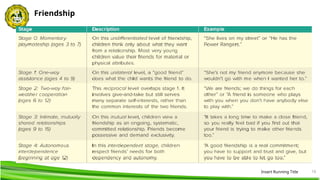
Friendship
Insert Running Title
17
Aggression and Bullying
Instrumental aggression - aggression aimed at achieving an
objective—the hallmark of the preschool period—becomes
much less common.
Hostile aggression - aggression intended to hurt another
person, proportionately increases, often taking verbal rather
than physical form.
Insert Running Title
18
Types of Aggression and Social Information Processing
Hostile attribution bias - Tendency to perceive others
as trying to hurt one and to strike out in retaliation or
self-defense.
Insert Running Title
19
The Influence of Media Violence on Aggression
Children are more vulnerable than adults to the
influence of televised violence. The influence is
stronger if the child believes the violence on the screen
is real, identifies with the violent character, finds that
character attractive, and watches without parental
supervision or intervention. Highly aggressive children
are more strongly affected by media violence than are
less aggressive children.
Insert Running Title
20
Bullies and Victims
Aggression becomes bullying when it is deliberately,
persistently directed against a particular target: a victim.
Bullying can be physical, verbal, or relational or emotional.
Cyberbullying—posting negative comments or derogatory
photos of the victim on a website—has become increasingly
common. The increase in use of cell phones, text messaging, e-
mail, and social
media use has opened new venues for bullies that provide
access to victims without the protection of family and
community.
Insert Running Title
UNIVERSITY OF SOUTHERN MINDANAO
Mental Health
Insert Running Title
21
Insert Running Title 22
Disruptive Conduct Disorders
Temper tantrums and defiant, argumentative, hostile, or deliberately
annoying behavior—common among 4- and 5-year-olds—typically are
out-grown by middle childhood as children get better at controlling
these behaviors (Miner & Clarke-Sterwart, 2009).
• Oppositional defiant disorder (ODD)
Pattern of behavior, persisting into middle childhood, marked by
negativity, hostility, and defiance.
• conduct disorder (CD)
Repetitive, persistent pattern of aggressive, antisocial behavior
violating societal norms or the rights of others.
Insert Running Title 23
School Phobia and Other Anxiety
Disorders
• School phobia
Unrealistic fear of going to school; may be a form of separation
anxiety disorder or social phobia.
• Separation anxiety disorder
Condition involving excessive, prolonged anxiety concerning
separation from home or from people to whom a person is attached.
• Social phobia
Extreme fear and/or avoidance of social situations.
• Generalized anxiety disorder
Anxiety not focused on any single target.
Insert Running Title 24
School Phobia and Other Anxiety
Disorders
• Obsessive-compulsive disorder (OCD)
Anxiety aroused by repetitive, intrusive thoughts, images, or
impulses, often leading to compulsive ritual behaviors.
• childhood depression
Mood disorder characterized by such symptoms as a
prolonged sense of friendlessness, inability to have fun or
concentrate, fatigue, extreme activity or apathy, feelings of
worthlessness, weight change, physical complaints, and
thoughts of death or suicide
Insert Running Title 25
TREATMENT TECHNIQUES
• Individual psychotherapy
Psychological treatment in which a therapist sees a troubled
person one-on-one.
• Family Therapy
Psychological treatment in which a therapist sees the whole
family together to analyze patterns of family functioning.
• Behavior Therapy
Therapeutic approach using principles of learning theory to
encourage desired behaviors or eliminate undesired ones;
also called behavior modification.
Insert Running Title 26
TREATMENT TECHNIQUES
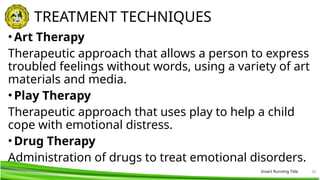
•Art Therapy
Therapeutic approach that allows a person to express
troubled feelings without words, using a variety of art
materials and media.
•Play Therapy
Therapeutic approach that uses play to help a child
cope with emotional distress.
•Drug Therapy
Administration of drugs to treat emotional disorders.
Insert Running Title 27
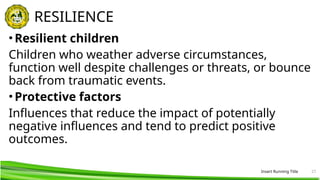
RESILIENCE
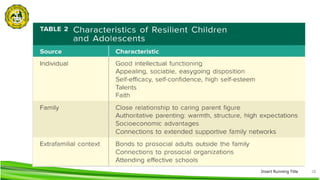
•Resilient children
Children who weather adverse circumstances,
function well despite challenges or threats, or bounce
back from traumatic events.
•Protective factors
Influences that reduce the impact of potentially
negative influences and tend to predict positive
outcomes.
Insert Running Title 28
Insert Running Title 29
THANK YOU FOR LISTENING!

Chapter-10-DEV-PSYCH-FINAL.pptx dodvnfokvn

  • 1.
    UNIVERSITY OF SOUTHERNMINDANAO CHAPTER 10: Psychosocial Development in Middle Childhood Niones, Dexter James Viado, Ria Czarina Gabudao, Karyl
  • 2.
    Insert Running Title2 The Developing Self • The cognitive growth that takes place during middle childhood enables children to develop more complex concepts of themselves and to gain in emotional understanding and control. SELF-CONCEPT DEVELOPMENT: REPRESENTATIONAL SYSTEMS at around age 7 or 8, children reach the third stage of self- concept development. At this time judgments about the self become more conscious, realistic, balanced, and comprehensive as children form representational systems: broad, inclusive self- concepts that integrate various aspects of the self
  • 3.
    Insert Running Title3 INDUSTRY VERSUS INFERIORITY According to Erikson (1982), a major determinant of self- esteem is children’s view of their capacity for productive work, which develops in his fourth stage of psychosocial development: industry versus inferiority • In the event that children are unable to obtain the praise of adults or peers in their lives, or lack motivation and self- esteem, they may develop a feeling of low self-worth, and thus develop a sense of inferiority
  • 4.
    Insert Running Title4 EMOTIONAL GROWTH As children grow older, they are more aware of their own and other people’s feelings. They can better regulate or control their emotions and can respond to others’ emotional distress (Saarni, Campos, Camras, & Witherington, 2006) Children learn what makes them angry, fearful, or sad and how other people react to displays of these emotions. Children also start to understand conflicting emotions (Zajdel, Bloom, Fireman, & arsen, 2013) • By age 7 or 8, children typically are aware of feeling shame and pride, and they have a clearer idea of the difference between guilt and shame
  • 5.
    Insert Running Title5 The Child in the Family To understand the child in the family, we need to look at the family environment—its atmosphere and structure. • FAMILY ATMOSPHERE Parenting Issues: From Control to Coregulation Control gradually shifts from parents to child. Children begin to request certain types of experiences, negotiate for desired objects, and communicate their shifting needs to parents. • Middle childhood brings a transitional stage of coregulation in which parent and child share power
  • 6.
    Insert Running Title6 The Child in the Family Children exposed to high levels of family conflict are more likely to show a variety of responses that can include externalizing or internalizing behaviors Internalizing behaviors • Include anxiety, fearfulness, and depression—anger turned inward. Externalizing behavior • Include aggression, fighting, disobedience, and hostility— anger turned outward
  • 7.
    The Child inthe Family The influence of parental control strategies is shaped by the cultural context in which it occurs. We cannot say a particular parenting strategy is “good” or “bad” without taking into account the culture in which it occurs. Maternal Employment In general, the more satisfied a mother is with her employment status, the more effective she is likely to be as a parent
  • 8.
    The Child inthe Family  There are relatively few differences in child well-being regardless of whether children live with biological cohabitating families, married/cohabitating stepfamilies, or blended families -Family instability, however, may be harmful Adjusting to Divorce Divorce is stressful for children, children may not fully understand what is happening.
  • 9.
    Living in aOne-Parent Family Living in a One-Parent Family  can result from divorce or separation, unwed parenthood, or death Living in a Cohabiting Family Approximately 17 percent of births in the United States are to cohabitating couples—in other words, unmarried partners living together
  • 10.
    The Child inthe Family Poverty and Parenting Poverty can harm children’s development through a multitude of pathways. Parents who live in poverty are likely to become anxious, depressed, and irritable and thus may become less affectionate with and responsive to their children. FAMILY STRUCTURE In earlier generations, the vast majority of children grew up in families with two married parents. Today, although about 2 out of 3 children under 18 live with two married biological, adoptive, or stepparents
  • 11.
    11 Living in aStepfamily Most divorced parents eventually remarry, and many unwed mothers marry men who were not the father of their children, forming step-, or blended, families. Living with Gay or Lesbian Parent Being raised by same-sex couples. Insert Running Title
  • 12.
    12 Adoptive Families Adoption isfound in all cultures throughout history. It is not only for infertile people; single people, older people, gay and lesbian couples, and people who already have biological children have become adoptive parents. Insert Running Title
  • 13.
    13 Sibling Relationships The numberof siblings in a family relationships spacing, birth order, and gender often determine roles and relationships. Insert Running Title
  • 14.
    14 The Child inthe Peer Group POSITIVE AND NEGATIVE EFFECTS OF PEER RELATIONS The peer group helps children learn how to adjust their needs and desires to those of others, when to yield, and when to stand firm. In comparing themselves to others their age, children can gauge their abilities and gain a clearer sense of self-efficacy. Unfortunately, peer groups may also reinforce prejudice: unfavorable attitudes toward outsiders, especially members of certain racial or ethnic groups. Insert Running Title
  • 15.
    15 Gender and PeerGroup Boys and girls peer groups engage in different types of activities. Groups of boys more consistently pursue gender-typed activities, while those of girls are more likely to engage in cross-gender activities, such as team sports Popularity Popularity is important in middle childhood. Schoolchildren whose peers like them are likely to be well adjusted as adolescents. Those who have trouble getting along with peers are more likely to develop psychological problems, drop out of school, or become delinquent. Insert Running Title
  • 16.
  • 17.
    17 Aggression and Bullying Instrumentalaggression - aggression aimed at achieving an objective—the hallmark of the preschool period—becomes much less common. Hostile aggression - aggression intended to hurt another person, proportionately increases, often taking verbal rather than physical form. Insert Running Title
  • 18.
    18 Types of Aggressionand Social Information Processing Hostile attribution bias - Tendency to perceive others as trying to hurt one and to strike out in retaliation or self-defense. Insert Running Title
  • 19.
    19 The Influence ofMedia Violence on Aggression Children are more vulnerable than adults to the influence of televised violence. The influence is stronger if the child believes the violence on the screen is real, identifies with the violent character, finds that character attractive, and watches without parental supervision or intervention. Highly aggressive children are more strongly affected by media violence than are less aggressive children. Insert Running Title
  • 20.
    20 Bullies and Victims Aggressionbecomes bullying when it is deliberately, persistently directed against a particular target: a victim. Bullying can be physical, verbal, or relational or emotional. Cyberbullying—posting negative comments or derogatory photos of the victim on a website—has become increasingly common. The increase in use of cell phones, text messaging, e- mail, and social media use has opened new venues for bullies that provide access to victims without the protection of family and community. Insert Running Title
  • 21.
    UNIVERSITY OF SOUTHERNMINDANAO Mental Health Insert Running Title 21
  • 22.
    Insert Running Title22 Disruptive Conduct Disorders Temper tantrums and defiant, argumentative, hostile, or deliberately annoying behavior—common among 4- and 5-year-olds—typically are out-grown by middle childhood as children get better at controlling these behaviors (Miner & Clarke-Sterwart, 2009). • Oppositional defiant disorder (ODD) Pattern of behavior, persisting into middle childhood, marked by negativity, hostility, and defiance. • conduct disorder (CD) Repetitive, persistent pattern of aggressive, antisocial behavior violating societal norms or the rights of others.
  • 23.
    Insert Running Title23 School Phobia and Other Anxiety Disorders • School phobia Unrealistic fear of going to school; may be a form of separation anxiety disorder or social phobia. • Separation anxiety disorder Condition involving excessive, prolonged anxiety concerning separation from home or from people to whom a person is attached. • Social phobia Extreme fear and/or avoidance of social situations. • Generalized anxiety disorder Anxiety not focused on any single target.
  • 24.
    Insert Running Title24 School Phobia and Other Anxiety Disorders • Obsessive-compulsive disorder (OCD) Anxiety aroused by repetitive, intrusive thoughts, images, or impulses, often leading to compulsive ritual behaviors. • childhood depression Mood disorder characterized by such symptoms as a prolonged sense of friendlessness, inability to have fun or concentrate, fatigue, extreme activity or apathy, feelings of worthlessness, weight change, physical complaints, and thoughts of death or suicide
  • 25.
    Insert Running Title25 TREATMENT TECHNIQUES • Individual psychotherapy Psychological treatment in which a therapist sees a troubled person one-on-one. • Family Therapy Psychological treatment in which a therapist sees the whole family together to analyze patterns of family functioning. • Behavior Therapy Therapeutic approach using principles of learning theory to encourage desired behaviors or eliminate undesired ones; also called behavior modification.
  • 26.
    Insert Running Title26 TREATMENT TECHNIQUES •Art Therapy Therapeutic approach that allows a person to express troubled feelings without words, using a variety of art materials and media. •Play Therapy Therapeutic approach that uses play to help a child cope with emotional distress. •Drug Therapy Administration of drugs to treat emotional disorders.
  • 27.
    Insert Running Title27 RESILIENCE •Resilient children Children who weather adverse circumstances, function well despite challenges or threats, or bounce back from traumatic events. •Protective factors Influences that reduce the impact of potentially negative influences and tend to predict positive outcomes.
  • 28.
  • 29.
    Insert Running Title29 THANK YOU FOR LISTENING!