Preschool (Part 2)
Piaget’s Preoperational Thinking The Use of Symbolic Thought, Mental Reasoning,& Concepts Symbolic Function The ability to use a mental symbol, a word, or object to stand for or represent  something not present Relation between language & thought Symbolic function is the basis of sophisticated language use in the  Preoperational Stage Language & thinking are interconnected Use of language allows the child to think beyond the present to the future Language = thought or thought = language?
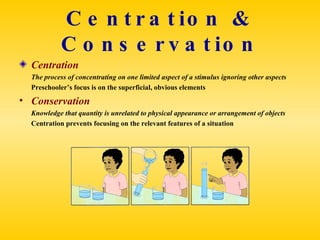
Centration & Conservation Centration The process of concentrating on one limited aspect of a stimulus ignoring other aspects Preschooler’s focus is on the superficial, obvious elements Conservation Knowledge that quantity is unrelated to physical appearance or arrangement of objects Centration prevents focusing on the relevant features of a situation
Preoperational Thinking Egocentricism Thinking that doesn’t take into account others’ viewpoints Takes 2 forms: 1. Lack of awareness that  others see things form a  different perspective 2. Failure to realize that  others may hold thoughts,  feelings, & points of view  different from your own Seen in talking to oneself in the presence of others or ignoring what others are saying
Preoperational Thinking Intuitive Thought Preschooler’s primitive reasoning & keen acquisition of knowledge about the world They begin to understand the concept of  functionality (actions, events, & outcomes are related to each other in fixed patterns) They begin to show awareness of the idea of  identity (certain things stay the same regardless of changes in shape, size, & appearance Both are important to understand conservation Evaluating Piaget Children have the innate ability to count Cognitive skills develop in a more continuous manner than stage theories imply Developmental changes are more quantitative than qualitative as Piaget claims
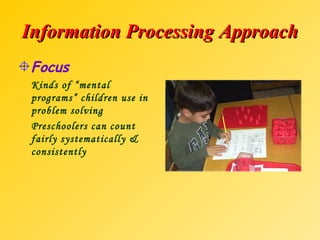
Information Processing Approach Focus Kinds of “mental programs” children use in problem solving Preschoolers can count fairly systematically & consistently
Memory Autobiographical Memory Memory of particular events on one’s life Unless the event is meaningful or vivid, it is likely not to be remembered Cultural factors affect memory Autobiographical memories fade & inaccurately recalled Scripts: broad representations in memory of events & the order in which they occurred Frequent events melded into scripts
Evaluating Information Processing Cognitive Development is Gradual There are improvements with maturity Provides a Comprehensive, Logical Set of Concepts There are no vague ideas Criticisms The focus is on a series of single, individual cognitive processes leaving out other factors that seem to influence cognition It pays too much attention to detailed, individual sequences of processes that are not clearly descriptive of what is happening
Vygotsky Definitions Zone of Proximal Development Level at which a child can almost, but not fully, perform a task  independently, but can do it with assistance from someone more  competent Scaffolding The support for learning & problem solving that encourages  independence & growth Cultural Tools Physical items & intellectual & conceptual framework for solving  problems
Vygotsky Cognitive Development & Social Interaction Tied Together Children are apprentices, learning from adult & peer mentors Cultural & social factors involved in the learning process Children’s cognitive development is dependent on the interaction with others There are differences in how some societies support learning for boys & girls Cultural tools provide a structure that can be used to help children define & solve problems as well as an intellectual POV that encourages cognitive development
Language Growth Syntax Combining words & phrases to form sentences Fast Mapping New words are associated with their meaning only after a brief encounter Grammar Rules that determine how thoughts can be expressed Private Speech Speech spoken & directed to oneself Pragmatics Aspect of language relating to communicating effectively & appropriately with others Social Speech Speech directed toward another & meant to be understood by that person
Language Growth Syntax Increases Frequent Use of Plurals & Possessives Grammar Principles are Understood Private Speech Allows Problem-solving Pragmatics Allows an Understanding of the Basics of Conversation Preschoolers Begin Directing Speech at Others
Language Exposure Living Conditions Affect Language Acquisition The type of language children are exposed to is associated with their performance on IQ tests Family income & living conditions affect general cognitive development & behavior
Early Childhood Education Involvement in Some Form of Education Before Formal Schooling is Beneficial Varieties of early education: Child-care centers Preschools School childcare
Effectiveness of Childcare More Verbal Fluency Memory & Comprehension Advantages Higher IQ Scores More Self-confidence More Independent More Socially Knowledgeable
Sesame Street Significantly Higher Vocabularies Significantly Higher Scores on Measures of Verbal & Math Tend to be Better Readers Spending More Time Reading

Preschool (Pt 2)

  • 1.
  • 2.
    Piaget’s Preoperational ThinkingThe Use of Symbolic Thought, Mental Reasoning,& Concepts Symbolic Function The ability to use a mental symbol, a word, or object to stand for or represent something not present Relation between language & thought Symbolic function is the basis of sophisticated language use in the Preoperational Stage Language & thinking are interconnected Use of language allows the child to think beyond the present to the future Language = thought or thought = language?
  • 3.
    Centration & ConservationCentration The process of concentrating on one limited aspect of a stimulus ignoring other aspects Preschooler’s focus is on the superficial, obvious elements Conservation Knowledge that quantity is unrelated to physical appearance or arrangement of objects Centration prevents focusing on the relevant features of a situation
  • 4.
    Preoperational Thinking EgocentricismThinking that doesn’t take into account others’ viewpoints Takes 2 forms: 1. Lack of awareness that others see things form a different perspective 2. Failure to realize that others may hold thoughts, feelings, & points of view different from your own Seen in talking to oneself in the presence of others or ignoring what others are saying
  • 5.
    Preoperational Thinking IntuitiveThought Preschooler’s primitive reasoning & keen acquisition of knowledge about the world They begin to understand the concept of functionality (actions, events, & outcomes are related to each other in fixed patterns) They begin to show awareness of the idea of identity (certain things stay the same regardless of changes in shape, size, & appearance Both are important to understand conservation Evaluating Piaget Children have the innate ability to count Cognitive skills develop in a more continuous manner than stage theories imply Developmental changes are more quantitative than qualitative as Piaget claims
  • 6.
    Information Processing ApproachFocus Kinds of “mental programs” children use in problem solving Preschoolers can count fairly systematically & consistently
  • 7.
    Memory Autobiographical MemoryMemory of particular events on one’s life Unless the event is meaningful or vivid, it is likely not to be remembered Cultural factors affect memory Autobiographical memories fade & inaccurately recalled Scripts: broad representations in memory of events & the order in which they occurred Frequent events melded into scripts
  • 8.
    Evaluating Information ProcessingCognitive Development is Gradual There are improvements with maturity Provides a Comprehensive, Logical Set of Concepts There are no vague ideas Criticisms The focus is on a series of single, individual cognitive processes leaving out other factors that seem to influence cognition It pays too much attention to detailed, individual sequences of processes that are not clearly descriptive of what is happening
  • 9.
    Vygotsky Definitions Zoneof Proximal Development Level at which a child can almost, but not fully, perform a task independently, but can do it with assistance from someone more competent Scaffolding The support for learning & problem solving that encourages independence & growth Cultural Tools Physical items & intellectual & conceptual framework for solving problems
  • 10.
    Vygotsky Cognitive Development& Social Interaction Tied Together Children are apprentices, learning from adult & peer mentors Cultural & social factors involved in the learning process Children’s cognitive development is dependent on the interaction with others There are differences in how some societies support learning for boys & girls Cultural tools provide a structure that can be used to help children define & solve problems as well as an intellectual POV that encourages cognitive development
  • 11.
    Language Growth SyntaxCombining words & phrases to form sentences Fast Mapping New words are associated with their meaning only after a brief encounter Grammar Rules that determine how thoughts can be expressed Private Speech Speech spoken & directed to oneself Pragmatics Aspect of language relating to communicating effectively & appropriately with others Social Speech Speech directed toward another & meant to be understood by that person
  • 12.
    Language Growth SyntaxIncreases Frequent Use of Plurals & Possessives Grammar Principles are Understood Private Speech Allows Problem-solving Pragmatics Allows an Understanding of the Basics of Conversation Preschoolers Begin Directing Speech at Others
  • 13.
    Language Exposure LivingConditions Affect Language Acquisition The type of language children are exposed to is associated with their performance on IQ tests Family income & living conditions affect general cognitive development & behavior
  • 14.
    Early Childhood EducationInvolvement in Some Form of Education Before Formal Schooling is Beneficial Varieties of early education: Child-care centers Preschools School childcare
  • 15.
    Effectiveness of ChildcareMore Verbal Fluency Memory & Comprehension Advantages Higher IQ Scores More Self-confidence More Independent More Socially Knowledgeable
  • 16.
    Sesame Street SignificantlyHigher Vocabularies Significantly Higher Scores on Measures of Verbal & Math Tend to be Better Readers Spending More Time Reading