Microemulsion: An
Alternate Technology in
Oil Extraction
By
Ashish Gadhave
•Introduction
»Conventional Oil
Extraction Method
»Microemulsion
Conventional Oil Extraction
• Water Distillation, Steam Distillation, Solvent
Extraction, Physical Pressing etc.
• In solvent extraction method, organic solvents
(mostly hexane) is preferred.
• Solvent is then recovered after separating the
oil by evaporation
Disadvantage of Conventional
Methods
• High temperature destroys protein, vitamin E etc.
• Lowering temperature (cold pressing) decreases yield
and increases cost.
• According to US EPA, Organic compounds are major
emission from vegetable oil industries.
• 0.8Kg of hexane per ton of seed is emitted.
• Complete removal of hexane is not possible.
• Health Problem: Atrophy, nerve damage, muscle
wasting.
• Alternate methods need to be developed.
Microemulsion
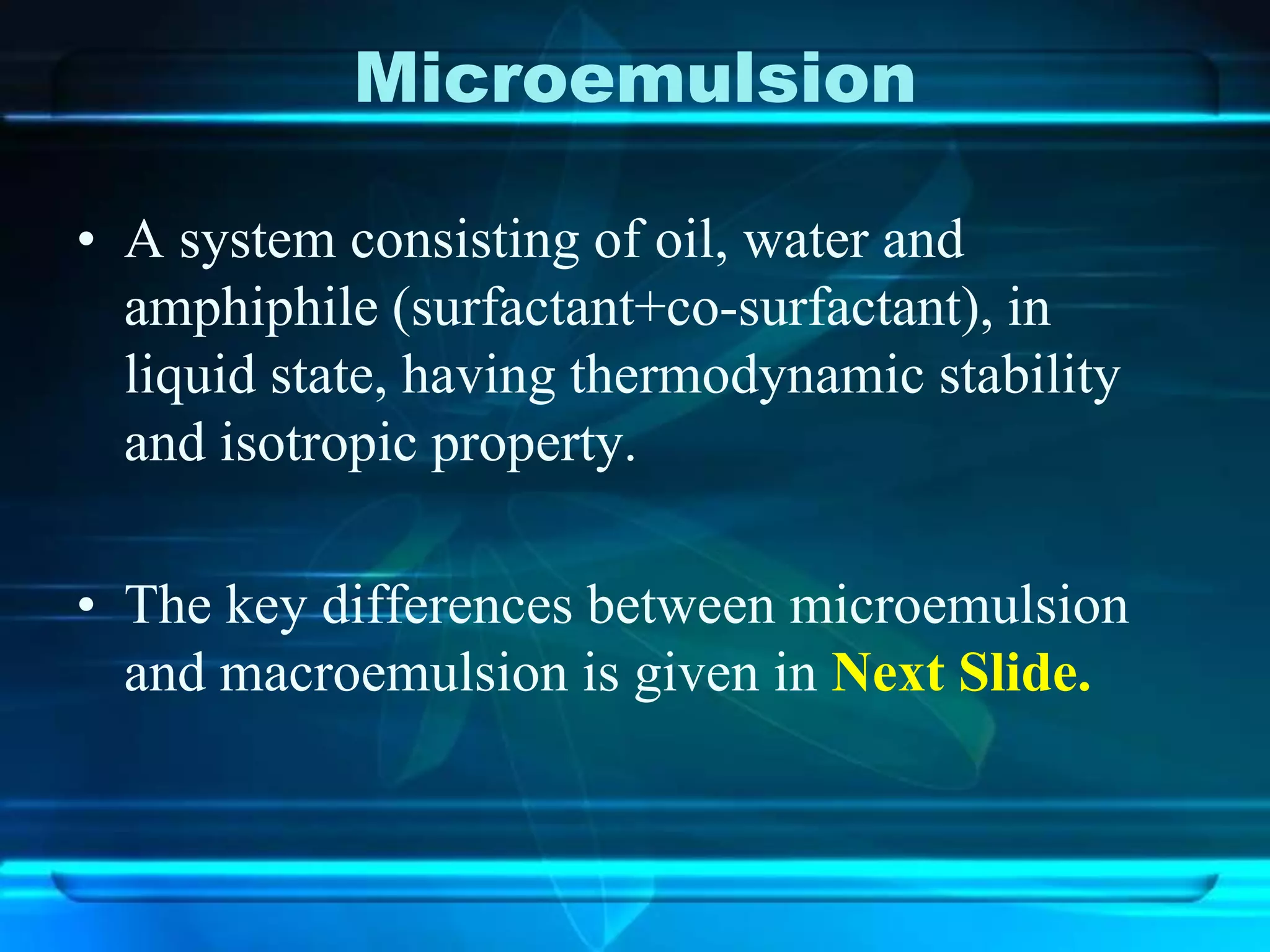
• A system consisting of oil, water and
amphiphile (surfactant+co-surfactant), in
liquid state, having thermodynamic stability
and isotropic property.
• The key differences between microemulsion
and macroemulsion is given in Next Slide.
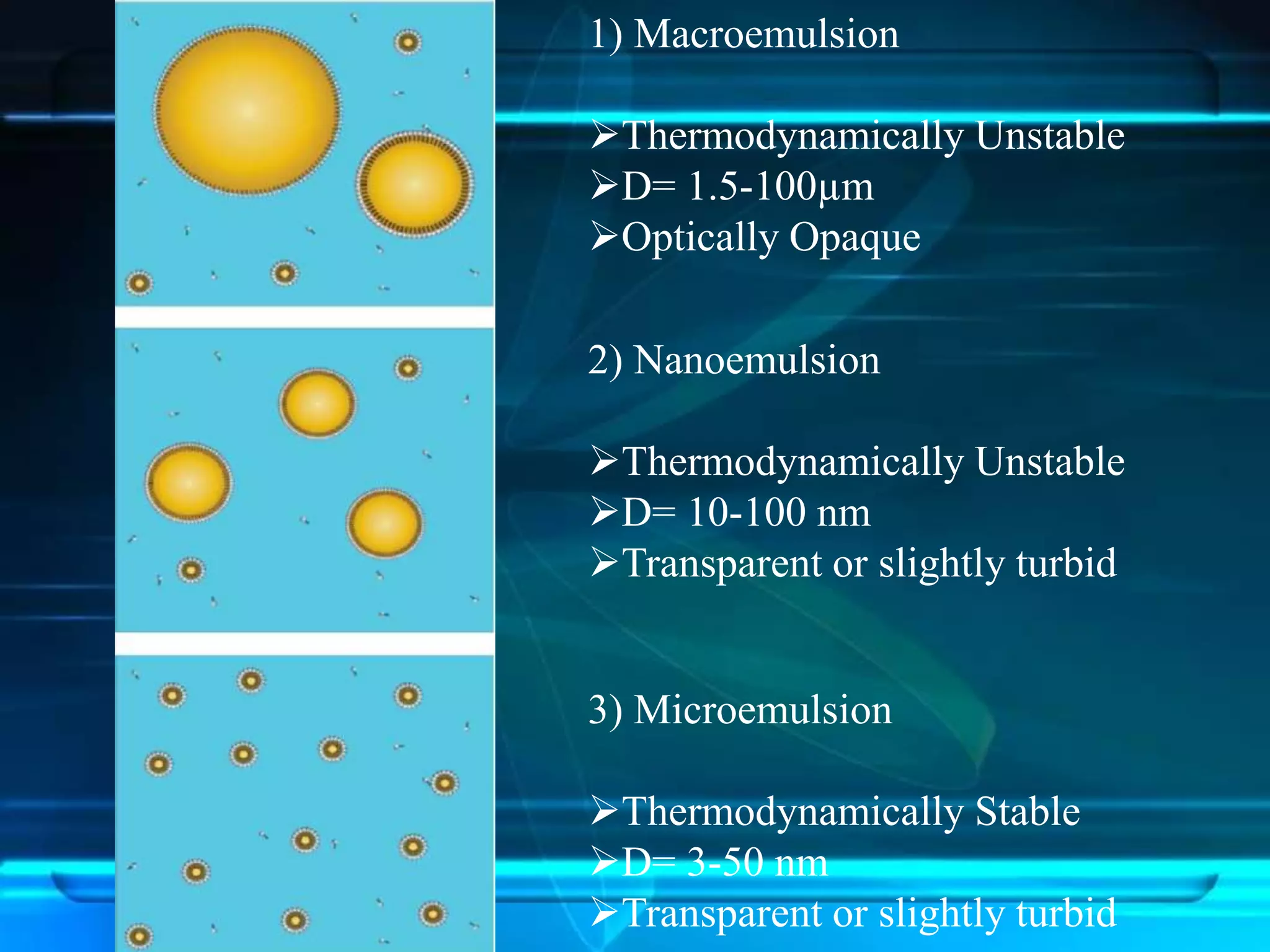
1) Macroemulsion
Thermodynamically Unstable
D= 1.5-100µm
Optically Opaque
2) Nanoemulsion
Thermodynamically Unstable
D= 10-100 nm
Transparent or slightly turbid
3) Microemulsion
Thermodynamically Stable
D= 3-50 nm
Transparent or slightly turbid
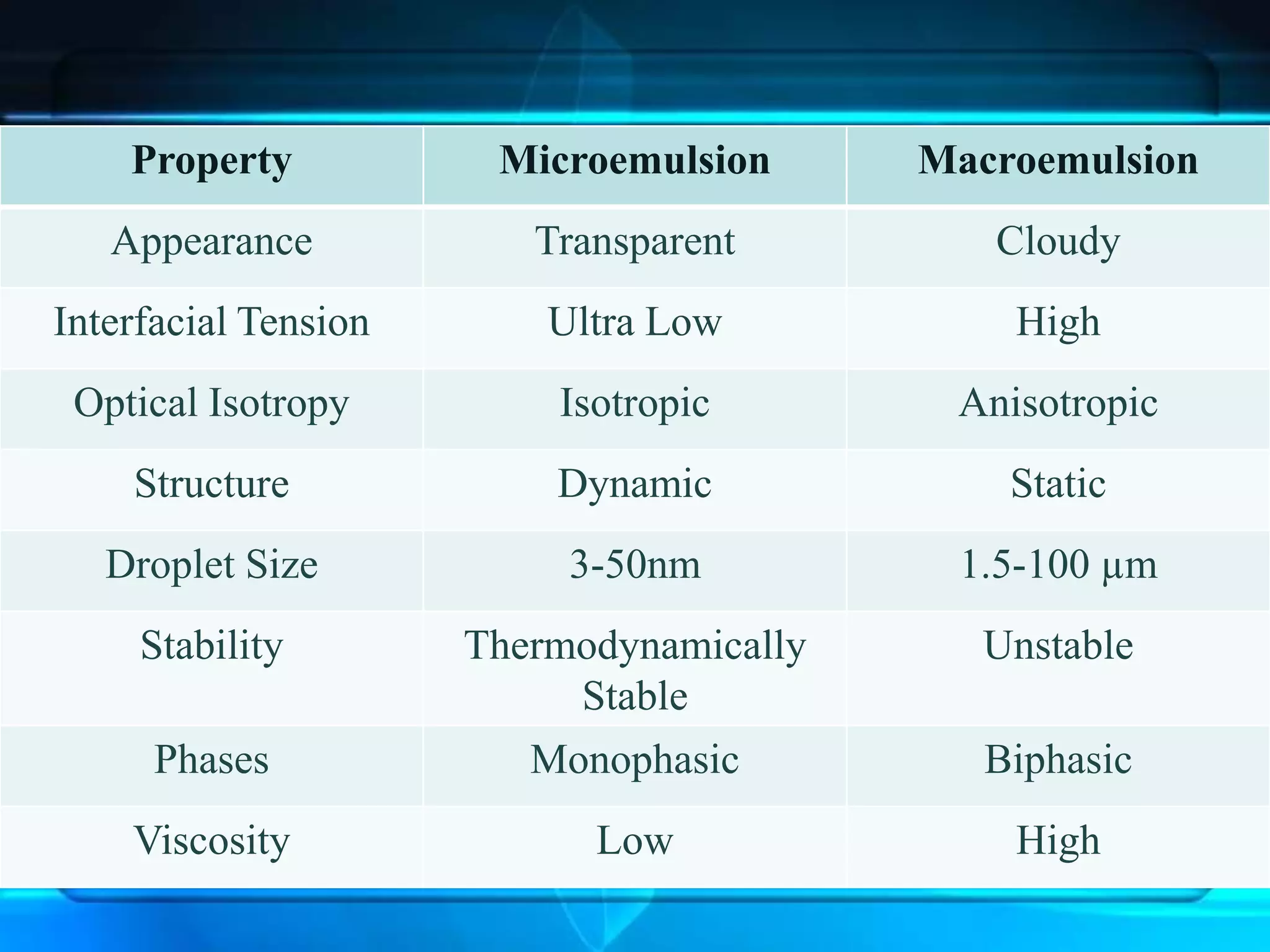
Property Microemulsion Macroemulsion
Appearance Transparent Cloudy
Interfacial Tension Ultra Low High
Optical Isotropy Isotropic Anisotropic
Structure Dynamic Static
Droplet Size 3-50nm 1.5-100 µm
Stability Thermodynamically
Stable
Unstable
Phases Monophasic Biphasic
Viscosity Low High
Main Components of
Microemulsion
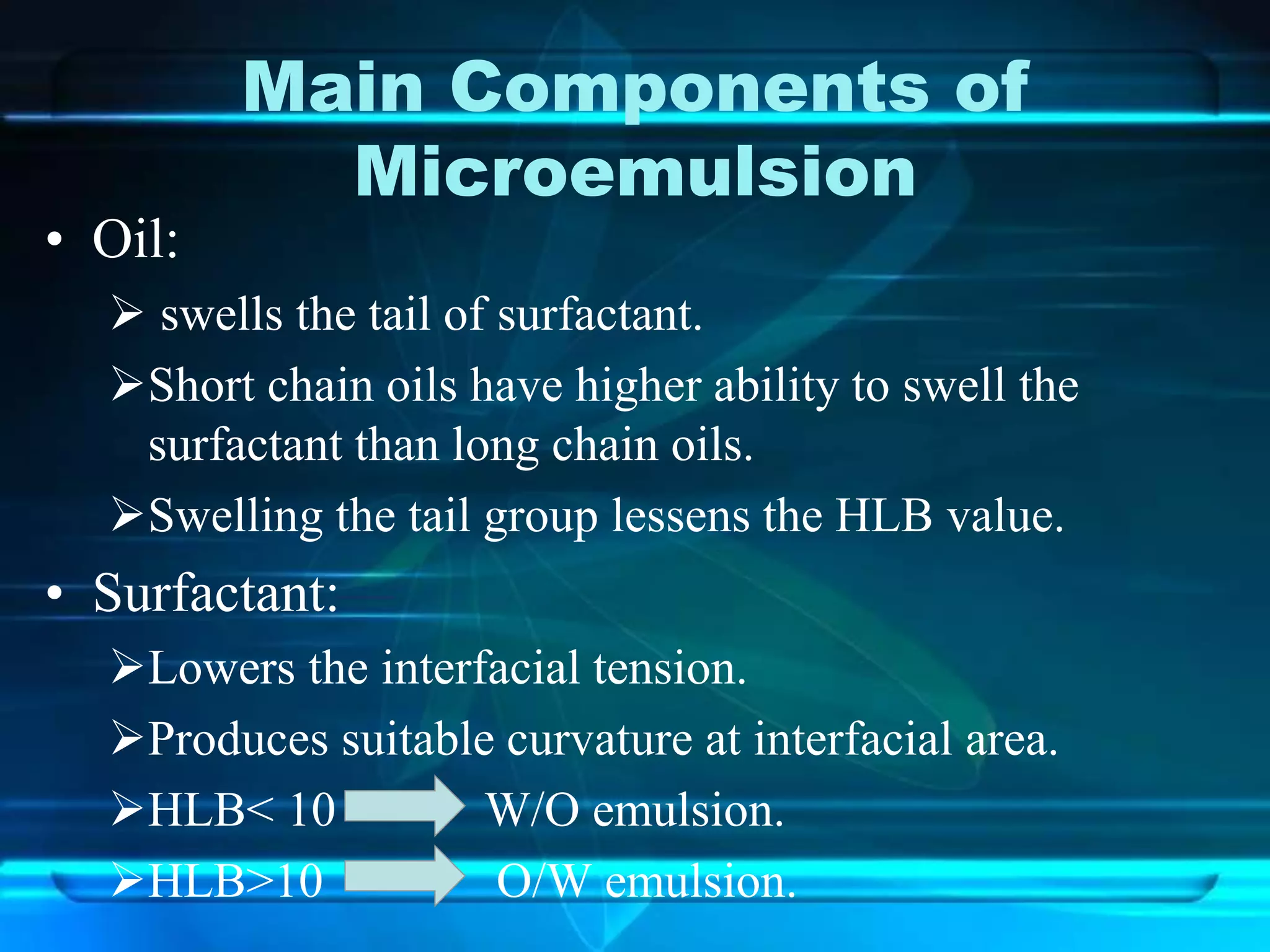
• Oil:
 swells the tail of surfactant.
Short chain oils have higher ability to swell the
surfactant than long chain oils.
Swelling the tail group lessens the HLB value.
• Surfactant:
Lowers the interfacial tension.
Produces suitable curvature at interfacial area.
HLB< 10 W/O emulsion.
HLB>10 O/W emulsion.
Continue…
• Co-surfactant:
Polar head group with short alkyl chain.
Lowers interfacial tension below CMC.
Acts as a spacer between surfactant molecules.
e.g. Pentanol, Hexanol etc.
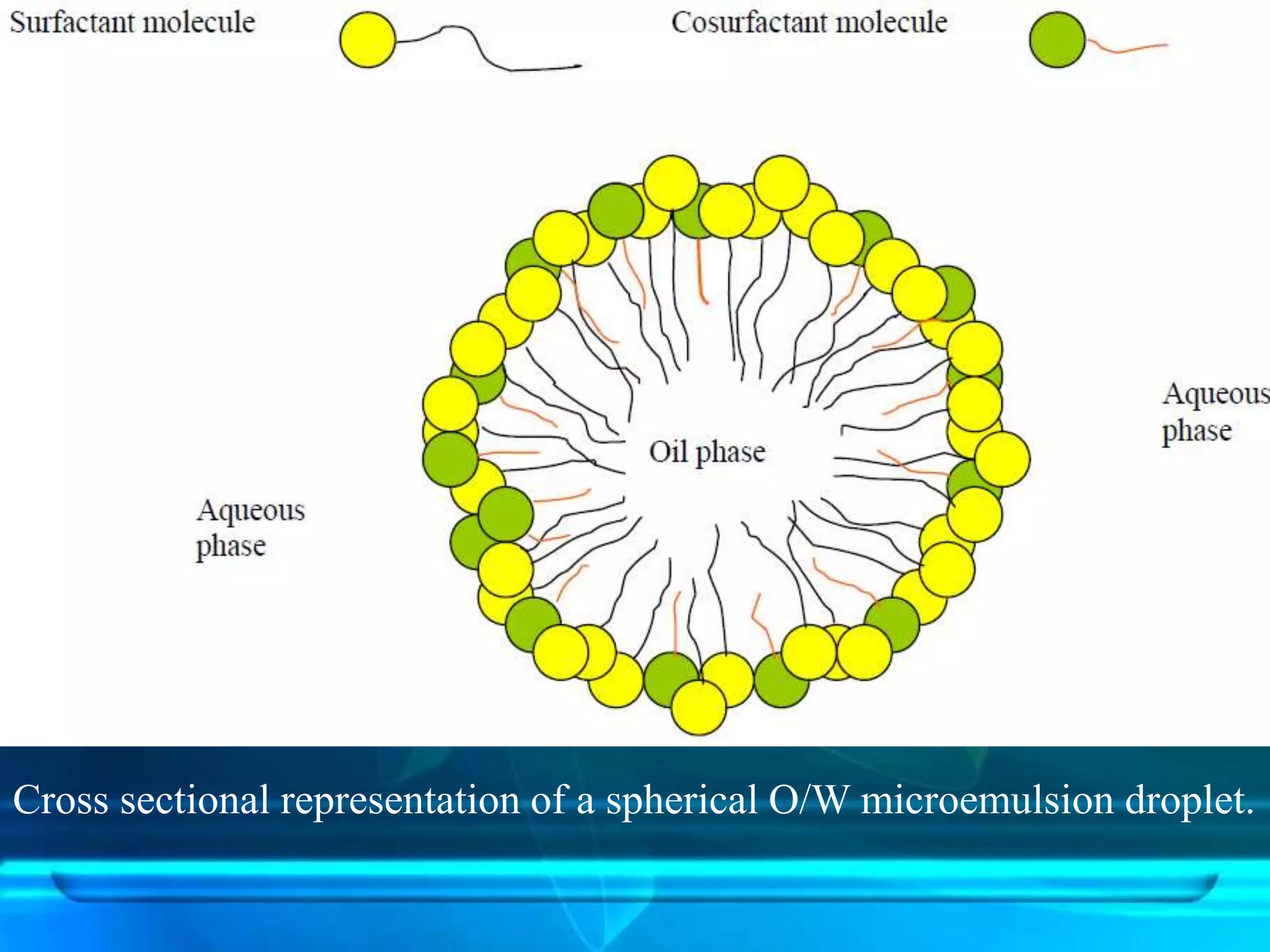
Cross sectional representation of a spherical O/W microemulsion droplet.
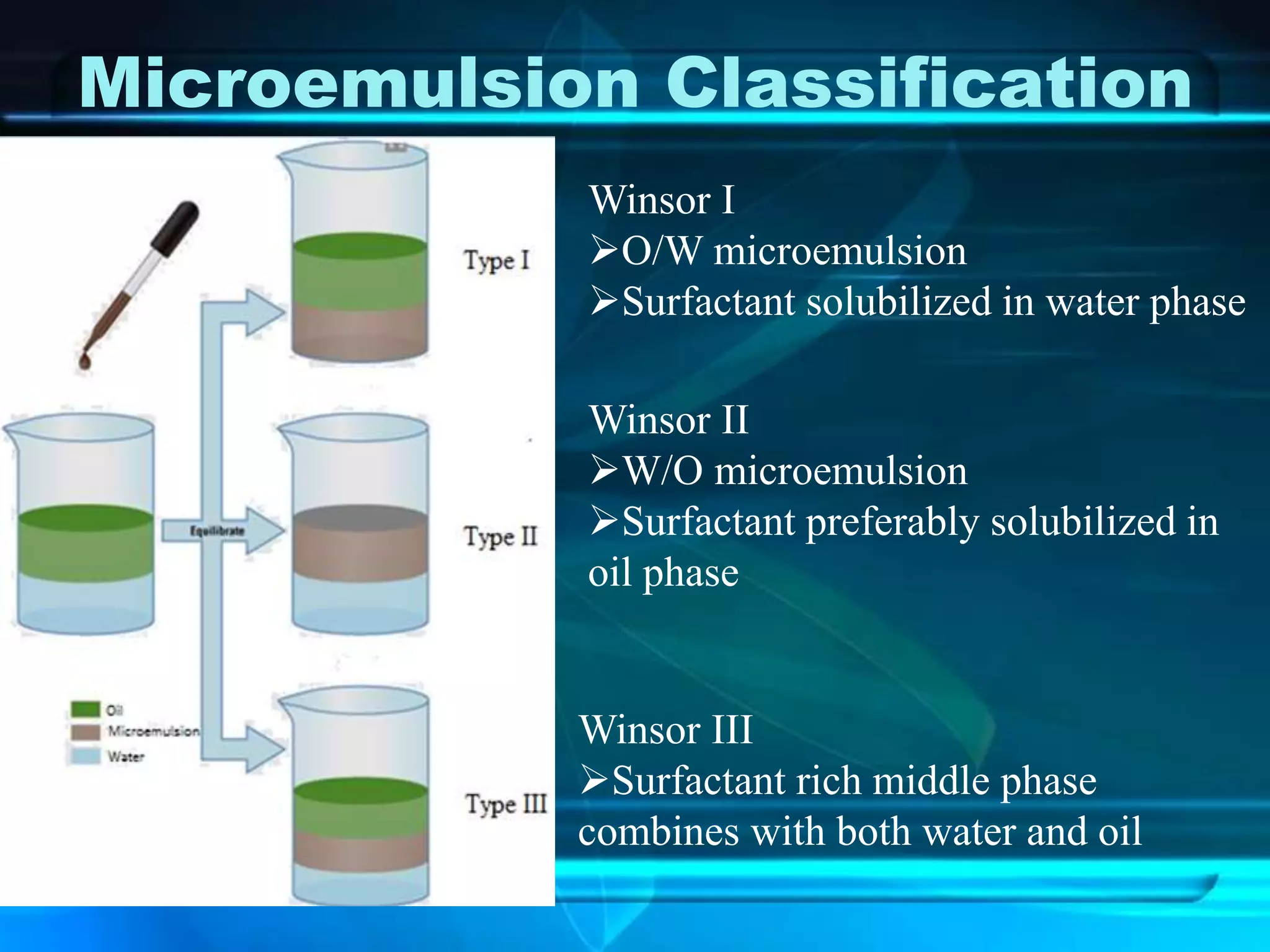
Microemulsion Classification
Winsor I
O/W microemulsion
Surfactant solubilized in water phase
Winsor II
W/O microemulsion
Surfactant preferably solubilized in
oil phase
Winsor III
Surfactant rich middle phase
combines with both water and oil
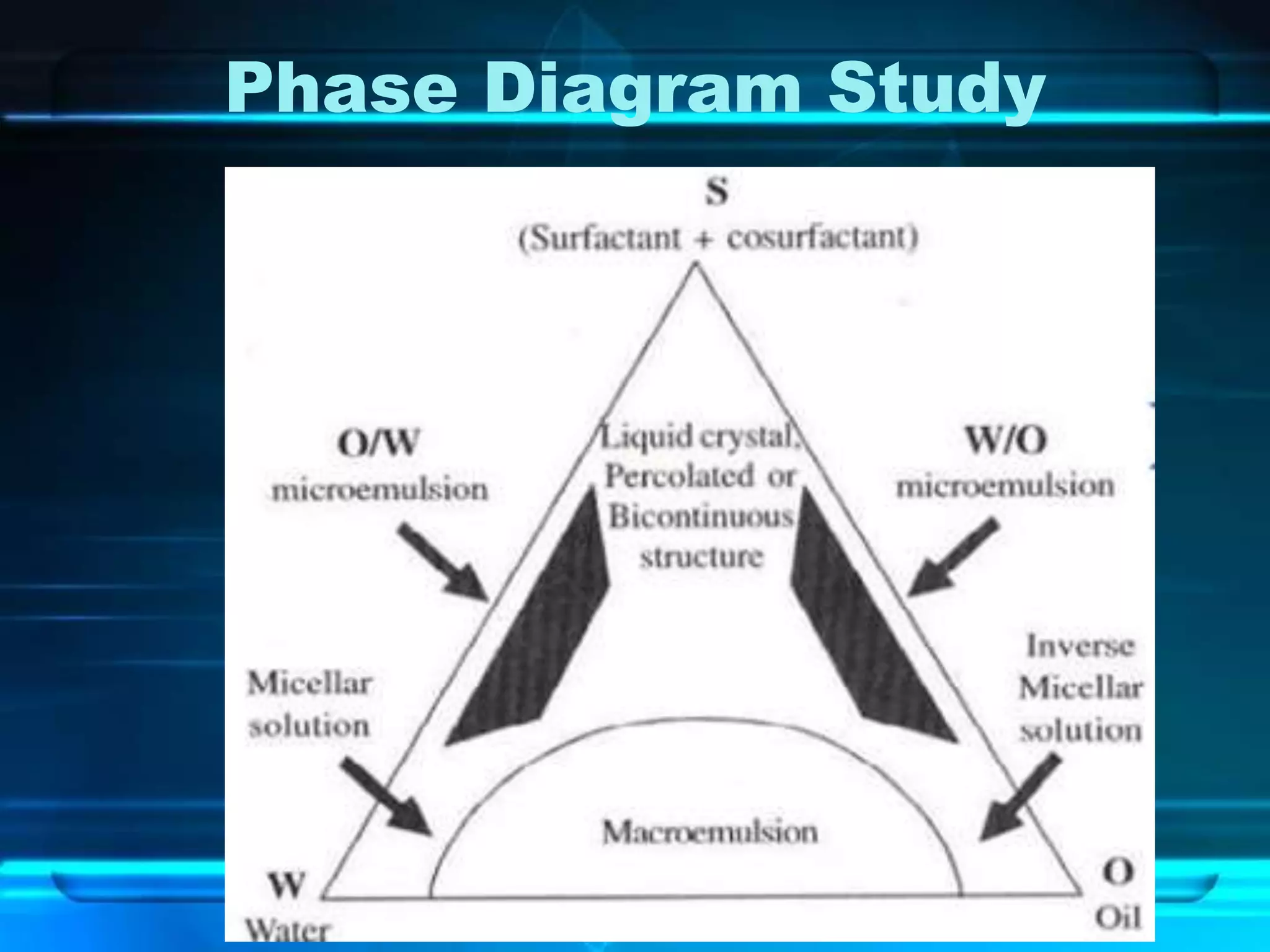
Phase Diagram Study
Role of Microemulsion in Oil
Extraction
Principle of microemulsion in
oil extraction
• Microemulsion acts as a small vessel for
conducting reaction.
• Capacity to solubilize oil and water soluble
compounds.
• The extraction of oil from oilseeds by
microemulsion (water/surfactant/co-surfactant)
system involves solubilization and incorporation
of oil into the micelles and builds oil-in-water
microemulsion.
Continue…
• Water is the continuum phase.
• Oil becomes trapped in the hydrophobic core of
the micelles.
• Extent of extraction can be determined by phase
diagram.
• When ambient conditions are not favorable for
microemulsion formation by using only extended
surfactants, linkers could be incorporated in the
system along with them to give better results.
Importance of Linkers
• Linkers help to reduce interfacial tension
drastically.
• Facilitate microemulsion formation and hence oil
extraction.
• Lipophilic linkers (unlike co-surfactants)
segregate near the surfactant tail.
• Hydrophilic linker (short hydrophobe and strong
hydrophile) absorb partially to surfactant and
expand interfacial area.
Continue…
• Both linkers self-assembled at the interface.
• Surfactant like properties.
• Can replace expensive surfactant.
• Increases the extent of extraction of oil.
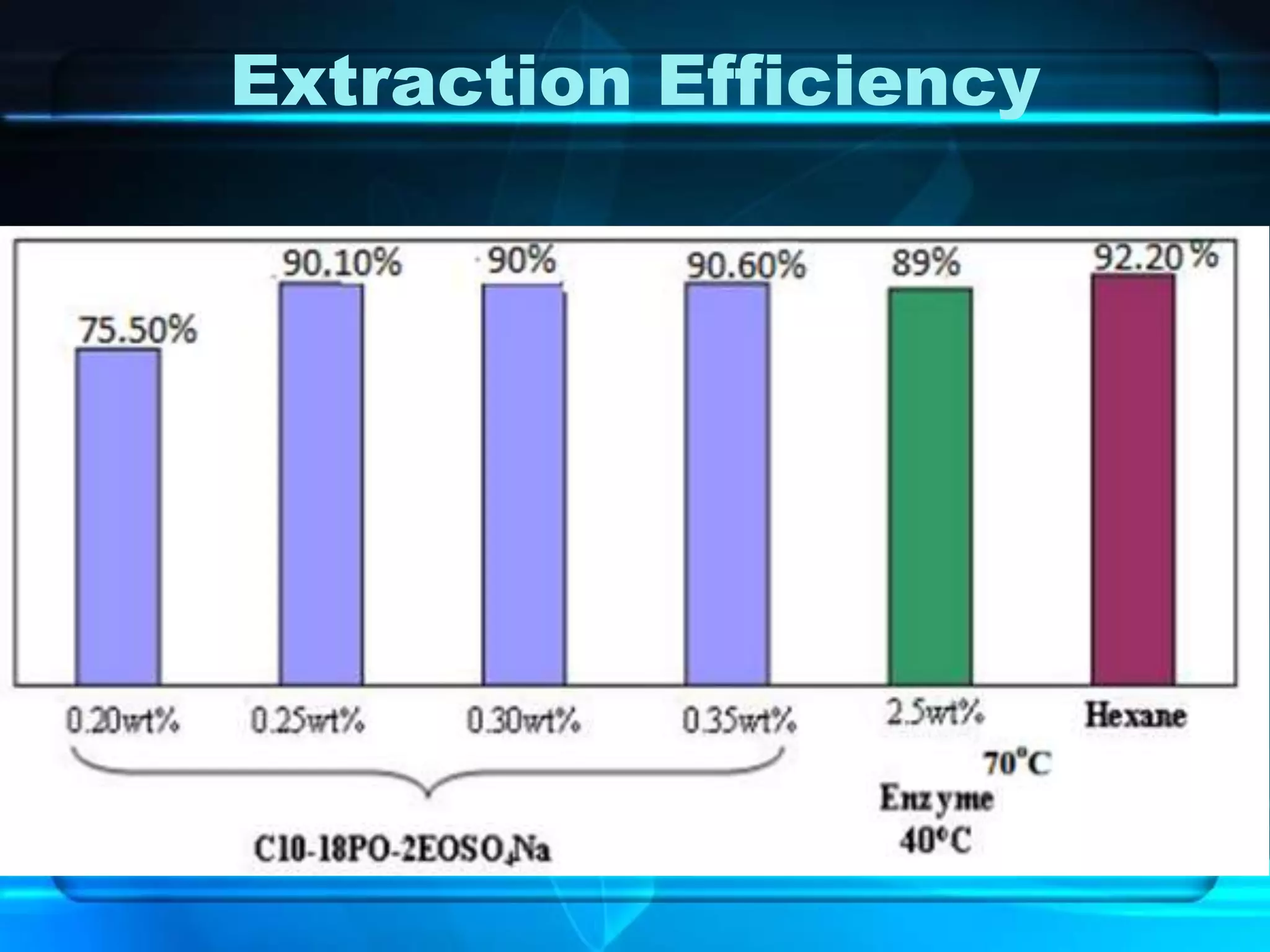
Extraction Efficiency
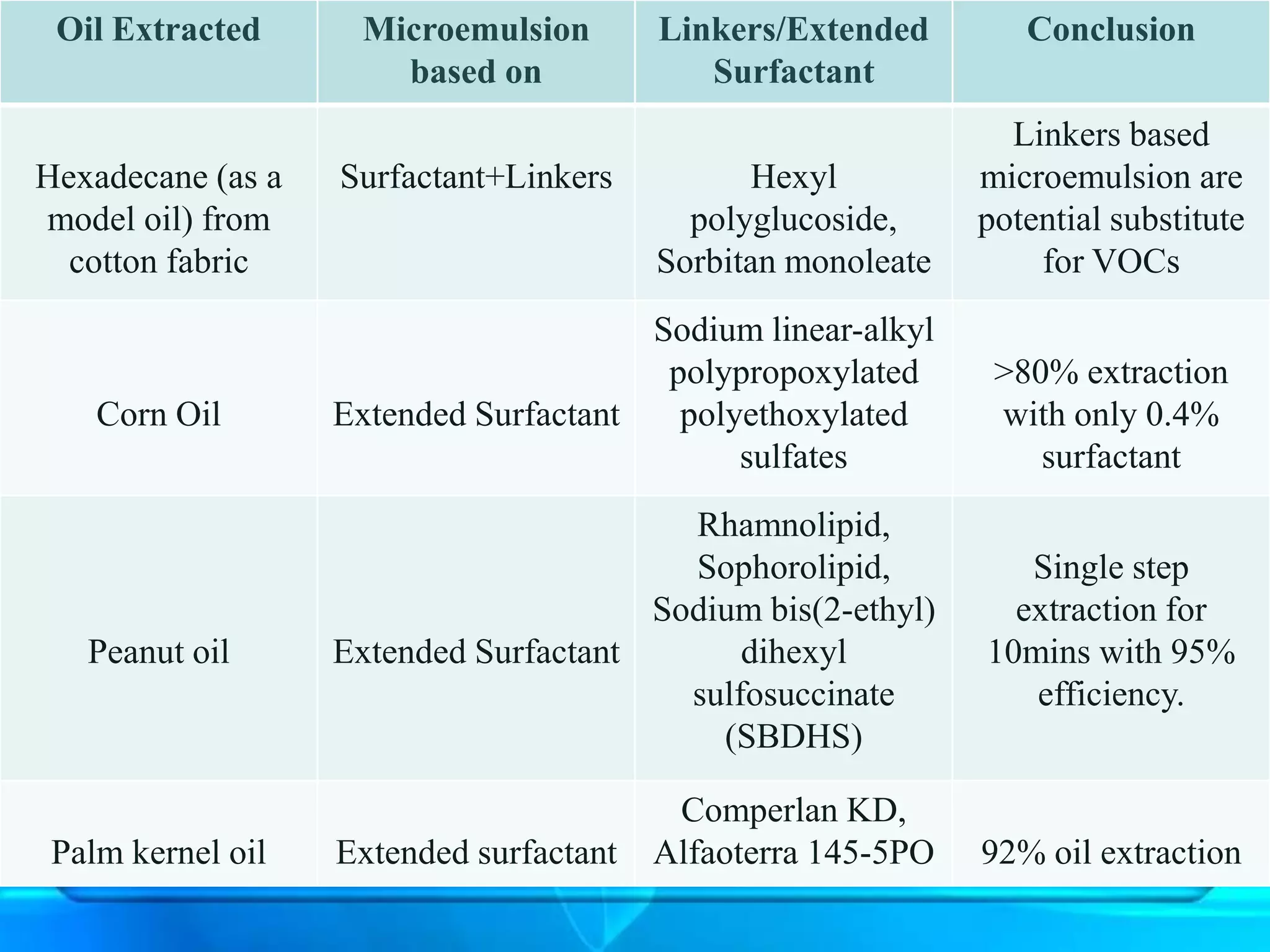
Oil Extracted Microemulsion
based on
Linkers/Extended
Surfactant
Conclusion
Hexadecane (as a
model oil) from
cotton fabric
Surfactant+Linkers Hexyl
polyglucoside,
Sorbitan monoleate
Linkers based
microemulsion are
potential substitute
for VOCs
Corn Oil Extended Surfactant
Sodium linear-alkyl
polypropoxylated
polyethoxylated
sulfates
>80% extraction
with only 0.4%
surfactant
Peanut oil Extended Surfactant
Rhamnolipid,
Sophorolipid,
Sodium bis(2-ethyl)
dihexyl
sulfosuccinate
(SBDHS)
Single step
extraction for
10mins with 95%
efficiency.
Palm kernel oil Extended surfactant
Comperlan KD,
Alfaoterra 145-5PO 92% oil extraction
Advantages of Microemulsion
• Process avoids use of any hazardous organic solvents for oil
extraction; hence it is a ‘Clean Approach.’
• Efficient at room temperatures.
• Low surfactant concentrations needed to achieve high
efficiencies.
• Less process (extraction) time.
• Simultaneous recovery of oil and protein is possible with low
initial costs.
• Evaporation is replaced by centrifugation for oil-solvent
separation, therefore decreasing the operating cost to a large
extent. Good quality oil without any burnt flavor which is
present in solvent extracted product as a result of heating.
Some Important References
• Control Of Volatile Organic Emissions From Manufacture Of
Vegetable Oils, EPA-450/2-78-035, U. S. Environmental
Protection Agency, Research Triangle Park, NC, June 1978.
• Aboofazeli R, Lawrence CB, Wicks SR, Lawrence MJ (1994)
Investigations into the formation and characterization of
phospholipid microemulsions III. Pseudo-ternary phase diagrams
of systems containing water-lecithin-isopropyl myristate and
either an alkanoic acid, amine, alkanediol, poly ethylene glycol
alkyl ether or alcohol as co-surfactant. Int J Pharma 111: 63-72.
• Witthayapanyanon A, Do L, Acosta EJ, Harwell JH, Sabatini DA
(2005) Advanced microemulsion for solvent replacement. 229th
ACS National Meeting. San Diego. CA. United States. IEC-072.
Thank You

Microemulsion an alternate technology in oil extraction

  • 1.
    Microemulsion: An Alternate Technologyin Oil Extraction By Ashish Gadhave
  • 2.
  • 3.
    Conventional Oil Extraction •Water Distillation, Steam Distillation, Solvent Extraction, Physical Pressing etc. • In solvent extraction method, organic solvents (mostly hexane) is preferred. • Solvent is then recovered after separating the oil by evaporation
  • 4.
    Disadvantage of Conventional Methods •High temperature destroys protein, vitamin E etc. • Lowering temperature (cold pressing) decreases yield and increases cost. • According to US EPA, Organic compounds are major emission from vegetable oil industries. • 0.8Kg of hexane per ton of seed is emitted. • Complete removal of hexane is not possible. • Health Problem: Atrophy, nerve damage, muscle wasting. • Alternate methods need to be developed.
  • 5.
    Microemulsion • A systemconsisting of oil, water and amphiphile (surfactant+co-surfactant), in liquid state, having thermodynamic stability and isotropic property. • The key differences between microemulsion and macroemulsion is given in Next Slide.
  • 6.
    1) Macroemulsion Thermodynamically Unstable D=1.5-100µm Optically Opaque 2) Nanoemulsion Thermodynamically Unstable D= 10-100 nm Transparent or slightly turbid 3) Microemulsion Thermodynamically Stable D= 3-50 nm Transparent or slightly turbid
  • 7.
    Property Microemulsion Macroemulsion AppearanceTransparent Cloudy Interfacial Tension Ultra Low High Optical Isotropy Isotropic Anisotropic Structure Dynamic Static Droplet Size 3-50nm 1.5-100 µm Stability Thermodynamically Stable Unstable Phases Monophasic Biphasic Viscosity Low High
  • 8.
    Main Components of Microemulsion •Oil:  swells the tail of surfactant. Short chain oils have higher ability to swell the surfactant than long chain oils. Swelling the tail group lessens the HLB value. • Surfactant: Lowers the interfacial tension. Produces suitable curvature at interfacial area. HLB< 10 W/O emulsion. HLB>10 O/W emulsion.
  • 9.
    Continue… • Co-surfactant: Polar headgroup with short alkyl chain. Lowers interfacial tension below CMC. Acts as a spacer between surfactant molecules. e.g. Pentanol, Hexanol etc.
  • 10.
    Cross sectional representationof a spherical O/W microemulsion droplet.
  • 11.
    Microemulsion Classification Winsor I O/Wmicroemulsion Surfactant solubilized in water phase Winsor II W/O microemulsion Surfactant preferably solubilized in oil phase Winsor III Surfactant rich middle phase combines with both water and oil
  • 12.
  • 13.
    Role of Microemulsionin Oil Extraction
  • 14.
    Principle of microemulsionin oil extraction • Microemulsion acts as a small vessel for conducting reaction. • Capacity to solubilize oil and water soluble compounds. • The extraction of oil from oilseeds by microemulsion (water/surfactant/co-surfactant) system involves solubilization and incorporation of oil into the micelles and builds oil-in-water microemulsion.
  • 15.
    Continue… • Water isthe continuum phase. • Oil becomes trapped in the hydrophobic core of the micelles. • Extent of extraction can be determined by phase diagram. • When ambient conditions are not favorable for microemulsion formation by using only extended surfactants, linkers could be incorporated in the system along with them to give better results.
  • 16.
    Importance of Linkers •Linkers help to reduce interfacial tension drastically. • Facilitate microemulsion formation and hence oil extraction. • Lipophilic linkers (unlike co-surfactants) segregate near the surfactant tail. • Hydrophilic linker (short hydrophobe and strong hydrophile) absorb partially to surfactant and expand interfacial area.
  • 17.
    Continue… • Both linkersself-assembled at the interface. • Surfactant like properties. • Can replace expensive surfactant. • Increases the extent of extraction of oil.
  • 18.
  • 19.
    Oil Extracted Microemulsion basedon Linkers/Extended Surfactant Conclusion Hexadecane (as a model oil) from cotton fabric Surfactant+Linkers Hexyl polyglucoside, Sorbitan monoleate Linkers based microemulsion are potential substitute for VOCs Corn Oil Extended Surfactant Sodium linear-alkyl polypropoxylated polyethoxylated sulfates >80% extraction with only 0.4% surfactant Peanut oil Extended Surfactant Rhamnolipid, Sophorolipid, Sodium bis(2-ethyl) dihexyl sulfosuccinate (SBDHS) Single step extraction for 10mins with 95% efficiency. Palm kernel oil Extended surfactant Comperlan KD, Alfaoterra 145-5PO 92% oil extraction
  • 20.
    Advantages of Microemulsion •Process avoids use of any hazardous organic solvents for oil extraction; hence it is a ‘Clean Approach.’ • Efficient at room temperatures. • Low surfactant concentrations needed to achieve high efficiencies. • Less process (extraction) time. • Simultaneous recovery of oil and protein is possible with low initial costs. • Evaporation is replaced by centrifugation for oil-solvent separation, therefore decreasing the operating cost to a large extent. Good quality oil without any burnt flavor which is present in solvent extracted product as a result of heating.
  • 21.
    Some Important References •Control Of Volatile Organic Emissions From Manufacture Of Vegetable Oils, EPA-450/2-78-035, U. S. Environmental Protection Agency, Research Triangle Park, NC, June 1978. • Aboofazeli R, Lawrence CB, Wicks SR, Lawrence MJ (1994) Investigations into the formation and characterization of phospholipid microemulsions III. Pseudo-ternary phase diagrams of systems containing water-lecithin-isopropyl myristate and either an alkanoic acid, amine, alkanediol, poly ethylene glycol alkyl ether or alcohol as co-surfactant. Int J Pharma 111: 63-72. • Witthayapanyanon A, Do L, Acosta EJ, Harwell JH, Sabatini DA (2005) Advanced microemulsion for solvent replacement. 229th ACS National Meeting. San Diego. CA. United States. IEC-072.
  • 22.