Basic Principles of
Emulsion Polymerization
Dr. Nagendra Kalva
NCL-PUNE 03/08/2016
Bulk Polymerization:
 Absence of any solvent
 Simple formulations, rapid reaction, pure polymer.
 Used in step-growth and chain growth polymerizations.
 Heat buildup, difficult to control and high viscosity.
Solution Polymerization:
 presence of solvent, effective heat dissipation.
 Easier to stir the polymer solution.
 Low rate of polymerization, low M.wt. polymers, Solvent recovery from viscous
polymer solution.
Suspension Polymerization:
 Monomer dispersed in a solution (usually water). Low viscosity.
Monomer droplets stabilized by the stabilizers (PVA, methyl cellulose).
Monomer soluble initiator is added to initiate the polymerization.
Heat dispersed efficiently by the water. Polymer obtains as granules.
Difficult in removal of additives.
Emulsion Polymerization:
 Radical chain polymerization,
 Polymerization of monomers occurs in the form of emulsion.
 Resemblance of suspension polymerization.
 Differs in the size of particles in which polymerization occurs and initiator.
 First introduced in the world war II.
Thermal and viscosity problems are less significant.
 Major difference between emulsion and other polymerization is to get high M.wt.
polymers with high reaction rates.
 Styrene –co-1,3 butadiene synthesized by the emulsion polymerization
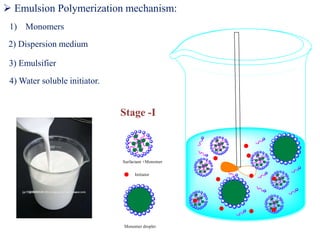
 Emulsion Polymerization mechanism:
1) Monomers
2) Dispersion medium
3) Emulsifier
4) Water soluble initiator.
Stage -I
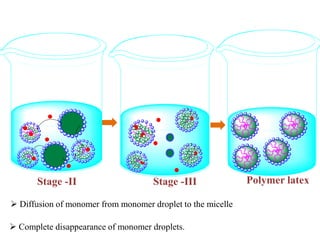
Polymer latex
 Diffusion of monomer from monomer droplet to the micelle
 Complete disappearance of monomer droplets.
Stage -II Stage -III
 The monomers dispersed in water as monomer droplets and stabilized by the
emulsifier.
 Emulsifier added to the solution above its CMC.
 Micelles size ranges from 2-10 nm.
 Each micelle consists of 50-150 surfactant molecules. Size of droplets depend on the
rotation speed.
Site of Polymerization:
 Water soluble initiator initiates the polymerization.
Polymerization occurs only in the micelles due to their large oil-water
Interfacial area.
Absence of polymerization is experimentally proved and this distinguish between
suspension and emulsion polymerization techniques.
Stage-1:
 Water soluble initiator starts the polymerization in the micelles and grows its size to
tens of nanometers (0.4 m).
 Each micelles become polymer particle.
 initiation also occurs in the aqueous solution but results oligomers due to the less
concentration of monomer in aqueous solution.
Stage-II:
 After 15% conversion the micelles are exhausted with monomer and new particle are
generated.
 The monomer diffuses from the monomer droplets to maintain thermodynamic
equilibrium between monomer and polymer.
Smith-Evart model
 After nucleation monomer micelles transforms to polymer particles.
Stage-III:
 After 40-60% conversion the monomer droplets are disappears from solution.
 Polymer particles remains constant both in number and diameter.
Initiators:
 Potasium or Ammonium persulfate, hydrogen peroxide, 2,2’-azobis(2-
amidinopropane) dihydrochloride.
 Should be water soluble.
Micro emulsion Polymerization:
 Polymerization occurs in small droplets size 10-100nm compared to 1-100m
 Excess amount of emulsifier used in these polymerization
 Capturing the radicals by the micelles happens through out the process
 Small latex particles <50nm are obtained from micro emulsion polymerization.
Mini emulsion Polymerization:
 Polymerization occurs in small monomer droplets size 50-1000nm compared to 1-
100m
 Emulsion stabilized by the “co-surfactant” such as cetyl alcohol and hexadecane.
 Long chain co-surfactant penetrate less in oil-water interface.
 Mini emulsions are usually stable for seversl days.

emision polymerization

  • 1.
    Basic Principles of EmulsionPolymerization Dr. Nagendra Kalva NCL-PUNE 03/08/2016
  • 2.
    Bulk Polymerization:  Absenceof any solvent  Simple formulations, rapid reaction, pure polymer.  Used in step-growth and chain growth polymerizations.  Heat buildup, difficult to control and high viscosity. Solution Polymerization:  presence of solvent, effective heat dissipation.  Easier to stir the polymer solution.  Low rate of polymerization, low M.wt. polymers, Solvent recovery from viscous polymer solution.
  • 3.
    Suspension Polymerization:  Monomerdispersed in a solution (usually water). Low viscosity. Monomer droplets stabilized by the stabilizers (PVA, methyl cellulose). Monomer soluble initiator is added to initiate the polymerization. Heat dispersed efficiently by the water. Polymer obtains as granules. Difficult in removal of additives.
  • 4.
    Emulsion Polymerization:  Radicalchain polymerization,  Polymerization of monomers occurs in the form of emulsion.  Resemblance of suspension polymerization.  Differs in the size of particles in which polymerization occurs and initiator.  First introduced in the world war II. Thermal and viscosity problems are less significant.  Major difference between emulsion and other polymerization is to get high M.wt. polymers with high reaction rates.  Styrene –co-1,3 butadiene synthesized by the emulsion polymerization
  • 5.
     Emulsion Polymerizationmechanism: 1) Monomers 2) Dispersion medium 3) Emulsifier 4) Water soluble initiator. Stage -I
  • 6.
    Polymer latex  Diffusionof monomer from monomer droplet to the micelle  Complete disappearance of monomer droplets. Stage -II Stage -III
  • 7.
     The monomersdispersed in water as monomer droplets and stabilized by the emulsifier.  Emulsifier added to the solution above its CMC.  Micelles size ranges from 2-10 nm.  Each micelle consists of 50-150 surfactant molecules. Size of droplets depend on the rotation speed. Site of Polymerization:  Water soluble initiator initiates the polymerization. Polymerization occurs only in the micelles due to their large oil-water Interfacial area. Absence of polymerization is experimentally proved and this distinguish between suspension and emulsion polymerization techniques.
  • 8.
    Stage-1:  Water solubleinitiator starts the polymerization in the micelles and grows its size to tens of nanometers (0.4 m).  Each micelles become polymer particle.  initiation also occurs in the aqueous solution but results oligomers due to the less concentration of monomer in aqueous solution. Stage-II:  After 15% conversion the micelles are exhausted with monomer and new particle are generated.  The monomer diffuses from the monomer droplets to maintain thermodynamic equilibrium between monomer and polymer. Smith-Evart model  After nucleation monomer micelles transforms to polymer particles.
  • 9.
    Stage-III:  After 40-60%conversion the monomer droplets are disappears from solution.  Polymer particles remains constant both in number and diameter. Initiators:  Potasium or Ammonium persulfate, hydrogen peroxide, 2,2’-azobis(2- amidinopropane) dihydrochloride.  Should be water soluble.
  • 10.
    Micro emulsion Polymerization: Polymerization occurs in small droplets size 10-100nm compared to 1-100m  Excess amount of emulsifier used in these polymerization  Capturing the radicals by the micelles happens through out the process  Small latex particles <50nm are obtained from micro emulsion polymerization. Mini emulsion Polymerization:  Polymerization occurs in small monomer droplets size 50-1000nm compared to 1- 100m  Emulsion stabilized by the “co-surfactant” such as cetyl alcohol and hexadecane.  Long chain co-surfactant penetrate less in oil-water interface.  Mini emulsions are usually stable for seversl days.