MULTIPLE EMULSIONS 
BBYY,, 
VV.. RREEKKHHAA 
MM..PPHHAARRMMAACCYY 
PPHHAARRMMAACCEEUUTTIICCSS
IINNTTRROODDUUCCTTIIOONN 
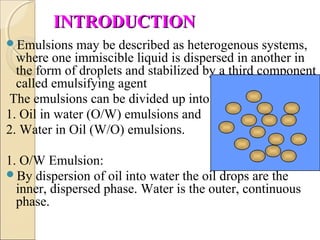
Emulsions may be described as heterogenous systems, 
where one immiscible liquid is dispersed in another in 
the form of droplets and stabilized by a third component 
called emulsifying agent 
The emulsions can be divided up into: 
1. Oil in water (O/W) emulsions and 
2. Water in Oil (W/O) emulsions. 
1. O/W Emulsion: 
By dispersion of oil into water the oil drops are the 
inner, dispersed phase. Water is the outer, continuous 
phase.
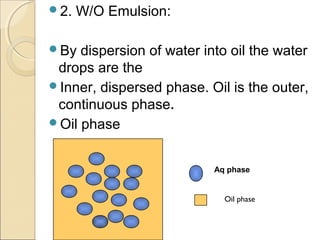
2. W/O Emulsion: 
By dispersion of water into oil the water 
drops are the 
Inner, dispersed phase. Oil is the outer, 
continuous phase. 
Oil phase 
Aq phase 
Oil phase
MMUULLTTIIPPLLEE EEMMUULLSSIIOONNSS:: 
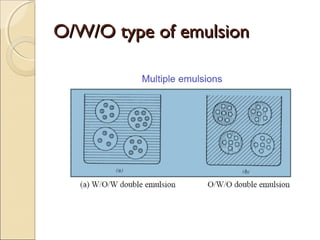
 Multiple emulsion are complex system which 
consist of both w/o and o/w at the same time. 
 There are potential matrices for the encapsulation of 
biactive compounds and for the controlled release 
compounds 
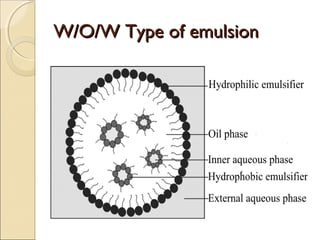
 w/o/w multiple emulsion are system where small 
water droplets are entrapped within larger oil 
droplets and they are disperse continous water phase 
 Because of presense of reseroir phase that can be 
use to prolong release of active ingredients.
 This is made possible by double emulsification 
hence the systems are also called as 
“Double emulsions”. 
 These are also called as “Liquid membrane 
systems” as the liquid film which separates the 
liquid phases acts as a thin semipermeable film 
through which solute must diffuse in order to 
transverse from one phase to another. 
Multiple emulsions are thermodynamically 
unstable. 
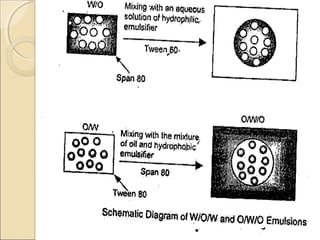
 They are often stabilized by using a 
combination of hydrophilic & hydrophobic 
surfactants. 
 The ratio of these surfactants is important in 
achieving stable multiple emulsions.
TTYYPPEESS:: 
 With optical microscopy method, 
multiple emulsions are classified as, 
1. coarse (>3 micrometer in diameter) 
2. Fine (1-3 micrometer in diameter) 
3. Micro-multiple emulsions 
(<1 micrometer in 
diameter)
WW//OO//WW TTyyppee ooff eemmuullssiioonn
OO//WW//OO ttyyppee ooff eemmuullssiioonn
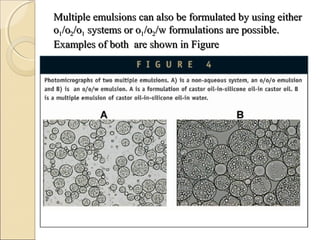
Multiple emulsions can also be ffoorrmmuullaatteedd bbyy uussiinngg eeiitthheerr 
oo11//oo22//oo11 ssyysstteemmss oorr oo11//oo22//ww ffoorrmmuullaattiioonnss aarree ppoossssiibbllee.. 
EExxaammpplleess ooff bbootthh aarree sshhoowwnn iinn FFiigguurree
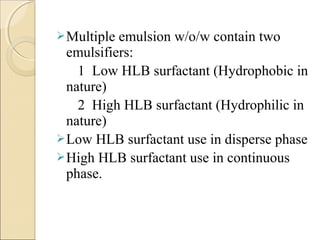
Multiple emulsion w/o/w contain two 
emulsifiers: 
1 Low HLB surfactant (Hydrophobic in 
nature) 
2 High HLB surfactant (Hydrophilic in 
nature) 
Low HLB surfactant use in disperse phase 
High HLB surfactant use in continuous 
phase.
EEMMUULLSSIIFFYYIINNGG AAGGEENNTTSS 
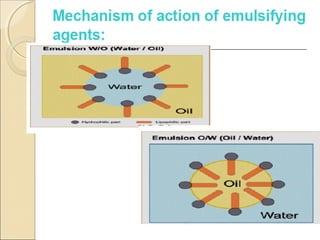
Emulsifier or surface active agent [SAA] is 
molecule which has two parts, one is 
hydrophilic and the other is hydrophobic. Upon 
the addition of SAA, it tends to form 
monolayer film at the oil/ water interface.
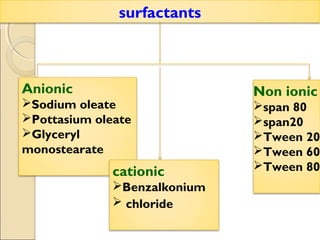
surfactants 
Anionic 
Sodium oleate 
Pottasium oleate 
Glyceryl 
monostearate 
cationic 
Benzalkonium 
 chloride 
Non ionic 
span 80 
span20 
Tween 20 
Tween 60 
Tween 80
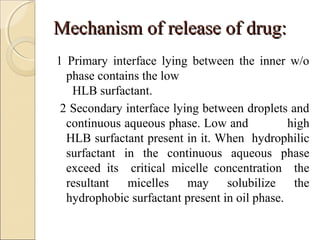
MMeecchhaanniissmm ooff rreelleeaassee ooff ddrruugg:: 
1 Primary interface lying between the inner w/o 
phase contains the low 
HLB surfactant. 
2 Secondary interface lying between droplets and 
continuous aqueous phase. Low and high 
HLB surfactant present in it. When hydrophilic 
surfactant in the continuous aqueous phase 
exceed its critical micelle concentration the 
resultant micelles may solubilize the 
hydrophobic surfactant present in oil phase.
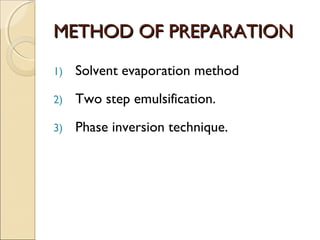
MMEETTHHOODD OOFF PPRREEPPAARRAATTIIOONN 
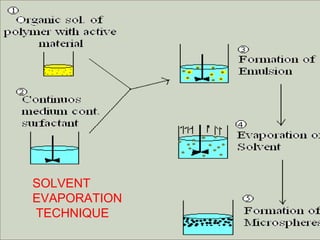
1) Solvent evaporation method 
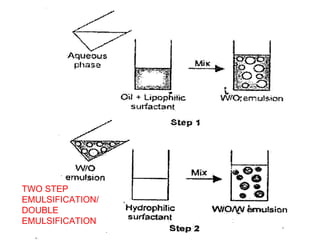
2) Two step emulsification. 
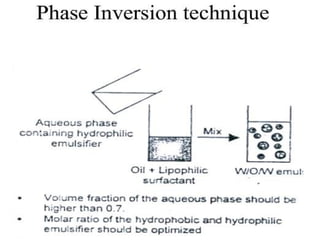
3) Phase inversion technique.
SOLVENT 
EVAPORATION 
TECHNIQUE
TWO STEP 
EMULSIFICATION/ 
DOUBLE 
EMULSIFICATION
AAPPLLLLIICCAATTOONNSS OOFF MMUULLTTIIPPLLEE 
EEMMUULLSSIIOONNSS 
Multiple emulsions finds wide range of 
applications in controlled or sustained drug 
delivery, targeted delivery, taste masking, 
bioavailability enhancement, enzyme 
immobilization, etc. 
It will be able to provide a novel carrier system 
for drugs, cosmetics and pharmaceutical agents.
1. Hemoglobin multiple emulsion having specified 
properties is suitable for provision of oxygen as a 
blood substitute and other oxygen transfer processes. 
2. W/O/W multiple emulsions are systems of potential 
interest in the oral administration of insulin. 
Although it has been shown that a single oral 
administration of insulin-loaded W/O/W multiple 
emulsion to diabetic rats led to the significant 
decrease of blood glucose. 
3. (w/o/w) multiple emulsions and polymeric 
nanoparticle formulations containing influenza virus 
surface antigen hemagglutinin (HA) are thought to 
be suitable carriers for a vaccine delivery system.
4. Using a water-in-oil-in-water multiple emulsion 
system developed for pulmonary drug targeting, 
the effectiveness of tetrandrine as an antifibrotic 
agent. 
5. To develop a prolonged and sustained 
release preparation , an albumin micro-sphere-in- 
oil-in-water emulsion was prepared. 
Tegafur was used as a model drug. 
6. Vitamin c has been widely used in 
formulations of skin care products. 
7. Multiple emulsions are also used in topical 
application ex… a w/o/w emulsion of 
Metronidazole.
RREEFFEERREENNCCEESS 
1) Pharmaceutical Emulsions and Suspensions, edited by Francoise 
Nielloud Gilberte Marti-Mestres. 
2) Pharmaceutical Dosage Forms: Disperse systems, vol.3, second 
edition, Edited by Herbert A.Liberman, Martin M. Rieger and 
Gilbert S. Banker. 
3) some studies on Multiple Emulsions by G.Vishwanadham, (Ph.D 
thesis, KU) 
4) Advances in Controlled and Novel Drug Delivery Systems, 
Edited by N.K. Jain. 
5) Targeted and controlled Drug Delivery Novel Carrier Systems 
by -S.P. Vyas and R.K. Khar. 
 http://www.aapsj.org/view.asp 
 http://www.blackwell-synergy.com 
 http://www.rsc.org/delivery/_ArticleLinking 
 http://cat.inist.fr 
 http://iufost.edpsciences.org
Multiple emulsions

Multiple emulsions

  • 1.
    MULTIPLE EMULSIONS BBYY,, VV.. RREEKKHHAA MM..PPHHAARRMMAACCYY PPHHAARRMMAACCEEUUTTIICCSS
  • 2.
    IINNTTRROODDUUCCTTIIOONN Emulsions maybe described as heterogenous systems, where one immiscible liquid is dispersed in another in the form of droplets and stabilized by a third component called emulsifying agent The emulsions can be divided up into: 1. Oil in water (O/W) emulsions and 2. Water in Oil (W/O) emulsions. 1. O/W Emulsion: By dispersion of oil into water the oil drops are the inner, dispersed phase. Water is the outer, continuous phase.
  • 3.
    2. W/O Emulsion: By dispersion of water into oil the water drops are the Inner, dispersed phase. Oil is the outer, continuous phase. Oil phase Aq phase Oil phase
  • 4.
    MMUULLTTIIPPLLEE EEMMUULLSSIIOONNSS:: Multiple emulsion are complex system which consist of both w/o and o/w at the same time.  There are potential matrices for the encapsulation of biactive compounds and for the controlled release compounds  w/o/w multiple emulsion are system where small water droplets are entrapped within larger oil droplets and they are disperse continous water phase  Because of presense of reseroir phase that can be use to prolong release of active ingredients.
  • 5.
     This ismade possible by double emulsification hence the systems are also called as “Double emulsions”.  These are also called as “Liquid membrane systems” as the liquid film which separates the liquid phases acts as a thin semipermeable film through which solute must diffuse in order to transverse from one phase to another. Multiple emulsions are thermodynamically unstable.  They are often stabilized by using a combination of hydrophilic & hydrophobic surfactants.  The ratio of these surfactants is important in achieving stable multiple emulsions.
  • 6.
    TTYYPPEESS::  Withoptical microscopy method, multiple emulsions are classified as, 1. coarse (>3 micrometer in diameter) 2. Fine (1-3 micrometer in diameter) 3. Micro-multiple emulsions (<1 micrometer in diameter)
  • 7.
    WW//OO//WW TTyyppee ooffeemmuullssiioonn
  • 8.
    OO//WW//OO ttyyppee ooffeemmuullssiioonn
  • 10.
    Multiple emulsions canalso be ffoorrmmuullaatteedd bbyy uussiinngg eeiitthheerr oo11//oo22//oo11 ssyysstteemmss oorr oo11//oo22//ww ffoorrmmuullaattiioonnss aarree ppoossssiibbllee.. EExxaammpplleess ooff bbootthh aarree sshhoowwnn iinn FFiigguurree
  • 11.
    Multiple emulsion w/o/wcontain two emulsifiers: 1 Low HLB surfactant (Hydrophobic in nature) 2 High HLB surfactant (Hydrophilic in nature) Low HLB surfactant use in disperse phase High HLB surfactant use in continuous phase.
  • 12.
    EEMMUULLSSIIFFYYIINNGG AAGGEENNTTSS Emulsifieror surface active agent [SAA] is molecule which has two parts, one is hydrophilic and the other is hydrophobic. Upon the addition of SAA, it tends to form monolayer film at the oil/ water interface.
  • 13.
    surfactants Anionic Sodiumoleate Pottasium oleate Glyceryl monostearate cationic Benzalkonium  chloride Non ionic span 80 span20 Tween 20 Tween 60 Tween 80
  • 15.
    MMeecchhaanniissmm ooff rreelleeaasseeooff ddrruugg:: 1 Primary interface lying between the inner w/o phase contains the low HLB surfactant. 2 Secondary interface lying between droplets and continuous aqueous phase. Low and high HLB surfactant present in it. When hydrophilic surfactant in the continuous aqueous phase exceed its critical micelle concentration the resultant micelles may solubilize the hydrophobic surfactant present in oil phase.
  • 16.
    MMEETTHHOODD OOFF PPRREEPPAARRAATTIIOONN 1) Solvent evaporation method 2) Two step emulsification. 3) Phase inversion technique.
  • 17.
  • 18.
    TWO STEP EMULSIFICATION/ DOUBLE EMULSIFICATION
  • 20.
    AAPPLLLLIICCAATTOONNSS OOFF MMUULLTTIIPPLLEE EEMMUULLSSIIOONNSS Multiple emulsions finds wide range of applications in controlled or sustained drug delivery, targeted delivery, taste masking, bioavailability enhancement, enzyme immobilization, etc. It will be able to provide a novel carrier system for drugs, cosmetics and pharmaceutical agents.
  • 21.
    1. Hemoglobin multipleemulsion having specified properties is suitable for provision of oxygen as a blood substitute and other oxygen transfer processes. 2. W/O/W multiple emulsions are systems of potential interest in the oral administration of insulin. Although it has been shown that a single oral administration of insulin-loaded W/O/W multiple emulsion to diabetic rats led to the significant decrease of blood glucose. 3. (w/o/w) multiple emulsions and polymeric nanoparticle formulations containing influenza virus surface antigen hemagglutinin (HA) are thought to be suitable carriers for a vaccine delivery system.
  • 22.
    4. Using awater-in-oil-in-water multiple emulsion system developed for pulmonary drug targeting, the effectiveness of tetrandrine as an antifibrotic agent. 5. To develop a prolonged and sustained release preparation , an albumin micro-sphere-in- oil-in-water emulsion was prepared. Tegafur was used as a model drug. 6. Vitamin c has been widely used in formulations of skin care products. 7. Multiple emulsions are also used in topical application ex… a w/o/w emulsion of Metronidazole.
  • 23.
    RREEFFEERREENNCCEESS 1) PharmaceuticalEmulsions and Suspensions, edited by Francoise Nielloud Gilberte Marti-Mestres. 2) Pharmaceutical Dosage Forms: Disperse systems, vol.3, second edition, Edited by Herbert A.Liberman, Martin M. Rieger and Gilbert S. Banker. 3) some studies on Multiple Emulsions by G.Vishwanadham, (Ph.D thesis, KU) 4) Advances in Controlled and Novel Drug Delivery Systems, Edited by N.K. Jain. 5) Targeted and controlled Drug Delivery Novel Carrier Systems by -S.P. Vyas and R.K. Khar.  http://www.aapsj.org/view.asp  http://www.blackwell-synergy.com  http://www.rsc.org/delivery/_ArticleLinking  http://cat.inist.fr  http://iufost.edpsciences.org