1
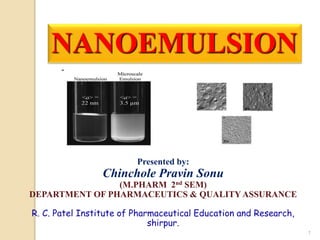
NANOEMULSION
Presented by:
Chinchole Pravin Sonu
(M.PHARM 2nd SEM)
DEPARTMENT OF PHARMACEUTICS & QUALITY ASSURANCE
R. C. Patel Institute of Pharmaceutical Education and Research,
shirpur.
Content
 Introduction
 Classification
 Defination and synonyms
 Structure of Nanoemulsion
 Physical properties of a Nanoemulsion
 Methods of preparation
 Components of Nanoemulsion
 Evaluation of Nanoemulsion
 Application
 Conclusion
 References
2
Nanotechnology
Comprises technological
developments on the nanometer scale,
usually 0.1 to 1000 nm.
The pharmaceuticals developed on
the basis of nanotechnology are
termed as
‘NANOPHARMACEUTICALS’.
Introduction
Emulsion:
“They are thermodynamically unstable
system consisting of atleast two immissible liquid
phase, one of which is dispersed as a globules in
the other liquid phase which is continuous phase.”
Dispersed phase
Continuous phase
4
CLASSIFICATION :
It is based upon the nature of Dispersion Phase,
1. Oil-in-water Emulsion(o/w) (0.1-100 µm)
2. Water-in-oil Emulsion (w/o) (0.1-100 µm)
3. Micro Emulsion (0.01 µm)
4. Nano Emulsion (0.1-0.5 µm)
5
The various nanopharmaceuticals
currently being used : _
 Nanoemulsion
 Nanosuspension
 Nanospheres
 Nanoshells
 Nanocapsules
 Lipid Nanoparticle
 Dendrimers
6
Nanoemulsion
 “Nanoemulsion can be defined as a oil in
water(o/w) emulsion with mean droplet
daimeters ranging from 50 to 1000nm.Usually the
average droplet size is between 100-500nm.”
Synonyms
Sub micron size emulsion
Mini emulsion
Ultrafine Emulsion
7
 transparent or translucent O/W or W/O emulsion
 droplet diameters ranging from 50-1000 nm.
[avg droplet size is between 100-500 nm]
 kinetically stable unlike microemulsions which are
thermodynamically stable
 Nanoparticles can exist core of particle
w/o form water
o/w form oil
 Ostwald ripening is the primary instability process :
Can be reduced by the addition of a second less soluble oil phase
and/or
addition of a strongly adsorbed and water insoluble polymeric surfact
 The inner core
consisting of any
oil
 Drug or nutrient
molecules within
the core
 The emulsifier
layer surrounding
the nano-particle.
Single nanoparticle
Nanoemulsion: Lipid
monolayer enclosing a
liquid lipid core.
Liposome: Lipid bilayer
enclosing an aqueous core.
Structure of Nanoemulsion
10
Fig-1 Fig-2
Fig-3
11
Types of Nanoemulsion
12
Physical Properties of Nanoemulsion
The relative transparency of nanoemulsion.
Their response to mechanical shear or ‘rheology’.
The enhanced shelf stability of
nanoemulsion against gravitationally driven
creaming.
13
A nanoemulsion (a) and A macroemulsion
(b) with droplet diameters of less than 100
nm and more than 1000 nm, respectively.
Nanoemulsion and Macroemulsion
14
Difference between Emulsion and
Nanoemulsion
 Themodynamically
unstable.
 Millky appearance.
 Droplet upto few
micrometer.
 Thermodynamically
stable.
 Transluscent,isotropic.
 Droplet 0.1-0.5 µm.
Emulsion Nanoemulsion
15
Advantages Of Nanoemulsions
1.Reduction of globules as the potential to:
Increase surface area
Enhance solubility
Increase oral bioavailability
More rapid onset of therapeutic action
Decrease the dose needed
2. They do not show the problems of inherent creaming
flocculation, coalescence and sedimentation.
3.They are non-toxic, non-irritant hence can be easily
applied to skin and mucous membranes.
4. They can be taken by enteric route becoz they are
formulated with surfactants, which are approved for
human consumption (GRAS),
Limitations of Nanoemulsion
 The manufacturing of Nanoemulsion is an
expensive process.
 Stability of Nanoemulsion is a unacceptable and
creates a big problem during the storage of
formulation for the longer period time.
 Less availability of surfactant and cosurfactant
required for the manufacturing of nanoemulsion.
17
Preparation of Nanoemulsion
 Drug
poorly water soluble drug
eg: CBZ,Diclofenac,Ramipril
 Oil phase
eg: dimethicone oil , castor oil , Soyabean oil
 Aqueous phase
 Surfactant
Cremphore, lecithin
 Cosurfactant : Propylene glycol, polysorbate 8
cetylphosphate,hydrogenated caster oil
Representative pseudoternary phase diagram of
surfactant and cosurfactant (Smix) mixture showing
oil/water nanoemulsion area (shaded area)
Thermodynamic Studies
Prepare number of formulations
Formulations centrifuged for specific period.
select stable formulation
kept under heating and cooling cycle.
select stable formulation
subjected to a freeze-thaw cycle test
select stable formulation for further mfg
Methods Of Preparation Of Nanoemulsions:
High-Energy
•1. High pressure homogenization
•2 Microfludization
•3 Ultrasound energy
Undesirable for labile
drugs and macromolecules
(proteins and nucleic acids)
(for lab & industrial preparation)
Low-Energy
1. Spontaneous
2. Solvent-diffusion
3. Phase inversion temperature (PIT)
a. Rapid cooling of selected ME state
b. Dilution with water
(for lab preparation)
1.High-Pressure Homogenisation
 In a high-pressure homogenizer, the
dispersion of two liquids (oily
phase and aqueous phase) is
achieved by forcing their mixture
through a small inlet orifice at very
high pressure (500 to 5000 psi),
which subjects the product to
intense turbulence and hydraulic
shear resulting in extremely fine
particles of emulsion.
Dia: High-Pressure Homogenisation
Advantage: produce nanoemulsions of extremely low particle
size (up to 1nm).
Disadvantage: high energy consumption and increase in
temperature of emulsion during processing.
2.Microfluidization
 patented mixing technology,
 use of a device called
microfluidizer.
 This device uses a high-pressure
positive displacement pump (500
to 20000psi), which forces the
product through the interaction
chamber, which consists of small
channels called ‘microchannels’.
 The product flows through the
microchannels on to an
impingement area resulting in
very fine particles of sub-micron
Coarse emulsion The two solutions
(aqueous phase
and oily phase) are
combined together
Interaction
chamber Microfluidizer
Filtrations
desired particle size
Stable & uniform nanoemulsion.
Lab scale preparation:
High shearing Energy
Solvent evaporation method
16
Phase inversion method
29
Stability of Nanoemulsion
 Brownian movement
 Low rate of sedimentation – due to the
small particle size low gravitational force
 As particles become smaller, the attractive
force of van der waals will be smaller.
 High Zeta potential- more electrostatic
repulsive forces ;resulted in reducing the
coalescence or coagulation of emulsion
droplets
 Optimum Thermodynamically stability ;but
high kinetic stability
Evaluation Of Nanoemulsion
Evaluation parameters of
Nanoemulsion
A) Average Globule Size And Size Distribution:-
Method used are-a)Transmission electon
Mcroscopy.
b)Droplet size analysis.
c)Light scattering.
32
B) Rheological Evaluation :-
 2 major parameters : -Viscosity.
-Refractive Index.
C) Zeta Potential : -It is used to determine surface
charge by the help of mobility & electrophoretic
velocity of dispersed globules.
33
D)Area Of Interfaces : It can be determined by
following formula.
S = 6/d
where, S = Total area of Interface
(sq.cm)
d = Diameter of Globules (cm)
E Analytical test
(UV,HPLC)
F Biological studies
Transmission Electron Microscopy
 Morphology and structure of the nanoemulsion were
studied using transmission electron microscopy
(TEM)
 To perform the TEM observations, a drop of the
nanoemulsion was directly deposited on the holey
film grid and observed after drying
eg:TEM positive image of
aceclofenac nanoemulsion
showing the size of some oil
droplets.
. Scanning Electron
Microscopy picture of
nanoemulsion.
Droplet size Analysis
Determined by photon correlation spectroscopy that analyzes the
fluctuations in light scattering due to Brownian motion of the particles, using
a Zetasizer 1000 HS (Malvern Instruments)
Viscosity determination
Brookfield viscometer
Refractive Index
Abbe-type refractometer
Zeta potential measurement
The zeta potential was measured by electrophoretic mobility using Malvern
Nanosizer/Zetasizer® nano-ZS ZEN 3600 (Malvern Instruments, USA).
Biological studies
Skin Irritation Test
Plasma-time profile
Applications of Nanoemulsion
 Use of Nanoemulsion in cosmetics.
 Antimicrobial Nanoemulsion.
 Nanoemulsion as Non-toxic disinfectant cleaner.
 Nanoemulsion in cell culture technology.
 NE as a vehicle for Transdermal drug delivery.
 NE in cancer therapy and targeted drug delivery.
 Nanoemulsion in the treatment of various other disease
condition
 Nanoemulsion as a mucosal vaccines.
 Nanoemulsion as a vehicle for a occular delivery 37
1.Use Of Nanoemulsions In Cosmetics
Due to their lipohilic interior,
nanoemulsions are more
suitable for the transport of
lipophilic compounds
High skin penetration due to
small size
Body Moisturiser Nanoemulsion
Face Lotion with Vitamin Nanoemulsion
Face Cream for Night Use with Vitamin Nanoemulsion
2.Antimicrobial Nanoemulsions
Antimicrobial nanoemulsions are oil-in-water droplets that range from 200-
600 nm.
The nanoemulsion has a broad spectrum activity against
o-bacteria (e.g., E. coli, Salmonella, S. aureus),
o -enveloped viruses (e.g., HIV, Herpes simplex),
o-fungi (e.g., Candida, Dermatophytes),
o-spores (e.g., anthrax).
nanoemulsion particles
are fuse with lipid-
containing organisms.
Due to electrostatic attraction between the
cationic charge of the emulsion and the
anionic charge on the pathogen
active ingredient
and the energy
releases
destabilize the
pathogen lipid
membrane
cell lysis and
death
In the case of spores
A unique aspect of the nanoemulsions is their
selective toxicity to microbes at concentrations that are
non-irritating to skin or mucous membrane.
The safety margin of the nanoemulsion is due to the
low level of detergent & have sufficient energy in each
droplet to destabilize the targeted microbes without
damaging healthy cells.
As a result, the nanoemulsion can achieve a level of
topical antimicrobial activity that has only been
previously achieved by systemic antibiotics.
Nanoemulsions as a prophylactic medication
 A human protective treatment, to protect
people exposed to bio-attack pathogens such
as Anthrax ,Hepatitis and Ebola.
 The technology has been tested on
gangrene and clostridium botulism spores and
even used on contaminated wounds to
salvage limbs
3.Nanoemulsions As Mucosal Vaccines
(Under Trial)
 Nanoemulsions are being used to deliver either
recombinant proteins or inactivated organisms to a
mucosal surface to produce an immune response.
nanoemulsion
causes proteins
applied to the
mucosal surface
facilitates
uptake by
antigen
presenting
cells
systemic and mucosal
immune response that
involves the
production of specific
IgG and IgA antibody
as well as cellular
immunity
 The first applications, an influenza
vaccine and an HIV vaccine, can
proceed to clinical trials.
4.Nanoemulsions In Cell Culture Technology
 Cell cultures are used for in vitro assays or to produce biological
compounds, such as antibodies or recombinant proteins
 it has been very difficult to supplement the media with oil-
soluble substances , only small amounts of these oil-soluble
substances (lipophilic compounds ) could be absorbed by the
cells.
 Nanoemulsions are a new method for the delivery of oil-soluble
substances to mammalian cell cultures.
 These nanoemulsions are transparent and can be passed through
0.1 µm filters for sterilization.
 Nanoemulsion droplets are easily taken up by the cells.
The advantages of using nanoemulsions in cell culture technology
are
· Better uptake of oil-soluble supplements in cell cultures.
· Improve growth and vitality of cultured cells.
· Allows toxicity studies of oil-soluble drugs in cell cultures
Nanoemulsion in cancer Therapy
“Anti-oxidant Synergy Formulation”(ASF) suppresses
malignancy: Nanoemulsions improve its effectiveness in culture
• ASF forces differentiation of neuroblastoma (most common
solid tumor in children)...Like neurons, if they begin to
differentiate, they no longer multiply
The neuroblastoma in the nude mice
Tumor
No Tumor
Control
(no treatment)
ASF
Nano-emulsion
Nanoemulsion delivery of
Tamoxifen
to breast cancer cell lines
The Effect of Tamoxifen (T) and
Nanoemulsion Preparation of Tamoxifen (NT) on Cell
Proliferation
0
20
40
60
80
100
120
140
160
CellProliferation
B Control
C Tamoxifen
D Nano-Tamoxifen
Control (no treatment)
Tamoxifen (T)
Nanoemulsion
Preparation of
Tamoxifen
Days of Culture
Nanoemulsion delivery of anti-
inflammatory agent Aspirin in mice
0.00
0.05
0.10
0.15
0.20
0.25
0.30
0.35
0.40
0.45
The Anti-inflammatory properties of Nanoemulsion
Containing Aspirin in CD-1 Mice
-61%
-25%
Aspirin
+
Nano-emulsion
Alone
AspirinControl
millimeters
Parenteral nanoemulsions
Carbamazepine IV injection (Under trial)
 widely used anticonvulsant drug, is a poorly
soluble drug with no parenteral treatment available
for patients.
Solubility of drug increases by decreasing the
particle size upto nanometer
 treatment available for patients i.e. CBZ
nanoemulsion given by IV route
Oral lipid nanoemulsion of primaquine
Primaquine is one of the most widely used antimalarial
and is the only available drug till date to combat
relapsing form of malaria especially in case of
Plasmodium vivax and Plasmodium ovale.
application of PQ in higher doses is limited by severe
tissue toxicity including hematological and GI related
side effects which are needed to be minimized.
 when incorporated into oral lipid nanoemulsion having
particle size in the range of 10–200 nm showed
effective antimalarial activity against Plasmodium
infection in swiss albino mice at a 25% lower dose level
as compared to conventional oral dose.
PATENTED NANOEMULSIONS
Some important patents related to nanoemulsions:
1.Patent name: Method of Preventing and Treating Microbial
Infections.Assignee: NanoBio Corporation (US) US Patent
number: 6,506,803
2. Patent name: Non-toxic Antimicrobial Compositions and Methods
of Use.Assignee: NanoBio Corporation (US) US Patent number:
6,559,189 and 6,635,676,
3. Patent name: Nanoemulsion based on phosphoric acid fatty acid
esters and its uses in the cosmetics, dermatological,
pharmaceutical, and/or ophthalmological fields.Assignee: L'Oreal
(Paris, FR) US Patent number: 6,274,150
4. Patent name: Nanoemulsion based on oxyethylenated or non-
oxyethylenated sorbitan fatty esters, and its uses in the cosmetics,
dermatological and/or ophthalmological fields. Assignee: L'Oreal
(Paris, FR) US Patent number: 6,335,022
5. Patent name: Nanoemulsion based on ethylene oxide and
propylene oxide block copolymers and its uses in the cosmetics,
dermatological and/or ophthalmological fields.Assignee: L'Oreal
(Paris, FR) US Patent number: 6,464,990
6. Patent name: Nanoemulsion based on glycerol fatty esters, and
its uses in the cosmetics, dermatological and/or ophthalmological
fields. Assignee: L'Oreal (Paris, FR) US Patent number:
6,541,018
7. Patent name: Nanoemulsion based on sugar fatty esters or on
sugar fatty ethers and its uses in the cosmetics, dermatological
and/or ophthalmological fields. Assignee: L'Oreal (Paris, FR) US
Patent number: 6,689,371
8. Patent name: Transparent nanoemulsion less than 100 NM
based on fluid non-ionic amphiphilic lipids and use in cosmetic or
in dermopharmaceuticals.Assignee: L'Oreal (Paris, FR)US Patent
number: 5,753,241
Conclusion
 NE formulation offer several advantages for the delivery
of drugs, biologicals, or diagnostic agents.
 Less availability of surfactant and cosurfactant required for
the manufacturing of nanoemulsion.
 Nano-emulsion has a various application as a drug delivery
systems because of their capacity of solublizing non-polar
active compound.
 There is no success for a delivery system if only academic
research groups are developing it. Success can only be
possible if also pharmaceutical industry takes up
developments.
57
References
 Vyas S.,Khar R., 2002, Targeted And Controlled Drug Delivery
System, 1st Edition, CBS Publication, 303-329.
 Jain N.K, 2001, Controlled And Novel Drug Delivery, 1st
Edition, CBS Publication,381-399.
 R.S.R. Murthy,Vesicular and Particulate Drug Delivery
Systems, 1st Edition,Career Publication,105-140.
 Leon Lachman,Herbert A.Liberman,Joseph L.Kanig,The
theory and practice of industrial pharmacy,Varghese publishing
house,Third edition,502-545.
 Monzer Fanun,Colloids in the drug delivery,CRS press
group,221-244.
Website :
 www.sciencedirect.com
 www.spinger.com
 www.pharma.info 58
59

Nanoemulsion CHINCHOLE

  • 1.
    1 NANOEMULSION Presented by: Chinchole PravinSonu (M.PHARM 2nd SEM) DEPARTMENT OF PHARMACEUTICS & QUALITY ASSURANCE R. C. Patel Institute of Pharmaceutical Education and Research, shirpur.
  • 2.
    Content  Introduction  Classification Defination and synonyms  Structure of Nanoemulsion  Physical properties of a Nanoemulsion  Methods of preparation  Components of Nanoemulsion  Evaluation of Nanoemulsion  Application  Conclusion  References 2
  • 3.
    Nanotechnology Comprises technological developments onthe nanometer scale, usually 0.1 to 1000 nm. The pharmaceuticals developed on the basis of nanotechnology are termed as ‘NANOPHARMACEUTICALS’. Introduction
  • 4.
    Emulsion: “They are thermodynamicallyunstable system consisting of atleast two immissible liquid phase, one of which is dispersed as a globules in the other liquid phase which is continuous phase.” Dispersed phase Continuous phase 4
  • 5.
    CLASSIFICATION : It isbased upon the nature of Dispersion Phase, 1. Oil-in-water Emulsion(o/w) (0.1-100 µm) 2. Water-in-oil Emulsion (w/o) (0.1-100 µm) 3. Micro Emulsion (0.01 µm) 4. Nano Emulsion (0.1-0.5 µm) 5
  • 6.
    The various nanopharmaceuticals currentlybeing used : _  Nanoemulsion  Nanosuspension  Nanospheres  Nanoshells  Nanocapsules  Lipid Nanoparticle  Dendrimers 6
  • 7.
    Nanoemulsion  “Nanoemulsion canbe defined as a oil in water(o/w) emulsion with mean droplet daimeters ranging from 50 to 1000nm.Usually the average droplet size is between 100-500nm.” Synonyms Sub micron size emulsion Mini emulsion Ultrafine Emulsion 7
  • 8.
     transparent ortranslucent O/W or W/O emulsion  droplet diameters ranging from 50-1000 nm. [avg droplet size is between 100-500 nm]  kinetically stable unlike microemulsions which are thermodynamically stable  Nanoparticles can exist core of particle w/o form water o/w form oil  Ostwald ripening is the primary instability process : Can be reduced by the addition of a second less soluble oil phase and/or addition of a strongly adsorbed and water insoluble polymeric surfact
  • 9.
     The innercore consisting of any oil  Drug or nutrient molecules within the core  The emulsifier layer surrounding the nano-particle. Single nanoparticle Nanoemulsion: Lipid monolayer enclosing a liquid lipid core. Liposome: Lipid bilayer enclosing an aqueous core.
  • 10.
  • 11.
  • 12.
  • 13.
    Physical Properties ofNanoemulsion The relative transparency of nanoemulsion. Their response to mechanical shear or ‘rheology’. The enhanced shelf stability of nanoemulsion against gravitationally driven creaming. 13
  • 14.
    A nanoemulsion (a)and A macroemulsion (b) with droplet diameters of less than 100 nm and more than 1000 nm, respectively. Nanoemulsion and Macroemulsion 14
  • 15.
    Difference between Emulsionand Nanoemulsion  Themodynamically unstable.  Millky appearance.  Droplet upto few micrometer.  Thermodynamically stable.  Transluscent,isotropic.  Droplet 0.1-0.5 µm. Emulsion Nanoemulsion 15
  • 16.
    Advantages Of Nanoemulsions 1.Reductionof globules as the potential to: Increase surface area Enhance solubility Increase oral bioavailability More rapid onset of therapeutic action Decrease the dose needed 2. They do not show the problems of inherent creaming flocculation, coalescence and sedimentation. 3.They are non-toxic, non-irritant hence can be easily applied to skin and mucous membranes. 4. They can be taken by enteric route becoz they are formulated with surfactants, which are approved for human consumption (GRAS),
  • 17.
    Limitations of Nanoemulsion The manufacturing of Nanoemulsion is an expensive process.  Stability of Nanoemulsion is a unacceptable and creates a big problem during the storage of formulation for the longer period time.  Less availability of surfactant and cosurfactant required for the manufacturing of nanoemulsion. 17
  • 18.
    Preparation of Nanoemulsion Drug poorly water soluble drug eg: CBZ,Diclofenac,Ramipril  Oil phase eg: dimethicone oil , castor oil , Soyabean oil  Aqueous phase  Surfactant Cremphore, lecithin  Cosurfactant : Propylene glycol, polysorbate 8 cetylphosphate,hydrogenated caster oil
  • 19.
    Representative pseudoternary phasediagram of surfactant and cosurfactant (Smix) mixture showing oil/water nanoemulsion area (shaded area)
  • 20.
    Thermodynamic Studies Prepare numberof formulations Formulations centrifuged for specific period. select stable formulation kept under heating and cooling cycle. select stable formulation subjected to a freeze-thaw cycle test select stable formulation for further mfg
  • 21.
    Methods Of PreparationOf Nanoemulsions: High-Energy •1. High pressure homogenization •2 Microfludization •3 Ultrasound energy Undesirable for labile drugs and macromolecules (proteins and nucleic acids) (for lab & industrial preparation) Low-Energy 1. Spontaneous 2. Solvent-diffusion 3. Phase inversion temperature (PIT) a. Rapid cooling of selected ME state b. Dilution with water (for lab preparation)
  • 22.
    1.High-Pressure Homogenisation  Ina high-pressure homogenizer, the dispersion of two liquids (oily phase and aqueous phase) is achieved by forcing their mixture through a small inlet orifice at very high pressure (500 to 5000 psi), which subjects the product to intense turbulence and hydraulic shear resulting in extremely fine particles of emulsion.
  • 23.
    Dia: High-Pressure Homogenisation Advantage:produce nanoemulsions of extremely low particle size (up to 1nm). Disadvantage: high energy consumption and increase in temperature of emulsion during processing.
  • 24.
    2.Microfluidization  patented mixingtechnology,  use of a device called microfluidizer.  This device uses a high-pressure positive displacement pump (500 to 20000psi), which forces the product through the interaction chamber, which consists of small channels called ‘microchannels’.  The product flows through the microchannels on to an impingement area resulting in very fine particles of sub-micron
  • 25.
    Coarse emulsion Thetwo solutions (aqueous phase and oily phase) are combined together Interaction chamber Microfluidizer Filtrations desired particle size Stable & uniform nanoemulsion.
  • 27.
  • 28.
  • 29.
  • 30.
    Stability of Nanoemulsion Brownian movement  Low rate of sedimentation – due to the small particle size low gravitational force  As particles become smaller, the attractive force of van der waals will be smaller.  High Zeta potential- more electrostatic repulsive forces ;resulted in reducing the coalescence or coagulation of emulsion droplets  Optimum Thermodynamically stability ;but high kinetic stability
  • 31.
  • 32.
    Evaluation parameters of Nanoemulsion A)Average Globule Size And Size Distribution:- Method used are-a)Transmission electon Mcroscopy. b)Droplet size analysis. c)Light scattering. 32 B) Rheological Evaluation :-  2 major parameters : -Viscosity. -Refractive Index.
  • 33.
    C) Zeta Potential: -It is used to determine surface charge by the help of mobility & electrophoretic velocity of dispersed globules. 33 D)Area Of Interfaces : It can be determined by following formula. S = 6/d where, S = Total area of Interface (sq.cm) d = Diameter of Globules (cm) E Analytical test (UV,HPLC) F Biological studies
  • 34.
    Transmission Electron Microscopy Morphology and structure of the nanoemulsion were studied using transmission electron microscopy (TEM)  To perform the TEM observations, a drop of the nanoemulsion was directly deposited on the holey film grid and observed after drying
  • 35.
    eg:TEM positive imageof aceclofenac nanoemulsion showing the size of some oil droplets. . Scanning Electron Microscopy picture of nanoemulsion.
  • 36.
    Droplet size Analysis Determinedby photon correlation spectroscopy that analyzes the fluctuations in light scattering due to Brownian motion of the particles, using a Zetasizer 1000 HS (Malvern Instruments) Viscosity determination Brookfield viscometer Refractive Index Abbe-type refractometer Zeta potential measurement The zeta potential was measured by electrophoretic mobility using Malvern Nanosizer/Zetasizer® nano-ZS ZEN 3600 (Malvern Instruments, USA). Biological studies Skin Irritation Test Plasma-time profile
  • 37.
    Applications of Nanoemulsion Use of Nanoemulsion in cosmetics.  Antimicrobial Nanoemulsion.  Nanoemulsion as Non-toxic disinfectant cleaner.  Nanoemulsion in cell culture technology.  NE as a vehicle for Transdermal drug delivery.  NE in cancer therapy and targeted drug delivery.  Nanoemulsion in the treatment of various other disease condition  Nanoemulsion as a mucosal vaccines.  Nanoemulsion as a vehicle for a occular delivery 37
  • 38.
    1.Use Of NanoemulsionsIn Cosmetics Due to their lipohilic interior, nanoemulsions are more suitable for the transport of lipophilic compounds High skin penetration due to small size Body Moisturiser Nanoemulsion Face Lotion with Vitamin Nanoemulsion Face Cream for Night Use with Vitamin Nanoemulsion
  • 39.
    2.Antimicrobial Nanoemulsions Antimicrobial nanoemulsionsare oil-in-water droplets that range from 200- 600 nm. The nanoemulsion has a broad spectrum activity against o-bacteria (e.g., E. coli, Salmonella, S. aureus), o -enveloped viruses (e.g., HIV, Herpes simplex), o-fungi (e.g., Candida, Dermatophytes), o-spores (e.g., anthrax). nanoemulsion particles are fuse with lipid- containing organisms. Due to electrostatic attraction between the cationic charge of the emulsion and the anionic charge on the pathogen active ingredient and the energy releases destabilize the pathogen lipid membrane cell lysis and death
  • 41.
    In the caseof spores
  • 42.
    A unique aspectof the nanoemulsions is their selective toxicity to microbes at concentrations that are non-irritating to skin or mucous membrane. The safety margin of the nanoemulsion is due to the low level of detergent & have sufficient energy in each droplet to destabilize the targeted microbes without damaging healthy cells. As a result, the nanoemulsion can achieve a level of topical antimicrobial activity that has only been previously achieved by systemic antibiotics.
  • 43.
    Nanoemulsions as aprophylactic medication  A human protective treatment, to protect people exposed to bio-attack pathogens such as Anthrax ,Hepatitis and Ebola.  The technology has been tested on gangrene and clostridium botulism spores and even used on contaminated wounds to salvage limbs
  • 44.
    3.Nanoemulsions As MucosalVaccines (Under Trial)  Nanoemulsions are being used to deliver either recombinant proteins or inactivated organisms to a mucosal surface to produce an immune response. nanoemulsion causes proteins applied to the mucosal surface facilitates uptake by antigen presenting cells systemic and mucosal immune response that involves the production of specific IgG and IgA antibody as well as cellular immunity  The first applications, an influenza vaccine and an HIV vaccine, can proceed to clinical trials.
  • 45.
    4.Nanoemulsions In CellCulture Technology  Cell cultures are used for in vitro assays or to produce biological compounds, such as antibodies or recombinant proteins  it has been very difficult to supplement the media with oil- soluble substances , only small amounts of these oil-soluble substances (lipophilic compounds ) could be absorbed by the cells.  Nanoemulsions are a new method for the delivery of oil-soluble substances to mammalian cell cultures.  These nanoemulsions are transparent and can be passed through 0.1 µm filters for sterilization.  Nanoemulsion droplets are easily taken up by the cells. The advantages of using nanoemulsions in cell culture technology are · Better uptake of oil-soluble supplements in cell cultures. · Improve growth and vitality of cultured cells. · Allows toxicity studies of oil-soluble drugs in cell cultures
  • 46.
  • 47.
    “Anti-oxidant Synergy Formulation”(ASF)suppresses malignancy: Nanoemulsions improve its effectiveness in culture • ASF forces differentiation of neuroblastoma (most common solid tumor in children)...Like neurons, if they begin to differentiate, they no longer multiply
  • 48.
    The neuroblastoma inthe nude mice Tumor No Tumor Control (no treatment) ASF Nano-emulsion
  • 49.
    Nanoemulsion delivery of Tamoxifen tobreast cancer cell lines
  • 50.
    The Effect ofTamoxifen (T) and Nanoemulsion Preparation of Tamoxifen (NT) on Cell Proliferation 0 20 40 60 80 100 120 140 160 CellProliferation B Control C Tamoxifen D Nano-Tamoxifen Control (no treatment) Tamoxifen (T) Nanoemulsion Preparation of Tamoxifen Days of Culture
  • 51.
    Nanoemulsion delivery ofanti- inflammatory agent Aspirin in mice
  • 52.
    0.00 0.05 0.10 0.15 0.20 0.25 0.30 0.35 0.40 0.45 The Anti-inflammatory propertiesof Nanoemulsion Containing Aspirin in CD-1 Mice -61% -25% Aspirin + Nano-emulsion Alone AspirinControl millimeters
  • 53.
    Parenteral nanoemulsions Carbamazepine IVinjection (Under trial)  widely used anticonvulsant drug, is a poorly soluble drug with no parenteral treatment available for patients. Solubility of drug increases by decreasing the particle size upto nanometer  treatment available for patients i.e. CBZ nanoemulsion given by IV route
  • 54.
    Oral lipid nanoemulsionof primaquine Primaquine is one of the most widely used antimalarial and is the only available drug till date to combat relapsing form of malaria especially in case of Plasmodium vivax and Plasmodium ovale. application of PQ in higher doses is limited by severe tissue toxicity including hematological and GI related side effects which are needed to be minimized.  when incorporated into oral lipid nanoemulsion having particle size in the range of 10–200 nm showed effective antimalarial activity against Plasmodium infection in swiss albino mice at a 25% lower dose level as compared to conventional oral dose.
  • 55.
    PATENTED NANOEMULSIONS Some importantpatents related to nanoemulsions: 1.Patent name: Method of Preventing and Treating Microbial Infections.Assignee: NanoBio Corporation (US) US Patent number: 6,506,803 2. Patent name: Non-toxic Antimicrobial Compositions and Methods of Use.Assignee: NanoBio Corporation (US) US Patent number: 6,559,189 and 6,635,676, 3. Patent name: Nanoemulsion based on phosphoric acid fatty acid esters and its uses in the cosmetics, dermatological, pharmaceutical, and/or ophthalmological fields.Assignee: L'Oreal (Paris, FR) US Patent number: 6,274,150 4. Patent name: Nanoemulsion based on oxyethylenated or non- oxyethylenated sorbitan fatty esters, and its uses in the cosmetics, dermatological and/or ophthalmological fields. Assignee: L'Oreal (Paris, FR) US Patent number: 6,335,022
  • 56.
    5. Patent name:Nanoemulsion based on ethylene oxide and propylene oxide block copolymers and its uses in the cosmetics, dermatological and/or ophthalmological fields.Assignee: L'Oreal (Paris, FR) US Patent number: 6,464,990 6. Patent name: Nanoemulsion based on glycerol fatty esters, and its uses in the cosmetics, dermatological and/or ophthalmological fields. Assignee: L'Oreal (Paris, FR) US Patent number: 6,541,018 7. Patent name: Nanoemulsion based on sugar fatty esters or on sugar fatty ethers and its uses in the cosmetics, dermatological and/or ophthalmological fields. Assignee: L'Oreal (Paris, FR) US Patent number: 6,689,371 8. Patent name: Transparent nanoemulsion less than 100 NM based on fluid non-ionic amphiphilic lipids and use in cosmetic or in dermopharmaceuticals.Assignee: L'Oreal (Paris, FR)US Patent number: 5,753,241
  • 57.
    Conclusion  NE formulationoffer several advantages for the delivery of drugs, biologicals, or diagnostic agents.  Less availability of surfactant and cosurfactant required for the manufacturing of nanoemulsion.  Nano-emulsion has a various application as a drug delivery systems because of their capacity of solublizing non-polar active compound.  There is no success for a delivery system if only academic research groups are developing it. Success can only be possible if also pharmaceutical industry takes up developments. 57
  • 58.
    References  Vyas S.,KharR., 2002, Targeted And Controlled Drug Delivery System, 1st Edition, CBS Publication, 303-329.  Jain N.K, 2001, Controlled And Novel Drug Delivery, 1st Edition, CBS Publication,381-399.  R.S.R. Murthy,Vesicular and Particulate Drug Delivery Systems, 1st Edition,Career Publication,105-140.  Leon Lachman,Herbert A.Liberman,Joseph L.Kanig,The theory and practice of industrial pharmacy,Varghese publishing house,Third edition,502-545.  Monzer Fanun,Colloids in the drug delivery,CRS press group,221-244. Website :  www.sciencedirect.com  www.spinger.com  www.pharma.info 58
  • 59.

Editor's Notes

  • #28 High shearing Energy