Page 1 of 19
Emulsion and Emulsifiers
Chandran Udumbasseri
Technical Consultant
chandran.udumbasseri@gmail.com.
Introduction
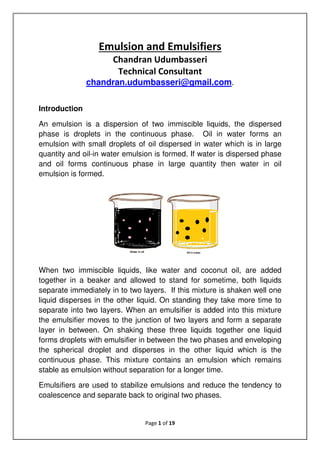
An emulsion is a dispersion of two immiscible liquids, the dispersed
phase is droplets in the continuous phase. Oil in water forms an
emulsion with small droplets of oil dispersed in water which is in large
quantity and oil-in water emulsion is formed. If water is dispersed phase
and oil forms continuous phase in large quantity then water in oil
emulsion is formed.
When two immiscible liquids, like water and coconut oil, are added
together in a beaker and allowed to stand for sometime, both liquids
separate immediately in to two layers. If this mixture is shaken well one
liquid disperses in the other liquid. On standing they take more time to
separate into two layers. When an emulsifier is added into this mixture
the emulsifier moves to the junction of two layers and form a separate
layer in between. On shaking these three liquids together one liquid
forms droplets with emulsifier in between the two phases and enveloping
the spherical droplet and disperses in the other liquid which is the
continuous phase. This mixture contains an emulsion which remains
stable as emulsion without separation for a longer time.
Emulsifiers are used to stabilize emulsions and reduce the tendency to
coalescence and separate back to original two phases.
Page 2 of 19
Emulsion interface
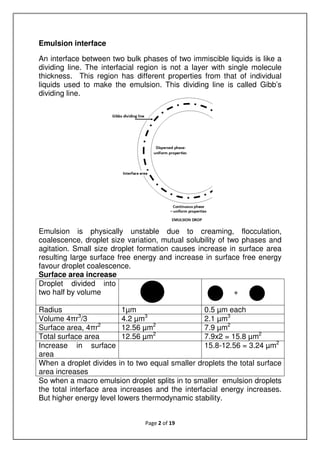
An interface between two bulk phases of two immiscible liquids is like a
dividing line. The interfacial region is not a layer with single molecule
thickness. This region has different properties from that of individual
liquids used to make the emulsion. This dividing line is called Gibb’s
dividing line.
Emulsion is physically unstable due to creaming, flocculation,
coalescence, droplet size variation, mutual solubility of two phases and
agitation. Small size droplet formation causes increase in surface area
resulting large surface free energy and increase in surface free energy
favour droplet coalescence.
Surface area increase
Droplet divided into
two half by volume +
Radius 1µm 0.5 µm each
Volume 4πr3
/3 4.2 µm3
2.1 µm3
Surface area, 4πr2
12.56 µm2
7.9 µm2
Total surface area 12.56 µm2
7.9x2 = 15.8 µm2
Increase in surface
area
15.8-12.56 = 3.24 µm2
When a droplet divides in to two equal smaller droplets the total surface
area increases
So when a macro emulsion droplet splits in to smaller emulsion droplets
the total interface area increases and the interfacial energy increases.
But higher energy level lowers thermodynamic stability.
Page 3 of 19
Bownian motion
As the emulsion size reduces the emulsions start moving under the
influence of Brownian movement. Brownian movement becomes
appreciable for particles under 3 microns and predominates when the
particle size reaches 0.1 micron. Brownian movement show a degree of
random movement and thus under the influence of entropy force.
As the macro emulsion tends to become micro emulsion of size below 3
micron the Brownian motion influences the emulsion particles and they
subject to entropy increase. This entropy brings thermodynamic stability
in the microemulsions.
When an emulsifier is added and adsorbed at the interface the surface
free energy reduces and emulsion becomes stable
This surface free energy is given by equation:
∆G = δ ∆A
In which δ (N/m) denotes interfacial tension, and ∆A (m2) the total
interfacial area.
The free energy ∆G is given as positive, as the emulsion formation is
non spontaneous and needs external force to create the droplets of
emulsion.
Emulsion and potential energy
Emulsions are thermodynamically unstable as both the dispersed and
continuous phases can revert as separate phases, oil, and water; by
fusion or the coalescing of droplets. The two phases experience
repulsive and attractive forces.
The forces that act between the two phases are
1. E. F = Electrostatic repulsion (droplets of similar structure
2. S.F = Steric repulsion (repulsive forces due to shape and location)
and
3. L.F = London attractive forces (hydrogen bonding, dipolar
attraction)
Total potential energy is the sum of repulsive forces (steric force and
electrostatic force) and deducing the London attractive forces.
P.E = S.F + E.F – LF
Repulsive and attractive forces balance each other in magnitude to keep
total potential energy to minimum in the emulsion to support its
existance
Page 4 of 19
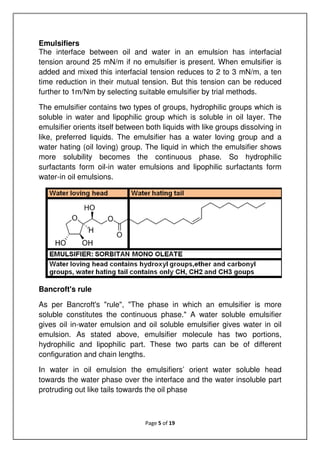
When the interfacial energy increases which is positive, the system
tends to be less stable thermodynamically and driving forces to collapse
the emulsion dominates. As the distance increases the repulsive forces
decreases and only attractive forces remain which causes for the
coalescence of droplets.
-8
-6
-4
-2
0
2
4
6
8
0 5 10 15
Force
Emulsion drop distance
Potential Energy curve
Stericc force Electrostatic force
London Force P.Energy
Page 5 of 19
Emulsifiers
The interface between oil and water in an emulsion has interfacial
tension around 25 mN/m if no emulsifier is present. When emulsifier is
added and mixed this interfacial tension reduces to 2 to 3 mN/m, a ten
time reduction in their mutual tension. But this tension can be reduced
further to 1m/Nm by selecting suitable emulsifier by trial methods.
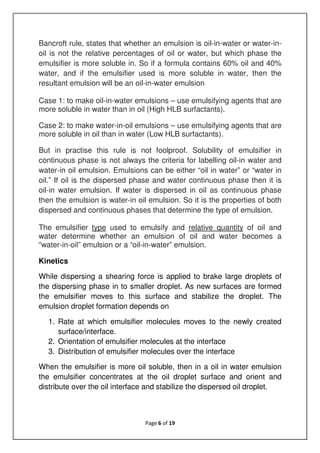
The emulsifier contains two types of groups, hydrophilic groups which is
soluble in water and lipophilic group which is soluble in oil layer. The
emulsifier orients itself between both liquids with like groups dissolving in
like, preferred liquids. The emulsifier has a water loving group and a
water hating (oil loving) group. The liquid in which the emulsifier shows
more solubility becomes the continuous phase. So hydrophilic
surfactants form oil-in water emulsions and lipophilic surfactants form
water-in oil emulsions.
Bancroft's rule
As per Bancroft's "rule", "The phase in which an emulsifier is more
soluble constitutes the continuous phase." A water soluble emulsifier
gives oil in-water emulsion and oil soluble emulsifier gives water in oil
emulsion. As stated above, emulsifier molecule has two portions,
hydrophilic and lipophilic part. These two parts can be of different
configuration and chain lengths.
In water in oil emulsion the emulsifiers’ orient water soluble head
towards the water phase over the interface and the water insoluble part
protruding out like tails towards the oil phase
Page 6 of 19
Bancroft rule, states that whether an emulsion is oil-in-water or water-in-
oil is not the relative percentages of oil or water, but which phase the
emulsifier is more soluble in. So if a formula contains 60% oil and 40%
water, and if the emulsifier used is more soluble in water, then the
resultant emulsion will be an oil-in-water emulsion
Case 1: to make oil-in-water emulsions – use emulsifying agents that are
more soluble in water than in oil (High HLB surfactants).
Case 2: to make water-in-oil emulsions – use emulsifying agents that are
more soluble in oil than in water (Low HLB surfactants).
But in practise this rule is not foolproof. Solubility of emulsifier in
continuous phase is not always the criteria for labelling oil-in water and
water-in oil emulsion. Emulsions can be either “oil in water” or “water in
oil.” If oil is the dispersed phase and water continuous phase then it is
oil-in water emulsion. If water is dispersed in oil as continuous phase
then the emulsion is water-in oil emulsion. So it is the properties of both
dispersed and continuous phases that determine the type of emulsion.
The emulsifier type used to emulsify and relative quantity of oil and
water determine whether an emulsion of oil and water becomes a
“water-in-oil” emulsion or a “oil-in-water” emulsion.
Kinetics
While dispersing a shearing force is applied to brake large droplets of
the dispersing phase in to smaller droplet. As new surfaces are formed
the emulsifier moves to this surface and stabilize the droplet. The
emulsion droplet formation depends on
1. Rate at which emulsifier molecules moves to the newly created
surface/interface.
2. Orientation of emulsifier molecules at the interface
3. Distribution of emulsifier molecules over the interface
When the emulsifier is more oil soluble, then in a oil in water emulsion
the emulsifier concentrates at the oil droplet surface and orient and
distribute over the oil interface and stabilize the dispersed oil droplet.
Page 7 of 19
In an emulsion droplet the surface of each droplet is an interface
between hydrophilic and hydrophobic molecules. Taking oil in water
emulsion, a droplet of oil is surrounded by water. Inside the oil droplet
the liquid has totally hydrophobic nature while outside the droplet it is
molecules with hydrophilic in behaviour. This immiscible nature of the
liquids cause increase in enthalpy (internal heat content) of the emulsion
system. When the immiscible liquids are mixed/agitated naturally
entropy increases. A positive enthalpy cannot bring spontaneous change
in the system, the system goes back to its original state. So an emulsion
is thermodynamically unstable.
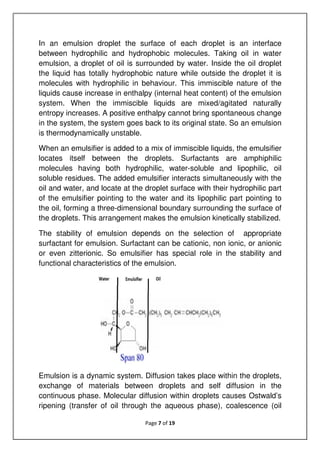
When an emulsifier is added to a mix of immiscible liquids, the emulsifier
locates itself between the droplets. Surfactants are amphiphilic
molecules having both hydrophilic, water-soluble and lipophilic, oil
soluble residues. The added emulsifier interacts simultaneously with the
oil and water, and locate at the droplet surface with their hydrophilic part
of the emulsifier pointing to the water and its lipophilic part pointing to
the oil, forming a three-dimensional boundary surrounding the surface of
the droplets. This arrangement makes the emulsion kinetically stabilized.
The stability of emulsion depends on the selection of appropriate
surfactant for emulsion. Surfactant can be cationic, non ionic, or anionic
or even zitterionic. So emulsifier has special role in the stability and
functional characteristics of the emulsion.
Emulsion is a dynamic system. Diffusion takes place within the droplets,
exchange of materials between droplets and self diffusion in the
continuous phase. Molecular diffusion within droplets causes Ostwald’s
ripening (transfer of oil through the aqueous phase), coalescence (oil
Page 8 of 19
transfer through fusion of emulsifier film over the droplets). The kinetic
process of droplet breaking and reorganizing continues constantly due to
molecular diffusion and this diffusion controls the kinetic reaction of
chemical processes.
Types of emulsifiers
There are slow emulsifiers and fast emulsifiers. There are small
emulsifiers and large molecule emulsifiers. Small emulsifiers have the
advantage of moving to the droplet interface without much steric
hindrance and stabilizing the droplet. But small emulsifiers are not tightly
adhered to the interface. So they have the disadvantage of being
removed from the interface due to the Brownian movement of
molecules. Smaller emulsifier molecules have low repulsive force to
counter and balance with London attractive forces. Eventually this leads
to coalescence. Smaller emulsifiers are fast moving molecules. They
quickly approach a newly formed interface, adhere to it and try to
stabilize. Slow emulsifiers are large molecules and approach the
interface slowly and adhere to the interface. These adhering large
molecules have more repulsive forces to counter act that of attractive
forces to balance and stabilize the droplet surface. Usually mixtures of
smaller and larger molecules give better stability to the emulsion. When
mixtures of emulsifiers with varying molecular weights are used this
gives high packing density at the interface making the emulsion more
stable.
Stability
Emulsified liquids have larger interfacial area compared to un-emulsified
mixture. The presence of emulsifier reduces the interfacial tension but
still thermodynamically unstable. When micro-emulsions are considered
then interfacial tension is considerably very small. Taking Gibbs
equation
∆G = δ ∆A –T∆S
When δ is small then δ ∆A is negligible. Then
∆G = –T∆S
Page 9 of 19
So the Gibbs free energy becomes negative and the system tends to be
spontaneous. That means the system is thermodynamically stable. So
as the emulsion becomes minuter to microlevel then the emulsion, micro
emulsion tends to be stable.
Emulsion systems
• Macro emulsion: Oil-in waterand water-in oil emulsions:
approximately 0.1to 5 micron size
• Nano emulsion: size 20 to 100 nm (nanometer)
• Micro emulsion: size: 5 to 50nm
• Multiple emulsion: they are emulsions of emulsions. W/O/W,
O/W/O
• Mixed emulsions: system with two different disperse.
Emulsion breakdown
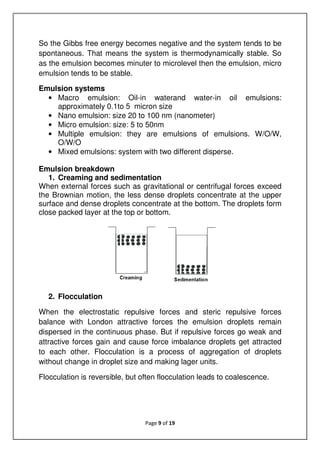
1. Creaming and sedimentation
When external forces such as gravitational or centrifugal forces exceed
the Brownian motion, the less dense droplets concentrate at the upper
surface and dense droplets concentrate at the bottom. The droplets form
close packed layer at the top or bottom.
2. Flocculation
When the electrostatic repulsive forces and steric repulsive forces
balance with London attractive forces the emulsion droplets remain
dispersed in the continuous phase. But if repulsive forces go weak and
attractive forces gain and cause force imbalance droplets get attracted
to each other. Flocculation is a process of aggregation of droplets
without change in droplet size and making lager units.
Flocculation is reversible, but often flocculation leads to coalescence.
Page 10 of 19
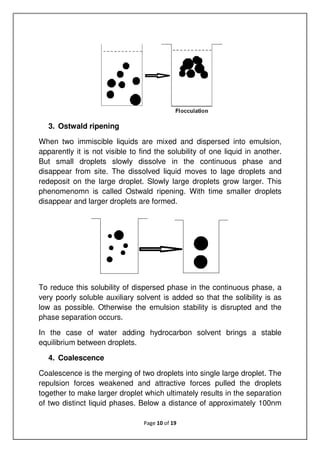
3. Ostwald ripening
When two immiscible liquids are mixed and dispersed into emulsion,
apparently it is not visible to find the solubility of one liquid in another.
But small droplets slowly dissolve in the continuous phase and
disappear from site. The dissolved liquid moves to lage droplets and
redeposit on the large droplet. Slowly large droplets grow larger. This
phenomenomn is called Ostwald ripening. With time smaller droplets
disappear and larger droplets are formed.
To reduce this solubility of dispersed phase in the continuous phase, a
very poorly soluble auxiliary solvent is added so that the solibility is as
low as possible. Otherwise the emulsion stability is disrupted and the
phase separation occurs.
In the case of water adding hydrocarbon solvent brings a stable
equilibrium between droplets.
4. Coalescence
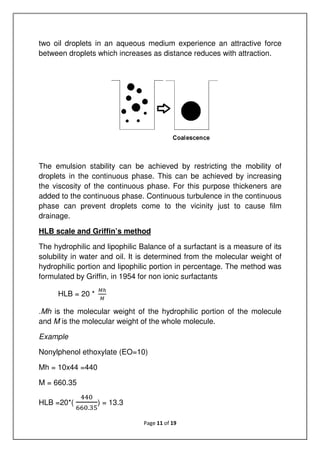
Coalescence is the merging of two droplets into single large droplet. The
repulsion forces weakened and attractive forces pulled the droplets
together to make larger droplet which ultimately results in the separation
of two distinct liquid phases. Below a distance of approximately 100nm
Page 11 of 19
two oil droplets in an aqueous medium experience an attractive force
between droplets which increases as distance reduces with attraction.
The emulsion stability can be achieved by restricting the mobility of
droplets in the continuous phase. This can be achieved by increasing
the viscosity of the continuous phase. For this purpose thickeners are
added to the continuous phase. Continuous turbulence in the continuous
phase can prevent droplets come to the vicinity just to cause film
drainage.
HLB scale and Griffin’s method
The hydrophilic and lipophilic Balance of a surfactant is a measure of its
solubility in water and oil. It is determined from the molecular weight of
hydrophilic portion and lipophilic portion in percentage. The method was
formulated by Griffin, in 1954 for non ionic surfactants
HLB = 20 *
.Mh is the molecular weight of the hydrophilic portion of the molecule
and M is the molecular weight of the whole molecule.
Example
Nonylphenol ethoxylate (EO=10)
Mh = 10x44 =440
M = 660.35
HLB =20*(
.
) = 13.3
Page 12 of 19
The result will be between 0 and 20. 0 means 100%
lipophilic/hydrophobic molecule. 20 means 100% hydrophilic/lipophobic
molecule.
HLB can be used to know the surfactant characteristics.
HLB value Character
<10 Lipid soluble and water insoluble
>10 Water soluble and lipid insoluble
1 – 3 Antifoaming agent
3 – 6 Water in oil emulsifier
7 – 9 Wetting and spreading agent
8 - 16 Oil in water emulsifier
13 - 16 Detergent
Davies method
In 1957 Davies suggested a method of calculation attributing certain
values for chemical groups in the molecule.
Hydrophilic Groups
Group
Number
Lipophilic Groups
Group
Number
-SO4
−
Na+
38.7 -CH- -0.475
-COO−
K+
21.1 -CH2- -0.475
-COO−
Na+
19.1 CH3- -0.475
N (tertiary amine) 9.4 =CH- -0.475
Ester (sorbitan ring) 6.8
Ester (free) 2.4
-COOH 2.1
Hydroxyl (free) 1.9
-O- 1.3
Hydroxyl (sorbitan
ring)
0.5
HLB calculation
HLB = 7 + hydrophilic groups + hydrophobic groups
Page 13 of 19
Example: PEG400 monooleate
Group Value No Total
Free OH 1.9 1 +1.9
-O- 1.3 8 +10.4
CH/CH2/CH3 -0.475 17 -8.075
HLB = 7+1.9+10.4-8.075 = 11.2
HLB is not considering, pH, temperature influence, emulsifier
concentration, molrcular interaction and concentration of both phases.
Emulsion stabilization using HLB value
To make a stable emulsion, the emulsifier or emulsifier mixture used
should have HLB value equal to the HLB value of the oil phase.
For nonionic surfactants, with polyoxyethylene as hydrophilic part the
HLB can be calculated using the formula
HLB=
E= percentage weight of ethylene oxide
Example: Nonylphenol 10 ethoxylate
Mol wt = 660
% EO = = = 66.67
HLB =
.
= 13.3
The HLB of Esters of polyhydric alcohols can be determined using the
following equation
HLB = 20[1 − ]
Page 14 of 19
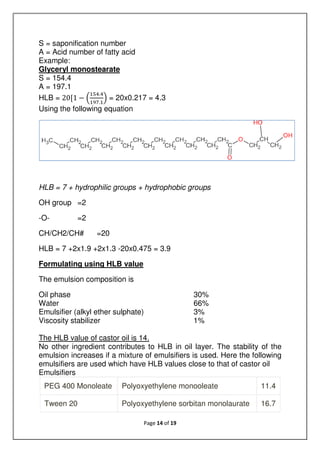
S = saponification number
A = Acid number of fatty acid
Example:
Glyceryl monostearate
S = 154.4
A = 197.1
HLB = 20[1 −
.
.
= 20x0.217 = 4.3
Using the following equation
HLB = 7 + hydrophilic groups + hydrophobic groups
OH group =2
-O- =2
CH/CH2/CH# =20
HLB = 7 +2x1.9 +2x1.3 -20x0.475 = 3.9
Formulating using HLB value
The emulsion composition is
Oil phase 30%
Water 66%
Emulsifier (alkyl ether sulphate) 3%
Viscosity stabilizer 1%
The HLB value of castor oil is 14.
No other ingredient contributes to HLB in oil layer. The stability of the
emulsion increases if a mixture of emulsifiers is used. Here the following
emulsifiers are used which have HLB values close to that of castor oil
Emulsifiers
PEG 400 Monoleate Polyoxyethylene monooleate 11.4
Tween 20 Polyoxyethylene sorbitan monolaurate 16.7
Page 15 of 19
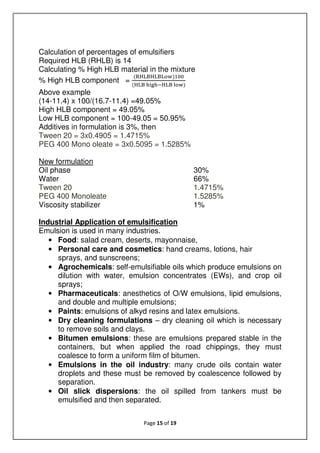
Calculation of percentages of emulsifiers
Required HLB (RHLB) is 14
Calculating % High HLB material in the mixture
% High HLB component =
( )
( !"#!$ % )
Above example
(14-11.4) x 100/(16.7-11.4) =49.05%
High HLB component = 49.05%
Low HLB component = 100-49.05 = 50.95%
Additives in formulation is 3%, then
Tween 20 = 3x0.4905 = 1.4715%
PEG 400 Mono oleate = 3x0.5095 = 1.5285%
New formulation
Oil phase 30%
Water 66%
Tween 20 1.4715%
PEG 400 Monoleate 1.5285%
Viscosity stabilizer 1%
Industrial Application of emulsification
Emulsion is used in many industries.
• Food: salad cream, deserts, mayonnaise,
• Personal care and cosmetics: hand creams, lotions, hair
sprays, and sunscreens;
• Agrochemicals: self-emulsifiable oils which produce emulsions on
dilution with water, emulsion concentrates (EWs), and crop oil
sprays;
• Pharmaceuticals: anesthetics of O/W emulsions, lipid emulsions,
and double and multiple emulsions;
• Paints: emulsions of alkyd resins and latex emulsions.
• Dry cleaning formulations – dry cleaning oil which is necessary
to remove soils and clays.
• Bitumen emulsions: these are emulsions prepared stable in the
containers, but when applied the road chippings, they must
coalesce to form a uniform film of bitumen.
• Emulsions in the oil industry: many crude oils contain water
droplets and these must be removed by coalescence followed by
separation.
• Oil slick dispersions: the oil spilled from tankers must be
emulsified and then separated.
Page 16 of 19
• Emulsification of unwanted oil: this is an important process for
pollution control
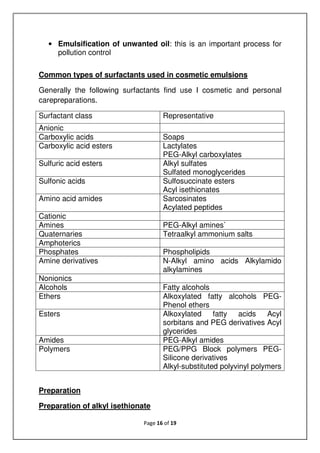
Common types of surfactants used in cosmetic emulsions
Generally the following surfactants find use I cosmetic and personal
carepreparations.
Surfactant class Representative
Anionic
Carboxylic acids Soaps
Carboxylic acid esters Lactylates
PEG-Alkyl carboxylates
Sulfuric acid esters Alkyl sulfates
Sulfated monoglycerides
Sulfonic acids Sulfosuccinate esters
Acyl isethionates
Amino acid amides Sarcosinates
Acylated peptides
Cationic
Amines PEG-Alkyl amines`
Quaternaries Tetraalkyl ammonium salts
Amphoterics
Phosphates Phospholipids
Amine derivatives N-Alkyl amino acids Alkylamido
alkylamines
Nonionics
Alcohols Fatty alcohols
Ethers Alkoxylated fatty alcohols PEG-
Phenol ethers
Esters Alkoxylated fatty acids Acyl
sorbitans and PEG derivatives Acyl
glycerides
Amides PEG-Alkyl amides
Polymers PEG/PPG Block polymers PEG-
Silicone derivatives
Alkyl-substituted polyvinyl polymers
Preparation
Preparation of alkyl isethionate
Page 17 of 19
A mixture of sodium hydroxyethane sulfonic acid solution, sodium
isethionate solution (54%) zinc oxide powder and coconut fatty acid was
fed in to a reactor. This mixture was heated to 195o
C. as quickly as
possible (about 6 hours) at atmospheric pressure with a subsurface
nitrogen purge. Distillation of water from the reaction vessel was started
when the temperature of the reaction mixture reached about 105o
C. at
atmospheric pressure. Water from the incoming sodium hydroxyethane
sulfonic acid solution was distilled off first with traces of fatty acids. After
this water was distilled off, the water from the esterification process
began to distill off. After 8 hours at 195o
C., the rate of distillation slowed
and molten paraffin (about 120o
C.) was added (MP 70o
C). apply vacuum
to 4mm Hg. Excess fatty acid was distilled out under vacuum until fatty
acid content was <5%. Cool to 150o
C and a mixture of stearic acid and
sodium hydroxide was added. Adjust pH to 5.8 to 6.5 (10% solution).
Cooled to 100o
C and added cold water to bring temperature to 65-70o
C.
The reaction product was a fluid of 36% sodium cocoyl isethionate
Acyl peptides
Carbobenzoxy-L-leucine-thiophenyl ester, glycine and glacial acetic acid
are heated under reflux for four hours, during which time the glycine
passes slowly into solution The acetic acid is then distilled off in the
vacuum. The product is taken up in acetic ester, the whole is shaken out
with a saturated sodium bicarbonate solution, and the bicarbonate
solution is acidified to pH 7by means of concentrated hydrochloric acid.
Fatty acid alkyl ethoxylate
Add palm acid ester to an autoclave and add catalyst barium oxide and
sulphuric acid. Heat under vacuum to 100o
C and distill out moisture.
Increase the temperature to 160o
C. Add ethylene oxide under pressure.
Increase pressure to 2 bar and allow temperature to go 180-190o
C.
Maintain at this condition for additional 1hr. reduces pressure to
atmospheric and neutralize with acetic acid to neutral pH.
Alkyl sulphate
To a round-bottomed flask fitted with a paddle stirrer, thermometer, and
addition funnel topped with a nitrogen blanket was added internal
pentadecene After cooling to 20-21 ° C, 95% sulfuric acid was added at
Page 18 of 19
such a rate that the temperature was maintained at 20-21 ° C. When
acid addition was complete, added distilled water and stirred for one
hour and then phase separated
The upper phase from the sulfation above was added to a small stirred
mixture of alcohol ethoxylate and 50% sodium hydroxide, at 38-39 ° C
over a period of forty-nine minutes. Neutralized to a pH of 14. After
neutralization, the mixture was heated with stirring to reflux
(approximately 108°C) and held at reflux for one hour. Using thin film
evaporator distil out free olefin and alcohol. The residue gives the alkyl
sulphate.
Sodium Stearoyl lactylate
Take 1liter glass beaker and 20 g of acetyl succinate starch and 600ml
water. Take another 20g acetyl succinate starch and 140g dextrin were
added to water and heated to 80o
C to dissolve the materials. Spray dry
the product to make dry material
PEG carboxylate
To a beaker added methoxy polyethylene glycol, tetra methyl pipiridine
and potassium bromide. Added water, stirred and cooled to 1o
C. Then
sodium hypochlorite (8% solution) was added. The pH was adjusted to
10 continuously under stirring with the addition of 0.5N sodium hydroxide
solution. After 2 hrs if pH remained at 10, continue stirring and cooling
for 6 hrs. The reaction was stopped by adding ethanol. Then pH was
adjusted to 3 with 4N hydrochloric acid. The product was then extracted
with dichloromethane. The extract was then added to cold ether solution
to crystallize out PEG carboxylic acid.
Sodium sarcosinates
To a reaction vessel containing hydroxyl acetonitrile, which is cooled to
10o
C, added 25% methyl amine solution and maintaining the
temperature to 15o
C. the mixture is stirred for 1hr after addition of methyl
amine. Heat the mixture to 100o
C and add sodium hydroxide. This forms
methyl amino sodium acetate. This product is neutralized with
hydrochloric acid and sorkosine and sodium chloride separated out.
Using electrodailitical method the pure sarkosine separated
Page 19 of 19
Sulfated lauric acid monoglycerides
Technical lauric acid monoglyceride (Monomols 90 L-12) were reacted
with sulfur trioxide at 95 C. The SO3 was used in a ratio of 0.5 mole to 1
mole of hydroxyl groups present in the partial ester
It was then stirred together with 37% by weight Sodium hydroxide
solution into a 1% by weight solution of Sodium triphosphate and
neutralized at pH 6.5 to 8.
Sulfosuccinate esters
110 kgs by weight of 3,4 dimethyl cyclohexanol was mixed with 38 kgs
of maleic anhydride in 80 liters of toluene containing 1.5 kgs of p-
toluenesulforic acid and the mixture was agitated at 132° C. for 4.5
hours while removing the water of esterification. The mixture was
washed with dilute NaOH solution and then with water and the solvent
and excess alcohol removed by distillation at reduced pressure. The
resulting di-3,5-dimethylcyclohexylmaleate was sulfonated by refluxing
with agitation in the presence of 30 kgs of sodium bisulfite dissolved in a
mixture of 80 Lts of ethyl alcohol and 25 Lts of water for 8.5 hours
followed by extraction with ether to remove any unsulfonated ester. The
aqueous solution was then evaporated, yielding a brittle white water-
soluble solid
Page 1 of 12
Food-grade emulsifiers
There are a number of families of food-grade emulsifiers, which may be
classified as
1. Mono- and diglycerides
2. Propylene glycol monoesters
3. Lactylated esters
4. Polyglycerol esters
5. Sorbitan esters
6. Ethoxylated esters
7. Succinylated esters
8. Fruit acid esters
9. Acetylated mono- and diglycerides
10. Phosphated mono- and diglycerides
11. Sucrose esters
General Preparation
1. Acetylated mono glyceride
Take an appropriate reaction vessel and fit temperature probe, stirrer
and condenser. Add acetic acid, glycerol, catalyst sulphuric acid and
zeolite. Heat to 80 to 100o
C for 5hrs. Cool to RT and add 5% sodium
carbonate solution and neutralize to a pH 7. Distil out acetic acid at 143
to 185o
C,then apply vacuum at 186 to 191o
C to get acetylated mono
glyceride.
2. Fruit acid (Citric acid)
Lemon juice is squeezed out from lemon and the juice filtered to get
cleat juice. Calcium hydroxide is added to make calcium citrate. Solid
calcium citrate precipitates at the bottom. The solution in filtered to get
solid material which is then washed with distilled water to remove
contaminants. The solid dried calcium citrate is then decomposed with
dilute sulfuric acid. The calcium sulphate is filtered out. The clear filtrate
concentrated by evaporation until crystals appear. The concentrated
solution cooled to crystallize citric acid crystals. These crystaqls are
brown in color. Recrystallize these crystals to get pure white citric acid.
3. Lauric acid esters of glycerol
Lauric acid, glycerol carbonate and sodium hydroxide were charged to a
reaction flask fitted with magnetic stirrer bar, nitrogen sparge, side-arm
Page 2 of 12
water condenser and collection flask. The mixture was heated under
stirring and gentle nitrogen sparge on an oil bath, itself heated with a
hotplate with stirrer motor until the oil temperature was 180°C. The
reaction mixture was then maintained at an oil bath temperature of
180°C, until all of the glycerol carbonate had been consumed, as
monitored by FT-IR and HPLC. The reaction was then stopped and the
product discharged.
4. Polyglycerol ester
Charge a RB flask with glycerol and (46% aqueous) of potassium
hydroxide. Fit flask with a variable speed agitator, nitrogen
sparge,vacuum connection to 1 mm Hg, a packed column, and a
receiver. Place the flask in a heating mantle. A vacuum of 200 mm Hg
was applied to the reactor and the glycerol-potassium hydroxide mixture
was agitated and heated to 230o
C. Reduce vacuum gradually to 150 mm
Hg and the reflux ratio varied from 1:1 to 10:1 over a 15 hour period to
maintain a column head temperature below 90°C. Check the hydroxyl
value. The reaction is completed when a Hydroxyl Value of 1435 is
achieved. Cool the reaction mixture to 200o
C. Strip the glycerol. The bulk
of the glycerol is stripped by applying a vacuum of 4 mm Hg to the
reactor while heating at 200o
C. The remainder of glycerol is stripped by
introducing steam into the bottom valve of the reactor. The final
composition is: 0.84% by weight of glycerol, 47% by weight of diglycerol,
32% by weight of triglycerol, 11% by weight of tetraglycerol, 5% by
weight of pentaglycerol, 2% by weight of hexaglycerol, and 2% by weight
of cyclic polyglycerol, based upon 100% total weight of polyglycerol.
5. Propylene glycol monoesters
Place in a dry autoclave soya oil/coconut oil and propylene glycol and
add catalytic quantity of potassium acetate. Close the autoclave and
purge CO below the liquid surface in the autoclave at a rate of 250psig.
The sealed reactor is heated to 220o
C. and the reaction is run at 220o
C.
for 2 hours at about 60 psig. After cooling, about 1.g. conc. phosphoric
acid is added to neutralize the product. About 3% by wt. DI water is
added, Allow the mixture to separate into layers. The upper layer is
collected and heated to 140o
C to strip glycerol and propylene glycol. The
Page 3 of 12
final product analysed to 90.0% monoesters (81.3% propylene glycol
monoesters and 8.7% glycerol monoesters).
6. Sorbitan monolaurate
To a RB flask fitted with agitator, thermometer, condenser, nitrogen
sparge, added sorbitol, lauric acid, sodium hydroxide, and decolorising
carbon. Flushed the assembly with nitrogen and heated to 200o
C. at
atmospheric pressure over a 45 minute period. The reaction mixture was
maintained at this temperature for 2 hrs and nitrogen flow was
maintained at a lower rate. The reaction mixture was then cooled and
left standing overnight. The next morning the mixture was heated to 101°
C. under nitrogen, added phosphoric acid and diatomaceous earth. Filter
the product at 90-100o
C with nitrogen flushing, treat the filtrate with
hydrogen peroxide and then with diatomaceous earth.
7. Lactylated monoglyceride
Lauric acid and glycerol were reacted at 130 to 140o
C in the presence of
methyl lactate for 5 hrs. After reaction the mixture was cooled, dissolved
in diethyl ether and washed with water.to remove glycerol and methyl
lactate.the trace water was removed by vacuum.
Emulsifiers for pharma applications
An emulsion is stabilized by using emulsifiers. It forms a thin mono layer
of the adsorbed molecules at the oil water interface. This adsorption of
emulsifier molecules reduce the interfacial tension. If this mono layer is
ionized the charged parts repell each other as they got same charge
envelope. This increases the stability of the droplet. Ionic emulsifiers like
sodium stearate, potassium laurate, etc are capable of stabilizing the
emulsion droplets by repulsion.
Function of emulsifiers
1. Stabilizes the droplets
2. On stabilizing the possibility of flocculation, coalescence ofdroplets
get inhibited
3. Reductionin interfacial tension.
4. Repulsion between droplets with same charge
5. Increase in viscosity helps to maintain suspension in the
continuous phase as dispersed globules.
Page 4 of 12
List of emulsifiers used in pharma applications
Most of these items are pure basic products or naturally pure products.
Name of Emulsifiers
1 Acacia
2 Carbomer
3 Carboxymethylcellulose Sodium / Carmellose Sodium
4 Sodium Lauryl Sulfate
5 Carrageenan
6 Cetyl Alcohol
7 Cetostearyl Alcohol, BP name: Emulsifying Wax
8 Cholesterol
9 Cetomacrogol 1000
10 Methylcellulose
11 Poloxamer
12 Polyoxyethylene Stearates
13 Bentonite
14 Colloidal clays (such as attapulgite)
15 Veegum/ Magnesium Aluminum Silicate
16 Triethanolamine
17 Stearic Acid
18 Hydroxypropyl Cellulose
19 Polycarbophil
20 Saponite
21 Hydroxypropyl Starch, Oleyl, Alcohol, Palmitic Acid, Pectin,
Potassium Alginate, Ammonium Alginate, Calcium, Alginate etc.
Preparation of some emulsifiers used in pharma
1. Carbamer
Recipe
1. Acylic acid 11.35parts
2. Diisopropyl azodicarboxylate 0.027
3. Pentaerythritol triallyl ether 0.027
4. Polysiloxane 0.046
5. Hexanaphthene (solvent) 34.05
6. Ethyl acetate (solvent) 45.41
7. N Hexane (solvent) 09.09
All the ingrediants were added to reactor and stirred. Nitrogen gas is
purged.using water bath heat the mixture to 50 to 70o
C for 4 to 8 hrs. the
Page 5 of 12
reaction mixture cooled filtered and dried. White and fluffy carbomer
powder is obtained
2. Carboxy methylcellulose sodium
A mixture of isopropyl alcohol (IPA) and sodium hydroxide was cooled to
15°C. Cellulose powder (Comminuted) was added and mixed for 2hrs at
15°C Dissolved mono chloroacetic acid (MCA) in additional IPA and
mixed with the slurry at the end of the alkali cellulose period. The
etherification reaction was carried out at 70o
C. for 1.5 hours. The slurry
was cooled to about room temperature (25 C-30° C.), the sodium
hydroxide was neutralized with acetic acid and the crude CMC product
was purified with aqueous alcohol prior to hardening. Moderate agitation
was used throughout the entire process.
3. Sodium lauryl sulphate
In an enameled sulfurizer equipped with a cooling jacket and a high-
speed propeller stirrer, 42 kg of dried lauryl alcohol is charged, and
chlorosulfonic acid is fed from a metering batcher at a rate of 0.25-0.3 l /
min. The sulfation process proceeds at a temperature of 38-45 ° C for
60-70 minutes. Hydrogen chloride by product is absorbed in absorber.
The product is neutralized with NaOH solution (1.25) of 46lts to a pH
8.5.The precipitated sulphate filtered off and recrystallized.
Emulsifiers used in other formulations
A. Defoamers
Defoamers are chemical additives that eliminate existing foam that has
been formed and antifoam is the additive that prevents the foam
formation. Foam is defined as dispersed air or gas in a liquid. Surface
active agents stabilize foam
Foam is a desired property in the case of soaps, detergents and
beverages. But it is not acceptable in the case of paint, coating, printing,
etc. In usual processes like mixing, blending, and distillation foaming
creates process problem and takes a lot of production hours to
accommodate the foaming character of a liquid. Foaming creates
craters, fish eyes, pin holes and such surface irregularities when surface
Page 6 of 12
coating, painting or printing is performed. The following situations cause
foam formation:
The defoaming formulations are based on water as diluents medium.
The organic phase is emulsified and the emulsion is stabilized with the
use of emulsifiers. In the following formulation, which is based on
organic silicone compounds is emulsified by using sorbitan mono oleate
and PEG400 monooleate mixture
Formulation %
1. Polyether modified Silicone fluid 1.64
2. Hydrophobic Silica 0.63
3. Dimethyl Silicone fluid 5.63
4. Sorbitan Mono oleate 1.05
5. PEG 600 Mono oleate 1.05
6. Water 90
Total 100
B. Metal working emulsions
The composition forms translucent emulsion with water and it can be
employed for metalworking operations. The said composition is
particularly suitable for grinding, milling, drilling, turning operations. It
has excellent swarf removal and cooling characteristics. It also has very
good corrosion protection properties, emulsion stability, bio-stability.
formulation:
Ingredients Qty (%)
Spindle oil 13.6 to 29.1 wt%,
Fatty acid diethanol amide 3.1 to 12.0%
Oleic acid 1.2 to 8%,
Tri-ethanolamine 5.4 to 14.8%,
Sodium petroleum sulphonate 4.2 to 6.8%,
Boric acid 0.5 to 3.0%,
Lauryl alcohol 0.9 to 4.1%,
Triazine 1.4 to 2.4 %,
Water 35.2 to 56.2%
-
Page 7 of 12
C. Emulsifiers for crude oil drilling fluids
Emulsifier is used to make a stable invert emulsion mud system. All the
present mud systems contain primary and secondary emulsifiers. The
most common emulsions are oil-in-water emulsions with water as the
continuous phase and water-insoluble organic liquid as the dispersed
phase. The secondary emulsifier is usually a wetting agent. The primary
emulsifier is a modified fatty acid and the secondary emulsifier is a fatty
acid amide.
Secondary emulsifier is used to stabilize the emulsion and also wet the
solid phase.
In a primary emulsion, the globules (droplets) inside emulsion consist of
only one substance or phase. That is droplets of oil inside water or
water droplets inside oil are primary emulsion
In a secondary emulsion, the globules inside emulsion consist of two
phases. Each droplet consists of a globule encapsulated with in another
globule. Secondary globules and emulsion is formed from the primary
emulsion
For example, there is an oil drop on which there is water drop
surrounding it, and this droplet is immersed in oil.
The primary emulsifiers form the basis for the emulsion-
Invert emulsion systems. It contains weighting agents to increase
density of mud.
The secondary emulsifier which is a wetting agent improves the stability
of the emulsion as well as to keep the weighting agents oil - wetted
Primary emulsifier is prepared by reacting tall oil fatty acid with maleic
anhydride in presence of iodine catalyst. It forms a tri-acid anhydride
The secondary emulsifier which is a wetting agent improves the stability
of the emulsion as well as to keep the weighting agents oil - wetted
Weighting agents such as barite, micromax, ilmenite, and
hematite are commonly added to drilling fluids to produce high-density
Page 8 of 12
fluids that could be used to drill deep oil and gas wells. Increasing the
drilling fluid density leads to highly conspicuous fluctuation in the drilling
fluid characteristicsThe secondary emulsifier which is a wetting agent
improves the stability of the emulsion as well as to keep the weighting
agents oil - wetted
Weighting agents such as barite, micromax, ilmenite, and
hematite are commonly added to drilling fluids to produce high-density
fluids that could be used to drill deep oil and gas wells. Increasing the
drilling fluid density leads to highly conspicuous fluctuation in the drilling
fluid characteristics
D. Bitumen emulsions:
Applying betumen after making into emulsion and spraying on road
makes it more convenient to apply at a lower temperature and avoiding
much fumes produced during heating which causes environmental
hazards. Cationic emulsifying agents are used in bitumen
emulsions. Emulsifiers like amine propane alkyldiamine and
modified alkyl diamines are preferably used at the amount of
0.05 to 0.5%..
E. Oil Spill Dispersant
Oil spill occurs mostly during handling crude oil at off shore drilling and
processing in drilling platforms which are located much distant from sea
shore. Large spills occur when oil carrying tankers sink in the sea. In
2017 there were two major spills, one in June a tanker carrying 5000
tons of oil sunk in Indian Ocean and second tanker sunk in September
off the coast of Greece carrying 700 tons of oil.
The oil spill on a body of water like ocean is managed by recovering of
spilled oil, or by dispersing the oil into emulsions and allowing to settle to
the bottom of the ocean. The recovery process is time consuming and a
small amount can be recovered in that period. Allowing the oil layer to
remain on the surface of water body causes wide spreading of oil layer
on the surface causing environmental pollution and contamination to
water body and toxic condition to the aquatic beings. So the acceptable
way to contain the spilled oil is to disperse into small droplets. Chemical
dispersants are used for this purpose.
Page 9 of 12
The basic solvent used in all formulations were hydrocarbon solvent
which adds to the loading of the ocean with compounds of the same
petrochemical class as the Spill itself. While selecting a dispersant it has
to be noted that the toxicity of the dispersant to the fish and wildlife
should balance with dispersing effect.
So water based dispersant are more environmentally friendly. Here
sodium petroleum sulfonate is used as emulsifier.
Agrochemical Emulsions:
Pesticides and insecticides are the organic chemicals used in
agriculture. The delivery of these chemicals is done by making aqueous
emulsions to make uniform distribution at low concentration to the crops
and vegitable cultivation. The suppliers of agrochemicals make
emulsifiable concentrates which the customer dilutes with water and
spray the crops.
Emulsifiable concentrate formulation contains organic solvents,
emulsifiers, and additives. All the components should make a
homogenuous solution without any phase separation. An efficient
formulation is the one that performs the purpose for which is formulated,
chemically stable (no degradation during the shelf life period), no phase
separation during the span of recommended period of usage and
emulsion stability
The selection of emulsifier depends on their ability to keep solvent and
water in homogenuous single solution without phase separation.
The formulation contains the following ingredients
1. Solid Technical
2. Antifoam
3. Bactericide*
4. Surfactant
5. Density/Viscosity Modifier System
6. Freeze/Thaw Additive
Sometimes the concentrates may not contain the diluents water and the
customer is given the procedure to dilute with water.
The emulsifiers used in the formulation have the following
properties:
1. a water-insoluble anionic surfactant
2. a highly water-soluble ethoxylated nonionic surfactant
3. a low water-soluble ethoxylated nonionic surfactant
Page 10 of 12
4. a highly water-soluble block co-polymer nonionic surfactant
the anionic surafactnt remains with organic layer and non-ionic
surfactant goes to water layer
.An example of a standard emulsifier system would be the following:
1. Calcium Dodecylbenzenesulfonate (CaDDBSA) - anionic
surfactant
2. Nonylphenolethoxylate-6 moles (NPE6) - low water solubility
ethoxylated nonionic
3. Nonylphenolethoxylate-30 moles (NPE30) - high water
solubility ethoxylated nonionic
4. High water solubile EO/PO block co-polymer nonionic
Emulsifiers Used in EC
1. Emulsifiers with low HLB
• Anionic: Calcium alkyl dodecyl benzene sulfonate
• Nonionic: Alkyl phenols with 3–6 ethylene oxide (EO) units and
fatty alcohols with 2–5 EO
2. Emulsifiers with high HLB
Anionic: Sodium dodecyl benzene sulfonate
Nonionic: Alkyl phenols with 8–30 EO, castor oil with 20–60 EO
When EC formulations are diluted with water they form a spontaneous
emulsion (particle sizes of emulsion droplets could be from 0.1 up to 5 or
10 µ) that allows a homogeneous distribution when sprayed to
vegitables and corps. The emulsion should be stable and achieved by
balancing both water soluble and oil soluble surfactants. For oil in water
emulsion water is the continuous phase anf the selected surfactant
should bemore soluble in water. For that the HLB value should be above
10 (11 to 18).
Preparation of emulsifiers
Calcium dodecyl benzene sulfonate
In a reactor, take 1000kg of methyl alcohol, 500kg of dodecyl benzene
sulfonic acid and mix well. Add 55kg calcium hydroxide and adjust
reaction solution pH value 7 to 8, at the temperature range 30 to 40o
C
and reaction duration of 1 hour, After reaction, reaction solution is taken
to a sedimentation still and left standstill for 10 to 15 hours; An upper
layer separates and product calcium dodecyl benzene sulfonate from
bottom is separated and cake filtered to give 65% converted product
Page 11 of 12
(750Kg). 500L of methanol is added to filtrate and under stirring allowed
the product to separate out.and total 90% final product is separated.
General cleaning composition
The composition contains, chelating agent, biocide, builder, surfactants,
solvent and diluents.
The nonionic surfactant component employed in the composition are:
amine oxides, alkoxylated alkanolamides and ethoxylated alcohols
(1) amine oxide compounds;
(2) ethoxylated alcohols formed by condensation of an aliphatic alcohol
with sufficient ethylene oxide to produce a compound having a
polyoxyethylene (-OCH2CH2-) groups; and
(3) alkoxylated alkanolamides,
The first group of nonionic surfactants are alkyl di(lower alkyl) amine
oxides in which the alkyl group has 10-20, and preferably 12-16 carbon
atoms, and can be straight or branched chain, saturated or unsaturated.
The lower alkyl groups include between 1 and 7 carbon atoms.
Examples include
• lauryl dimethyl amine oxide,
• myristyl dimethyl amine oxide,
• lauryl myristyl dimethyl amine oxide,
• dimethyl cocoamine oxide,
• dimethyl (hydrogenated tallow) amine oxide,
The second group of used nonionic surfactants are ethoxylated alcohols
with 8-13), moles of ethylene oxide with 1 mole of the parent
compound.. The parent compounds may include one or more of the
following: a primary, tertiary, or secondary aliphatic alcohol having 11-
15, carbon atoms
The third group of used nonionic surfactants are alkoxylated
alkanolamides.
In the formulation, the nonionic surfactant is used in an amount from 4 to
8 weight percent of total weight of the composition.
Examples of surfactants which are commercially available include
ethoxylated nonylphenol (4 Mole EO) ethoxylated nonylphenol (9-10
Mole EO), lauryl dimethyl amino oxide sodium lauroyl sarcosinate,
Page 12 of 12
dodecylbenzenesulfonic acid (DDBSA), polysorbates including
polysorbate 80, and polyethoxylated alcohols.
Typical formulation:
Component Chemical name Qty (%)
Fragrance &
Dye
0.45
Quaternary Dialkyl Dimethyl Ammonium Chloride (50%) 0.50
Nonionic
Surfactant
Lauric/Myristic Dimethyl Amine Oxide (30%) 0.75
Chelating
agent
Tetrasodium Ethylenediamine Tetraacetate
(38%)
1
Builder Sodium Citrate 1
Nonionic
Surfactant
Ethoxylated Alkanolamide 1
Quaternary Alkyl Dimethyl Benzyl Ammonium Chloride
(80%)
1
Builder Triethanolamine 2
Nonionic
Surfactant
Alkyloxypolyethylenoxyethanol 5
Solvent Diethylene Glycol Monobutyl Ether 5
Diluent Tap Water 82.3
=100

Emulsion and Emulsifiers.pdf

  • 1.
    Page 1 of19 Emulsion and Emulsifiers Chandran Udumbasseri Technical Consultant chandran.udumbasseri@gmail.com. Introduction An emulsion is a dispersion of two immiscible liquids, the dispersed phase is droplets in the continuous phase. Oil in water forms an emulsion with small droplets of oil dispersed in water which is in large quantity and oil-in water emulsion is formed. If water is dispersed phase and oil forms continuous phase in large quantity then water in oil emulsion is formed. When two immiscible liquids, like water and coconut oil, are added together in a beaker and allowed to stand for sometime, both liquids separate immediately in to two layers. If this mixture is shaken well one liquid disperses in the other liquid. On standing they take more time to separate into two layers. When an emulsifier is added into this mixture the emulsifier moves to the junction of two layers and form a separate layer in between. On shaking these three liquids together one liquid forms droplets with emulsifier in between the two phases and enveloping the spherical droplet and disperses in the other liquid which is the continuous phase. This mixture contains an emulsion which remains stable as emulsion without separation for a longer time. Emulsifiers are used to stabilize emulsions and reduce the tendency to coalescence and separate back to original two phases.
  • 2.
    Page 2 of19 Emulsion interface An interface between two bulk phases of two immiscible liquids is like a dividing line. The interfacial region is not a layer with single molecule thickness. This region has different properties from that of individual liquids used to make the emulsion. This dividing line is called Gibb’s dividing line. Emulsion is physically unstable due to creaming, flocculation, coalescence, droplet size variation, mutual solubility of two phases and agitation. Small size droplet formation causes increase in surface area resulting large surface free energy and increase in surface free energy favour droplet coalescence. Surface area increase Droplet divided into two half by volume + Radius 1µm 0.5 µm each Volume 4πr3 /3 4.2 µm3 2.1 µm3 Surface area, 4πr2 12.56 µm2 7.9 µm2 Total surface area 12.56 µm2 7.9x2 = 15.8 µm2 Increase in surface area 15.8-12.56 = 3.24 µm2 When a droplet divides in to two equal smaller droplets the total surface area increases So when a macro emulsion droplet splits in to smaller emulsion droplets the total interface area increases and the interfacial energy increases. But higher energy level lowers thermodynamic stability.
  • 3.
    Page 3 of19 Bownian motion As the emulsion size reduces the emulsions start moving under the influence of Brownian movement. Brownian movement becomes appreciable for particles under 3 microns and predominates when the particle size reaches 0.1 micron. Brownian movement show a degree of random movement and thus under the influence of entropy force. As the macro emulsion tends to become micro emulsion of size below 3 micron the Brownian motion influences the emulsion particles and they subject to entropy increase. This entropy brings thermodynamic stability in the microemulsions. When an emulsifier is added and adsorbed at the interface the surface free energy reduces and emulsion becomes stable This surface free energy is given by equation: ∆G = δ ∆A In which δ (N/m) denotes interfacial tension, and ∆A (m2) the total interfacial area. The free energy ∆G is given as positive, as the emulsion formation is non spontaneous and needs external force to create the droplets of emulsion. Emulsion and potential energy Emulsions are thermodynamically unstable as both the dispersed and continuous phases can revert as separate phases, oil, and water; by fusion or the coalescing of droplets. The two phases experience repulsive and attractive forces. The forces that act between the two phases are 1. E. F = Electrostatic repulsion (droplets of similar structure 2. S.F = Steric repulsion (repulsive forces due to shape and location) and 3. L.F = London attractive forces (hydrogen bonding, dipolar attraction) Total potential energy is the sum of repulsive forces (steric force and electrostatic force) and deducing the London attractive forces. P.E = S.F + E.F – LF Repulsive and attractive forces balance each other in magnitude to keep total potential energy to minimum in the emulsion to support its existance
  • 4.
    Page 4 of19 When the interfacial energy increases which is positive, the system tends to be less stable thermodynamically and driving forces to collapse the emulsion dominates. As the distance increases the repulsive forces decreases and only attractive forces remain which causes for the coalescence of droplets. -8 -6 -4 -2 0 2 4 6 8 0 5 10 15 Force Emulsion drop distance Potential Energy curve Stericc force Electrostatic force London Force P.Energy
  • 5.
    Page 5 of19 Emulsifiers The interface between oil and water in an emulsion has interfacial tension around 25 mN/m if no emulsifier is present. When emulsifier is added and mixed this interfacial tension reduces to 2 to 3 mN/m, a ten time reduction in their mutual tension. But this tension can be reduced further to 1m/Nm by selecting suitable emulsifier by trial methods. The emulsifier contains two types of groups, hydrophilic groups which is soluble in water and lipophilic group which is soluble in oil layer. The emulsifier orients itself between both liquids with like groups dissolving in like, preferred liquids. The emulsifier has a water loving group and a water hating (oil loving) group. The liquid in which the emulsifier shows more solubility becomes the continuous phase. So hydrophilic surfactants form oil-in water emulsions and lipophilic surfactants form water-in oil emulsions. Bancroft's rule As per Bancroft's "rule", "The phase in which an emulsifier is more soluble constitutes the continuous phase." A water soluble emulsifier gives oil in-water emulsion and oil soluble emulsifier gives water in oil emulsion. As stated above, emulsifier molecule has two portions, hydrophilic and lipophilic part. These two parts can be of different configuration and chain lengths. In water in oil emulsion the emulsifiers’ orient water soluble head towards the water phase over the interface and the water insoluble part protruding out like tails towards the oil phase
  • 6.
    Page 6 of19 Bancroft rule, states that whether an emulsion is oil-in-water or water-in- oil is not the relative percentages of oil or water, but which phase the emulsifier is more soluble in. So if a formula contains 60% oil and 40% water, and if the emulsifier used is more soluble in water, then the resultant emulsion will be an oil-in-water emulsion Case 1: to make oil-in-water emulsions – use emulsifying agents that are more soluble in water than in oil (High HLB surfactants). Case 2: to make water-in-oil emulsions – use emulsifying agents that are more soluble in oil than in water (Low HLB surfactants). But in practise this rule is not foolproof. Solubility of emulsifier in continuous phase is not always the criteria for labelling oil-in water and water-in oil emulsion. Emulsions can be either “oil in water” or “water in oil.” If oil is the dispersed phase and water continuous phase then it is oil-in water emulsion. If water is dispersed in oil as continuous phase then the emulsion is water-in oil emulsion. So it is the properties of both dispersed and continuous phases that determine the type of emulsion. The emulsifier type used to emulsify and relative quantity of oil and water determine whether an emulsion of oil and water becomes a “water-in-oil” emulsion or a “oil-in-water” emulsion. Kinetics While dispersing a shearing force is applied to brake large droplets of the dispersing phase in to smaller droplet. As new surfaces are formed the emulsifier moves to this surface and stabilize the droplet. The emulsion droplet formation depends on 1. Rate at which emulsifier molecules moves to the newly created surface/interface. 2. Orientation of emulsifier molecules at the interface 3. Distribution of emulsifier molecules over the interface When the emulsifier is more oil soluble, then in a oil in water emulsion the emulsifier concentrates at the oil droplet surface and orient and distribute over the oil interface and stabilize the dispersed oil droplet.
  • 7.
    Page 7 of19 In an emulsion droplet the surface of each droplet is an interface between hydrophilic and hydrophobic molecules. Taking oil in water emulsion, a droplet of oil is surrounded by water. Inside the oil droplet the liquid has totally hydrophobic nature while outside the droplet it is molecules with hydrophilic in behaviour. This immiscible nature of the liquids cause increase in enthalpy (internal heat content) of the emulsion system. When the immiscible liquids are mixed/agitated naturally entropy increases. A positive enthalpy cannot bring spontaneous change in the system, the system goes back to its original state. So an emulsion is thermodynamically unstable. When an emulsifier is added to a mix of immiscible liquids, the emulsifier locates itself between the droplets. Surfactants are amphiphilic molecules having both hydrophilic, water-soluble and lipophilic, oil soluble residues. The added emulsifier interacts simultaneously with the oil and water, and locate at the droplet surface with their hydrophilic part of the emulsifier pointing to the water and its lipophilic part pointing to the oil, forming a three-dimensional boundary surrounding the surface of the droplets. This arrangement makes the emulsion kinetically stabilized. The stability of emulsion depends on the selection of appropriate surfactant for emulsion. Surfactant can be cationic, non ionic, or anionic or even zitterionic. So emulsifier has special role in the stability and functional characteristics of the emulsion. Emulsion is a dynamic system. Diffusion takes place within the droplets, exchange of materials between droplets and self diffusion in the continuous phase. Molecular diffusion within droplets causes Ostwald’s ripening (transfer of oil through the aqueous phase), coalescence (oil
  • 8.
    Page 8 of19 transfer through fusion of emulsifier film over the droplets). The kinetic process of droplet breaking and reorganizing continues constantly due to molecular diffusion and this diffusion controls the kinetic reaction of chemical processes. Types of emulsifiers There are slow emulsifiers and fast emulsifiers. There are small emulsifiers and large molecule emulsifiers. Small emulsifiers have the advantage of moving to the droplet interface without much steric hindrance and stabilizing the droplet. But small emulsifiers are not tightly adhered to the interface. So they have the disadvantage of being removed from the interface due to the Brownian movement of molecules. Smaller emulsifier molecules have low repulsive force to counter and balance with London attractive forces. Eventually this leads to coalescence. Smaller emulsifiers are fast moving molecules. They quickly approach a newly formed interface, adhere to it and try to stabilize. Slow emulsifiers are large molecules and approach the interface slowly and adhere to the interface. These adhering large molecules have more repulsive forces to counter act that of attractive forces to balance and stabilize the droplet surface. Usually mixtures of smaller and larger molecules give better stability to the emulsion. When mixtures of emulsifiers with varying molecular weights are used this gives high packing density at the interface making the emulsion more stable. Stability Emulsified liquids have larger interfacial area compared to un-emulsified mixture. The presence of emulsifier reduces the interfacial tension but still thermodynamically unstable. When micro-emulsions are considered then interfacial tension is considerably very small. Taking Gibbs equation ∆G = δ ∆A –T∆S When δ is small then δ ∆A is negligible. Then ∆G = –T∆S
  • 9.
    Page 9 of19 So the Gibbs free energy becomes negative and the system tends to be spontaneous. That means the system is thermodynamically stable. So as the emulsion becomes minuter to microlevel then the emulsion, micro emulsion tends to be stable. Emulsion systems • Macro emulsion: Oil-in waterand water-in oil emulsions: approximately 0.1to 5 micron size • Nano emulsion: size 20 to 100 nm (nanometer) • Micro emulsion: size: 5 to 50nm • Multiple emulsion: they are emulsions of emulsions. W/O/W, O/W/O • Mixed emulsions: system with two different disperse. Emulsion breakdown 1. Creaming and sedimentation When external forces such as gravitational or centrifugal forces exceed the Brownian motion, the less dense droplets concentrate at the upper surface and dense droplets concentrate at the bottom. The droplets form close packed layer at the top or bottom. 2. Flocculation When the electrostatic repulsive forces and steric repulsive forces balance with London attractive forces the emulsion droplets remain dispersed in the continuous phase. But if repulsive forces go weak and attractive forces gain and cause force imbalance droplets get attracted to each other. Flocculation is a process of aggregation of droplets without change in droplet size and making lager units. Flocculation is reversible, but often flocculation leads to coalescence.
  • 10.
    Page 10 of19 3. Ostwald ripening When two immiscible liquids are mixed and dispersed into emulsion, apparently it is not visible to find the solubility of one liquid in another. But small droplets slowly dissolve in the continuous phase and disappear from site. The dissolved liquid moves to lage droplets and redeposit on the large droplet. Slowly large droplets grow larger. This phenomenomn is called Ostwald ripening. With time smaller droplets disappear and larger droplets are formed. To reduce this solubility of dispersed phase in the continuous phase, a very poorly soluble auxiliary solvent is added so that the solibility is as low as possible. Otherwise the emulsion stability is disrupted and the phase separation occurs. In the case of water adding hydrocarbon solvent brings a stable equilibrium between droplets. 4. Coalescence Coalescence is the merging of two droplets into single large droplet. The repulsion forces weakened and attractive forces pulled the droplets together to make larger droplet which ultimately results in the separation of two distinct liquid phases. Below a distance of approximately 100nm
  • 11.
    Page 11 of19 two oil droplets in an aqueous medium experience an attractive force between droplets which increases as distance reduces with attraction. The emulsion stability can be achieved by restricting the mobility of droplets in the continuous phase. This can be achieved by increasing the viscosity of the continuous phase. For this purpose thickeners are added to the continuous phase. Continuous turbulence in the continuous phase can prevent droplets come to the vicinity just to cause film drainage. HLB scale and Griffin’s method The hydrophilic and lipophilic Balance of a surfactant is a measure of its solubility in water and oil. It is determined from the molecular weight of hydrophilic portion and lipophilic portion in percentage. The method was formulated by Griffin, in 1954 for non ionic surfactants HLB = 20 * .Mh is the molecular weight of the hydrophilic portion of the molecule and M is the molecular weight of the whole molecule. Example Nonylphenol ethoxylate (EO=10) Mh = 10x44 =440 M = 660.35 HLB =20*( . ) = 13.3
  • 12.
    Page 12 of19 The result will be between 0 and 20. 0 means 100% lipophilic/hydrophobic molecule. 20 means 100% hydrophilic/lipophobic molecule. HLB can be used to know the surfactant characteristics. HLB value Character <10 Lipid soluble and water insoluble >10 Water soluble and lipid insoluble 1 – 3 Antifoaming agent 3 – 6 Water in oil emulsifier 7 – 9 Wetting and spreading agent 8 - 16 Oil in water emulsifier 13 - 16 Detergent Davies method In 1957 Davies suggested a method of calculation attributing certain values for chemical groups in the molecule. Hydrophilic Groups Group Number Lipophilic Groups Group Number -SO4 − Na+ 38.7 -CH- -0.475 -COO− K+ 21.1 -CH2- -0.475 -COO− Na+ 19.1 CH3- -0.475 N (tertiary amine) 9.4 =CH- -0.475 Ester (sorbitan ring) 6.8 Ester (free) 2.4 -COOH 2.1 Hydroxyl (free) 1.9 -O- 1.3 Hydroxyl (sorbitan ring) 0.5 HLB calculation HLB = 7 + hydrophilic groups + hydrophobic groups
  • 13.
    Page 13 of19 Example: PEG400 monooleate Group Value No Total Free OH 1.9 1 +1.9 -O- 1.3 8 +10.4 CH/CH2/CH3 -0.475 17 -8.075 HLB = 7+1.9+10.4-8.075 = 11.2 HLB is not considering, pH, temperature influence, emulsifier concentration, molrcular interaction and concentration of both phases. Emulsion stabilization using HLB value To make a stable emulsion, the emulsifier or emulsifier mixture used should have HLB value equal to the HLB value of the oil phase. For nonionic surfactants, with polyoxyethylene as hydrophilic part the HLB can be calculated using the formula HLB= E= percentage weight of ethylene oxide Example: Nonylphenol 10 ethoxylate Mol wt = 660 % EO = = = 66.67 HLB = . = 13.3 The HLB of Esters of polyhydric alcohols can be determined using the following equation HLB = 20[1 − ]
  • 14.
    Page 14 of19 S = saponification number A = Acid number of fatty acid Example: Glyceryl monostearate S = 154.4 A = 197.1 HLB = 20[1 − . . = 20x0.217 = 4.3 Using the following equation HLB = 7 + hydrophilic groups + hydrophobic groups OH group =2 -O- =2 CH/CH2/CH# =20 HLB = 7 +2x1.9 +2x1.3 -20x0.475 = 3.9 Formulating using HLB value The emulsion composition is Oil phase 30% Water 66% Emulsifier (alkyl ether sulphate) 3% Viscosity stabilizer 1% The HLB value of castor oil is 14. No other ingredient contributes to HLB in oil layer. The stability of the emulsion increases if a mixture of emulsifiers is used. Here the following emulsifiers are used which have HLB values close to that of castor oil Emulsifiers PEG 400 Monoleate Polyoxyethylene monooleate 11.4 Tween 20 Polyoxyethylene sorbitan monolaurate 16.7
  • 15.
    Page 15 of19 Calculation of percentages of emulsifiers Required HLB (RHLB) is 14 Calculating % High HLB material in the mixture % High HLB component = ( ) ( !"#!$ % ) Above example (14-11.4) x 100/(16.7-11.4) =49.05% High HLB component = 49.05% Low HLB component = 100-49.05 = 50.95% Additives in formulation is 3%, then Tween 20 = 3x0.4905 = 1.4715% PEG 400 Mono oleate = 3x0.5095 = 1.5285% New formulation Oil phase 30% Water 66% Tween 20 1.4715% PEG 400 Monoleate 1.5285% Viscosity stabilizer 1% Industrial Application of emulsification Emulsion is used in many industries. • Food: salad cream, deserts, mayonnaise, • Personal care and cosmetics: hand creams, lotions, hair sprays, and sunscreens; • Agrochemicals: self-emulsifiable oils which produce emulsions on dilution with water, emulsion concentrates (EWs), and crop oil sprays; • Pharmaceuticals: anesthetics of O/W emulsions, lipid emulsions, and double and multiple emulsions; • Paints: emulsions of alkyd resins and latex emulsions. • Dry cleaning formulations – dry cleaning oil which is necessary to remove soils and clays. • Bitumen emulsions: these are emulsions prepared stable in the containers, but when applied the road chippings, they must coalesce to form a uniform film of bitumen. • Emulsions in the oil industry: many crude oils contain water droplets and these must be removed by coalescence followed by separation. • Oil slick dispersions: the oil spilled from tankers must be emulsified and then separated.
  • 16.
    Page 16 of19 • Emulsification of unwanted oil: this is an important process for pollution control Common types of surfactants used in cosmetic emulsions Generally the following surfactants find use I cosmetic and personal carepreparations. Surfactant class Representative Anionic Carboxylic acids Soaps Carboxylic acid esters Lactylates PEG-Alkyl carboxylates Sulfuric acid esters Alkyl sulfates Sulfated monoglycerides Sulfonic acids Sulfosuccinate esters Acyl isethionates Amino acid amides Sarcosinates Acylated peptides Cationic Amines PEG-Alkyl amines` Quaternaries Tetraalkyl ammonium salts Amphoterics Phosphates Phospholipids Amine derivatives N-Alkyl amino acids Alkylamido alkylamines Nonionics Alcohols Fatty alcohols Ethers Alkoxylated fatty alcohols PEG- Phenol ethers Esters Alkoxylated fatty acids Acyl sorbitans and PEG derivatives Acyl glycerides Amides PEG-Alkyl amides Polymers PEG/PPG Block polymers PEG- Silicone derivatives Alkyl-substituted polyvinyl polymers Preparation Preparation of alkyl isethionate
  • 17.
    Page 17 of19 A mixture of sodium hydroxyethane sulfonic acid solution, sodium isethionate solution (54%) zinc oxide powder and coconut fatty acid was fed in to a reactor. This mixture was heated to 195o C. as quickly as possible (about 6 hours) at atmospheric pressure with a subsurface nitrogen purge. Distillation of water from the reaction vessel was started when the temperature of the reaction mixture reached about 105o C. at atmospheric pressure. Water from the incoming sodium hydroxyethane sulfonic acid solution was distilled off first with traces of fatty acids. After this water was distilled off, the water from the esterification process began to distill off. After 8 hours at 195o C., the rate of distillation slowed and molten paraffin (about 120o C.) was added (MP 70o C). apply vacuum to 4mm Hg. Excess fatty acid was distilled out under vacuum until fatty acid content was <5%. Cool to 150o C and a mixture of stearic acid and sodium hydroxide was added. Adjust pH to 5.8 to 6.5 (10% solution). Cooled to 100o C and added cold water to bring temperature to 65-70o C. The reaction product was a fluid of 36% sodium cocoyl isethionate Acyl peptides Carbobenzoxy-L-leucine-thiophenyl ester, glycine and glacial acetic acid are heated under reflux for four hours, during which time the glycine passes slowly into solution The acetic acid is then distilled off in the vacuum. The product is taken up in acetic ester, the whole is shaken out with a saturated sodium bicarbonate solution, and the bicarbonate solution is acidified to pH 7by means of concentrated hydrochloric acid. Fatty acid alkyl ethoxylate Add palm acid ester to an autoclave and add catalyst barium oxide and sulphuric acid. Heat under vacuum to 100o C and distill out moisture. Increase the temperature to 160o C. Add ethylene oxide under pressure. Increase pressure to 2 bar and allow temperature to go 180-190o C. Maintain at this condition for additional 1hr. reduces pressure to atmospheric and neutralize with acetic acid to neutral pH. Alkyl sulphate To a round-bottomed flask fitted with a paddle stirrer, thermometer, and addition funnel topped with a nitrogen blanket was added internal pentadecene After cooling to 20-21 ° C, 95% sulfuric acid was added at
  • 18.
    Page 18 of19 such a rate that the temperature was maintained at 20-21 ° C. When acid addition was complete, added distilled water and stirred for one hour and then phase separated The upper phase from the sulfation above was added to a small stirred mixture of alcohol ethoxylate and 50% sodium hydroxide, at 38-39 ° C over a period of forty-nine minutes. Neutralized to a pH of 14. After neutralization, the mixture was heated with stirring to reflux (approximately 108°C) and held at reflux for one hour. Using thin film evaporator distil out free olefin and alcohol. The residue gives the alkyl sulphate. Sodium Stearoyl lactylate Take 1liter glass beaker and 20 g of acetyl succinate starch and 600ml water. Take another 20g acetyl succinate starch and 140g dextrin were added to water and heated to 80o C to dissolve the materials. Spray dry the product to make dry material PEG carboxylate To a beaker added methoxy polyethylene glycol, tetra methyl pipiridine and potassium bromide. Added water, stirred and cooled to 1o C. Then sodium hypochlorite (8% solution) was added. The pH was adjusted to 10 continuously under stirring with the addition of 0.5N sodium hydroxide solution. After 2 hrs if pH remained at 10, continue stirring and cooling for 6 hrs. The reaction was stopped by adding ethanol. Then pH was adjusted to 3 with 4N hydrochloric acid. The product was then extracted with dichloromethane. The extract was then added to cold ether solution to crystallize out PEG carboxylic acid. Sodium sarcosinates To a reaction vessel containing hydroxyl acetonitrile, which is cooled to 10o C, added 25% methyl amine solution and maintaining the temperature to 15o C. the mixture is stirred for 1hr after addition of methyl amine. Heat the mixture to 100o C and add sodium hydroxide. This forms methyl amino sodium acetate. This product is neutralized with hydrochloric acid and sorkosine and sodium chloride separated out. Using electrodailitical method the pure sarkosine separated
  • 19.
    Page 19 of19 Sulfated lauric acid monoglycerides Technical lauric acid monoglyceride (Monomols 90 L-12) were reacted with sulfur trioxide at 95 C. The SO3 was used in a ratio of 0.5 mole to 1 mole of hydroxyl groups present in the partial ester It was then stirred together with 37% by weight Sodium hydroxide solution into a 1% by weight solution of Sodium triphosphate and neutralized at pH 6.5 to 8. Sulfosuccinate esters 110 kgs by weight of 3,4 dimethyl cyclohexanol was mixed with 38 kgs of maleic anhydride in 80 liters of toluene containing 1.5 kgs of p- toluenesulforic acid and the mixture was agitated at 132° C. for 4.5 hours while removing the water of esterification. The mixture was washed with dilute NaOH solution and then with water and the solvent and excess alcohol removed by distillation at reduced pressure. The resulting di-3,5-dimethylcyclohexylmaleate was sulfonated by refluxing with agitation in the presence of 30 kgs of sodium bisulfite dissolved in a mixture of 80 Lts of ethyl alcohol and 25 Lts of water for 8.5 hours followed by extraction with ether to remove any unsulfonated ester. The aqueous solution was then evaporated, yielding a brittle white water- soluble solid
  • 20.
    Page 1 of12 Food-grade emulsifiers There are a number of families of food-grade emulsifiers, which may be classified as 1. Mono- and diglycerides 2. Propylene glycol monoesters 3. Lactylated esters 4. Polyglycerol esters 5. Sorbitan esters 6. Ethoxylated esters 7. Succinylated esters 8. Fruit acid esters 9. Acetylated mono- and diglycerides 10. Phosphated mono- and diglycerides 11. Sucrose esters General Preparation 1. Acetylated mono glyceride Take an appropriate reaction vessel and fit temperature probe, stirrer and condenser. Add acetic acid, glycerol, catalyst sulphuric acid and zeolite. Heat to 80 to 100o C for 5hrs. Cool to RT and add 5% sodium carbonate solution and neutralize to a pH 7. Distil out acetic acid at 143 to 185o C,then apply vacuum at 186 to 191o C to get acetylated mono glyceride. 2. Fruit acid (Citric acid) Lemon juice is squeezed out from lemon and the juice filtered to get cleat juice. Calcium hydroxide is added to make calcium citrate. Solid calcium citrate precipitates at the bottom. The solution in filtered to get solid material which is then washed with distilled water to remove contaminants. The solid dried calcium citrate is then decomposed with dilute sulfuric acid. The calcium sulphate is filtered out. The clear filtrate concentrated by evaporation until crystals appear. The concentrated solution cooled to crystallize citric acid crystals. These crystaqls are brown in color. Recrystallize these crystals to get pure white citric acid. 3. Lauric acid esters of glycerol Lauric acid, glycerol carbonate and sodium hydroxide were charged to a reaction flask fitted with magnetic stirrer bar, nitrogen sparge, side-arm
  • 21.
    Page 2 of12 water condenser and collection flask. The mixture was heated under stirring and gentle nitrogen sparge on an oil bath, itself heated with a hotplate with stirrer motor until the oil temperature was 180°C. The reaction mixture was then maintained at an oil bath temperature of 180°C, until all of the glycerol carbonate had been consumed, as monitored by FT-IR and HPLC. The reaction was then stopped and the product discharged. 4. Polyglycerol ester Charge a RB flask with glycerol and (46% aqueous) of potassium hydroxide. Fit flask with a variable speed agitator, nitrogen sparge,vacuum connection to 1 mm Hg, a packed column, and a receiver. Place the flask in a heating mantle. A vacuum of 200 mm Hg was applied to the reactor and the glycerol-potassium hydroxide mixture was agitated and heated to 230o C. Reduce vacuum gradually to 150 mm Hg and the reflux ratio varied from 1:1 to 10:1 over a 15 hour period to maintain a column head temperature below 90°C. Check the hydroxyl value. The reaction is completed when a Hydroxyl Value of 1435 is achieved. Cool the reaction mixture to 200o C. Strip the glycerol. The bulk of the glycerol is stripped by applying a vacuum of 4 mm Hg to the reactor while heating at 200o C. The remainder of glycerol is stripped by introducing steam into the bottom valve of the reactor. The final composition is: 0.84% by weight of glycerol, 47% by weight of diglycerol, 32% by weight of triglycerol, 11% by weight of tetraglycerol, 5% by weight of pentaglycerol, 2% by weight of hexaglycerol, and 2% by weight of cyclic polyglycerol, based upon 100% total weight of polyglycerol. 5. Propylene glycol monoesters Place in a dry autoclave soya oil/coconut oil and propylene glycol and add catalytic quantity of potassium acetate. Close the autoclave and purge CO below the liquid surface in the autoclave at a rate of 250psig. The sealed reactor is heated to 220o C. and the reaction is run at 220o C. for 2 hours at about 60 psig. After cooling, about 1.g. conc. phosphoric acid is added to neutralize the product. About 3% by wt. DI water is added, Allow the mixture to separate into layers. The upper layer is collected and heated to 140o C to strip glycerol and propylene glycol. The
  • 22.
    Page 3 of12 final product analysed to 90.0% monoesters (81.3% propylene glycol monoesters and 8.7% glycerol monoesters). 6. Sorbitan monolaurate To a RB flask fitted with agitator, thermometer, condenser, nitrogen sparge, added sorbitol, lauric acid, sodium hydroxide, and decolorising carbon. Flushed the assembly with nitrogen and heated to 200o C. at atmospheric pressure over a 45 minute period. The reaction mixture was maintained at this temperature for 2 hrs and nitrogen flow was maintained at a lower rate. The reaction mixture was then cooled and left standing overnight. The next morning the mixture was heated to 101° C. under nitrogen, added phosphoric acid and diatomaceous earth. Filter the product at 90-100o C with nitrogen flushing, treat the filtrate with hydrogen peroxide and then with diatomaceous earth. 7. Lactylated monoglyceride Lauric acid and glycerol were reacted at 130 to 140o C in the presence of methyl lactate for 5 hrs. After reaction the mixture was cooled, dissolved in diethyl ether and washed with water.to remove glycerol and methyl lactate.the trace water was removed by vacuum. Emulsifiers for pharma applications An emulsion is stabilized by using emulsifiers. It forms a thin mono layer of the adsorbed molecules at the oil water interface. This adsorption of emulsifier molecules reduce the interfacial tension. If this mono layer is ionized the charged parts repell each other as they got same charge envelope. This increases the stability of the droplet. Ionic emulsifiers like sodium stearate, potassium laurate, etc are capable of stabilizing the emulsion droplets by repulsion. Function of emulsifiers 1. Stabilizes the droplets 2. On stabilizing the possibility of flocculation, coalescence ofdroplets get inhibited 3. Reductionin interfacial tension. 4. Repulsion between droplets with same charge 5. Increase in viscosity helps to maintain suspension in the continuous phase as dispersed globules.
  • 23.
    Page 4 of12 List of emulsifiers used in pharma applications Most of these items are pure basic products or naturally pure products. Name of Emulsifiers 1 Acacia 2 Carbomer 3 Carboxymethylcellulose Sodium / Carmellose Sodium 4 Sodium Lauryl Sulfate 5 Carrageenan 6 Cetyl Alcohol 7 Cetostearyl Alcohol, BP name: Emulsifying Wax 8 Cholesterol 9 Cetomacrogol 1000 10 Methylcellulose 11 Poloxamer 12 Polyoxyethylene Stearates 13 Bentonite 14 Colloidal clays (such as attapulgite) 15 Veegum/ Magnesium Aluminum Silicate 16 Triethanolamine 17 Stearic Acid 18 Hydroxypropyl Cellulose 19 Polycarbophil 20 Saponite 21 Hydroxypropyl Starch, Oleyl, Alcohol, Palmitic Acid, Pectin, Potassium Alginate, Ammonium Alginate, Calcium, Alginate etc. Preparation of some emulsifiers used in pharma 1. Carbamer Recipe 1. Acylic acid 11.35parts 2. Diisopropyl azodicarboxylate 0.027 3. Pentaerythritol triallyl ether 0.027 4. Polysiloxane 0.046 5. Hexanaphthene (solvent) 34.05 6. Ethyl acetate (solvent) 45.41 7. N Hexane (solvent) 09.09 All the ingrediants were added to reactor and stirred. Nitrogen gas is purged.using water bath heat the mixture to 50 to 70o C for 4 to 8 hrs. the
  • 24.
    Page 5 of12 reaction mixture cooled filtered and dried. White and fluffy carbomer powder is obtained 2. Carboxy methylcellulose sodium A mixture of isopropyl alcohol (IPA) and sodium hydroxide was cooled to 15°C. Cellulose powder (Comminuted) was added and mixed for 2hrs at 15°C Dissolved mono chloroacetic acid (MCA) in additional IPA and mixed with the slurry at the end of the alkali cellulose period. The etherification reaction was carried out at 70o C. for 1.5 hours. The slurry was cooled to about room temperature (25 C-30° C.), the sodium hydroxide was neutralized with acetic acid and the crude CMC product was purified with aqueous alcohol prior to hardening. Moderate agitation was used throughout the entire process. 3. Sodium lauryl sulphate In an enameled sulfurizer equipped with a cooling jacket and a high- speed propeller stirrer, 42 kg of dried lauryl alcohol is charged, and chlorosulfonic acid is fed from a metering batcher at a rate of 0.25-0.3 l / min. The sulfation process proceeds at a temperature of 38-45 ° C for 60-70 minutes. Hydrogen chloride by product is absorbed in absorber. The product is neutralized with NaOH solution (1.25) of 46lts to a pH 8.5.The precipitated sulphate filtered off and recrystallized. Emulsifiers used in other formulations A. Defoamers Defoamers are chemical additives that eliminate existing foam that has been formed and antifoam is the additive that prevents the foam formation. Foam is defined as dispersed air or gas in a liquid. Surface active agents stabilize foam Foam is a desired property in the case of soaps, detergents and beverages. But it is not acceptable in the case of paint, coating, printing, etc. In usual processes like mixing, blending, and distillation foaming creates process problem and takes a lot of production hours to accommodate the foaming character of a liquid. Foaming creates craters, fish eyes, pin holes and such surface irregularities when surface
  • 25.
    Page 6 of12 coating, painting or printing is performed. The following situations cause foam formation: The defoaming formulations are based on water as diluents medium. The organic phase is emulsified and the emulsion is stabilized with the use of emulsifiers. In the following formulation, which is based on organic silicone compounds is emulsified by using sorbitan mono oleate and PEG400 monooleate mixture Formulation % 1. Polyether modified Silicone fluid 1.64 2. Hydrophobic Silica 0.63 3. Dimethyl Silicone fluid 5.63 4. Sorbitan Mono oleate 1.05 5. PEG 600 Mono oleate 1.05 6. Water 90 Total 100 B. Metal working emulsions The composition forms translucent emulsion with water and it can be employed for metalworking operations. The said composition is particularly suitable for grinding, milling, drilling, turning operations. It has excellent swarf removal and cooling characteristics. It also has very good corrosion protection properties, emulsion stability, bio-stability. formulation: Ingredients Qty (%) Spindle oil 13.6 to 29.1 wt%, Fatty acid diethanol amide 3.1 to 12.0% Oleic acid 1.2 to 8%, Tri-ethanolamine 5.4 to 14.8%, Sodium petroleum sulphonate 4.2 to 6.8%, Boric acid 0.5 to 3.0%, Lauryl alcohol 0.9 to 4.1%, Triazine 1.4 to 2.4 %, Water 35.2 to 56.2% -
  • 26.
    Page 7 of12 C. Emulsifiers for crude oil drilling fluids Emulsifier is used to make a stable invert emulsion mud system. All the present mud systems contain primary and secondary emulsifiers. The most common emulsions are oil-in-water emulsions with water as the continuous phase and water-insoluble organic liquid as the dispersed phase. The secondary emulsifier is usually a wetting agent. The primary emulsifier is a modified fatty acid and the secondary emulsifier is a fatty acid amide. Secondary emulsifier is used to stabilize the emulsion and also wet the solid phase. In a primary emulsion, the globules (droplets) inside emulsion consist of only one substance or phase. That is droplets of oil inside water or water droplets inside oil are primary emulsion In a secondary emulsion, the globules inside emulsion consist of two phases. Each droplet consists of a globule encapsulated with in another globule. Secondary globules and emulsion is formed from the primary emulsion For example, there is an oil drop on which there is water drop surrounding it, and this droplet is immersed in oil. The primary emulsifiers form the basis for the emulsion- Invert emulsion systems. It contains weighting agents to increase density of mud. The secondary emulsifier which is a wetting agent improves the stability of the emulsion as well as to keep the weighting agents oil - wetted Primary emulsifier is prepared by reacting tall oil fatty acid with maleic anhydride in presence of iodine catalyst. It forms a tri-acid anhydride The secondary emulsifier which is a wetting agent improves the stability of the emulsion as well as to keep the weighting agents oil - wetted Weighting agents such as barite, micromax, ilmenite, and hematite are commonly added to drilling fluids to produce high-density
  • 27.
    Page 8 of12 fluids that could be used to drill deep oil and gas wells. Increasing the drilling fluid density leads to highly conspicuous fluctuation in the drilling fluid characteristicsThe secondary emulsifier which is a wetting agent improves the stability of the emulsion as well as to keep the weighting agents oil - wetted Weighting agents such as barite, micromax, ilmenite, and hematite are commonly added to drilling fluids to produce high-density fluids that could be used to drill deep oil and gas wells. Increasing the drilling fluid density leads to highly conspicuous fluctuation in the drilling fluid characteristics D. Bitumen emulsions: Applying betumen after making into emulsion and spraying on road makes it more convenient to apply at a lower temperature and avoiding much fumes produced during heating which causes environmental hazards. Cationic emulsifying agents are used in bitumen emulsions. Emulsifiers like amine propane alkyldiamine and modified alkyl diamines are preferably used at the amount of 0.05 to 0.5%.. E. Oil Spill Dispersant Oil spill occurs mostly during handling crude oil at off shore drilling and processing in drilling platforms which are located much distant from sea shore. Large spills occur when oil carrying tankers sink in the sea. In 2017 there were two major spills, one in June a tanker carrying 5000 tons of oil sunk in Indian Ocean and second tanker sunk in September off the coast of Greece carrying 700 tons of oil. The oil spill on a body of water like ocean is managed by recovering of spilled oil, or by dispersing the oil into emulsions and allowing to settle to the bottom of the ocean. The recovery process is time consuming and a small amount can be recovered in that period. Allowing the oil layer to remain on the surface of water body causes wide spreading of oil layer on the surface causing environmental pollution and contamination to water body and toxic condition to the aquatic beings. So the acceptable way to contain the spilled oil is to disperse into small droplets. Chemical dispersants are used for this purpose.
  • 28.
    Page 9 of12 The basic solvent used in all formulations were hydrocarbon solvent which adds to the loading of the ocean with compounds of the same petrochemical class as the Spill itself. While selecting a dispersant it has to be noted that the toxicity of the dispersant to the fish and wildlife should balance with dispersing effect. So water based dispersant are more environmentally friendly. Here sodium petroleum sulfonate is used as emulsifier. Agrochemical Emulsions: Pesticides and insecticides are the organic chemicals used in agriculture. The delivery of these chemicals is done by making aqueous emulsions to make uniform distribution at low concentration to the crops and vegitable cultivation. The suppliers of agrochemicals make emulsifiable concentrates which the customer dilutes with water and spray the crops. Emulsifiable concentrate formulation contains organic solvents, emulsifiers, and additives. All the components should make a homogenuous solution without any phase separation. An efficient formulation is the one that performs the purpose for which is formulated, chemically stable (no degradation during the shelf life period), no phase separation during the span of recommended period of usage and emulsion stability The selection of emulsifier depends on their ability to keep solvent and water in homogenuous single solution without phase separation. The formulation contains the following ingredients 1. Solid Technical 2. Antifoam 3. Bactericide* 4. Surfactant 5. Density/Viscosity Modifier System 6. Freeze/Thaw Additive Sometimes the concentrates may not contain the diluents water and the customer is given the procedure to dilute with water. The emulsifiers used in the formulation have the following properties: 1. a water-insoluble anionic surfactant 2. a highly water-soluble ethoxylated nonionic surfactant 3. a low water-soluble ethoxylated nonionic surfactant
  • 29.
    Page 10 of12 4. a highly water-soluble block co-polymer nonionic surfactant the anionic surafactnt remains with organic layer and non-ionic surfactant goes to water layer .An example of a standard emulsifier system would be the following: 1. Calcium Dodecylbenzenesulfonate (CaDDBSA) - anionic surfactant 2. Nonylphenolethoxylate-6 moles (NPE6) - low water solubility ethoxylated nonionic 3. Nonylphenolethoxylate-30 moles (NPE30) - high water solubility ethoxylated nonionic 4. High water solubile EO/PO block co-polymer nonionic Emulsifiers Used in EC 1. Emulsifiers with low HLB • Anionic: Calcium alkyl dodecyl benzene sulfonate • Nonionic: Alkyl phenols with 3–6 ethylene oxide (EO) units and fatty alcohols with 2–5 EO 2. Emulsifiers with high HLB Anionic: Sodium dodecyl benzene sulfonate Nonionic: Alkyl phenols with 8–30 EO, castor oil with 20–60 EO When EC formulations are diluted with water they form a spontaneous emulsion (particle sizes of emulsion droplets could be from 0.1 up to 5 or 10 µ) that allows a homogeneous distribution when sprayed to vegitables and corps. The emulsion should be stable and achieved by balancing both water soluble and oil soluble surfactants. For oil in water emulsion water is the continuous phase anf the selected surfactant should bemore soluble in water. For that the HLB value should be above 10 (11 to 18). Preparation of emulsifiers Calcium dodecyl benzene sulfonate In a reactor, take 1000kg of methyl alcohol, 500kg of dodecyl benzene sulfonic acid and mix well. Add 55kg calcium hydroxide and adjust reaction solution pH value 7 to 8, at the temperature range 30 to 40o C and reaction duration of 1 hour, After reaction, reaction solution is taken to a sedimentation still and left standstill for 10 to 15 hours; An upper layer separates and product calcium dodecyl benzene sulfonate from bottom is separated and cake filtered to give 65% converted product
  • 30.
    Page 11 of12 (750Kg). 500L of methanol is added to filtrate and under stirring allowed the product to separate out.and total 90% final product is separated. General cleaning composition The composition contains, chelating agent, biocide, builder, surfactants, solvent and diluents. The nonionic surfactant component employed in the composition are: amine oxides, alkoxylated alkanolamides and ethoxylated alcohols (1) amine oxide compounds; (2) ethoxylated alcohols formed by condensation of an aliphatic alcohol with sufficient ethylene oxide to produce a compound having a polyoxyethylene (-OCH2CH2-) groups; and (3) alkoxylated alkanolamides, The first group of nonionic surfactants are alkyl di(lower alkyl) amine oxides in which the alkyl group has 10-20, and preferably 12-16 carbon atoms, and can be straight or branched chain, saturated or unsaturated. The lower alkyl groups include between 1 and 7 carbon atoms. Examples include • lauryl dimethyl amine oxide, • myristyl dimethyl amine oxide, • lauryl myristyl dimethyl amine oxide, • dimethyl cocoamine oxide, • dimethyl (hydrogenated tallow) amine oxide, The second group of used nonionic surfactants are ethoxylated alcohols with 8-13), moles of ethylene oxide with 1 mole of the parent compound.. The parent compounds may include one or more of the following: a primary, tertiary, or secondary aliphatic alcohol having 11- 15, carbon atoms The third group of used nonionic surfactants are alkoxylated alkanolamides. In the formulation, the nonionic surfactant is used in an amount from 4 to 8 weight percent of total weight of the composition. Examples of surfactants which are commercially available include ethoxylated nonylphenol (4 Mole EO) ethoxylated nonylphenol (9-10 Mole EO), lauryl dimethyl amino oxide sodium lauroyl sarcosinate,
  • 31.
    Page 12 of12 dodecylbenzenesulfonic acid (DDBSA), polysorbates including polysorbate 80, and polyethoxylated alcohols. Typical formulation: Component Chemical name Qty (%) Fragrance & Dye 0.45 Quaternary Dialkyl Dimethyl Ammonium Chloride (50%) 0.50 Nonionic Surfactant Lauric/Myristic Dimethyl Amine Oxide (30%) 0.75 Chelating agent Tetrasodium Ethylenediamine Tetraacetate (38%) 1 Builder Sodium Citrate 1 Nonionic Surfactant Ethoxylated Alkanolamide 1 Quaternary Alkyl Dimethyl Benzyl Ammonium Chloride (80%) 1 Builder Triethanolamine 2 Nonionic Surfactant Alkyloxypolyethylenoxyethanol 5 Solvent Diethylene Glycol Monobutyl Ether 5 Diluent Tap Water 82.3 =100