Microemulsion
Presented By:
Mr.Sudarshan B. Aher
T.Y.B.Pharm
Roll No.05
Guided By:
Mr. S. B.Gondkar
M.Pharm (Pharmaceutics)
R.G.SAPKAL COLLEGE OF PHARMACY,ANJANERI,NASHIK
YOUR SITE HERE
LOGO
1. Introduction
2. Basic Concepts
3. Characteristic & Properties
4.Physicochemical
characteristics
Outline
5. conclusion
YOUR SITE HERE
LOGO
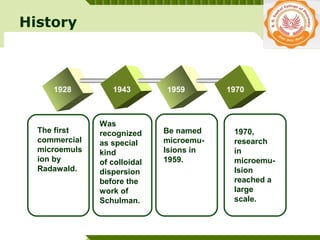
History
1928 1943 1959 1970
The first
commercial
microemuls
ion by
Radawald.
Was
recognized
as special
kind
of colloidal
dispersion
before the
work of
Schulman.
Be named
microemu-
lsions in
1959.
1970,
research
in
microemu-
lsion
reached a
large
scale.
YOUR SITE HERE
LOGO
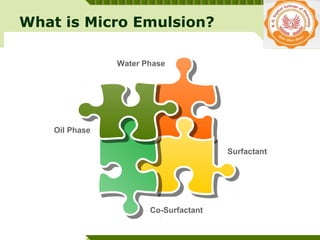
What is Micro Emulsion?
Surfactant
Oil Phase
Water Phase
Co-Surfactant
YOUR SITE HERE
LOGO
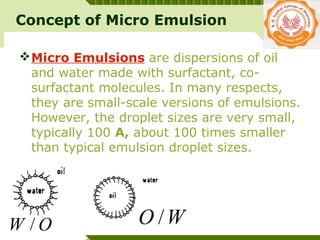
Concept of Micro Emulsion
Micro Emulsions are dispersions of oil
and water made with surfactant, co-
surfactant molecules. In many respects,
they are small-scale versions of emulsions.
However, the droplet sizes are very small,
typically 100 A, about 100 times smaller
than typical emulsion droplet sizes.
/W O /O W
YOUR SITE HERE
LOGO
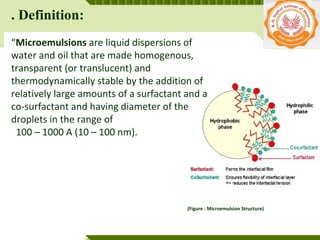
. Definition:
“Microemulsions are liquid dispersions of
water and oil that are made homogenous,
transparent (or translucent) and
thermodynamically stable by the addition of
relatively large amounts of a surfactant and a
co-surfactant and having diameter of the
droplets in the range of
100 – 1000 A (10 – 100 nm).
(Figure : Microemulsion Structure)
YOUR SITE HERE
LOGO
The advent of micro emulsion has lead to the
improvement in many fields.
Micro Emulsion
Food
pharmacy
…
Daily use
Chemistry
Oil
Recovery
Catalyst
Micro Emulsion in Our Life
YOUR SITE HERE
LOGO
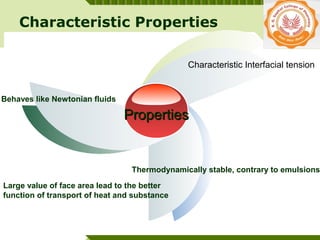
Characteristic Properties
PropertiesProperties
Behaves like Newtonian fluids
Characteristic Interfacial tension
Thermodynamically stable, contrary to emulsions
Large value of face area lead to the better
function of transport of heat and substance
YOUR SITE HERE
LOGO
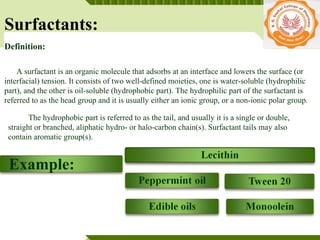
Surfactants:
Definition:
A surfactant is an organic molecule that adsorbs at an interface and lowers the surface (or
interfacial) tension. It consists of two well-defined moieties, one is water-soluble (hydrophilic
part), and the other is oil-soluble (hydrophobic part). The hydrophilic part of the surfactant is
referred to as the head group and it is usually either an ionic group, or a non-ionic polar group.
Example:
The hydrophobic part is referred to as the tail, and usually it is a single or double,
straight or branched, aliphatic hydro- or halo-carbon chain(s). Surfactant tails may also
contain aromatic group(s).
YOUR SITE HERE
LOGO
Advantages of Microemulsions:
.These are thermodynamically stable .
. Require minimum energy for formation.
.Easy of manufacturing .
. Improved drug solubilization and bioavailability.
. Wide applications in colloidal drug delivery systems.
. The formation of microemulsion is reversible.
. Improve the efficacy of a drug & Minimum side effects.
Disadvantages of Microemulsions:
•Use of a large concentration of surfactant and co-surfactants.
• Limited solubilizing capacity for high-melting substances.
• The surfactant must be nontoxic for using pharmaceutical applications.
• Microemulsion stability is influenced by environmental parameters such as temperature and
pH.
YOUR SITE HERE
LOGO
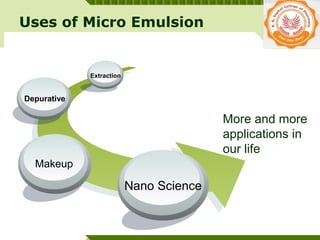
Uses of Micro Emulsion
 Microemulsions ave many commercially important uses.
 The fluid used in some dry cleaning processes is a water-in-oil
microemulsion.
 Some floor polishes and cleaners, personal care products,
pesticide formulations are actually microemulsions.
 Much of the work done on these systems have been motivated by
their possible use to mobilize petroleum trapped in porous
sandstone for enhanced oil recovery.
 Microemulsions in Pharmaceuticals:
.Widely used in pharmaceutical preparations.
. Used as injection solutions, as they are miscible with blood in any ratio.
. In contrast to emulsions, microemulsions cause minimum immune reactions
or fat embolism.
YOUR SITE HERE
LOGO
Uses of Micro Emulsion
More and more
applications in
our life
Nano Science
Makeup
Depurative
Extraction
YOUR SITE HERE
LOGO
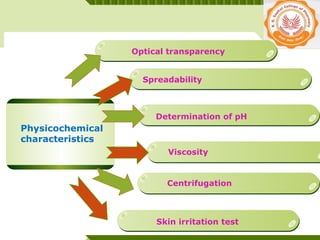
Physicochemical
characteristics
Determination of pH
Viscosity
Centrifugation
Spreadability
Skin irritation test
Optical transparency
YOUR SITE HERE
LOGO
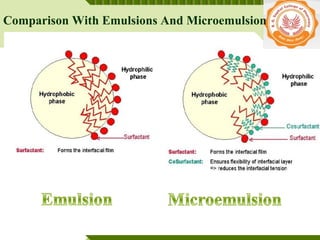
Comparison With Emulsions And Microemulsion
YOUR SITE HERE
LOGO
Emulsions Microemulsions
1.Emulsions consist of roughly spherical droplets of one
phase dispersed into the other.
1.They constantly evolve between various structures
ranging from droplet like swollen micelles to bicontinuous
structure.
2. Droplet diameter: 1 – 20 mm. 2. 10 – 100 nm.
3. Most emulsions are opaque (white) because bulk of their
droplets is greater than wavelength of light and most oils
have higher refractive indices than water.
3. Microemulsions are transparent or translucent as their
droplet diameter are less than ¼ of the wavelength of light,
they scatter little light.
4. Ordinary emulsion droplets, however small exist as
individual entities until coalesance or ostwald ripening
occurs.
4. Microemulsion droplet may disappear within a fraction of
a second whilst another droplet forms spontaneously
elsewhere in the system.
5. They may remain stable for long periods of time, will
ultimately undergo phase separation on standing to attain a
minimum in free energy. They are kinetically stable
thermodynamically unstable
5. More thermodynamically stable than emulsions and can
have essentially infinite lifetime assuming no change in
composition, temperature and pressure, and do not tend to
separate.
6. They are lyophobic. 6. They are on the borderline between lyophobic and
lyophilic colloids.
7. Require intense agitation for their formation. 7. Generally obtained by gentle mixing of ingredients.
YOUR SITE HERE
LOGO
Summary:
 Microemulsions are optically isotropic and thermodynamically stable liquid
solutions of oil, water and amphiphile. Microemulsions are readily
distinguished from normal emulsions by their transparency, low viscosity and
more fundamentally their thermodynamic stability.
Conclusion:
 Drug delivery through microemulsions is a promising area for continued
research with the aim of achieving controlled release with enhanced
bioavailability and for drug targeting to various sites in the body.
YOUR SITE HERE
LOGO
Marketed Preparations:
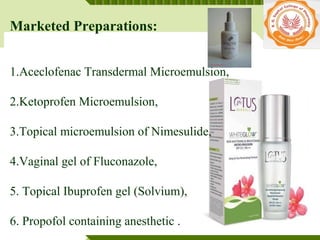
1.Aceclofenac Transdermal Microemulsion,
2.Ketoprofen Microemulsion,
3.Topical microemulsion of Nimesulide,
4.Vaginal gel of Fluconazole,
5. Topical Ibuprofen gel (Solvium),
6. Propofol containing anesthetic .
YOUR SITE HERE
LOGOREFRENCES:
•Pharmaceuticals dosage form: disperse system volume1st
,second edition, reviced and
expended edited by Hebert D. Liberman, Martine M. Rieger and Gilbert S. bankar page
no 57-61.
•Pharmaceuticals dosage form: disperse system volume2nd
,second edition, reviced and
expended edited by Hebert D. Liberman, Martine M. Rieger and Gilbert S. bankar page
no 49-51,67-74,95-96,109.
•The theory & practice of industrial pharmacy ,leon lachman,Herbert a. Lieberman
special edition 2009, CBS publisher & distributors pvt. Ltd page no 503-529
•Aulton,pharmaceutics the design and mfg of medicine by micheal aulton 3
editionchurchil living store Elsevier.page no. 92-93, 391, 530-536,594.
•http://en.wikipedia.org/wiki/microemulsion.
YOUR SITE HERE
LOGO
Thank you!
SUDARSHAN B. AHER
T.Y.B.PHARMACY

Microemulsion by sudarshan aher

  • 1.
    Microemulsion Presented By: Mr.Sudarshan B.Aher T.Y.B.Pharm Roll No.05 Guided By: Mr. S. B.Gondkar M.Pharm (Pharmaceutics) R.G.SAPKAL COLLEGE OF PHARMACY,ANJANERI,NASHIK
  • 2.
    YOUR SITE HERE LOGO 1.Introduction 2. Basic Concepts 3. Characteristic & Properties 4.Physicochemical characteristics Outline 5. conclusion
  • 3.
    YOUR SITE HERE LOGO History 19281943 1959 1970 The first commercial microemuls ion by Radawald. Was recognized as special kind of colloidal dispersion before the work of Schulman. Be named microemu- lsions in 1959. 1970, research in microemu- lsion reached a large scale.
  • 4.
    YOUR SITE HERE LOGO Whatis Micro Emulsion? Surfactant Oil Phase Water Phase Co-Surfactant
  • 5.
    YOUR SITE HERE LOGO Conceptof Micro Emulsion Micro Emulsions are dispersions of oil and water made with surfactant, co- surfactant molecules. In many respects, they are small-scale versions of emulsions. However, the droplet sizes are very small, typically 100 A, about 100 times smaller than typical emulsion droplet sizes. /W O /O W
  • 6.
    YOUR SITE HERE LOGO .Definition: “Microemulsions are liquid dispersions of water and oil that are made homogenous, transparent (or translucent) and thermodynamically stable by the addition of relatively large amounts of a surfactant and a co-surfactant and having diameter of the droplets in the range of 100 – 1000 A (10 – 100 nm). (Figure : Microemulsion Structure)
  • 7.
    YOUR SITE HERE LOGO Theadvent of micro emulsion has lead to the improvement in many fields. Micro Emulsion Food pharmacy … Daily use Chemistry Oil Recovery Catalyst Micro Emulsion in Our Life
  • 8.
    YOUR SITE HERE LOGO CharacteristicProperties PropertiesProperties Behaves like Newtonian fluids Characteristic Interfacial tension Thermodynamically stable, contrary to emulsions Large value of face area lead to the better function of transport of heat and substance
  • 9.
    YOUR SITE HERE LOGO Surfactants: Definition: Asurfactant is an organic molecule that adsorbs at an interface and lowers the surface (or interfacial) tension. It consists of two well-defined moieties, one is water-soluble (hydrophilic part), and the other is oil-soluble (hydrophobic part). The hydrophilic part of the surfactant is referred to as the head group and it is usually either an ionic group, or a non-ionic polar group. Example: The hydrophobic part is referred to as the tail, and usually it is a single or double, straight or branched, aliphatic hydro- or halo-carbon chain(s). Surfactant tails may also contain aromatic group(s).
  • 10.
    YOUR SITE HERE LOGO Advantagesof Microemulsions: .These are thermodynamically stable . . Require minimum energy for formation. .Easy of manufacturing . . Improved drug solubilization and bioavailability. . Wide applications in colloidal drug delivery systems. . The formation of microemulsion is reversible. . Improve the efficacy of a drug & Minimum side effects. Disadvantages of Microemulsions: •Use of a large concentration of surfactant and co-surfactants. • Limited solubilizing capacity for high-melting substances. • The surfactant must be nontoxic for using pharmaceutical applications. • Microemulsion stability is influenced by environmental parameters such as temperature and pH.
  • 11.
    YOUR SITE HERE LOGO Usesof Micro Emulsion  Microemulsions ave many commercially important uses.  The fluid used in some dry cleaning processes is a water-in-oil microemulsion.  Some floor polishes and cleaners, personal care products, pesticide formulations are actually microemulsions.  Much of the work done on these systems have been motivated by their possible use to mobilize petroleum trapped in porous sandstone for enhanced oil recovery.  Microemulsions in Pharmaceuticals: .Widely used in pharmaceutical preparations. . Used as injection solutions, as they are miscible with blood in any ratio. . In contrast to emulsions, microemulsions cause minimum immune reactions or fat embolism.
  • 12.
    YOUR SITE HERE LOGO Usesof Micro Emulsion More and more applications in our life Nano Science Makeup Depurative Extraction
  • 13.
    YOUR SITE HERE LOGO Physicochemical characteristics Determinationof pH Viscosity Centrifugation Spreadability Skin irritation test Optical transparency
  • 14.
    YOUR SITE HERE LOGO ComparisonWith Emulsions And Microemulsion
  • 15.
    YOUR SITE HERE LOGO EmulsionsMicroemulsions 1.Emulsions consist of roughly spherical droplets of one phase dispersed into the other. 1.They constantly evolve between various structures ranging from droplet like swollen micelles to bicontinuous structure. 2. Droplet diameter: 1 – 20 mm. 2. 10 – 100 nm. 3. Most emulsions are opaque (white) because bulk of their droplets is greater than wavelength of light and most oils have higher refractive indices than water. 3. Microemulsions are transparent or translucent as their droplet diameter are less than ¼ of the wavelength of light, they scatter little light. 4. Ordinary emulsion droplets, however small exist as individual entities until coalesance or ostwald ripening occurs. 4. Microemulsion droplet may disappear within a fraction of a second whilst another droplet forms spontaneously elsewhere in the system. 5. They may remain stable for long periods of time, will ultimately undergo phase separation on standing to attain a minimum in free energy. They are kinetically stable thermodynamically unstable 5. More thermodynamically stable than emulsions and can have essentially infinite lifetime assuming no change in composition, temperature and pressure, and do not tend to separate. 6. They are lyophobic. 6. They are on the borderline between lyophobic and lyophilic colloids. 7. Require intense agitation for their formation. 7. Generally obtained by gentle mixing of ingredients.
  • 16.
    YOUR SITE HERE LOGO Summary: Microemulsions are optically isotropic and thermodynamically stable liquid solutions of oil, water and amphiphile. Microemulsions are readily distinguished from normal emulsions by their transparency, low viscosity and more fundamentally their thermodynamic stability. Conclusion:  Drug delivery through microemulsions is a promising area for continued research with the aim of achieving controlled release with enhanced bioavailability and for drug targeting to various sites in the body.
  • 17.
    YOUR SITE HERE LOGO MarketedPreparations: 1.Aceclofenac Transdermal Microemulsion, 2.Ketoprofen Microemulsion, 3.Topical microemulsion of Nimesulide, 4.Vaginal gel of Fluconazole, 5. Topical Ibuprofen gel (Solvium), 6. Propofol containing anesthetic .
  • 18.
    YOUR SITE HERE LOGOREFRENCES: •Pharmaceuticalsdosage form: disperse system volume1st ,second edition, reviced and expended edited by Hebert D. Liberman, Martine M. Rieger and Gilbert S. bankar page no 57-61. •Pharmaceuticals dosage form: disperse system volume2nd ,second edition, reviced and expended edited by Hebert D. Liberman, Martine M. Rieger and Gilbert S. bankar page no 49-51,67-74,95-96,109. •The theory & practice of industrial pharmacy ,leon lachman,Herbert a. Lieberman special edition 2009, CBS publisher & distributors pvt. Ltd page no 503-529 •Aulton,pharmaceutics the design and mfg of medicine by micheal aulton 3 editionchurchil living store Elsevier.page no. 92-93, 391, 530-536,594. •http://en.wikipedia.org/wiki/microemulsion.
  • 19.
    YOUR SITE HERE LOGO Thankyou! SUDARSHAN B. AHER T.Y.B.PHARMACY