Pharmaceutics-IVB (Industrial Pharmacy)-B
Emulsions: Mechanical equipments, Specific Formulation
Consideratons & Emulsion Stability
Ajar Elahi Butt (BPD02183058)
Abubakar Javed (BPD02183200)
Sikandar Afzaal (BPD02183196)
Muhammad Waqas (BPD02183188)
Hafiz Shah Nawaz (BPD02183147)
Araib Naveed ( BPD02183032)
Ismail Ur Rehman (BPD02183054)
Hasnan Azeem (BPD02183071)
Faizan Khalil (BPD02183267)
Semester 8th – (B)
Submitted To:
Dr. Kashif Barkat
EMULSIONS (DEFINITION)
▪ An emulsion is a thermodynamically unstable two-phase system
consisting of at least two immiscible liquid phases one of which is
dispersed as globules in the other liquid phase stabilized by a third
substance called emulsifying agent.
▪ An emulsifier defined as a stabilizer of the droplet form of the
internal phase. They comprises of both hydrophilic and
hydrophobic portions.
OR
An emulsion is a dispersion in which the dispersed phase is
composed of small globules of a liquid distributed throughout a
vehicle in which it is immiscible.
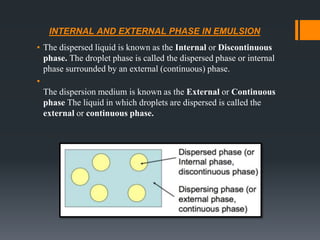
INTERNAL AND EXTERNAL PHASE IN EMULSION
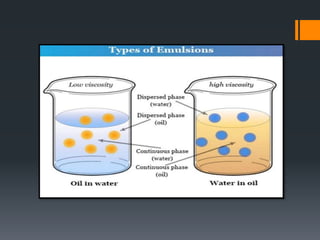
▪ The dispersed liquid is known as the Internal or Discontinuous
phase. The droplet phase is called the dispersed phase or internal
phase surrounded by an external (continuous) phase.
▪
The dispersion medium is known as the External or Continuous
phase The liquid in which droplets are dispersed is called the
external or continuous phase.
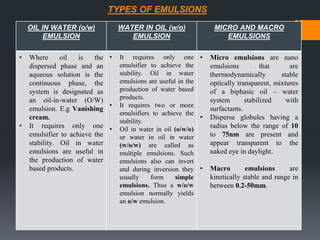
TYPES OF EMULSIONS
OIL IN WATER (o/w)
EMULSION
WATER IN OIL (w/o)
EMULSION
MICRO AND MACRO
EMULSIONS
• Where oil is the
dispersed phase and an
aqueous solution is the
continuous phase, the
system is designated as
an oil-in-water (O/W)
emulsion. E.g Vanishing
cream.
• It requires only one
emulsifier to achieve the
stability. Oil in water
emulsions are useful in
the production of water
based products.
• It requires only one
emulsifier to achieve the
stability. Oil in water
emulsions are useful in the
production of water based
products.
• It requires two or more
emulsifiers to achieve the
stability.
• Oil in water in oil (o/w/o)
or water in oil in water
(w/o/w) are called as
multiple emulsions. Such
emulsions also can invert
and during inversion they
usually form simple
emulsions. Thus a w/o/w
emulsion normally yields
an o/w emulsion.
• Micro emulsions are nano
emulsions that are
thermodynamically stable
optically transparent, mixtures
of a biphasic oil – water
system stabilized with
surfactants.
• Disperse globules having a
radius below the range of 10
to 75nm are present and
appear transparent to the
naked eye in daylight.
• Macro emulsions are
kinetically stable and range in
between 0.2-50mm.
ADVANTAGES OF EMULSIONS OVER LIQUID FORMS
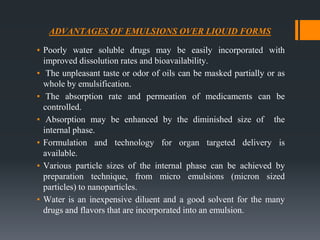
▪ Poorly water soluble drugs may be easily incorporated with
improved dissolution rates and bioavailability.
▪ The unpleasant taste or odor of oils can be masked partially or as
whole by emulsification.
▪ The absorption rate and permeation of medicaments can be
controlled.
▪ Absorption may be enhanced by the diminished size of the
internal phase.
▪ Formulation and technology for organ targeted delivery is
available.
▪ Various particle sizes of the internal phase can be achieved by
preparation technique, from micro emulsions (micron sized
particles) to nanoparticles.
▪ Water is an inexpensive diluent and a good solvent for the many
drugs and flavors that are incorporated into an emulsion.
SPECIFIC FORMULATION CONSIDERATIONS OF
EMULSIONS
▪ When oil and water are mixed and agitated, droplets of varying sizes are produced.
A tension exists at the interface because the two immiscible phases tend to have
different attractive forces for a molecule at the interface.
▪ A molecule of phase A is attracted into phase A and repelled by phase B. In general,
the greater the degree of immiscibility, the greater is the interfacial tension.
DROPLET STABILIZATION
▪ Two conceptual alternatives exist for creating opaque, i.e., milky appearing,
emulsions.
▪ Such dispersions can be formed and stabilized by lowering the interfacial tension
and/or by preventing the coalescing of droplets.
▪ According to classic emulsion theory, Emulsifying agents assist in the formation of
emulsions by three mechanisms:
▪ Reduction of interfacial tension-thermo dynamic stabilization.
▪ Formation of a rigid interfacial film mechanical barrier to coalescence.
▪ Formation of an electrical double layer electrical barrier to approach of particles
INTERFACIAL TENSION
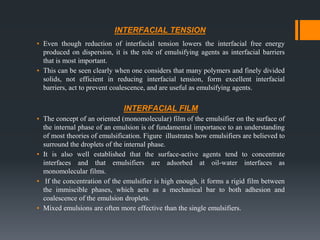
▪ Even though reduction of interfacial tension lowers the interfacial free energy
produced on dispersion, it is the role of emulsifying agents as interfacial barriers
that is most important.
▪ This can be seen clearly when one considers that many polymers and finely divided
solids, not efficient in reducing interfacial tension, form excellent interfacial
barriers, act to prevent coalescence, and are useful as emulsifying agents.
INTERFACIAL FILM
▪ The concept of an oriented (monomolecular) film of the emulsifier on the surface of
the internal phase of an emulsion is of fundamental importance to an understanding
of most theories of emulsification. Figure illustrates how emulsifiers are believed to
surround the droplets of the internal phase.
▪ It is also well established that the surface-active agents tend to concentrate
interfaces and that emulsifiers are adsorbed at oil-water interfaces as
monomolecular films.
▪ If the concentration of the emulsifier is high enough, it forms a rigid film between
the immiscible phases, which acts as a mechanical bar to both adhesion and
coalescence of the emulsion droplets.
▪ Mixed emulsions are often more effective than the single emulsifiers.
ELECTRICAL REPULSION
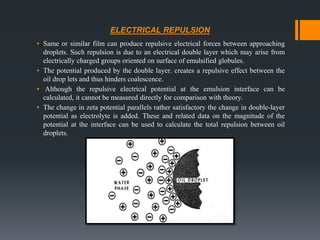
▪ Same or similar film can produce repulsive electrical forces between approaching
droplets. Such repulsion is due to an electrical double layer which may arise from
electrically charged groups oriented on surface of emulsified globules.
▪ The potential produced by the double layer. creates a repulsive effect between the
oil drop lets and thus hinders coalescence.
▪ Although the repulsive electrical potential at the emulsion interface can be
calculated, it cannot be measured directly for comparison with theory.
▪ The change in zeta potential parallels rather satisfactory the change in double-layer
potential as electrolyte is added. These and related data on the magnitude of the
potential at the interface can be used to calculate the total repulsion between oil
droplets.
OPTIMUM PHASE RATIO
▪ The ratio of volume of the disperse phase to the volume of the dispersion medium
(phase ratio) greatly influences the characteristics of an emulsion.
▪ The optimum-phase volume ratio is generally obtained when the internal or
dispersed phase is about 40%–60% of the total quantity of the product.
▪ A conventional emulsion containing less than 25% of the dispersed phase has a high
propensity toward creaming or sedimentation.
▪ Nevertheless, a combination of proper emulsifiers and suitable process-ing
technology makes it possible to prepare emulsions with only 10% disperse phase
without stability problems.
▪ Such combination of emulsifiers includes the use of a hydrophilic emulsifier in
aqueous phase and hydrophobic emulsifier in oil phase.
SIZE, VISCOSITY AND DENSITY
▪ Decreasing the globule size of the internal phase. The dispersed globule size less
than 5 μm in diameter contributes to good physical stability and dispersion of the
emulsion.
▪ Increasing the viscosity of the system. Gums and hydrophilic poly-mers are
frequently added to the external phase of an o/w emulsion to increase viscosity, in
addition to reducing the interfacial tension and forming a thin film at the interface.
▪ Higher the viscosity of the continuous phase, lower the Brownian motion, collision
frequency, and energy of collisions of the dispersed-phase globules. Increasing the
viscosity can have an unwanted effect of reduction of deliverable volume from the
container because highly viscous liquids tend to adhere to the container.
▪ Reducing the density difference between the dispersed phase and the dispersion
medium. This reduces the creaming tendency by minimizing the driver for
separation and preferential accumulation of the disperse phase in a particular
direction.
MICROEMULSIONS
▪ They are defined as dispersions of insoluble liquids in a second liquid that appears
clear and homogeneous to the naked eye.
▪ Micro emulsions are frequently called as solubilized systems because on a
macroscopic basis they seem to behave as true solutions.
▪ In general micro emulsions or solubilized systems are believed to be
thermodynamically stable.
▪ Transparent or clear emulsions in which a water insoluble oil or drug is dissolved in
an aqueous surfactant system play an important role in drug administration.
▪ A Wide variety of clear proprietary and toiletry products are in fact clear emulsions.
PROPERTIES AND STABILITY OF EMULSIONS
▪ Emulsification is not a spontaneous process and hence emulsions have minimal
stability.
▪ Garrett defined a stable emulsion as one that "would maintain the same number of
sizes of particles of the dispersed phase per unit volume of weight of the continuous
phase.
▪ As soon as an emulsion has been prepared, time- and temperature-dependent
processes occur to effect its separation.
▪ During storage, an emulsion's instability is evidenced by creaming, reversible
aggregation (flocculation), and/or irreversible aggregation (coalescence) and phase
inversion.
FLOCCULATION
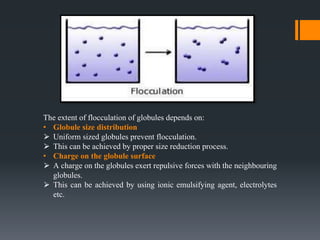
▪ Neighbouring globules come closer to each other and form colonies in the
continuous phase. This aggregation of globules is not clearly visible.
▪ This is the initial stage that leads to instability. Flocculation of the dispersed phase
may take place before, during or after creaming.
▪ An increase of the ionic strength with electrolytes or an increase of the emulsifier
concentration tends to promote flocculation.
▪ The reversibility of flocculation depends upon strength of interaction between
particles as determined by, the chemical nature of emulsifier, the phase volume
ratio, the concentration of dissolved substances, specially electrolytes and ionic
emulsifiers.
The extent of flocculation of globules depends on:
• Globule size distribution
⮚ Uniform sized globules prevent flocculation.
⮚ This can be achieved by proper size reduction process.
• Charge on the globule surface
⮚ A charge on the globules exert repulsive forces with the neighbouring
globules.
⮚ This can be achieved by using ionic emulsifying agent, electrolytes
etc.
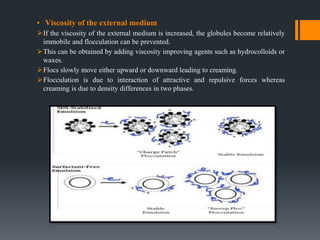
▪ Viscosity of the external medium
⮚If the viscosity of the external medium is increased, the globules become relatively
immobile and flocculation can be prevented.
⮚This can be obtained by adding viscosity improving agents such as hydrocolloids or
waxes.
⮚Flocs slowly move either upward or downward leading to creaming.
⮚Flocculation is due to interaction of attractive and repulsive forces whereas
creaming is due to density differences in two phases.
CREAMING
▪ Creaming is the upward movement of dispersed droplets of emulsion relative to the
continuous phase (due to the density difference between two phases).
▪ Creaming is the concentration of globules at the top or bottom of the emulsion.
▪ Droplets larger than 1 mm may settle preferentially to the top or the bottom under
gravitational forces.
▪ Creaming may also be observed on account of the difference of individual globules
(movement rather than flocs). It can be observed by a difference in color shade of
the layers.
▪ It is a reversible process, i.e., cream can be re-dispersed easily by agitation, this is
possible because the oil globules are still surrounded by the protective sheath of the
▪ emulsifier.
▪ Creaming results in a lack of uniformity of drug distribution. This leads to variable
dosage. Therefore emulsion should be shaken thoroughly before use.
▪ Since creaming involves the movement of globules in an emulsion, Stokes law can
be applied.
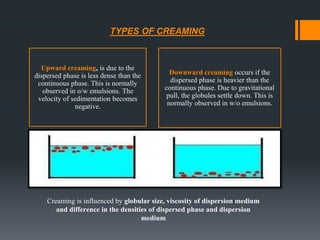
TYPES OF CREAMING
Upward creaming, is due to the
dispersed phase is less dense than the
continuous phase. This is normally
observed in o/w emulsions. The
velocity of sedimentation becomes
negative.
Downward creaming occurs if the
dispersed phase is heavier than the
continuous phase. Due to gravitational
pull, the globules settle down. This is
normally observed in w/o emulsions.
Creaming is influenced by globular size, viscosity of dispersion medium
and difference in the densities of dispersed phase and dispersion
medium
PPREVENTION OF CREAMING
▪ Reducing the particle size by homogenization. Doubling the diameter of oil globules
increases the creaming rate by a factor of four.
▪ Increasing the viscosity of the external phase by adding the thickening agents such
as methyl cellulose tragacanth or sodium alginate.
▪ Reducing the difference in the densities between the dispersed phase and dispersion
medium.
COALESCENCE
▪ Aggregation is that when dispersed particles come together but do not fuse.
▪ Coalescence is the process by which emulsified particles merge with each other to
form large particles.
▪ This type of closed packing induces greater cohesion which leads to coalescence.
▪ In this process, the emulsifier film around the globules is destroyed to a certain
extent. This step can be recognized by increased globule size and reduced number of
globules.
Coalescence is observed due to:
▪ Insufficient amount of the emulsifying agent.
▪ Altered partitioning of the emulsifying agent.
▪ Incompatibilities between emulsifying agents.
The major factor to prevent coalescence is the mechanical strength of the interfacial film.
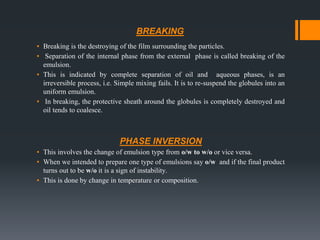
BREAKING
▪ Breaking is the destroying of the film surrounding the particles.
▪ Separation of the internal phase from the external phase is called breaking of the
emulsion.
▪ This is indicated by complete separation of oil and aqueous phases, is an
irreversible process, i.e. Simple mixing fails. It is to re-suspend the globules into an
uniform emulsion.
▪ In breaking, the protective sheath around the globules is completely destroyed and
oil tends to coalesce.
PHASE INVERSION
▪ This involves the change of emulsion type from o/w to w/o or vice versa.
▪ When we intended to prepare one type of emulsions say o/w and if the final product
turns out to be w/o it is a sign of instability.
▪ This is done by change in temperature or composition.
FOAMING DURING AGITATION
▪ During the agitation or transfer of an emulsion, foam may be formed. Foaming
occurs because the water soluble surfactant required for emulsification generally
also reduces the surface tension at the air-water interface.
▪ To minimize foaming, emulsification may be carried out in closed systems (with a
minimum of free air space) and/or under vacuum.
▪ In addition, mechanical stirring, particularly during the cooling of a freshly prepared
emulsion, can be regulated to cause air to rise to the top.
▪ If these precautions should fail to eliminate or reduce foaming, it is sometimes
necessary to add foam depressants (antifoams).
▪ The most effective defoamers are long-chain alcohols and commercially available
silicone derivatives, both of which are generally believed to spread over the air-
water interface as insoluble films.
OSTWALD RIPENING
▪ It is the growth of one emulsion droplet at the expense of a smaller one as a result of
the difference in chemical potential of the material within droplets.
▪ Medium or long chain triglycerides inhibits droplet growth and adding triglycerides
over 20% into the oil phase prohibited Oswald ripening.
CHEMICAL STABILITY
▪ Chemical inertness is an absolute and almost obvious requirement for emulsion
ingredients. It is important that the chemical nature of all emulsion constituents be
understood before the selection for a given preparation is made.
▪ Choice of the lipid phase, phase ratio, choice of emulsifying Agents and choice of
surfactant should be made in terms of stability.
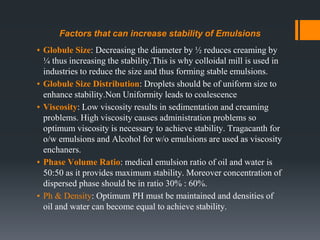
Factors that can increase stability of Emulsions
▪ Globule Size: Decreasing the diameter by ½ reduces creaming by
¼ thus increasing the stability.This is why colloidal mill is used in
industries to reduce the size and thus forming stable emulsions.
▪ Globule Size Distribution: Droplets should be of uniform size to
enhance stability.Non Uniformity leads to coalescence
▪ Viscosity: Low viscosity results in sedimentation and creaming
problems. High viscosity causes administration problems so
optimum viscosity is necessary to achieve stability. Tragacanth for
o/w emulsions and Alcohol for w/o emulsions are used as viscosity
enchaners.
▪ Phase Volume Ratio: medical emulsion ratio of oil and water is
50:50 as it provides maximum stability. Moreover concentration of
dispersed phase should be in ratio 30% : 60%.
▪ Ph & Density: Optimum PH must be maintained and densities of
oil and water can become equal to achieve stability.
MECHANICAL EQUIPMENTS FOR EMULSIONS
▪ The preparation of emulsions requires a certain amount of energy to form the
interface between the two phases, and additional work must be done to stir the
system to overcome resistance to flow.
▪ In addition, heat is often supplied to the system to melt waxy solids and/or reduce
viscosity. Consequently, the preparation of emulsions on a large scale requires
consider-able amounts of energy for heating and mixing.
▪ A wide selection of equipment for processing both emulsions and suspensions has
been described.
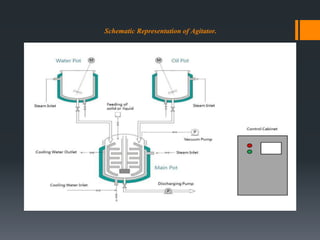
AGITATORS
▪ Ordinary agitation or shaking may be used to prepare the emulsion. This method is
frequently employed by the pharmacist, particularly in the emulsification of easily
dispersed, low-viscosity oils.
▪ Under certain conditions, intermittent shaking is considerably more effective than
ordinary continuous shaking. Continuous shaking tends to break up not only the
phase to be dispersed, but also the dispersion medium, thus, impairing the ease of
emulsification.
▪ Laboratory shaking devices may be used for small-scale production.
Schematic Representation of Agitator.
MECHANICAL MIXERS
▪ Emulsions may be prepared using one of several mixers that are available.
▪ Propeller and impeller type mixers that have a propeller attached to a shaft driven by an electric
motor are convenient and portable and can be used for both stirring and emulsification.
▪ This type operates best in mixtures that have low viscosity, that is, mixtures with a viscosity of
glycerin or less. They are also useful for preparing emulsions.
Working:
▪ A turbine mixer has a number of blades that may be straight or curved, with or without a pitch,
mounted on a shaft.
▪ • The turbine tends to give a greater shear than propellers. The shear can be increased by using
diffuser rings perforated and surrounding the turbine, so the liquid from the turbine must pass
through holes.
▪ The turbines can be used for both low-viscosity mixtures and medium-viscosity liquids.
▪ The degree of stirring and shear by propeller or turbine mixers depends on several factors, such
as the speed of rotation, pattern of liquid flow, position in the container, and baffles in the
container.
▪ Small electric mixers may be used to prepare emulsions at the prescription counter. They save
time and energy and produces satisfactory emulsions, when the emulsifying agent is acacia or
agar.
▪ The commercially available Waring Blender disperses efficiently by means of the shearing
action of rapidly rotating blades.
▪ It transfers large amounts of energy and incorporates air into the emulsion.
Construction
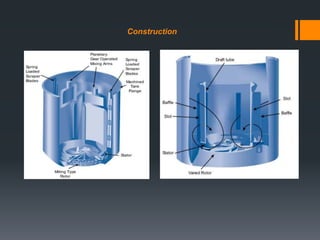
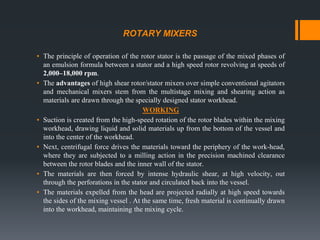
ROTARY MIXERS
▪ The principle of operation of the rotor stator is the passage of the mixed phases of
an emulsion formula between a stator and a high speed rotor revolving at speeds of
2,000–18,000 rpm.
▪ The advantages of high shear rotor/stator mixers over simple conventional agitators
and mechanical mixers stem from the multistage mixing and shearing action as
materials are drawn through the specially designed stator workhead.
WORKING
▪ Suction is created from the high-speed rotation of the rotor blades within the mixing
workhead, drawing liquid and solid materials up from the bottom of the vessel and
into the center of the workhead.
▪ Next, centrifugal force drives the materials toward the periphery of the work-head,
where they are subjected to a milling action in the precision machined clearance
between the rotor blades and the inner wall of the stator.
▪ The materials are then forced by intense hydraulic shear, at high velocity, out
through the perforations in the stator and circulated back into the vessel.
▪ The materials expelled from the head are projected radially at high speed towards
the sides of the mixing vessel . At the same time, fresh material is continually drawn
into the workhead, maintaining the mixing cycle.
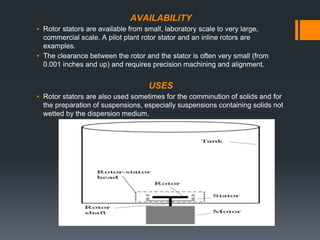
AVAILABILITY
▪ Rotor stators are available from small, laboratory scale to very large,
commercial scale. A pilot plant rotor stator and an inline rotors are
examples.
▪ The clearance between the rotor and the stator is often very small (from
0.001 inches and up) and requires precision machining and alignment.
USES
▪ Rotor stators are also used sometimes for the comminution of solids and for
the preparation of suspensions, especially suspensions containing solids not
wetted by the dispersion medium.
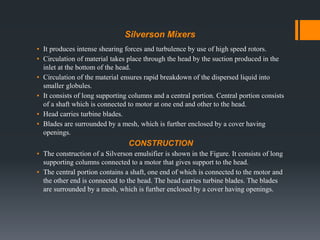
Silverson Mixers
▪ It produces intense shearing forces and turbulence by use of high speed rotors.
▪ Circulation of material takes place through the head by the suction produced in the
inlet at the bottom of the head.
▪ Circulation of the material ensures rapid breakdown of the dispersed liquid into
smaller globules.
▪ It consists of long supporting columns and a central portion. Central portion consists
of a shaft which is connected to motor at one end and other to the head.
▪ Head carries turbine blades.
▪ Blades are surrounded by a mesh, which is further enclosed by a cover having
openings.
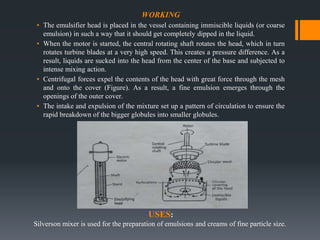
CONSTRUCTION
▪ The construction of a Silverson emulsifier is shown in the Figure. It consists of long
supporting columns connected to a motor that gives support to the head.
▪ The central portion contains a shaft, one end of which is connected to the motor and
the other end is connected to the head. The head carries turbine blades. The blades
are surrounded by a mesh, which is further enclosed by a cover having openings.
WORKING
▪ The emulsifier head is placed in the vessel containing immiscible liquids (or coarse
emulsion) in such a way that it should get completely dipped in the liquid.
▪ When the motor is started, the central rotating shaft rotates the head, which in turn
rotates turbine blades at a very high speed. This creates a pressure difference. As a
result, liquids are sucked into the head from the center of the base and subjected to
intense mixing action.
▪ Centrifugal forces expel the contents of the head with great force through the mesh
and onto the cover (Figure). As a result, a fine emulsion emerges through the
openings of the outer cover.
▪ The intake and expulsion of the mixture set up a pattern of circulation to ensure the
rapid breakdown of the bigger globules into smaller globules.
USES:
Silverson mixer is used for the preparation of emulsions and creams of fine particle size.
HOMOGENIZERS
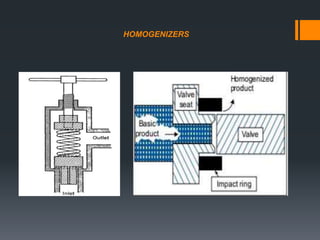
▪ In a homogenizer, the dispersion of two liquids is achieved by forcing their mixture
through a small inlet orifice at high pressures.
▪ A homogenizer generally consists of a pump that raises the pressure of the
dispersion to a range of 500 to 5,000 psi and an orifice through which this fluid
impinges upon the homogenizing valve held in place on the valve seat by a strong
spring.
▪ As the pressure builds up, the spring is compressed, and some of the dispersion
escapes between the valve and the valve seat.
▪ At this point, the energy that has been stored in the liquid as pressure is released
instantaneously and subjects the product to intense turbulence and hydraulic shear.
▪ The use of a homogenizer is warranted whenever a reasonably monodisperse
emulsion of low particle size (1 nm) is required.
▪ For small-scale extemporaneous preparation of emulsions, the inexpensive hand-
operated homogenizer is particularly useful. It is probably the most efficient
emulsifying apparatus available to the pharmacist and pharmaceutical scientists.
▪ • A homogenizer does not incorporate air into the final product. Air may ruin an
emulsion, because the emulsifying agent is adsorbed preferentially at the air–water
interface, followed by an irreversible precipitation termed “denaturization.” This is
particularly prone to occur with protein emulsifying agents.
▪ • Homogenizers have been used most frequently with liquid emulsions, but now
they may be used with suspensions, as the metal surfaces are formed from wear-
resistant alloys that resist the wear of solid particles contained in suspensions.
HOMOGENIZERS
ULTRASONIC DEVICES
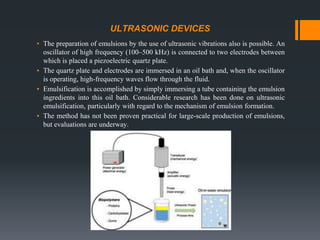
▪ The preparation of emulsions by the use of ultrasonic vibrations also is possible. An
oscillator of high frequency (100–500 kHz) is connected to two electrodes between
which is placed a piezoelectric quartz plate.
▪ The quartz plate and electrodes are immersed in an oil bath and, when the oscillator
is operating, high-frequency waves flow through the fluid.
▪ Emulsification is accomplished by simply immersing a tube containing the emulsion
ingredients into this oil bath. Considerable research has been done on ultrasonic
emulsification, particularly with regard to the mechanism of emulsion formation.
▪ The method has not been proven practical for large-scale production of emulsions,
but evaluations are underway.
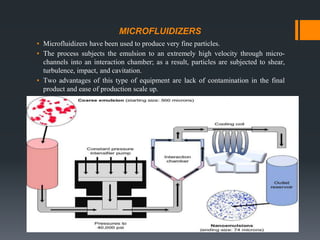
MICROFLUIDIZERS
▪ Microfluidizers have been used to produce very fine particles.
▪ The process subjects the emulsion to an extremely high velocity through micro-
channels into an interaction chamber; as a result, particles are subjected to shear,
turbulence, impact, and cavitation.
▪ Two advantages of this type of equipment are lack of contamination in the final
product and ease of production scale up.
COLLOIDAL MILLS
▪ Homogenizers and ultrasonic equipment depend on sudden changes in pressure to
effect the dispersion of liquids.
▪ By contrast, colloid mills operate on the principle of high shear, which is normally
generated be tween the rotor and the stator of the mill.
▪ Colloid mills are used primarily for the comminution of solids and for the
dispersion of suspensions containing poorly wetted solids but are also useful for the
preparation of relatively viscous emulsions.
Shukriya 3
Terzan!

Emulsions

  • 1.
    Pharmaceutics-IVB (Industrial Pharmacy)-B Emulsions:Mechanical equipments, Specific Formulation Consideratons & Emulsion Stability Ajar Elahi Butt (BPD02183058) Abubakar Javed (BPD02183200) Sikandar Afzaal (BPD02183196) Muhammad Waqas (BPD02183188) Hafiz Shah Nawaz (BPD02183147) Araib Naveed ( BPD02183032) Ismail Ur Rehman (BPD02183054) Hasnan Azeem (BPD02183071) Faizan Khalil (BPD02183267) Semester 8th – (B) Submitted To: Dr. Kashif Barkat
  • 2.
    EMULSIONS (DEFINITION) ▪ Anemulsion is a thermodynamically unstable two-phase system consisting of at least two immiscible liquid phases one of which is dispersed as globules in the other liquid phase stabilized by a third substance called emulsifying agent. ▪ An emulsifier defined as a stabilizer of the droplet form of the internal phase. They comprises of both hydrophilic and hydrophobic portions. OR An emulsion is a dispersion in which the dispersed phase is composed of small globules of a liquid distributed throughout a vehicle in which it is immiscible.
  • 3.
    INTERNAL AND EXTERNALPHASE IN EMULSION ▪ The dispersed liquid is known as the Internal or Discontinuous phase. The droplet phase is called the dispersed phase or internal phase surrounded by an external (continuous) phase. ▪ The dispersion medium is known as the External or Continuous phase The liquid in which droplets are dispersed is called the external or continuous phase.
  • 4.
    TYPES OF EMULSIONS OILIN WATER (o/w) EMULSION WATER IN OIL (w/o) EMULSION MICRO AND MACRO EMULSIONS • Where oil is the dispersed phase and an aqueous solution is the continuous phase, the system is designated as an oil-in-water (O/W) emulsion. E.g Vanishing cream. • It requires only one emulsifier to achieve the stability. Oil in water emulsions are useful in the production of water based products. • It requires only one emulsifier to achieve the stability. Oil in water emulsions are useful in the production of water based products. • It requires two or more emulsifiers to achieve the stability. • Oil in water in oil (o/w/o) or water in oil in water (w/o/w) are called as multiple emulsions. Such emulsions also can invert and during inversion they usually form simple emulsions. Thus a w/o/w emulsion normally yields an o/w emulsion. • Micro emulsions are nano emulsions that are thermodynamically stable optically transparent, mixtures of a biphasic oil – water system stabilized with surfactants. • Disperse globules having a radius below the range of 10 to 75nm are present and appear transparent to the naked eye in daylight. • Macro emulsions are kinetically stable and range in between 0.2-50mm.
  • 6.
    ADVANTAGES OF EMULSIONSOVER LIQUID FORMS ▪ Poorly water soluble drugs may be easily incorporated with improved dissolution rates and bioavailability. ▪ The unpleasant taste or odor of oils can be masked partially or as whole by emulsification. ▪ The absorption rate and permeation of medicaments can be controlled. ▪ Absorption may be enhanced by the diminished size of the internal phase. ▪ Formulation and technology for organ targeted delivery is available. ▪ Various particle sizes of the internal phase can be achieved by preparation technique, from micro emulsions (micron sized particles) to nanoparticles. ▪ Water is an inexpensive diluent and a good solvent for the many drugs and flavors that are incorporated into an emulsion.
  • 7.
    SPECIFIC FORMULATION CONSIDERATIONSOF EMULSIONS ▪ When oil and water are mixed and agitated, droplets of varying sizes are produced. A tension exists at the interface because the two immiscible phases tend to have different attractive forces for a molecule at the interface. ▪ A molecule of phase A is attracted into phase A and repelled by phase B. In general, the greater the degree of immiscibility, the greater is the interfacial tension. DROPLET STABILIZATION ▪ Two conceptual alternatives exist for creating opaque, i.e., milky appearing, emulsions. ▪ Such dispersions can be formed and stabilized by lowering the interfacial tension and/or by preventing the coalescing of droplets. ▪ According to classic emulsion theory, Emulsifying agents assist in the formation of emulsions by three mechanisms: ▪ Reduction of interfacial tension-thermo dynamic stabilization. ▪ Formation of a rigid interfacial film mechanical barrier to coalescence. ▪ Formation of an electrical double layer electrical barrier to approach of particles
  • 8.
    INTERFACIAL TENSION ▪ Eventhough reduction of interfacial tension lowers the interfacial free energy produced on dispersion, it is the role of emulsifying agents as interfacial barriers that is most important. ▪ This can be seen clearly when one considers that many polymers and finely divided solids, not efficient in reducing interfacial tension, form excellent interfacial barriers, act to prevent coalescence, and are useful as emulsifying agents. INTERFACIAL FILM ▪ The concept of an oriented (monomolecular) film of the emulsifier on the surface of the internal phase of an emulsion is of fundamental importance to an understanding of most theories of emulsification. Figure illustrates how emulsifiers are believed to surround the droplets of the internal phase. ▪ It is also well established that the surface-active agents tend to concentrate interfaces and that emulsifiers are adsorbed at oil-water interfaces as monomolecular films. ▪ If the concentration of the emulsifier is high enough, it forms a rigid film between the immiscible phases, which acts as a mechanical bar to both adhesion and coalescence of the emulsion droplets. ▪ Mixed emulsions are often more effective than the single emulsifiers.
  • 9.
    ELECTRICAL REPULSION ▪ Sameor similar film can produce repulsive electrical forces between approaching droplets. Such repulsion is due to an electrical double layer which may arise from electrically charged groups oriented on surface of emulsified globules. ▪ The potential produced by the double layer. creates a repulsive effect between the oil drop lets and thus hinders coalescence. ▪ Although the repulsive electrical potential at the emulsion interface can be calculated, it cannot be measured directly for comparison with theory. ▪ The change in zeta potential parallels rather satisfactory the change in double-layer potential as electrolyte is added. These and related data on the magnitude of the potential at the interface can be used to calculate the total repulsion between oil droplets.
  • 10.
    OPTIMUM PHASE RATIO ▪The ratio of volume of the disperse phase to the volume of the dispersion medium (phase ratio) greatly influences the characteristics of an emulsion. ▪ The optimum-phase volume ratio is generally obtained when the internal or dispersed phase is about 40%–60% of the total quantity of the product. ▪ A conventional emulsion containing less than 25% of the dispersed phase has a high propensity toward creaming or sedimentation. ▪ Nevertheless, a combination of proper emulsifiers and suitable process-ing technology makes it possible to prepare emulsions with only 10% disperse phase without stability problems. ▪ Such combination of emulsifiers includes the use of a hydrophilic emulsifier in aqueous phase and hydrophobic emulsifier in oil phase.
  • 11.
    SIZE, VISCOSITY ANDDENSITY ▪ Decreasing the globule size of the internal phase. The dispersed globule size less than 5 μm in diameter contributes to good physical stability and dispersion of the emulsion. ▪ Increasing the viscosity of the system. Gums and hydrophilic poly-mers are frequently added to the external phase of an o/w emulsion to increase viscosity, in addition to reducing the interfacial tension and forming a thin film at the interface. ▪ Higher the viscosity of the continuous phase, lower the Brownian motion, collision frequency, and energy of collisions of the dispersed-phase globules. Increasing the viscosity can have an unwanted effect of reduction of deliverable volume from the container because highly viscous liquids tend to adhere to the container. ▪ Reducing the density difference between the dispersed phase and the dispersion medium. This reduces the creaming tendency by minimizing the driver for separation and preferential accumulation of the disperse phase in a particular direction.
  • 12.
    MICROEMULSIONS ▪ They aredefined as dispersions of insoluble liquids in a second liquid that appears clear and homogeneous to the naked eye. ▪ Micro emulsions are frequently called as solubilized systems because on a macroscopic basis they seem to behave as true solutions. ▪ In general micro emulsions or solubilized systems are believed to be thermodynamically stable. ▪ Transparent or clear emulsions in which a water insoluble oil or drug is dissolved in an aqueous surfactant system play an important role in drug administration. ▪ A Wide variety of clear proprietary and toiletry products are in fact clear emulsions.
  • 13.
    PROPERTIES AND STABILITYOF EMULSIONS ▪ Emulsification is not a spontaneous process and hence emulsions have minimal stability. ▪ Garrett defined a stable emulsion as one that "would maintain the same number of sizes of particles of the dispersed phase per unit volume of weight of the continuous phase. ▪ As soon as an emulsion has been prepared, time- and temperature-dependent processes occur to effect its separation. ▪ During storage, an emulsion's instability is evidenced by creaming, reversible aggregation (flocculation), and/or irreversible aggregation (coalescence) and phase inversion. FLOCCULATION ▪ Neighbouring globules come closer to each other and form colonies in the continuous phase. This aggregation of globules is not clearly visible. ▪ This is the initial stage that leads to instability. Flocculation of the dispersed phase may take place before, during or after creaming. ▪ An increase of the ionic strength with electrolytes or an increase of the emulsifier concentration tends to promote flocculation. ▪ The reversibility of flocculation depends upon strength of interaction between particles as determined by, the chemical nature of emulsifier, the phase volume ratio, the concentration of dissolved substances, specially electrolytes and ionic emulsifiers.
  • 14.
    The extent offlocculation of globules depends on: • Globule size distribution ⮚ Uniform sized globules prevent flocculation. ⮚ This can be achieved by proper size reduction process. • Charge on the globule surface ⮚ A charge on the globules exert repulsive forces with the neighbouring globules. ⮚ This can be achieved by using ionic emulsifying agent, electrolytes etc.
  • 15.
    ▪ Viscosity ofthe external medium ⮚If the viscosity of the external medium is increased, the globules become relatively immobile and flocculation can be prevented. ⮚This can be obtained by adding viscosity improving agents such as hydrocolloids or waxes. ⮚Flocs slowly move either upward or downward leading to creaming. ⮚Flocculation is due to interaction of attractive and repulsive forces whereas creaming is due to density differences in two phases.
  • 16.
    CREAMING ▪ Creaming isthe upward movement of dispersed droplets of emulsion relative to the continuous phase (due to the density difference between two phases). ▪ Creaming is the concentration of globules at the top or bottom of the emulsion. ▪ Droplets larger than 1 mm may settle preferentially to the top or the bottom under gravitational forces. ▪ Creaming may also be observed on account of the difference of individual globules (movement rather than flocs). It can be observed by a difference in color shade of the layers. ▪ It is a reversible process, i.e., cream can be re-dispersed easily by agitation, this is possible because the oil globules are still surrounded by the protective sheath of the ▪ emulsifier. ▪ Creaming results in a lack of uniformity of drug distribution. This leads to variable dosage. Therefore emulsion should be shaken thoroughly before use. ▪ Since creaming involves the movement of globules in an emulsion, Stokes law can be applied.
  • 17.
    TYPES OF CREAMING Upwardcreaming, is due to the dispersed phase is less dense than the continuous phase. This is normally observed in o/w emulsions. The velocity of sedimentation becomes negative. Downward creaming occurs if the dispersed phase is heavier than the continuous phase. Due to gravitational pull, the globules settle down. This is normally observed in w/o emulsions. Creaming is influenced by globular size, viscosity of dispersion medium and difference in the densities of dispersed phase and dispersion medium
  • 18.
    PPREVENTION OF CREAMING ▪Reducing the particle size by homogenization. Doubling the diameter of oil globules increases the creaming rate by a factor of four. ▪ Increasing the viscosity of the external phase by adding the thickening agents such as methyl cellulose tragacanth or sodium alginate. ▪ Reducing the difference in the densities between the dispersed phase and dispersion medium.
  • 19.
    COALESCENCE ▪ Aggregation isthat when dispersed particles come together but do not fuse. ▪ Coalescence is the process by which emulsified particles merge with each other to form large particles. ▪ This type of closed packing induces greater cohesion which leads to coalescence. ▪ In this process, the emulsifier film around the globules is destroyed to a certain extent. This step can be recognized by increased globule size and reduced number of globules. Coalescence is observed due to: ▪ Insufficient amount of the emulsifying agent. ▪ Altered partitioning of the emulsifying agent. ▪ Incompatibilities between emulsifying agents. The major factor to prevent coalescence is the mechanical strength of the interfacial film.
  • 20.
    BREAKING ▪ Breaking isthe destroying of the film surrounding the particles. ▪ Separation of the internal phase from the external phase is called breaking of the emulsion. ▪ This is indicated by complete separation of oil and aqueous phases, is an irreversible process, i.e. Simple mixing fails. It is to re-suspend the globules into an uniform emulsion. ▪ In breaking, the protective sheath around the globules is completely destroyed and oil tends to coalesce. PHASE INVERSION ▪ This involves the change of emulsion type from o/w to w/o or vice versa. ▪ When we intended to prepare one type of emulsions say o/w and if the final product turns out to be w/o it is a sign of instability. ▪ This is done by change in temperature or composition.
  • 21.
    FOAMING DURING AGITATION ▪During the agitation or transfer of an emulsion, foam may be formed. Foaming occurs because the water soluble surfactant required for emulsification generally also reduces the surface tension at the air-water interface. ▪ To minimize foaming, emulsification may be carried out in closed systems (with a minimum of free air space) and/or under vacuum. ▪ In addition, mechanical stirring, particularly during the cooling of a freshly prepared emulsion, can be regulated to cause air to rise to the top. ▪ If these precautions should fail to eliminate or reduce foaming, it is sometimes necessary to add foam depressants (antifoams). ▪ The most effective defoamers are long-chain alcohols and commercially available silicone derivatives, both of which are generally believed to spread over the air- water interface as insoluble films.
  • 22.
    OSTWALD RIPENING ▪ Itis the growth of one emulsion droplet at the expense of a smaller one as a result of the difference in chemical potential of the material within droplets. ▪ Medium or long chain triglycerides inhibits droplet growth and adding triglycerides over 20% into the oil phase prohibited Oswald ripening.
  • 23.
    CHEMICAL STABILITY ▪ Chemicalinertness is an absolute and almost obvious requirement for emulsion ingredients. It is important that the chemical nature of all emulsion constituents be understood before the selection for a given preparation is made. ▪ Choice of the lipid phase, phase ratio, choice of emulsifying Agents and choice of surfactant should be made in terms of stability.
  • 24.
    Factors that canincrease stability of Emulsions ▪ Globule Size: Decreasing the diameter by ½ reduces creaming by ¼ thus increasing the stability.This is why colloidal mill is used in industries to reduce the size and thus forming stable emulsions. ▪ Globule Size Distribution: Droplets should be of uniform size to enhance stability.Non Uniformity leads to coalescence ▪ Viscosity: Low viscosity results in sedimentation and creaming problems. High viscosity causes administration problems so optimum viscosity is necessary to achieve stability. Tragacanth for o/w emulsions and Alcohol for w/o emulsions are used as viscosity enchaners. ▪ Phase Volume Ratio: medical emulsion ratio of oil and water is 50:50 as it provides maximum stability. Moreover concentration of dispersed phase should be in ratio 30% : 60%. ▪ Ph & Density: Optimum PH must be maintained and densities of oil and water can become equal to achieve stability.
  • 25.
    MECHANICAL EQUIPMENTS FOREMULSIONS ▪ The preparation of emulsions requires a certain amount of energy to form the interface between the two phases, and additional work must be done to stir the system to overcome resistance to flow. ▪ In addition, heat is often supplied to the system to melt waxy solids and/or reduce viscosity. Consequently, the preparation of emulsions on a large scale requires consider-able amounts of energy for heating and mixing. ▪ A wide selection of equipment for processing both emulsions and suspensions has been described. AGITATORS ▪ Ordinary agitation or shaking may be used to prepare the emulsion. This method is frequently employed by the pharmacist, particularly in the emulsification of easily dispersed, low-viscosity oils. ▪ Under certain conditions, intermittent shaking is considerably more effective than ordinary continuous shaking. Continuous shaking tends to break up not only the phase to be dispersed, but also the dispersion medium, thus, impairing the ease of emulsification. ▪ Laboratory shaking devices may be used for small-scale production.
  • 26.
  • 27.
    MECHANICAL MIXERS ▪ Emulsionsmay be prepared using one of several mixers that are available. ▪ Propeller and impeller type mixers that have a propeller attached to a shaft driven by an electric motor are convenient and portable and can be used for both stirring and emulsification. ▪ This type operates best in mixtures that have low viscosity, that is, mixtures with a viscosity of glycerin or less. They are also useful for preparing emulsions. Working: ▪ A turbine mixer has a number of blades that may be straight or curved, with or without a pitch, mounted on a shaft. ▪ • The turbine tends to give a greater shear than propellers. The shear can be increased by using diffuser rings perforated and surrounding the turbine, so the liquid from the turbine must pass through holes. ▪ The turbines can be used for both low-viscosity mixtures and medium-viscosity liquids. ▪ The degree of stirring and shear by propeller or turbine mixers depends on several factors, such as the speed of rotation, pattern of liquid flow, position in the container, and baffles in the container. ▪ Small electric mixers may be used to prepare emulsions at the prescription counter. They save time and energy and produces satisfactory emulsions, when the emulsifying agent is acacia or agar. ▪ The commercially available Waring Blender disperses efficiently by means of the shearing action of rapidly rotating blades. ▪ It transfers large amounts of energy and incorporates air into the emulsion.
  • 28.
  • 29.
    ROTARY MIXERS ▪ Theprinciple of operation of the rotor stator is the passage of the mixed phases of an emulsion formula between a stator and a high speed rotor revolving at speeds of 2,000–18,000 rpm. ▪ The advantages of high shear rotor/stator mixers over simple conventional agitators and mechanical mixers stem from the multistage mixing and shearing action as materials are drawn through the specially designed stator workhead. WORKING ▪ Suction is created from the high-speed rotation of the rotor blades within the mixing workhead, drawing liquid and solid materials up from the bottom of the vessel and into the center of the workhead. ▪ Next, centrifugal force drives the materials toward the periphery of the work-head, where they are subjected to a milling action in the precision machined clearance between the rotor blades and the inner wall of the stator. ▪ The materials are then forced by intense hydraulic shear, at high velocity, out through the perforations in the stator and circulated back into the vessel. ▪ The materials expelled from the head are projected radially at high speed towards the sides of the mixing vessel . At the same time, fresh material is continually drawn into the workhead, maintaining the mixing cycle.
  • 30.
    AVAILABILITY ▪ Rotor statorsare available from small, laboratory scale to very large, commercial scale. A pilot plant rotor stator and an inline rotors are examples. ▪ The clearance between the rotor and the stator is often very small (from 0.001 inches and up) and requires precision machining and alignment. USES ▪ Rotor stators are also used sometimes for the comminution of solids and for the preparation of suspensions, especially suspensions containing solids not wetted by the dispersion medium.
  • 31.
    Silverson Mixers ▪ Itproduces intense shearing forces and turbulence by use of high speed rotors. ▪ Circulation of material takes place through the head by the suction produced in the inlet at the bottom of the head. ▪ Circulation of the material ensures rapid breakdown of the dispersed liquid into smaller globules. ▪ It consists of long supporting columns and a central portion. Central portion consists of a shaft which is connected to motor at one end and other to the head. ▪ Head carries turbine blades. ▪ Blades are surrounded by a mesh, which is further enclosed by a cover having openings. CONSTRUCTION ▪ The construction of a Silverson emulsifier is shown in the Figure. It consists of long supporting columns connected to a motor that gives support to the head. ▪ The central portion contains a shaft, one end of which is connected to the motor and the other end is connected to the head. The head carries turbine blades. The blades are surrounded by a mesh, which is further enclosed by a cover having openings.
  • 32.
    WORKING ▪ The emulsifierhead is placed in the vessel containing immiscible liquids (or coarse emulsion) in such a way that it should get completely dipped in the liquid. ▪ When the motor is started, the central rotating shaft rotates the head, which in turn rotates turbine blades at a very high speed. This creates a pressure difference. As a result, liquids are sucked into the head from the center of the base and subjected to intense mixing action. ▪ Centrifugal forces expel the contents of the head with great force through the mesh and onto the cover (Figure). As a result, a fine emulsion emerges through the openings of the outer cover. ▪ The intake and expulsion of the mixture set up a pattern of circulation to ensure the rapid breakdown of the bigger globules into smaller globules. USES: Silverson mixer is used for the preparation of emulsions and creams of fine particle size.
  • 33.
    HOMOGENIZERS ▪ In ahomogenizer, the dispersion of two liquids is achieved by forcing their mixture through a small inlet orifice at high pressures. ▪ A homogenizer generally consists of a pump that raises the pressure of the dispersion to a range of 500 to 5,000 psi and an orifice through which this fluid impinges upon the homogenizing valve held in place on the valve seat by a strong spring. ▪ As the pressure builds up, the spring is compressed, and some of the dispersion escapes between the valve and the valve seat. ▪ At this point, the energy that has been stored in the liquid as pressure is released instantaneously and subjects the product to intense turbulence and hydraulic shear. ▪ The use of a homogenizer is warranted whenever a reasonably monodisperse emulsion of low particle size (1 nm) is required.
  • 34.
    ▪ For small-scaleextemporaneous preparation of emulsions, the inexpensive hand- operated homogenizer is particularly useful. It is probably the most efficient emulsifying apparatus available to the pharmacist and pharmaceutical scientists. ▪ • A homogenizer does not incorporate air into the final product. Air may ruin an emulsion, because the emulsifying agent is adsorbed preferentially at the air–water interface, followed by an irreversible precipitation termed “denaturization.” This is particularly prone to occur with protein emulsifying agents. ▪ • Homogenizers have been used most frequently with liquid emulsions, but now they may be used with suspensions, as the metal surfaces are formed from wear- resistant alloys that resist the wear of solid particles contained in suspensions.
  • 35.
  • 36.
    ULTRASONIC DEVICES ▪ Thepreparation of emulsions by the use of ultrasonic vibrations also is possible. An oscillator of high frequency (100–500 kHz) is connected to two electrodes between which is placed a piezoelectric quartz plate. ▪ The quartz plate and electrodes are immersed in an oil bath and, when the oscillator is operating, high-frequency waves flow through the fluid. ▪ Emulsification is accomplished by simply immersing a tube containing the emulsion ingredients into this oil bath. Considerable research has been done on ultrasonic emulsification, particularly with regard to the mechanism of emulsion formation. ▪ The method has not been proven practical for large-scale production of emulsions, but evaluations are underway.
  • 37.

    MICROFLUIDIZERS ▪ Microfluidizers havebeen used to produce very fine particles. ▪ The process subjects the emulsion to an extremely high velocity through micro- channels into an interaction chamber; as a result, particles are subjected to shear, turbulence, impact, and cavitation. ▪ Two advantages of this type of equipment are lack of contamination in the final product and ease of production scale up.
  • 38.
    COLLOIDAL MILLS ▪ Homogenizersand ultrasonic equipment depend on sudden changes in pressure to effect the dispersion of liquids. ▪ By contrast, colloid mills operate on the principle of high shear, which is normally generated be tween the rotor and the stator of the mill. ▪ Colloid mills are used primarily for the comminution of solids and for the dispersion of suspensions containing poorly wetted solids but are also useful for the preparation of relatively viscous emulsions.
  • 39.