BHARTIVIDYAPEETH UNIVERSITY
POONACOLLEGEOFPHARMACY, PUNE
Introduction
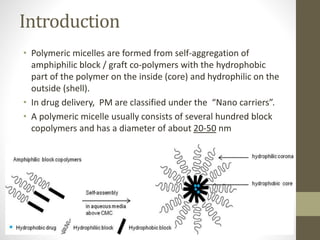
• Polymeric micelles are formed from self-aggregation of
amphiphilic block / graft co-polymers with the hydrophobic
part of the polymer on the inside (core) and hydrophilic on the
outside (shell).
• In drug delivery, PM are classified under the “Nano carriers”.
• A polymeric micelle usually consists of several hundred block
copolymers and has a diameter of about 20-50 nm
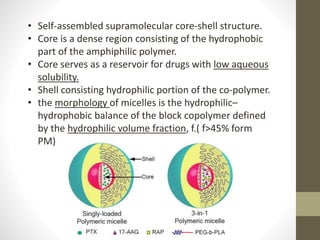
• Self-assembled supramolecular core-shell structure.
• Core is a dense region consisting of the hydrophobic
part of the amphiphilic polymer.
• Core serves as a reservoir for drugs with low aqueous
solubility.
• Shell consisting hydrophilic portion of the co-polymer.
• the morphology of micelles is the hydrophilic–
hydrophobic balance of the block copolymer defined
by the hydrophilic volume fraction, f.( f>45% form
PM)
Mechanism of Micellization
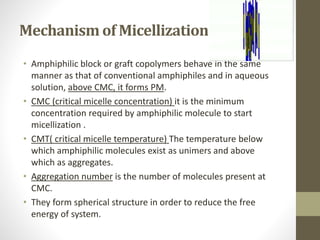
• Amphiphilic block or graft copolymers behave in the same
manner as that of conventional amphiphiles and in aqueous
solution, above CMC, it forms PM.
• CMC (critical micelle concentration) it is the minimum
concentration required by amphiphilic molecule to start
micellization .
• CMT( critical micelle temperature) The temperature below
which amphiphilic molecules exist as unimers and above
which as aggregates.
• Aggregation number is the number of molecules present at
CMC.
• They form spherical structure in order to reduce the free
energy of system.
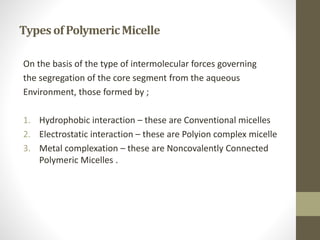
TypesofPolymericMicelle
On the basis of the type of intermolecular forces governing
the segregation of the core segment from the aqueous
Environment, those formed by ;
1. Hydrophobic interaction – these are Conventional micelles
2. Electrostatic interaction – these are Polyion complex micelle
3. Metal complexation – these are Noncovalently Connected
Polymeric Micelles .
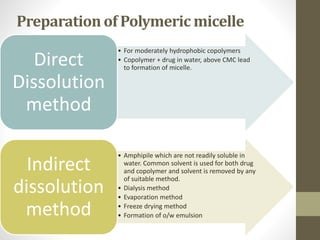
Preparation of Polymeric micelle
• For moderately hydrophobic copolymers
• Copolymer + drug in water, above CMC lead
to formation of micelle.
Direct
Dissolution
method
• Amphipile which are not readily soluble in
water. Common solvent is used for both drug
and copolymer and solvent is removed by any
of suitable method.
• Dialysis method
• Evaporation method
• Freeze drying method
• Formation of o/w emulsion
Indirect
dissolution
method
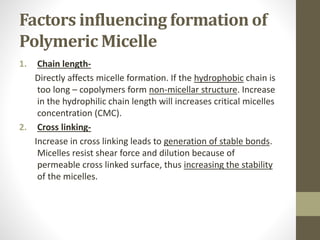
Factors influencing formation of
Polymeric Micelle
1. Chain length-
Directly affects micelle formation. If the hydrophobic chain is
too long – copolymers form non-micellar structure. Increase
in the hydrophilic chain length will increases critical micelles
concentration (CMC).
2. Cross linking-
Increase in cross linking leads to generation of stable bonds.
Micelles resist shear force and dilution because of
permeable cross linked surface, thus increasing the stability
of the micelles.
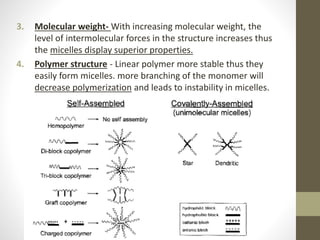
3. Molecular weight- With increasing molecular weight, the
level of intermolecular forces in the structure increases thus
the micelles display superior properties.
4. Polymer structure - Linear polymer more stable thus they
easily form micelles. more branching of the monomer will
decrease polymerization and leads to instability in micelles.
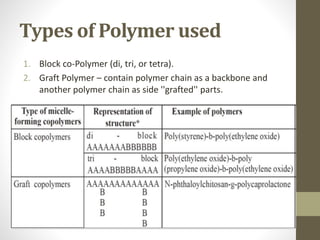
Types of Polymer used
1. Block co-Polymer (di, tri, or tetra).
2. Graft Polymer – contain polymer chain as a backbone and
another polymer chain as side ''grafted'' parts.
Characterisation of micelle
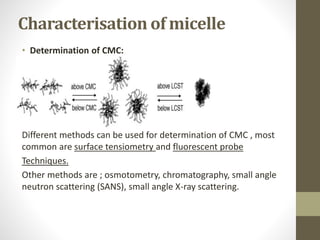
• Determination of CMC:
Different methods can be used for determination of CMC , most
common are surface tensiometry and fluorescent probe
Techniques.
Other methods are ; osmotometry, chromatography, small angle
neutron scattering (SANS), small angle X-ray scattering.
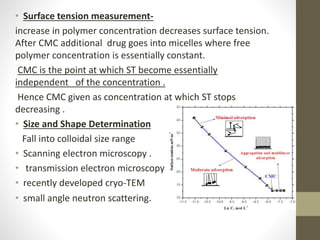
• Surface tension measurement-
increase in polymer concentration decreases surface tension.
After CMC additional drug goes into micelles where free
polymer concentration is essentially constant.
CMC is the point at which ST become essentially
independent of the concentration .
Hence CMC given as concentration at which ST stops
decreasing .
• Size and Shape Determination
Fall into colloidal size range
• Scanning electron microscopy .
• transmission electron microscopy (TEM)
• recently developed cryo-TEM
• small angle neutron scattering.
• Polydispersity index (PDI) determination
PDI indicates the degree of the dispersity of the prepared
polymer micelles. obtained by examining the micellar
solution with quasi-elastic light scattering technique.
• In vitro Drug Release Behavior
It can be studied by placing PM in Dialysis bag.
Dialysis bag is kept into medium at constant temperature
Amount of drug release is determined by taking aliquots
• Lowe Critical Solution Temperature (LCST) or Cloud
Point
Temperature above which PM starts precipitating and
form turbid solution.
Stabilityof PolymericMicelle
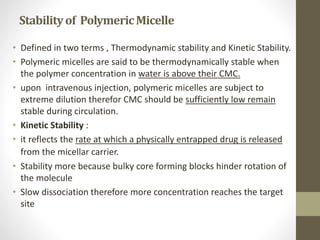
• Defined in two terms , Thermodynamic stability and Kinetic Stability.
• Polymeric micelles are said to be thermodynamically stable when
the polymer concentration in water is above their CMC.
• upon intravenous injection, polymeric micelles are subject to
extreme dilution therefor CMC should be sufficiently low remain
stable during circulation.
• Kinetic Stability :
• it reflects the rate at which a physically entrapped drug is released
from the micellar carrier.
• Stability more because bulky core forming blocks hinder rotation of
the molecule
• Slow dissociation therefore more concentration reaches the target
site
Advantages of PolymericMicelle
• PM helps to increase the solubility of the original drug thus
increasing the biocompatibility.
• The hydrophilic shell and the nanoscopic size prevent
mechanical clearance.
• Various functional groups can be incorporated by physical
entrapment or chemical conjugation.
• High kinetic stability helps to maintain the integrity
• It having high drug-loading capacity of the inner core.
• It can be used for receptor-mediated drug delivery system.
• suitable for intravenously administered drug delivery systems.
Disadvantages
• The industrial growth of polymeric micelles is hindered
by high cost of preparation and the difficulty in drug
loading.
• Extreme dilutions by blood upon intravenous injections
of micellar solution, polymeric micelles are prone to
deformation and disassembly which may lead to leakage
and burst release of loaded drugs.
• Drugs or copolymers prone to hydrolytic cleavage in
aqueous systems i.e.stability problems.
Application
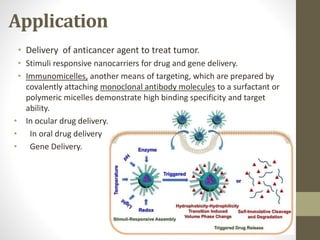
• Delivery of anticancer agent to treat tumor.
• Stimuli responsive nanocarriers for drug and gene delivery.
• Immunomicelles, another means of targeting, which are prepared by
covalently attaching monoclonal antibody molecules to a surfactant or
polymeric micelles demonstrate high binding specificity and target
ability.
• In ocular drug delivery.
• In oral drug delivery
• Gene Delivery.
Case Study
• 2-(octadecyloxy)-1,3-dioxan-5-amine (OD) with an acid
degradable ortho ester group was synthesized, and conjugated
to hyaluronic acid (HA) backbone to prepare
pH-responsive and tumor-targeted hyaluronic acid-
2-(octadecyloxy)-1,3-dioxan-5-amine (HOD) conjugates.
Abstract
• 1H NMR was used to confirm the structures of the OD and
HOD.
• Doxorubicin (DOX)-loaded HOD micelles (DOX/HOD) with a
narrow size distribution were prepared and
characterized.
• in vitro cytotoxicity assays (MTT) against MCF-7 cells of DOX/HOD
show highest cytotoxicity than pH insensitive control
HA-octadecylamine (HOA) micelle and free DOX.
• Micelles are rapidly disassembled because of pH-triggered
hydrolysis of OD.
Method :
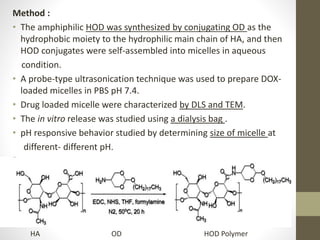
• The amphiphilic HOD was synthesized by conjugating OD as the
hydrophobic moiety to the hydrophilic main chain of HA, and then
HOD conjugates were self-assembled into micelles in aqueous
condition.
• A probe-type ultrasonication technique was used to prepare DOX-
loaded micelles in PBS pH 7.4.
• Drug loaded micelle were characterized by DLS and TEM.
• The in vitro release was studied using a dialysis bag .
• pH responsive behavior studied by determining size of micelle at
different- different pH.
HA OD HOD Polymer
Result :
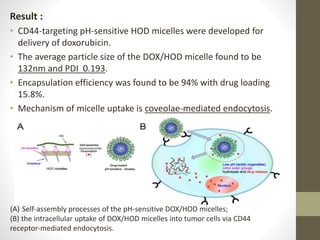
• CD44-targeting pH-sensitive HOD micelles were developed for
delivery of doxorubicin.
• The average particle size of the DOX/HOD micelle found to be
132nm and PDI 0.193.
• Encapsulation efficiency was found to be 94% with drug loading
15.8%.
• Mechanism of micelle uptake is coveolae-mediated endocytosis.
(A) Self-assembly processes of the pH-sensitive DOX/HOD micelles;
(B) the intracellular uptake of DOX/HOD micelles into tumor cells via CD44
receptor-mediated endocytosis.
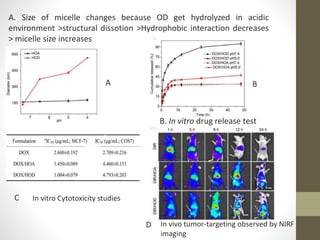
A. Size of micelle changes because OD get hydrolyzed in acidic
environment >structural dissotion >Hydrophobic interaction decreases
> micelle size increases
B. In vitro drug release test
A B
In vitro Cytotoxicity studies
In vivo tumor-targeting observed by NIRF
imaging
C
D
Conclusion :
• DOX/HOD micelles, with a narrow size
distribution, were stable under physiological
conditions, but the drug was released quickly in
the tumor acidic microenvironment.
• Effective internalization and promptly pH-
triggered release compared to free DOX and
DOX/HOA.
• DOX/HOD micelle enter in cell via caveolae-
mediated endocytosis.
• Results demonstrate that HOD conjugates can
be used as biocompatible, pH-sensitive and
tumor-targeted nanocarriers for efficient
delivery of hydrophobic anticancer drugs.
Reference
• LipengQiu et al , pH-triggered degradable polymeric micelles for
targeted antitumor drug delivery, Materials Science & Engineering C
,vol.78, 2017,p.no.912-922.
• V.K. Mourya, Nazma Inamdar, R.B. Nawale, S.S. Kulthe , Polymeric
Micelles: General Considerations and their Applications, Indian
Journal of Pharmaceutical Education and Research, , 2011/ Vol 45/
Issue 2.
• Sushant S. Kulthe , Yogesh M. Choudhari , Nazma N. Inamdar &
Vishnukant Mourya, Polymeric micelles: authoritative aspects for
drug delivery, Designed Monomers and Polymers, Vol. 15, No. 5,
September 2012, 465–521.
• Glen S. Kwon, Teruo Okanob, Polymeric micelles as new drug
carriers , Advanced Drug Delivery Reviews 21 (1996) 107-116 .
• Ying Lua, Kinam Parka, Polymeric micelles and alternative nanonized
delivery vehicles for poorly soluble drugs, International Journal of
Pharmaceutics, 453 (2013) 198– 214.
Polymeric Micelle

Polymeric Micelle

  • 1.
  • 2.
    Introduction • Polymeric micellesare formed from self-aggregation of amphiphilic block / graft co-polymers with the hydrophobic part of the polymer on the inside (core) and hydrophilic on the outside (shell). • In drug delivery, PM are classified under the “Nano carriers”. • A polymeric micelle usually consists of several hundred block copolymers and has a diameter of about 20-50 nm
  • 3.
    • Self-assembled supramolecularcore-shell structure. • Core is a dense region consisting of the hydrophobic part of the amphiphilic polymer. • Core serves as a reservoir for drugs with low aqueous solubility. • Shell consisting hydrophilic portion of the co-polymer. • the morphology of micelles is the hydrophilic– hydrophobic balance of the block copolymer defined by the hydrophilic volume fraction, f.( f>45% form PM)
  • 4.
    Mechanism of Micellization •Amphiphilic block or graft copolymers behave in the same manner as that of conventional amphiphiles and in aqueous solution, above CMC, it forms PM. • CMC (critical micelle concentration) it is the minimum concentration required by amphiphilic molecule to start micellization . • CMT( critical micelle temperature) The temperature below which amphiphilic molecules exist as unimers and above which as aggregates. • Aggregation number is the number of molecules present at CMC. • They form spherical structure in order to reduce the free energy of system.
  • 5.
    TypesofPolymericMicelle On the basisof the type of intermolecular forces governing the segregation of the core segment from the aqueous Environment, those formed by ; 1. Hydrophobic interaction – these are Conventional micelles 2. Electrostatic interaction – these are Polyion complex micelle 3. Metal complexation – these are Noncovalently Connected Polymeric Micelles .
  • 6.
    Preparation of Polymericmicelle • For moderately hydrophobic copolymers • Copolymer + drug in water, above CMC lead to formation of micelle. Direct Dissolution method • Amphipile which are not readily soluble in water. Common solvent is used for both drug and copolymer and solvent is removed by any of suitable method. • Dialysis method • Evaporation method • Freeze drying method • Formation of o/w emulsion Indirect dissolution method
  • 7.
    Factors influencing formationof Polymeric Micelle 1. Chain length- Directly affects micelle formation. If the hydrophobic chain is too long – copolymers form non-micellar structure. Increase in the hydrophilic chain length will increases critical micelles concentration (CMC). 2. Cross linking- Increase in cross linking leads to generation of stable bonds. Micelles resist shear force and dilution because of permeable cross linked surface, thus increasing the stability of the micelles.
  • 8.
    3. Molecular weight-With increasing molecular weight, the level of intermolecular forces in the structure increases thus the micelles display superior properties. 4. Polymer structure - Linear polymer more stable thus they easily form micelles. more branching of the monomer will decrease polymerization and leads to instability in micelles.
  • 9.
    Types of Polymerused 1. Block co-Polymer (di, tri, or tetra). 2. Graft Polymer – contain polymer chain as a backbone and another polymer chain as side ''grafted'' parts.
  • 10.
    Characterisation of micelle •Determination of CMC: Different methods can be used for determination of CMC , most common are surface tensiometry and fluorescent probe Techniques. Other methods are ; osmotometry, chromatography, small angle neutron scattering (SANS), small angle X-ray scattering.
  • 11.
    • Surface tensionmeasurement- increase in polymer concentration decreases surface tension. After CMC additional drug goes into micelles where free polymer concentration is essentially constant. CMC is the point at which ST become essentially independent of the concentration . Hence CMC given as concentration at which ST stops decreasing . • Size and Shape Determination Fall into colloidal size range • Scanning electron microscopy . • transmission electron microscopy (TEM) • recently developed cryo-TEM • small angle neutron scattering.
  • 12.
    • Polydispersity index(PDI) determination PDI indicates the degree of the dispersity of the prepared polymer micelles. obtained by examining the micellar solution with quasi-elastic light scattering technique. • In vitro Drug Release Behavior It can be studied by placing PM in Dialysis bag. Dialysis bag is kept into medium at constant temperature Amount of drug release is determined by taking aliquots • Lowe Critical Solution Temperature (LCST) or Cloud Point Temperature above which PM starts precipitating and form turbid solution.
  • 13.
    Stabilityof PolymericMicelle • Definedin two terms , Thermodynamic stability and Kinetic Stability. • Polymeric micelles are said to be thermodynamically stable when the polymer concentration in water is above their CMC. • upon intravenous injection, polymeric micelles are subject to extreme dilution therefor CMC should be sufficiently low remain stable during circulation. • Kinetic Stability : • it reflects the rate at which a physically entrapped drug is released from the micellar carrier. • Stability more because bulky core forming blocks hinder rotation of the molecule • Slow dissociation therefore more concentration reaches the target site
  • 14.
    Advantages of PolymericMicelle •PM helps to increase the solubility of the original drug thus increasing the biocompatibility. • The hydrophilic shell and the nanoscopic size prevent mechanical clearance. • Various functional groups can be incorporated by physical entrapment or chemical conjugation. • High kinetic stability helps to maintain the integrity • It having high drug-loading capacity of the inner core. • It can be used for receptor-mediated drug delivery system. • suitable for intravenously administered drug delivery systems.
  • 15.
    Disadvantages • The industrialgrowth of polymeric micelles is hindered by high cost of preparation and the difficulty in drug loading. • Extreme dilutions by blood upon intravenous injections of micellar solution, polymeric micelles are prone to deformation and disassembly which may lead to leakage and burst release of loaded drugs. • Drugs or copolymers prone to hydrolytic cleavage in aqueous systems i.e.stability problems.
  • 16.
    Application • Delivery ofanticancer agent to treat tumor. • Stimuli responsive nanocarriers for drug and gene delivery. • Immunomicelles, another means of targeting, which are prepared by covalently attaching monoclonal antibody molecules to a surfactant or polymeric micelles demonstrate high binding specificity and target ability. • In ocular drug delivery. • In oral drug delivery • Gene Delivery.
  • 17.
  • 18.
    • 2-(octadecyloxy)-1,3-dioxan-5-amine (OD)with an acid degradable ortho ester group was synthesized, and conjugated to hyaluronic acid (HA) backbone to prepare pH-responsive and tumor-targeted hyaluronic acid- 2-(octadecyloxy)-1,3-dioxan-5-amine (HOD) conjugates. Abstract • 1H NMR was used to confirm the structures of the OD and HOD. • Doxorubicin (DOX)-loaded HOD micelles (DOX/HOD) with a narrow size distribution were prepared and characterized. • in vitro cytotoxicity assays (MTT) against MCF-7 cells of DOX/HOD show highest cytotoxicity than pH insensitive control HA-octadecylamine (HOA) micelle and free DOX. • Micelles are rapidly disassembled because of pH-triggered hydrolysis of OD.
  • 19.
    Method : • Theamphiphilic HOD was synthesized by conjugating OD as the hydrophobic moiety to the hydrophilic main chain of HA, and then HOD conjugates were self-assembled into micelles in aqueous condition. • A probe-type ultrasonication technique was used to prepare DOX- loaded micelles in PBS pH 7.4. • Drug loaded micelle were characterized by DLS and TEM. • The in vitro release was studied using a dialysis bag . • pH responsive behavior studied by determining size of micelle at different- different pH. HA OD HOD Polymer
  • 20.
    Result : • CD44-targetingpH-sensitive HOD micelles were developed for delivery of doxorubicin. • The average particle size of the DOX/HOD micelle found to be 132nm and PDI 0.193. • Encapsulation efficiency was found to be 94% with drug loading 15.8%. • Mechanism of micelle uptake is coveolae-mediated endocytosis. (A) Self-assembly processes of the pH-sensitive DOX/HOD micelles; (B) the intracellular uptake of DOX/HOD micelles into tumor cells via CD44 receptor-mediated endocytosis.
  • 21.
    A. Size ofmicelle changes because OD get hydrolyzed in acidic environment >structural dissotion >Hydrophobic interaction decreases > micelle size increases B. In vitro drug release test A B In vitro Cytotoxicity studies In vivo tumor-targeting observed by NIRF imaging C D
  • 22.
    Conclusion : • DOX/HODmicelles, with a narrow size distribution, were stable under physiological conditions, but the drug was released quickly in the tumor acidic microenvironment. • Effective internalization and promptly pH- triggered release compared to free DOX and DOX/HOA. • DOX/HOD micelle enter in cell via caveolae- mediated endocytosis. • Results demonstrate that HOD conjugates can be used as biocompatible, pH-sensitive and tumor-targeted nanocarriers for efficient delivery of hydrophobic anticancer drugs.
  • 23.
    Reference • LipengQiu etal , pH-triggered degradable polymeric micelles for targeted antitumor drug delivery, Materials Science & Engineering C ,vol.78, 2017,p.no.912-922. • V.K. Mourya, Nazma Inamdar, R.B. Nawale, S.S. Kulthe , Polymeric Micelles: General Considerations and their Applications, Indian Journal of Pharmaceutical Education and Research, , 2011/ Vol 45/ Issue 2. • Sushant S. Kulthe , Yogesh M. Choudhari , Nazma N. Inamdar & Vishnukant Mourya, Polymeric micelles: authoritative aspects for drug delivery, Designed Monomers and Polymers, Vol. 15, No. 5, September 2012, 465–521. • Glen S. Kwon, Teruo Okanob, Polymeric micelles as new drug carriers , Advanced Drug Delivery Reviews 21 (1996) 107-116 . • Ying Lua, Kinam Parka, Polymeric micelles and alternative nanonized delivery vehicles for poorly soluble drugs, International Journal of Pharmaceutics, 453 (2013) 198– 214.

Editor's Notes

  • #3 PM are nano carrior formed from self aggregation of….
  • #4 morpholgy
  • #5 Mechanism of PM is same as the conventional micellization process i.e. above cmc it form PM
  • #6 Formed due to Electrostatic interactions between two oppositely charged moieties, such as polyelectrolytes, Electrostatic and vander wall force control stru and size Metal com: contain driving force is interpolymer HB or metal ligand interaction
  • #7 Direct method for low mw , short length of insoluble block , sirring , sonigation , heating also be used to increase dissolution
  • #8 Hydrophilic part directly prop CMC Increase in cross linking increase the stability
  • #9 As MW increases intermolecular forces increase and form Stable Preparation
  • #12 As we can see in graph increasing increasing conc. decreases ST and after cmc additional polymer goes into micelle and it doesn’t affect on ST so that CMC…..
  • #13 Monodisperse micelles produce blue color from light scattering which indicates good micellar preparation, as contrasted with the white color shown by aggregates
  • #14 For increasing stability we can chemically or physically conjugate the micelle
  • #17 Nano scopic size of micelle show EPR effect so it can be used as anticancer drug carrior system
  • #19 Concept of tumar cell pH is acidic , so that we can prepare PM in such way that incorporated drug will release only in acidic environment.
  • #20 pH vs size of micelle
  • #21 Mechanism of uptake, Phygocytosos ( >20um) , Endocytosis inhibitors
  • #22 Blank Micelle having higher diameter than DOX loded micelle size bcz Hydrophobic interaction in drug and carrier. But in interaction get decreased in acidic medium bcz structural dissociation of acid labile Hydrophobic OD. Non-invasive near infrared optical imaging technique was used to monitor the in vivo biodistribution and tumor-targeting characteristics of the micelles. which shows accumulation of DOX/HOD micelle at tumer site after 3hr .