POLYMER SCIENCE
PRESENTED BY
VARSHA AWASARKAR
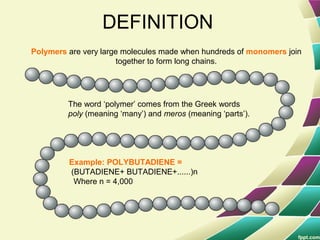
DEFINITION
The word ‘polymer’ comes from the Greek words
poly (meaning ‘many’) and meros (meaning ‘parts’).
Example: POLYBUTADIENE =
(BUTADIENE+ BUTADIENE+......)n
Where n = 4,000
Polymers are very large molecules made when hundreds of monomers join
together to form long chains.
INTRODUCTION
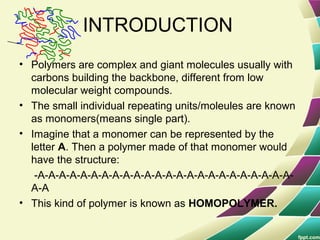
• Polymers are complex and giant molecules usually with
carbons building the backbone, different from low
molecular weight compounds.
• The small individual repeating units/moleules are known
as monomers(means single part).
• Imagine that a monomer can be represented by the
letter A. Then a polymer made of that monomer would
have the structure:
-A-A-A-A-A-A-A-A-A-A-A-A-A-A-A-A-A-A-A-A-A-A-A-A-
A-A
• This kind of polymer is known as HOMOPOLYMER.
CONT…..
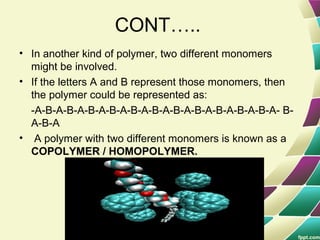
• In another kind of polymer, two different monomers
might be involved.
• If the letters A and B represent those monomers, then
the polymer could be represented as:
-A-B-A-B-A-B-A-B-A-B-A-B-A-B-A-B-A-B-A-B-A-B-A- B-
A-B-A
• A polymer with two different monomers is known as a
COPOLYMER / HOMOPOLYMER.
Molecular Structure of Polymer
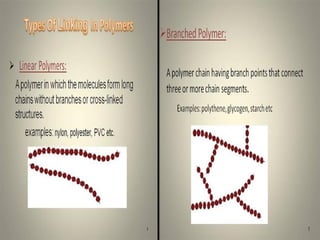
Linear
– High Density Polyethylene (HDPE), PVC, Nylon,
Cotton
Branched
– Low Density
- Polyethylene (LDPE)
Cross-linked
– Rubber
Network
– Kevlar, Epoxy
CHARACTERISTICS OF
IDEAL POLYMER
• Should be inert and compatible with
the environment.
• Should be non-toxic.
• Should be easily administered.
• Should be easy and inexpensive to
fabricate.
• Should have good mechanical
strength.
POLYMERISATION
• The process by which the monomer molecules are linked
to form a big polymer molecule is called ‘polymerisation’.
• Polymerization is a process of bonding monomer, or
“single units” together through a variety of reaction
mechanisms to form longer chains named Polymer
• As important as polymers are, they exist with monomers,
which are small, single molecules such as hydrocarbons
and amino acids.
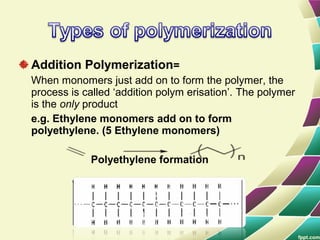
Addition Polymerization=
When monomers just add on to form the polymer, the
process is called ‘addition polym erisation’. The polymer
is the only product
e.g. Ethylene monomers add on to form
polyethylene. (5 Ethylene monomers)
Polyethylene formation
It Is useful to dIstInguIsh four
polymerIzatIon procedures fIttIng
thIs general descrIptIon.
• Radical Polymerization The initiator is a radical, and the
propagating site of reactivity (*) is a carbon radical.
• Cationic Polymerization The initiator is an acid, and the
propagating site of reactivity (*) is a carbocation.
• Anionic Polymerization The initiator is a nucleophile, and
the propagating site of reactivity (*) is a carbanion.
• Coordination Catalytic Polymerization The initiator is a
transition metal complex, and the propagating site of
reactivity (*) is a terminal catalytic complex.
CONT….
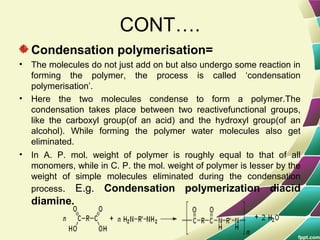
Condensation polymerisation=
• The molecules do not just add on but also undergo some reaction in
forming the polymer, the process is called ‘condensation
polymerisation’.
• Here the two molecules condense to form a polymer.The
condensation takes place between two reactivefunctional groups,
like the carboxyl group(of an acid) and the hydroxyl group(of an
alcohol). While forming the polymer water molecules also get
eliminated.
• In A. P. mol. weight of polymer is roughly equal to that of all
monomers, while in C. P. the mol. weight of polymer is lesser by the
weight of simple molecules eliminated during the condensation
process. E.g. Condensation polymerization diacid
diamine.
1. Natural and Synthetic Polymers
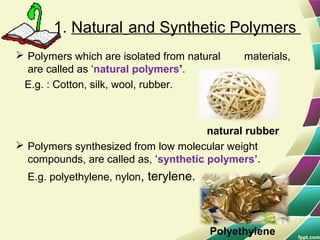
 Polymers which are isolated from natural materials,
are called as ‘natural polymers’.
E.g. : Cotton, silk, wool, rubber.
natural rubber
 Polymers synthesized from low molecular weight
compounds, are called as, ‘synthetic polymers’.
E.g. polyethylene, nylon, terylene.
Polyethylene
NATURAL RUBBER-
Hevea brasiilensis
2. Organic and Inorganic
Polymers
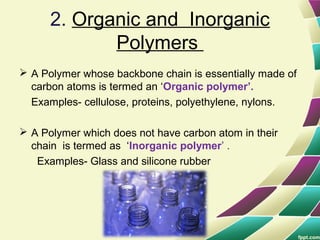
 A Polymer whose backbone chain is essentially made of
carbon atoms is termed an ‘Organic polymer’.
Examples- cellulose, proteins, polyethylene, nylons.
 A Polymer which does not have carbon atom in their
chain is termed as ‘Inorganic polymer’ .
Examples- Glass and silicone rubber
3. Thermoplastic and Thermosetting
Polymer
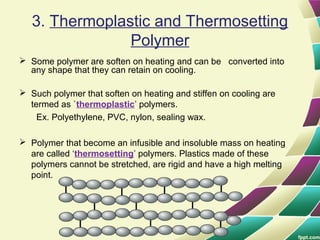
 Some polymer are soften on heating and can be converted into
any shape that they can retain on cooling.
 Such polymer that soften on heating and stiffen on cooling are
termed as `thermoplastic’ polymers.
Ex. Polyethylene, PVC, nylon, sealing wax.
 Polymer that become an infusible and insoluble mass on heating
are called ‘thermosetting’ polymers. Plastics made of these
polymers cannot be stretched, are rigid and have a high melting
point.
4. Plastics, Elastomers, Fibres & Liquid
resins
 Polymer is shaped into hard and tough utility articles by application
of heat and pressure, is known as ‘plastics’.
E.g. polysterene, PVC, polymethyl methacrylate.
 When plastics are vulcanised into rubbery products exhibiting good
strength and elongation, polymers are known as ‘elastomers’.
E.g. silicone rubber, natural rubber, synthetic rubber, etc.
 Long filament like material whose length is atleast 100 times it’s
diameter, polymers are said to be ‘fibres’.
E.g. Nylon, terylene.
 Polymers used as adhesives, potting compounds, sealants, etc., in
a liquid form are described as ‘liquid resins’.
E.g. Epoxy adhesives and polysulphides sealants.
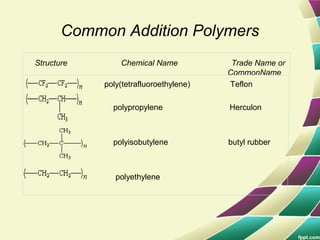
Common Addition Polymers
Structure Chemical Name Trade Name or
CommonName
poly(tetrafluoroethylene) Teflon
polypropylene Herculon
polyisobutylene butyl rubber
polyethylene
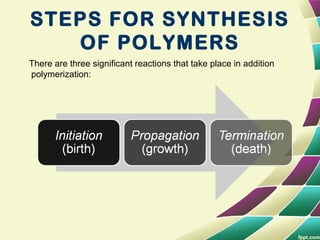
STEPS FOR SYNTHESIS
OF POLYMERS
There are three significant reactions that take place in addition
polymerization:
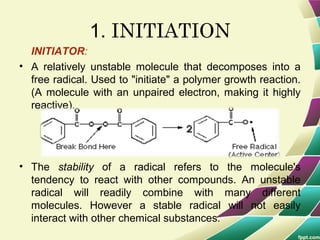
1. INITIATION
INITIATOR:
• A relatively unstable molecule that decomposes into a
free radical. Used to "initiate" a polymer growth reaction.
(A molecule with an unpaired electron, making it highly
reactive).
• The stability of a radical refers to the molecule's
tendency to react with other compounds. An unstable
radical will readily combine with many different
molecules. However a stable radical will not easily
interact with other chemical substances.
CONT….
• The first step in chain polymerization- Initiation involves
the formation of a free radical. Addition can occur at
either end of the monomer. This process is illustrated in
the following animation in which a chlorine atom
possessing an unpaired electron (often indicated as cl-)
initiates the reaction.
.
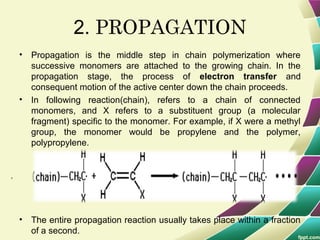
2. PROPAGATION
• Propagation is the middle step in chain polymerization where
successive monomers are attached to the growing chain. In the
propagation stage, the process of electron transfer and
consequent motion of the active center down the chain proceeds.
• In following reaction(chain), refers to a chain of connected
monomers, and X refers to a substituent group (a molecular
fragment) specific to the monomer. For example, if X were a methyl
group, the monomer would be propylene and the polymer,
polypropylene.
• The entire propagation reaction usually takes place within a fraction
of a second.
3. TERMINATION
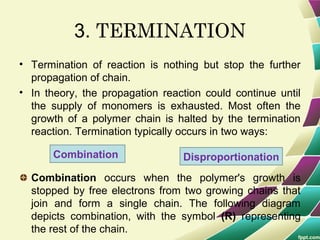
• Termination of reaction is nothing but stop the further
propagation of chain.
• In theory, the propagation reaction could continue until
the supply of monomers is exhausted. Most often the
growth of a polymer chain is halted by the termination
reaction. Termination typically occurs in two ways:
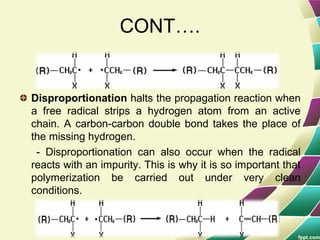
Combination occurs when the polymer's growth is
stopped by free electrons from two growing chains that
join and form a single chain. The following diagram
depicts combination, with the symbol (R) representing
the rest of the chain.
Combination Disproportionation
CONT….
Disproportionation halts the propagation reaction when
a free radical strips a hydrogen atom from an active
chain. A carbon-carbon double bond takes the place of
the missing hydrogen.
- Disproportionation can also occur when the radical
reacts with an impurity. This is why it is so important that
polymerization be carried out under very clean
conditions.
LIVING POLYMERISATION
• There exists a type of addition polymerization that does
not undergo a termination reaction. This so-called "living
polymerization" continues until the monomer supply has
been exhausted. When this happens, the free radicals
become less active due to interactions with solvent
molecules. If more monomers are added to the solution,
the polymerization will resume.
• Uniform molecular weights (low polydispersity) are
characteristic of living polymerization. Because the
supply of monomers is controlled, the chain length can
be manipulated to serve the needs of a specific
application. This assumes that the initiator is 100%
efficient.
MOLECULAR WEIGHT
DETERMINATION
• There are two ways to calculate the average molecular
weight:
1. Number Average Molecular Weight
2. Weight Average Molecular Weight
CONT…
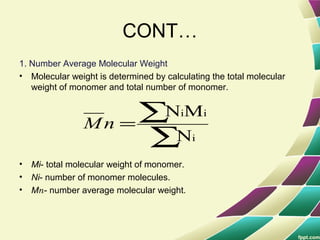
1. Number Average Molecular Weight
• Molecular weight is determined by calculating the total molecular
weight of monomer and total number of monomer.
• Mi- total molecular weight of monomer.
• Ni- number of monomer molecules.
• Mn- number average molecular weight.
∑
∑=
i
ii
N
MN
nM
CONT…
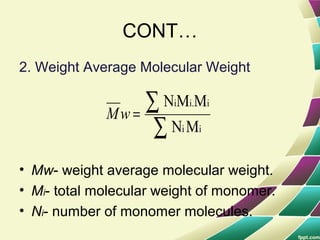
2. Weight Average Molecular Weight
• Mw- weight average molecular weight.
• Mi- total molecular weight of monomer.
• Ni- number of monomer molecules.
∑
∑=
ii
ii.i
MN
MMN
wM
APPLICATIONS
 Mainly used for drug delivery.
– As a coating material
examples: Hydroxyl propyl methyl cellulose(HPMC),
Methyl cellulose,
Propylene glycol.
– As a binders in tabletting granulation
examples: Acacia, Gelatin, Sodium alginate.
– As a disintegrants
examples: starch, HPMC
– As a thickening agent in suspension and ophthalmic preparations
Example: methyl cellulose.
– To form bases in ointments.
– In hard and soft capsule gelatin is used.
– Gelatin also used as suppository base, as an emulsifying agent and
suspending agent.
THERMAL
CHARACTERIZATION
Thermal analysis of the polymers is the
important phenomenon to study the
stability and degradation of polymers.
Method :-
a) TGA
b) DSC
c) Thermo mechanical analysis
Thermo-gravimetric Analysis (TGA)
• This method provides indication for thermal
stability and upper limit of thermal degradation
where loss of sample begins.
• This method only measures loss of volatile
content from the polymer.
• This method has limitation that it can not detect
temperature at chain cleavage of chain takes
place.
Differential Scanning Calorimetry
(DSC)
Parameters measured-
1. Glass transition temperature (Tg)
2. Crystalline melting point
3. Heat of fusion
4. Heat of crystallization
• It requires placing of Reference and test sample
for the continuous monitoring in the heating
chamber.
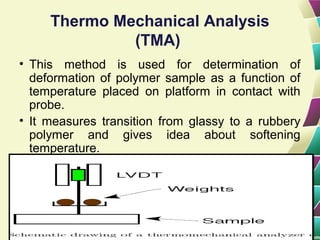
Thermo Mechanical Analysis
(TMA)
• This method is used for determination of
deformation of polymer sample as a function of
temperature placed on platform in contact with
probe.
• It measures transition from glassy to a rubbery
polymer and gives idea about softening
temperature.
BIODEGRADABLE POLYMERS
• Definition :
Biodegradable polymers are defined as polymers
comprised of monomers linked to one another through
functional groups and have unstable links in the
backbone.
• They slowly disappear from the site of administration in
response to a chemical reaction such as hydrolysis.
• Material progressively releasing dissolved or dispersed
drug, with ability of functioning for a temporary period
and subsequently degrade in the biological fluids under a
controlled mechanism, in to product easily eliminated in
body metabolism pathway.
Classification
• Biodegradable polymers can be classified in two:
1. Natural biodegradable polymer
examples:
a) Collagen
b) Albumin
c) Casein
d) gelatin
e) xanthum gum
f) gaur gum
g) chitosan
h) chtin
2. Synthetic biodegradable polymer
examples: Polyanhydrides, Poly(ß-Hydroxybutyric Acids) etc.
• Synthetic biodegradable polymer are preferred more than the natural
biodegradable polymer because they are free of immunogenicity & their
physicochemical properties are more predictable &reproducible
ADVANTAGES
• Localized delivery of drug
• Sustained delivery of drug
• Stabilization of drug
• Decrease in dosing frequency
• Reduce side effects
• Improved patient compliance
• Controllable degradation rate
BIBLIOGRAPHY
• file:///D:/polymerization/polymers%20with
%20biodegradable.htm
• file:///D:/polymerization/Polymerization.htm
• file:///D:/polymerization/synthesis%20of
%20polymerization.htm
• file:///D:/polymerization/types.html
Polymer science: preparation and uses of polymers

Polymer science: preparation and uses of polymers

  • 1.
  • 2.
    DEFINITION The word ‘polymer’comes from the Greek words poly (meaning ‘many’) and meros (meaning ‘parts’). Example: POLYBUTADIENE = (BUTADIENE+ BUTADIENE+......)n Where n = 4,000 Polymers are very large molecules made when hundreds of monomers join together to form long chains.
  • 3.
    INTRODUCTION • Polymers arecomplex and giant molecules usually with carbons building the backbone, different from low molecular weight compounds. • The small individual repeating units/moleules are known as monomers(means single part). • Imagine that a monomer can be represented by the letter A. Then a polymer made of that monomer would have the structure: -A-A-A-A-A-A-A-A-A-A-A-A-A-A-A-A-A-A-A-A-A-A-A-A- A-A • This kind of polymer is known as HOMOPOLYMER.
  • 4.
    CONT….. • In anotherkind of polymer, two different monomers might be involved. • If the letters A and B represent those monomers, then the polymer could be represented as: -A-B-A-B-A-B-A-B-A-B-A-B-A-B-A-B-A-B-A-B-A-B-A- B- A-B-A • A polymer with two different monomers is known as a COPOLYMER / HOMOPOLYMER.
  • 6.
    Molecular Structure ofPolymer Linear – High Density Polyethylene (HDPE), PVC, Nylon, Cotton Branched – Low Density - Polyethylene (LDPE) Cross-linked – Rubber Network – Kevlar, Epoxy
  • 7.
    CHARACTERISTICS OF IDEAL POLYMER •Should be inert and compatible with the environment. • Should be non-toxic. • Should be easily administered. • Should be easy and inexpensive to fabricate. • Should have good mechanical strength.
  • 8.
    POLYMERISATION • The processby which the monomer molecules are linked to form a big polymer molecule is called ‘polymerisation’. • Polymerization is a process of bonding monomer, or “single units” together through a variety of reaction mechanisms to form longer chains named Polymer • As important as polymers are, they exist with monomers, which are small, single molecules such as hydrocarbons and amino acids.
  • 9.
    Addition Polymerization= When monomersjust add on to form the polymer, the process is called ‘addition polym erisation’. The polymer is the only product e.g. Ethylene monomers add on to form polyethylene. (5 Ethylene monomers) Polyethylene formation
  • 10.
    It Is usefulto dIstInguIsh four polymerIzatIon procedures fIttIng thIs general descrIptIon. • Radical Polymerization The initiator is a radical, and the propagating site of reactivity (*) is a carbon radical. • Cationic Polymerization The initiator is an acid, and the propagating site of reactivity (*) is a carbocation. • Anionic Polymerization The initiator is a nucleophile, and the propagating site of reactivity (*) is a carbanion. • Coordination Catalytic Polymerization The initiator is a transition metal complex, and the propagating site of reactivity (*) is a terminal catalytic complex.
  • 11.
    CONT…. Condensation polymerisation= • Themolecules do not just add on but also undergo some reaction in forming the polymer, the process is called ‘condensation polymerisation’. • Here the two molecules condense to form a polymer.The condensation takes place between two reactivefunctional groups, like the carboxyl group(of an acid) and the hydroxyl group(of an alcohol). While forming the polymer water molecules also get eliminated. • In A. P. mol. weight of polymer is roughly equal to that of all monomers, while in C. P. the mol. weight of polymer is lesser by the weight of simple molecules eliminated during the condensation process. E.g. Condensation polymerization diacid diamine.
  • 13.
    1. Natural andSynthetic Polymers  Polymers which are isolated from natural materials, are called as ‘natural polymers’. E.g. : Cotton, silk, wool, rubber. natural rubber  Polymers synthesized from low molecular weight compounds, are called as, ‘synthetic polymers’. E.g. polyethylene, nylon, terylene. Polyethylene
  • 14.
  • 15.
    2. Organic andInorganic Polymers  A Polymer whose backbone chain is essentially made of carbon atoms is termed an ‘Organic polymer’. Examples- cellulose, proteins, polyethylene, nylons.  A Polymer which does not have carbon atom in their chain is termed as ‘Inorganic polymer’ . Examples- Glass and silicone rubber
  • 16.
    3. Thermoplastic andThermosetting Polymer  Some polymer are soften on heating and can be converted into any shape that they can retain on cooling.  Such polymer that soften on heating and stiffen on cooling are termed as `thermoplastic’ polymers. Ex. Polyethylene, PVC, nylon, sealing wax.  Polymer that become an infusible and insoluble mass on heating are called ‘thermosetting’ polymers. Plastics made of these polymers cannot be stretched, are rigid and have a high melting point.
  • 17.
    4. Plastics, Elastomers,Fibres & Liquid resins  Polymer is shaped into hard and tough utility articles by application of heat and pressure, is known as ‘plastics’. E.g. polysterene, PVC, polymethyl methacrylate.  When plastics are vulcanised into rubbery products exhibiting good strength and elongation, polymers are known as ‘elastomers’. E.g. silicone rubber, natural rubber, synthetic rubber, etc.  Long filament like material whose length is atleast 100 times it’s diameter, polymers are said to be ‘fibres’. E.g. Nylon, terylene.  Polymers used as adhesives, potting compounds, sealants, etc., in a liquid form are described as ‘liquid resins’. E.g. Epoxy adhesives and polysulphides sealants.
  • 18.
    Common Addition Polymers StructureChemical Name Trade Name or CommonName poly(tetrafluoroethylene) Teflon polypropylene Herculon polyisobutylene butyl rubber polyethylene
  • 19.
    STEPS FOR SYNTHESIS OFPOLYMERS There are three significant reactions that take place in addition polymerization:
  • 20.
    1. INITIATION INITIATOR: • Arelatively unstable molecule that decomposes into a free radical. Used to "initiate" a polymer growth reaction. (A molecule with an unpaired electron, making it highly reactive). • The stability of a radical refers to the molecule's tendency to react with other compounds. An unstable radical will readily combine with many different molecules. However a stable radical will not easily interact with other chemical substances.
  • 21.
    CONT…. • The firststep in chain polymerization- Initiation involves the formation of a free radical. Addition can occur at either end of the monomer. This process is illustrated in the following animation in which a chlorine atom possessing an unpaired electron (often indicated as cl-) initiates the reaction.
  • 22.
    . 2. PROPAGATION • Propagationis the middle step in chain polymerization where successive monomers are attached to the growing chain. In the propagation stage, the process of electron transfer and consequent motion of the active center down the chain proceeds. • In following reaction(chain), refers to a chain of connected monomers, and X refers to a substituent group (a molecular fragment) specific to the monomer. For example, if X were a methyl group, the monomer would be propylene and the polymer, polypropylene. • The entire propagation reaction usually takes place within a fraction of a second.
  • 23.
    3. TERMINATION • Terminationof reaction is nothing but stop the further propagation of chain. • In theory, the propagation reaction could continue until the supply of monomers is exhausted. Most often the growth of a polymer chain is halted by the termination reaction. Termination typically occurs in two ways: Combination occurs when the polymer's growth is stopped by free electrons from two growing chains that join and form a single chain. The following diagram depicts combination, with the symbol (R) representing the rest of the chain. Combination Disproportionation
  • 24.
    CONT…. Disproportionation halts thepropagation reaction when a free radical strips a hydrogen atom from an active chain. A carbon-carbon double bond takes the place of the missing hydrogen. - Disproportionation can also occur when the radical reacts with an impurity. This is why it is so important that polymerization be carried out under very clean conditions.
  • 25.
    LIVING POLYMERISATION • Thereexists a type of addition polymerization that does not undergo a termination reaction. This so-called "living polymerization" continues until the monomer supply has been exhausted. When this happens, the free radicals become less active due to interactions with solvent molecules. If more monomers are added to the solution, the polymerization will resume. • Uniform molecular weights (low polydispersity) are characteristic of living polymerization. Because the supply of monomers is controlled, the chain length can be manipulated to serve the needs of a specific application. This assumes that the initiator is 100% efficient.
  • 26.
    MOLECULAR WEIGHT DETERMINATION • Thereare two ways to calculate the average molecular weight: 1. Number Average Molecular Weight 2. Weight Average Molecular Weight
  • 27.
    CONT… 1. Number AverageMolecular Weight • Molecular weight is determined by calculating the total molecular weight of monomer and total number of monomer. • Mi- total molecular weight of monomer. • Ni- number of monomer molecules. • Mn- number average molecular weight. ∑ ∑= i ii N MN nM
  • 28.
    CONT… 2. Weight AverageMolecular Weight • Mw- weight average molecular weight. • Mi- total molecular weight of monomer. • Ni- number of monomer molecules. ∑ ∑= ii ii.i MN MMN wM
  • 29.
    APPLICATIONS  Mainly usedfor drug delivery. – As a coating material examples: Hydroxyl propyl methyl cellulose(HPMC), Methyl cellulose, Propylene glycol. – As a binders in tabletting granulation examples: Acacia, Gelatin, Sodium alginate. – As a disintegrants examples: starch, HPMC – As a thickening agent in suspension and ophthalmic preparations Example: methyl cellulose. – To form bases in ointments. – In hard and soft capsule gelatin is used. – Gelatin also used as suppository base, as an emulsifying agent and suspending agent.
  • 30.
    THERMAL CHARACTERIZATION Thermal analysis ofthe polymers is the important phenomenon to study the stability and degradation of polymers. Method :- a) TGA b) DSC c) Thermo mechanical analysis
  • 31.
    Thermo-gravimetric Analysis (TGA) •This method provides indication for thermal stability and upper limit of thermal degradation where loss of sample begins. • This method only measures loss of volatile content from the polymer. • This method has limitation that it can not detect temperature at chain cleavage of chain takes place.
  • 32.
    Differential Scanning Calorimetry (DSC) Parametersmeasured- 1. Glass transition temperature (Tg) 2. Crystalline melting point 3. Heat of fusion 4. Heat of crystallization • It requires placing of Reference and test sample for the continuous monitoring in the heating chamber.
  • 33.
    Thermo Mechanical Analysis (TMA) •This method is used for determination of deformation of polymer sample as a function of temperature placed on platform in contact with probe. • It measures transition from glassy to a rubbery polymer and gives idea about softening temperature.
  • 34.
    BIODEGRADABLE POLYMERS • Definition: Biodegradable polymers are defined as polymers comprised of monomers linked to one another through functional groups and have unstable links in the backbone. • They slowly disappear from the site of administration in response to a chemical reaction such as hydrolysis. • Material progressively releasing dissolved or dispersed drug, with ability of functioning for a temporary period and subsequently degrade in the biological fluids under a controlled mechanism, in to product easily eliminated in body metabolism pathway.
  • 35.

    Classification • Biodegradable polymerscan be classified in two: 1. Natural biodegradable polymer examples: a) Collagen b) Albumin c) Casein d) gelatin e) xanthum gum f) gaur gum g) chitosan h) chtin 2. Synthetic biodegradable polymer examples: Polyanhydrides, Poly(ß-Hydroxybutyric Acids) etc. • Synthetic biodegradable polymer are preferred more than the natural biodegradable polymer because they are free of immunogenicity & their physicochemical properties are more predictable &reproducible
  • 36.
    ADVANTAGES • Localized deliveryof drug • Sustained delivery of drug • Stabilization of drug • Decrease in dosing frequency • Reduce side effects • Improved patient compliance • Controllable degradation rate
  • 37.
    BIBLIOGRAPHY • file:///D:/polymerization/polymers%20with %20biodegradable.htm • file:///D:/polymerization/Polymerization.htm •file:///D:/polymerization/synthesis%20of %20polymerization.htm • file:///D:/polymerization/types.html