FIMBRIAE AND PILI
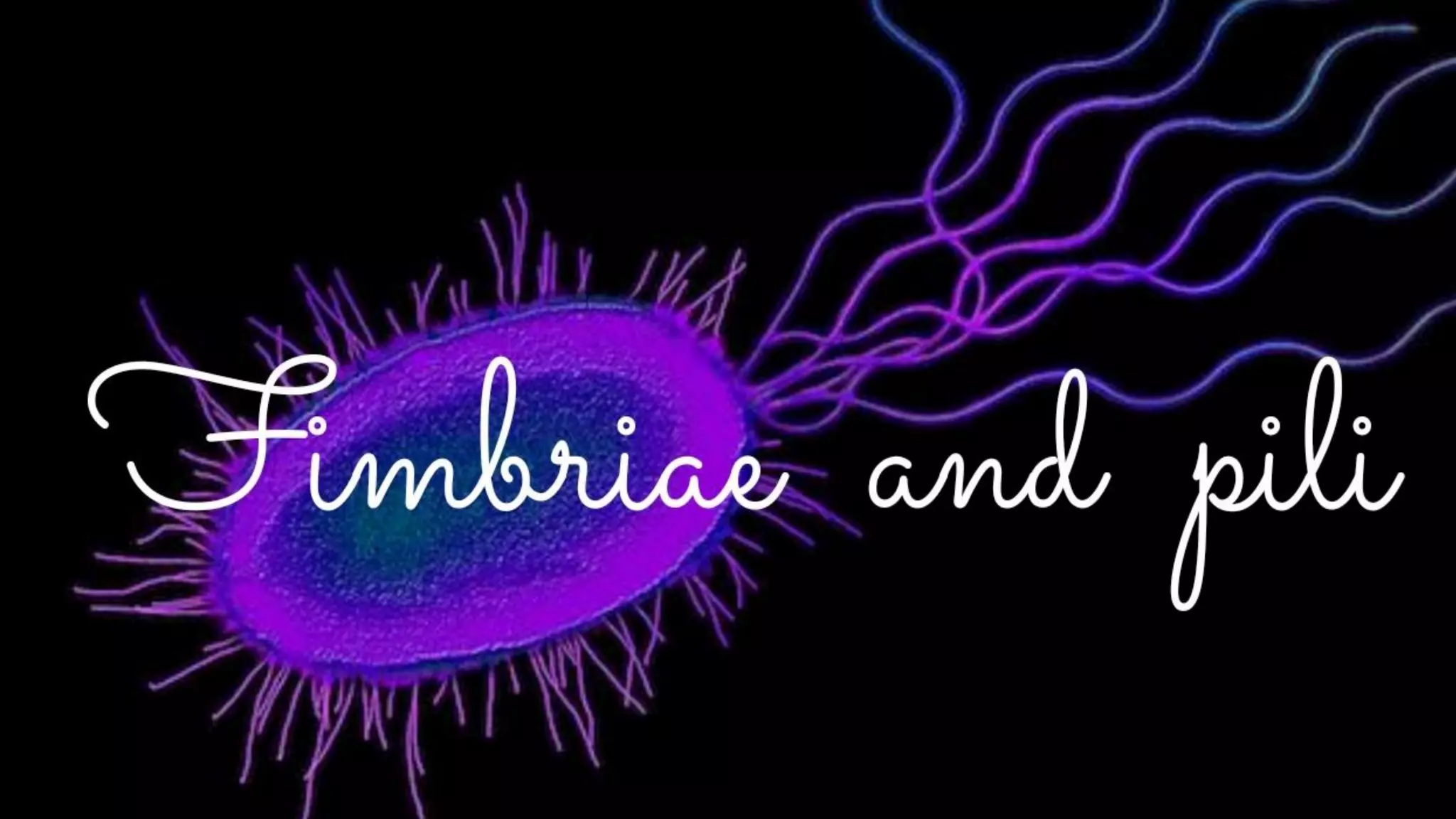
•Fimbriae and Pili are filamentous structures
composed of protein that extend from the surface
of a cell and can have many functions.
Fimbriae are found in gram negative as well as
gram positive bacteria but are shorter in length as
compared to pili. Pili are longer than fimbriae and
there are only a few per cell.
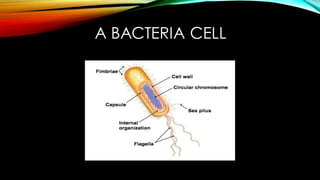
A BACTERIA CELL
FIMBRIAE
•This appendage ranges from 3–10 nanometers in
diameter and can be up to several micrometers
long. Fimbriae are used by bacteria to adhere to
one another and to adhere to animal cells and
some inanimate objects. A bacterium can have as
many as 1,000 fimbriae. Fimbriae are only visible
with the use of an electron microscope. They may
be straight or flexible.
•Fimbriae carry adhesins which attach them to the
substratum so that the bacteria can
withstand shear forces and obtain nutrients. For
example, E. coli uses them to attach to mannose
receptors.
PILI
•Pili are shorter than flagella and they are not involved in
motility. They are used to attach the bacterium to the
substrate upon which it is living. They are made up of
special protein called pilin. True pili are only present on
gram negative bacteria.
•They are primarily involved in the mating process
between cells called conjugation in [bacteria].
•Sex pili (long conjugation pili or F pili)
and
•Common pili (short attachment pili
also called fimbriae).
MAINLY PILI ARE OF TWO TYPES
•Common pili (Adhesins): They mediate the
attachment of bacteria to specific receptors on the
human cell surface, which is the first step in
establishing infection in some organisms. They
contribute to the pathogenicity of certain
bacteria—their ability to produce disease—by
enhancing colonization on the surfaces of the cells
of other organisms.
Example: Mutants of Neisseria gonorrhoeaethat do
not form pili are nonpathogen.
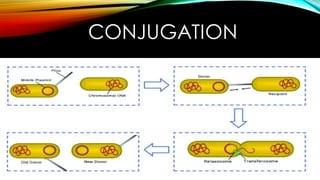
•Sex pili (conjugation tube): It is a specialized
kind of pili that forms the attachment
between male (donor) and the female
(recipient) bacteria during conjugation and acts
as a conduit for the passage of DNA. This
process is well characterized in the gram
negative bacillus Escherichia coli.
•Some pili are also involved in biofilm
formation, phage transduction, DNA uptake
and a special form of bacterial cell movement,
known as ‘twitching motility’.
•(a) Bacteria containing fimbriae are called
fimbriate bacteria. Fimbriae have the adhesive
properties which attach the organism to the natural
substrate or to the other organism. Fimbriae
agglutinate the blood cells such as erythrocytes,
leucocytes, eplithelial cells, etc.
FUNCTIONS OF PILI AND FIMBRIAE
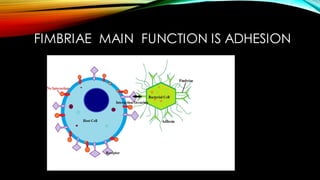
FIMBRIAE MAIN FUNCTION IS ADHESION
•(b) Fimbriae are equipped with antigenic
properties as they act as thermolabile nonspecific
agglutinogen.
•(c) Fimbriae affect the metabolic activity. The
Fim+ cells (cells containing fimbriae) possess
higher rate of metabolic activity than the Fim– cells
(cells devoid of fimbriae). Moreover, they function
as aggregation organelles i.e. they can form stellate
aggregation on a static liquid medium.
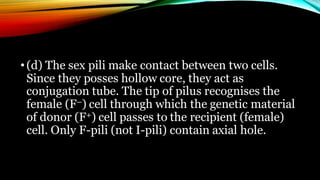
•(d) The sex pili make contact between two cells.
Since they posses hollow core, they act as
conjugation tube. The tip of pilus recognises the
female (F–) cell through which the genetic material
of donor (F+) cell passes to the recipient (female)
cell. Only F-pili (not I-pili) contain axial hole.
CONJUGATION
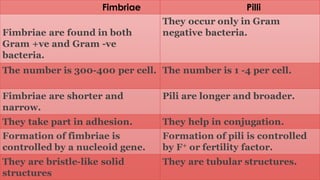
DIFFERENCE BETWEEN PILI AND FIMBRIAEFimbriae Pilli
Fimbriae are found in both
Gram +ve and Gram -ve
bacteria.
They occur only in Gram
negative bacteria.
The number is 300-400 per cell. The number is 1 -4 per cell.
Fimbriae are shorter and
narrow.
Pili are longer and broader.
They take part in adhesion. They help in conjugation.
Formation of fimbriae is
controlled by a nucleoid gene.
Formation of pili is controlled
by F+ or fertility factor.
They are bristle-like solid
structures
They are tubular structures.
THANK YOU

Fimbriae and pili

  • 2.
    FIMBRIAE AND PILI •Fimbriaeand Pili are filamentous structures composed of protein that extend from the surface of a cell and can have many functions. Fimbriae are found in gram negative as well as gram positive bacteria but are shorter in length as compared to pili. Pili are longer than fimbriae and there are only a few per cell.
  • 3.
  • 4.
    FIMBRIAE •This appendage rangesfrom 3–10 nanometers in diameter and can be up to several micrometers long. Fimbriae are used by bacteria to adhere to one another and to adhere to animal cells and some inanimate objects. A bacterium can have as many as 1,000 fimbriae. Fimbriae are only visible with the use of an electron microscope. They may be straight or flexible.
  • 5.
    •Fimbriae carry adhesinswhich attach them to the substratum so that the bacteria can withstand shear forces and obtain nutrients. For example, E. coli uses them to attach to mannose receptors.
  • 6.
    PILI •Pili are shorterthan flagella and they are not involved in motility. They are used to attach the bacterium to the substrate upon which it is living. They are made up of special protein called pilin. True pili are only present on gram negative bacteria. •They are primarily involved in the mating process between cells called conjugation in [bacteria].
  • 7.
    •Sex pili (longconjugation pili or F pili) and •Common pili (short attachment pili also called fimbriae). MAINLY PILI ARE OF TWO TYPES
  • 8.
    •Common pili (Adhesins):They mediate the attachment of bacteria to specific receptors on the human cell surface, which is the first step in establishing infection in some organisms. They contribute to the pathogenicity of certain bacteria—their ability to produce disease—by enhancing colonization on the surfaces of the cells of other organisms. Example: Mutants of Neisseria gonorrhoeaethat do not form pili are nonpathogen.
  • 9.
    •Sex pili (conjugationtube): It is a specialized kind of pili that forms the attachment between male (donor) and the female (recipient) bacteria during conjugation and acts as a conduit for the passage of DNA. This process is well characterized in the gram negative bacillus Escherichia coli.
  • 10.
    •Some pili arealso involved in biofilm formation, phage transduction, DNA uptake and a special form of bacterial cell movement, known as ‘twitching motility’.
  • 11.
    •(a) Bacteria containingfimbriae are called fimbriate bacteria. Fimbriae have the adhesive properties which attach the organism to the natural substrate or to the other organism. Fimbriae agglutinate the blood cells such as erythrocytes, leucocytes, eplithelial cells, etc. FUNCTIONS OF PILI AND FIMBRIAE
  • 12.
  • 13.
    •(b) Fimbriae areequipped with antigenic properties as they act as thermolabile nonspecific agglutinogen. •(c) Fimbriae affect the metabolic activity. The Fim+ cells (cells containing fimbriae) possess higher rate of metabolic activity than the Fim– cells (cells devoid of fimbriae). Moreover, they function as aggregation organelles i.e. they can form stellate aggregation on a static liquid medium.
  • 14.
    •(d) The sexpili make contact between two cells. Since they posses hollow core, they act as conjugation tube. The tip of pilus recognises the female (F–) cell through which the genetic material of donor (F+) cell passes to the recipient (female) cell. Only F-pili (not I-pili) contain axial hole.
  • 15.
  • 16.
    DIFFERENCE BETWEEN PILIAND FIMBRIAEFimbriae Pilli Fimbriae are found in both Gram +ve and Gram -ve bacteria. They occur only in Gram negative bacteria. The number is 300-400 per cell. The number is 1 -4 per cell. Fimbriae are shorter and narrow. Pili are longer and broader. They take part in adhesion. They help in conjugation. Formation of fimbriae is controlled by a nucleoid gene. Formation of pili is controlled by F+ or fertility factor. They are bristle-like solid structures They are tubular structures.
  • 17.