BACTERIA
Definition and classification
R.NAGALAKSHMI
ASST. PROF
THE OXFORD COLLEGE OF PHARMACY
BANGALORE
Definition and classification
• Bacteria are microscopic living organisms, usually one-celled, that can be
found everywhere. They can be dangerous, such as when they cause infection,
or beneficial, as in the process of fermentation (such as in wine) and that of
decomposition.
• Classification of bacteria
1. on the basis of mode of nutrition
2. on the basis of optimum temperature requirement for growth
3. on the basis of optimal pH for growth
4. on the basis of salt concentration
5. on the basis of gaseous requirement
6. on the basis of morphology
7. on the basis of gram staining
8. on the basis of flagella
9. on the basis of spore
CLASSIFICATION OF BACTERIA ON THE BASIS OF MODE OF NUTRITION
Autotrops Heterotrops
Photoautotroph's Chemoautotroph's Photoheterotrophs Chemoheterotrophs
CLASSIFICATION OF BACTERIA ON THE BASIS OF MODE OF NUTRITION
A] Autotrops: Those bacteria which uses carbon dioxide as sole source of carbon to
prepare its own food.
Autotrops are divide into two types on the basis of energy utilized to assimilate
carbon dioxide. Ie. Photoautotroph and chemoautotroph
a) Photoautotrophs: These bacteria capture the energy of sun light and transform
it into the chemical energy. In this process CO2 is reduced to carbohydrates.
The hydrogen donor is water and the process produce free oxygen.
Chlorophyll is present in the cell and its main function is to capture sun light e.g.,
Cyanobacteria. The reaction produces free oxygen.
However, in some bacterial photosynthesis hydrogen donor is a substance other than
water, hence, oxygen is never produced. This is called an oxygenic photosynthesis
and is found in purple sulphur bacteria and green sulphur bacteria.
Purple Sulphur Bacteria: These bacteria have the pigment bacterio-chlorophyll
located on the intra-cytoplasmic membrane i.e., thylakoids. These bacteria
obtain energy from sulphur compounds e.g., Chromatiiun. Theopedia rosea,
Thiospirilium.
Green Sulphur Bacteria: These bacteria used hydrogen sulphide (H2S) as
hydrogen donor. The reaction takes place in the presence of light and pigment
termed as bacteriovirdin or bacteriopheophytin or chlorobium chlorophyll e.g.,
Chlorobium limicola, Chlorobacterium etc. These bacteria take hydrogen from
inorganic sources like sulphides and thiosulphates. Therefore, these bacteria
are also known as photolithographs.
b) Chemoautotrophs: These bacteria do not require light (lack the light phase but
have the dark phase of photosynthesis) and pigment for their nutrition.
• These bacteria oxidize certain inorganic substances with the help of atmospheric
oxygen. This reaction releases the energy (exothermic) which is used to drive the
synthetic processes of the cell.
• Nitrifying Bacteria: These bacteria obtain energy by oxidizing ammonia into
nitrate. The process occurs in two steps and each step is carried out by a
specialized group of bacteria. e.g., Nitrosomonas, Nitrococcus:
• Sulphur Bacteria: These bacteria obtains energy either by oxidation of
elemental sulphur or H2S. e.g., Thiobacillus denitrificans, Beggiatoa.
• Iron Bacteria: These bacteria inhabit waters that contain inorganic iron
compounds and oxidize ferrous compounds to ferric forms e.g., Thiobacillus
ferroxidans, Ferro bacillus, Leptothrix.
• Hydrogen Bacteria: These bacteria oxidizes hydrogen into water e.g.
Hydrogenomonas
• Carbon Bacteria: These bacteria oxidizes CO into CO2 e.g., Bacillus
oligocarbophillous, Oligotropha carboxydovorans
2) Heterotrops: Those bacteria which uses organic compound as carbon source.
They lack the ability to fix CO2. Most of the human pathogenic bacteria are
heterotropic in nature. Some heterotrops are simple, because they have simple
nutritional requirement. However there are some bacteria that require special
nutrients for their growth; known as fastidious heterotrops.
a) Photoheterotrophs (Gr., Photo = light; hetero = (an), other; troph =
nourishment): These bacteria can trap light energy but cannot use carbon
dioxide as their sole carbon source. They use organic compounds from the
environment to satisfy their carbon and electron requirements. They use organic
compounds such as carbohydrates, fatty acids and alcohols as their organic food.
The pigment is bacteriochlorophyll e.g., Purple non-sulphur bacteria
(Rhodospirillum, Rhodomicrobium, Rhodopseudomonas palustris).
b) Chemoheterotrophs: These bacteria obtain both carbon and energy from organic
compounds such as carbohydrates, lipids and proteins. The carbon source as well
as the source of energy are mostly the same for these bacteria. Most of the bacteria
are chemoheterotrophs. Chemoheterotrophs may belong to one of the three main
categories that differ in how they obtain their organic nutrients. These are:
(i) Parasitic
(ii) Saprophytic
(iii) Symbiotic:
(i) Parasitic: These bacteria obtain their food from the tissues of living organisms,
the hosts. They may be harmless or may cause serious diseases. The disease-
producing bacteria are pathogenic which cause various diseases in plants and
animals. Examples are Bacillus typhosus, B. anthracis, B.tetani. B. diplheriae, B.
tuberculosis, B. pneumoniae, Vibrio cholerae, Pseudomonas citri etc.
(ii) Saprophytic: These bacteria obtain their food from dead and organic remains
like fruits, vegetables, leaves, meat, faeces, corpses and other non-living
products. The anaerobic breakdown of carbohydrates is fermentation while that
of proteins is called putrefaction, e.g., Putrefying bacteria like Bacillus
mycoides, B. ramosus etc. They secrete enzymes to digest the food and absorb it.
The enzymes secreted break down the complex compounds into simpler soluble
compounds, which are easily absorbed. Examples are Bacillus acidi lacti,
Acetobacter etc.
(iii) Symbiotic: These bacteria live in close association with organs of other
organisms (higher plants and animals) in such a way that both the concerned
organism receive mutual benefit from this association. This is called symbiosis.
This bacteria fix free atmospheric nitrogen into nitrogenous compounds which
are utilized by the plants in the root nodules of the leguminous plants. In return,
the plant provides nutrients and protection to the bacteria. for e.g., Rhizobium
leguminosarum, Bacillus radicicola, B. azotobacter, Rhizobium, Ctostridium etc.
Rhizobium spp.,B. radicicola and B. azotobacter
CLASSIFICATION OF BACTERIA ON THE BASIS OF OPTIMUM
TEMPERATURE OF GROWTH
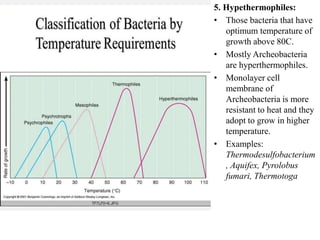
1. Psychrophiles: Bacteria that can grow at 0°C or below but the optimum
temperature of growth is 15 °C or below and maximum temperature is 20°C are
called psychrophiles. Psychrophiles have polyunsaturated fattyacids in their cell
membrane which gives fluid nature to the cell membrane even at lower
temperature. Examples: Vibrio psychroerythrus, vibrio marinus, Polaromonas
vaculata, Psychroflexus
2. Psychrotrops (facultative psychrophiles): Those bacteria that can grow even at 0°C
but optimum temperature for growth is (20-30)°C
3. Mesophiles: Those bacteria that can grow best between (25-40)C but optimum
temperature for growth is 37C. Most of the human pathogens are mesophilic in
nature. Examples: coli, Salmonella, Klebsiella, Staphulococci
4. Thermophiles: Those bacteria that can best grow above 45C.
• Thermophiles capable of growing in mesophilic range are called facultative
thermophiles. True thermophiles are called as Stenothermophiles, they are obligate
thermophiles. Thermophils contains saturated fattyacids in their cell membrane so
their cell membrane does not become too fluid even at higher temperature.
• Examples: Streptococcus thermophiles, Bacillus stearothermophilus, Thermus
aquaticus,
5. Hypethermophiles:
• Those bacteria that have
optimum temperature of
growth above 80C.
• Mostly Archeobacteria
are hyperthermophiles.
• Monolayer cell
membrane of
Archeobacteria is more
resistant to heat and they
adopt to grow in higher
temperature.
• Examples:
Thermodesulfobacterium
, Aquifex, Pyrolobus
fumari, Thermotoga
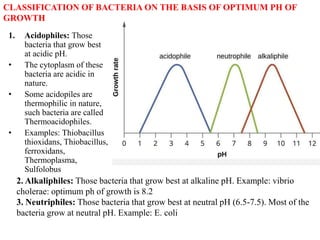
1. Acidophiles: Those
bacteria that grow best
at acidic pH.
• The cytoplasm of these
bacteria are acidic in
nature.
• Some acidopiles are
thermophilic in nature,
such bacteria are called
Thermoacidophiles.
• Examples: Thiobacillus
thioxidans, Thiobacillus,
ferroxidans,
Thermoplasma,
Sulfolobus
2. Alkaliphiles: Those bacteria that grow best at alkaline pH. Example: vibrio
cholerae: optimum ph of growth is 8.2
3. Neutriphiles: Those bacteria that grow best at neutral pH (6.5-7.5). Most of the
bacteria grow at neutral pH. Example: E. coli
CLASSIFICATION OF BACTERIA ON THE BASIS OF OPTIMUM PH OF
GROWTH
CLASSIFICATION OF BACTERIA ON THE BASIS OF SALT
REQUIREMENT
1. Halophiles: Those bacteria that require high concentration of NaCl for growth.
• Cell membrane of halophilic bacteria is made up of glycoprotein with high
content of negatively (-Ve) charged glutamic acid and aspartic acids. So high
concentration of Na+ ion concentration is required to shield the –ve charge.
• Example: Archeobacteria, Halobacterium, Halococcus
2. Halotolerant: Most of the bacteria do not require NaCl but can tolerate low
concentration of NaCl in growth media are called halotolerant.
CLASSIFICATION OF BACTERIA ON THE BASIS OF GASEOUS
REQUIREMENT
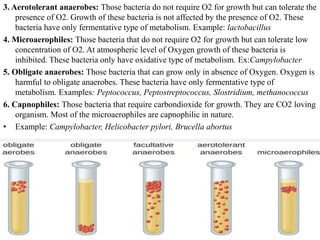
1. Obligate aerobes: Those bacteria that require oxygen and cannot grow in the
absence of O2. These bacteria carryout only oxidative type of metabolism.
• Examples; Mycobacterium, Bacillus
2. Facultative anaerobes: Those bacteria that do not require O2 but can use it if
available. Growth of these bacteria become batter in presence of O2. These
bacteria carryout both oxidative and fermentative type of metabolism
• Examples: coli, Klebsiella, Salmonella
3. Aerotolerant anaerobes: Those bacteria do not require O2 for growth but can tolerate the
presence of O2. Growth of these bacteria is not affected by the presence of O2. These
bacteria have only fermentative type of metabolism. Example: lactobacillus
4. Microaerophiles: Those bacteria that do not require O2 for growth but can tolerate low
concentration of O2. At atmospheric level of Oxygen growth of these bacteria is
inhibited. These bacteria only have oxidative type of metabolism. Ex:Campylobacter
5. Obligate anaerobes: Those bacteria that can grow only in absence of Oxygen. Oxygen is
harmful to obligate anaerobes. These bacteria have only fermentative type of
metabolism. Examples: Peptococcus, Peptostreptococcus, Slostridium, methanococcus
6. Capnophiles: Those bacteria that require carbondioxide for growth. They are CO2 loving
organism. Most of the microaerophiles are capnophilic in nature.
• Example: Campylobacter, Helicobacter pylori, Brucella abortus
CLASSIFICATION OF BACTERIA ON THE BASIS OF
MORPHOLOGY
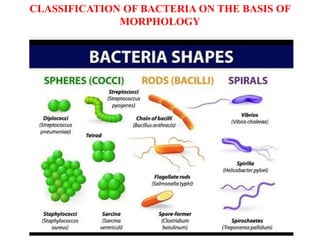
1. Coccus: These bacteria are spherical or oval in shape. On the basis of arrangement,
cocci are further classified as-
i) Diplococcus: coccus in pair. Eg, Neissseria gonorrhoae, Pneumococcus
ii) Streptococcus: coccus in chain. Eg. Streptococcus salivarius
iii) Staphylococcus: coccus in bunch. Eg. Staphylococcus aureus
iv) Tetrad: coccus in group of four.
v) Sarcina: cocus in cubical arrangement of cell. Eg. Sporosarcina
2. Bacilli: These are rod shaped bacteria. On the basis of arrangement, bacilli are
further classified as-
i) Coccobacilli: Eg. Brucella
ii) Streptobacilli: chain of rod shape bacteria: Eg. Bacillus subtilis,
iii) Comma shaped: Eg. Vibrio cholarae
iv) Chinese letter shaped: Corynebacterium dephtherae
3. Spirochaetes: They are spiral shaped bacteria. Spirochaetes
4. Rickettsiae and Chlamydiae: They are obligate intracellular parasites resemble
more closely to viruses than bacteria
5. Actinomycetes: They have filamentous or branching structure. They resemble
more closely to Fungi than bacteria. Example: Streptomyces
6. Mycoplasma: They are cell wall lacking bacteria. Also known as PPLO
(Pleuropneumonia like organism) Mycoplasma pneumoniae
CLASSIFICATION OF BACTERIA ON THE BASIS OF GRAN STAINING
1. Gram positive bacteria: cell wall of these bacteria is composed of peptidoglycan
layer only. Eg. Staphylococcus, Streptococcus, micrococcus
2. Gram negative bacteria: cell wall of these bacteria is composed of Peptidoglycan
and outer membrane. Eg. E. coli, Salmonella
1. Monotrichous bacteria:
bacteria having single
flagella in one end of cell.
eg. Vibrio cholera,
Pseudomonas aerogenosa
2. Lophotrichous bacteria:
bacteria having bundle of
flagella in one end of cell.
eg. Pseudomanas
fluroscence
3. Amphitrichous bacteria:
bacteria having single or
cluster of flagella at both end
of cell. eg. Aquaspirillium
4. Peritrichous bacteria: bacteria
having flagella all over the
cell surface. Eg. E.coli,
Salmonella, Klebsiella
5. Atrichous bacteria: bacteria
without flagella. Eg. Shigella
CLASSIFICATION OF BACTERIA ON THE BASIS OF FLAGELLA
CLASSIFICATION OF BACTERIA ON THE BASIS OF SPORE
• 1. Spore forming bacteria: Those bacteria that produce spore during
unfavorable condition.
• These are further divided into two group
• i) Endospore forming bacteria: Spore produced within the bacterial cell.
• Bacillus, Clostridium, Sporosarcina etc
• ii) Exospore forming bacteria: Spore produced outside the cell
• Methylosinus
• 2. Non sporing bacteria: those bacteria which do not produce spore.
• E. coli, Salmonella
THANK YOU

Bacteria and its classification. Microbiology

  • 1.
    BACTERIA Definition and classification R.NAGALAKSHMI ASST.PROF THE OXFORD COLLEGE OF PHARMACY BANGALORE
  • 2.
    Definition and classification •Bacteria are microscopic living organisms, usually one-celled, that can be found everywhere. They can be dangerous, such as when they cause infection, or beneficial, as in the process of fermentation (such as in wine) and that of decomposition. • Classification of bacteria 1. on the basis of mode of nutrition 2. on the basis of optimum temperature requirement for growth 3. on the basis of optimal pH for growth 4. on the basis of salt concentration 5. on the basis of gaseous requirement 6. on the basis of morphology 7. on the basis of gram staining 8. on the basis of flagella 9. on the basis of spore
  • 3.
    CLASSIFICATION OF BACTERIAON THE BASIS OF MODE OF NUTRITION Autotrops Heterotrops Photoautotroph's Chemoautotroph's Photoheterotrophs Chemoheterotrophs CLASSIFICATION OF BACTERIA ON THE BASIS OF MODE OF NUTRITION A] Autotrops: Those bacteria which uses carbon dioxide as sole source of carbon to prepare its own food. Autotrops are divide into two types on the basis of energy utilized to assimilate carbon dioxide. Ie. Photoautotroph and chemoautotroph a) Photoautotrophs: These bacteria capture the energy of sun light and transform it into the chemical energy. In this process CO2 is reduced to carbohydrates. The hydrogen donor is water and the process produce free oxygen. Chlorophyll is present in the cell and its main function is to capture sun light e.g., Cyanobacteria. The reaction produces free oxygen. However, in some bacterial photosynthesis hydrogen donor is a substance other than water, hence, oxygen is never produced. This is called an oxygenic photosynthesis and is found in purple sulphur bacteria and green sulphur bacteria.
  • 4.
    Purple Sulphur Bacteria:These bacteria have the pigment bacterio-chlorophyll located on the intra-cytoplasmic membrane i.e., thylakoids. These bacteria obtain energy from sulphur compounds e.g., Chromatiiun. Theopedia rosea, Thiospirilium. Green Sulphur Bacteria: These bacteria used hydrogen sulphide (H2S) as hydrogen donor. The reaction takes place in the presence of light and pigment termed as bacteriovirdin or bacteriopheophytin or chlorobium chlorophyll e.g., Chlorobium limicola, Chlorobacterium etc. These bacteria take hydrogen from inorganic sources like sulphides and thiosulphates. Therefore, these bacteria are also known as photolithographs.
  • 5.
    b) Chemoautotrophs: Thesebacteria do not require light (lack the light phase but have the dark phase of photosynthesis) and pigment for their nutrition. • These bacteria oxidize certain inorganic substances with the help of atmospheric oxygen. This reaction releases the energy (exothermic) which is used to drive the synthetic processes of the cell. • Nitrifying Bacteria: These bacteria obtain energy by oxidizing ammonia into nitrate. The process occurs in two steps and each step is carried out by a specialized group of bacteria. e.g., Nitrosomonas, Nitrococcus: • Sulphur Bacteria: These bacteria obtains energy either by oxidation of elemental sulphur or H2S. e.g., Thiobacillus denitrificans, Beggiatoa. • Iron Bacteria: These bacteria inhabit waters that contain inorganic iron compounds and oxidize ferrous compounds to ferric forms e.g., Thiobacillus ferroxidans, Ferro bacillus, Leptothrix. • Hydrogen Bacteria: These bacteria oxidizes hydrogen into water e.g. Hydrogenomonas • Carbon Bacteria: These bacteria oxidizes CO into CO2 e.g., Bacillus oligocarbophillous, Oligotropha carboxydovorans
  • 6.
    2) Heterotrops: Thosebacteria which uses organic compound as carbon source. They lack the ability to fix CO2. Most of the human pathogenic bacteria are heterotropic in nature. Some heterotrops are simple, because they have simple nutritional requirement. However there are some bacteria that require special nutrients for their growth; known as fastidious heterotrops. a) Photoheterotrophs (Gr., Photo = light; hetero = (an), other; troph = nourishment): These bacteria can trap light energy but cannot use carbon dioxide as their sole carbon source. They use organic compounds from the environment to satisfy their carbon and electron requirements. They use organic compounds such as carbohydrates, fatty acids and alcohols as their organic food. The pigment is bacteriochlorophyll e.g., Purple non-sulphur bacteria (Rhodospirillum, Rhodomicrobium, Rhodopseudomonas palustris). b) Chemoheterotrophs: These bacteria obtain both carbon and energy from organic compounds such as carbohydrates, lipids and proteins. The carbon source as well as the source of energy are mostly the same for these bacteria. Most of the bacteria are chemoheterotrophs. Chemoheterotrophs may belong to one of the three main categories that differ in how they obtain their organic nutrients. These are: (i) Parasitic (ii) Saprophytic (iii) Symbiotic:
  • 7.
    (i) Parasitic: Thesebacteria obtain their food from the tissues of living organisms, the hosts. They may be harmless or may cause serious diseases. The disease- producing bacteria are pathogenic which cause various diseases in plants and animals. Examples are Bacillus typhosus, B. anthracis, B.tetani. B. diplheriae, B. tuberculosis, B. pneumoniae, Vibrio cholerae, Pseudomonas citri etc. (ii) Saprophytic: These bacteria obtain their food from dead and organic remains like fruits, vegetables, leaves, meat, faeces, corpses and other non-living products. The anaerobic breakdown of carbohydrates is fermentation while that of proteins is called putrefaction, e.g., Putrefying bacteria like Bacillus mycoides, B. ramosus etc. They secrete enzymes to digest the food and absorb it. The enzymes secreted break down the complex compounds into simpler soluble compounds, which are easily absorbed. Examples are Bacillus acidi lacti, Acetobacter etc. (iii) Symbiotic: These bacteria live in close association with organs of other organisms (higher plants and animals) in such a way that both the concerned organism receive mutual benefit from this association. This is called symbiosis. This bacteria fix free atmospheric nitrogen into nitrogenous compounds which are utilized by the plants in the root nodules of the leguminous plants. In return, the plant provides nutrients and protection to the bacteria. for e.g., Rhizobium leguminosarum, Bacillus radicicola, B. azotobacter, Rhizobium, Ctostridium etc. Rhizobium spp.,B. radicicola and B. azotobacter
  • 8.
    CLASSIFICATION OF BACTERIAON THE BASIS OF OPTIMUM TEMPERATURE OF GROWTH 1. Psychrophiles: Bacteria that can grow at 0°C or below but the optimum temperature of growth is 15 °C or below and maximum temperature is 20°C are called psychrophiles. Psychrophiles have polyunsaturated fattyacids in their cell membrane which gives fluid nature to the cell membrane even at lower temperature. Examples: Vibrio psychroerythrus, vibrio marinus, Polaromonas vaculata, Psychroflexus 2. Psychrotrops (facultative psychrophiles): Those bacteria that can grow even at 0°C but optimum temperature for growth is (20-30)°C 3. Mesophiles: Those bacteria that can grow best between (25-40)C but optimum temperature for growth is 37C. Most of the human pathogens are mesophilic in nature. Examples: coli, Salmonella, Klebsiella, Staphulococci 4. Thermophiles: Those bacteria that can best grow above 45C. • Thermophiles capable of growing in mesophilic range are called facultative thermophiles. True thermophiles are called as Stenothermophiles, they are obligate thermophiles. Thermophils contains saturated fattyacids in their cell membrane so their cell membrane does not become too fluid even at higher temperature. • Examples: Streptococcus thermophiles, Bacillus stearothermophilus, Thermus aquaticus,
  • 9.
    5. Hypethermophiles: • Thosebacteria that have optimum temperature of growth above 80C. • Mostly Archeobacteria are hyperthermophiles. • Monolayer cell membrane of Archeobacteria is more resistant to heat and they adopt to grow in higher temperature. • Examples: Thermodesulfobacterium , Aquifex, Pyrolobus fumari, Thermotoga
  • 10.
    1. Acidophiles: Those bacteriathat grow best at acidic pH. • The cytoplasm of these bacteria are acidic in nature. • Some acidopiles are thermophilic in nature, such bacteria are called Thermoacidophiles. • Examples: Thiobacillus thioxidans, Thiobacillus, ferroxidans, Thermoplasma, Sulfolobus 2. Alkaliphiles: Those bacteria that grow best at alkaline pH. Example: vibrio cholerae: optimum ph of growth is 8.2 3. Neutriphiles: Those bacteria that grow best at neutral pH (6.5-7.5). Most of the bacteria grow at neutral pH. Example: E. coli CLASSIFICATION OF BACTERIA ON THE BASIS OF OPTIMUM PH OF GROWTH
  • 11.
    CLASSIFICATION OF BACTERIAON THE BASIS OF SALT REQUIREMENT 1. Halophiles: Those bacteria that require high concentration of NaCl for growth. • Cell membrane of halophilic bacteria is made up of glycoprotein with high content of negatively (-Ve) charged glutamic acid and aspartic acids. So high concentration of Na+ ion concentration is required to shield the –ve charge. • Example: Archeobacteria, Halobacterium, Halococcus 2. Halotolerant: Most of the bacteria do not require NaCl but can tolerate low concentration of NaCl in growth media are called halotolerant. CLASSIFICATION OF BACTERIA ON THE BASIS OF GASEOUS REQUIREMENT 1. Obligate aerobes: Those bacteria that require oxygen and cannot grow in the absence of O2. These bacteria carryout only oxidative type of metabolism. • Examples; Mycobacterium, Bacillus 2. Facultative anaerobes: Those bacteria that do not require O2 but can use it if available. Growth of these bacteria become batter in presence of O2. These bacteria carryout both oxidative and fermentative type of metabolism • Examples: coli, Klebsiella, Salmonella
  • 12.
    3. Aerotolerant anaerobes:Those bacteria do not require O2 for growth but can tolerate the presence of O2. Growth of these bacteria is not affected by the presence of O2. These bacteria have only fermentative type of metabolism. Example: lactobacillus 4. Microaerophiles: Those bacteria that do not require O2 for growth but can tolerate low concentration of O2. At atmospheric level of Oxygen growth of these bacteria is inhibited. These bacteria only have oxidative type of metabolism. Ex:Campylobacter 5. Obligate anaerobes: Those bacteria that can grow only in absence of Oxygen. Oxygen is harmful to obligate anaerobes. These bacteria have only fermentative type of metabolism. Examples: Peptococcus, Peptostreptococcus, Slostridium, methanococcus 6. Capnophiles: Those bacteria that require carbondioxide for growth. They are CO2 loving organism. Most of the microaerophiles are capnophilic in nature. • Example: Campylobacter, Helicobacter pylori, Brucella abortus
  • 13.
    CLASSIFICATION OF BACTERIAON THE BASIS OF MORPHOLOGY
  • 14.
    1. Coccus: Thesebacteria are spherical or oval in shape. On the basis of arrangement, cocci are further classified as- i) Diplococcus: coccus in pair. Eg, Neissseria gonorrhoae, Pneumococcus ii) Streptococcus: coccus in chain. Eg. Streptococcus salivarius iii) Staphylococcus: coccus in bunch. Eg. Staphylococcus aureus iv) Tetrad: coccus in group of four. v) Sarcina: cocus in cubical arrangement of cell. Eg. Sporosarcina 2. Bacilli: These are rod shaped bacteria. On the basis of arrangement, bacilli are further classified as- i) Coccobacilli: Eg. Brucella ii) Streptobacilli: chain of rod shape bacteria: Eg. Bacillus subtilis, iii) Comma shaped: Eg. Vibrio cholarae iv) Chinese letter shaped: Corynebacterium dephtherae 3. Spirochaetes: They are spiral shaped bacteria. Spirochaetes
  • 15.
    4. Rickettsiae andChlamydiae: They are obligate intracellular parasites resemble more closely to viruses than bacteria 5. Actinomycetes: They have filamentous or branching structure. They resemble more closely to Fungi than bacteria. Example: Streptomyces 6. Mycoplasma: They are cell wall lacking bacteria. Also known as PPLO (Pleuropneumonia like organism) Mycoplasma pneumoniae
  • 16.
    CLASSIFICATION OF BACTERIAON THE BASIS OF GRAN STAINING 1. Gram positive bacteria: cell wall of these bacteria is composed of peptidoglycan layer only. Eg. Staphylococcus, Streptococcus, micrococcus 2. Gram negative bacteria: cell wall of these bacteria is composed of Peptidoglycan and outer membrane. Eg. E. coli, Salmonella
  • 17.
    1. Monotrichous bacteria: bacteriahaving single flagella in one end of cell. eg. Vibrio cholera, Pseudomonas aerogenosa 2. Lophotrichous bacteria: bacteria having bundle of flagella in one end of cell. eg. Pseudomanas fluroscence 3. Amphitrichous bacteria: bacteria having single or cluster of flagella at both end of cell. eg. Aquaspirillium 4. Peritrichous bacteria: bacteria having flagella all over the cell surface. Eg. E.coli, Salmonella, Klebsiella 5. Atrichous bacteria: bacteria without flagella. Eg. Shigella CLASSIFICATION OF BACTERIA ON THE BASIS OF FLAGELLA
  • 18.
    CLASSIFICATION OF BACTERIAON THE BASIS OF SPORE • 1. Spore forming bacteria: Those bacteria that produce spore during unfavorable condition. • These are further divided into two group • i) Endospore forming bacteria: Spore produced within the bacterial cell. • Bacillus, Clostridium, Sporosarcina etc • ii) Exospore forming bacteria: Spore produced outside the cell • Methylosinus • 2. Non sporing bacteria: those bacteria which do not produce spore. • E. coli, Salmonella
  • 19.