MICROBIOLOGY
- Dr.Salil Choudhary
- BDS,MBA(HA)
WHAT IS MICROBIOLOGY
 Microbiology is the study of very tiny life
 Micro - too small to be seen with the naked eye
 Bio - life
 ology - study of
 The study of SMALL organisms- usually < 0.1 mm=
100 µm in size, or small that what is invisible to the
human eye.
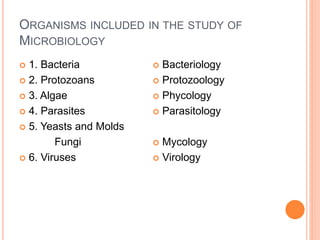
ORGANISMS INCLUDED IN THE STUDY OF
MICROBIOLOGY
 1. Bacteria
 2. Protozoans
 3. Algae
 4. Parasites
 5. Yeasts and Molds
Fungi
 6. Viruses
 Bacteriology
 Protozoology
 Phycology
 Parasitology
 Mycology
 Virology
HISTORY
 The existence of microorganisms was
hypothesized for many centuries before their actual
discovery in the 17th century.
 The first theories on microorganisms was made by
Roman scholar Marcus Terentius Varro in a book
titled ‘On Agriculture’
HISTORY
 Antonie Van Leeuwenhoek (1632–1723) was one of
the first people to observe microorganisms, using a
microscope of his own design
 While Van Leeuwenhoek is often cited as the first
microbiologist, the first recorded microbiological
observation, that of the fruiting bodies of molds,
was actually made earlier in 1665 by Robert Hooke.
 Robert Hooke was the first to use a microscope to
observe living things
HISTORY
 The name "bacterium" was introduced much later,
by Ehrenberg in 1828, derived from the Greek, and
meaning "small stick".
 In 1876, Robert Koch (1843–1910) established that
microbes can cause disease.
 Louis Pasteur (1822–1895) and Robert Koch
(1843–1910) are often considered to be the
founders of medical microbiology.
 The field of bacteriology (later a subdiscipline of
microbiology) is generally considered to have been
founded by Ferdinand Cohn (1828–1898), a
botanist whose studies on algae and photosynthetic
bacteria led him to describe several bacteria
including Bacillus. Cohn was also the first to
formulate a scheme for the taxonomic classification
of bacteria.
 His classification of bacteria into four groups based
on shape (sphericals, short rods, threads, and
spirals) is still in use today
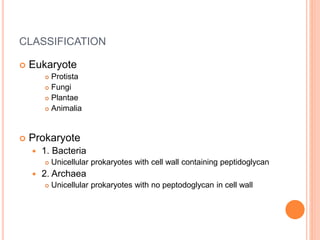
CLASSIFICATION
 Eukaryote
 Protista
 Fungi
 Plantae
 Animalia
 Prokaryote
 1. Bacteria
 Unicellular prokaryotes with cell wall containing peptidoglycan
 2. Archaea
 Unicellular prokaryotes with no peptodoglycan in cell wall
 Eukaryote vs Prokaryotes
 Prokaryotes (from Old Greek pro- before + karyon nut
or kernel, referring to the cell nucleus, + suffix -otos, pl. -
otes; also spelled "procaryotes") are organisms without
a cell nucleus (= karyon), or any other membrane-bound
organelles. Most are unicellular, but some prokaryotes
are multicellular.
 Eukaryotes are organisms whose cells are organized
into complex structures by internal membranes and a
cytoskeleton. The most characteristic membrane bound
structure is the nucleus. This feature gives them their
name, (also spelled "eucaryote,") which comes from the
Greek ευ, meaning good/true, and κάρυον, meaning nut,
referring to the nucleus. Animals, plants, fungi, and
protists are eukaryotes.
WHY MICROBIOLOGY ????
 Worldwide more than 20% of deaths are caused by
infectious disease, and this number is increasing in
both wealthy and poor economies.
 Deaths from HIV peaked at around 50,000 in 1995,
but still exceed 12,000 each year.
 Influenza and pneumonia kill 61,000 people each
year and affect many millions.
 Drug-resistant tuberculosis (TB) is a major cause of
concern, as are food-borne infections and hospital-
acquired infections.
REASONS FOR THE RESURGENCE OF
INFECTIOUS DISEASES
 New patterns of travel and trade (especially food
commodities), new agricultural practices, altered
sexual behaviour, medical interventions and
overuse of antibiotics.
 The evolution of multi-drug resistant bacteria, such
as MRSA, and their frequency in hospital patients,
has become a major problem.
 The emergence of new human infections such as a
novel strain of influenza virus, or a new infection of
wildlife origin
 Climate change, with increased temperatures and
altered rainfall adding to the incidence of vector-
borne infection
WHY MICROBIOLOGY FOR HEALTHCARE
ADMIN ???
 It is without doubt microbiology and the continuing
study of micro-organisms remains essential to the
future of medicine and disease management, and
its importance in every-day health care should
never be under-estimated.

MICROBIOLOGY class 1.pptx

  • 1.
  • 2.
    WHAT IS MICROBIOLOGY Microbiology is the study of very tiny life  Micro - too small to be seen with the naked eye  Bio - life  ology - study of  The study of SMALL organisms- usually < 0.1 mm= 100 µm in size, or small that what is invisible to the human eye.
  • 3.
    ORGANISMS INCLUDED INTHE STUDY OF MICROBIOLOGY  1. Bacteria  2. Protozoans  3. Algae  4. Parasites  5. Yeasts and Molds Fungi  6. Viruses  Bacteriology  Protozoology  Phycology  Parasitology  Mycology  Virology
  • 4.
    HISTORY  The existenceof microorganisms was hypothesized for many centuries before their actual discovery in the 17th century.  The first theories on microorganisms was made by Roman scholar Marcus Terentius Varro in a book titled ‘On Agriculture’
  • 5.
    HISTORY  Antonie VanLeeuwenhoek (1632–1723) was one of the first people to observe microorganisms, using a microscope of his own design  While Van Leeuwenhoek is often cited as the first microbiologist, the first recorded microbiological observation, that of the fruiting bodies of molds, was actually made earlier in 1665 by Robert Hooke.  Robert Hooke was the first to use a microscope to observe living things
  • 6.
    HISTORY  The name"bacterium" was introduced much later, by Ehrenberg in 1828, derived from the Greek, and meaning "small stick".  In 1876, Robert Koch (1843–1910) established that microbes can cause disease.  Louis Pasteur (1822–1895) and Robert Koch (1843–1910) are often considered to be the founders of medical microbiology.
  • 8.
     The fieldof bacteriology (later a subdiscipline of microbiology) is generally considered to have been founded by Ferdinand Cohn (1828–1898), a botanist whose studies on algae and photosynthetic bacteria led him to describe several bacteria including Bacillus. Cohn was also the first to formulate a scheme for the taxonomic classification of bacteria.  His classification of bacteria into four groups based on shape (sphericals, short rods, threads, and spirals) is still in use today
  • 9.
    CLASSIFICATION  Eukaryote  Protista Fungi  Plantae  Animalia  Prokaryote  1. Bacteria  Unicellular prokaryotes with cell wall containing peptidoglycan  2. Archaea  Unicellular prokaryotes with no peptodoglycan in cell wall
  • 10.
     Eukaryote vsProkaryotes  Prokaryotes (from Old Greek pro- before + karyon nut or kernel, referring to the cell nucleus, + suffix -otos, pl. - otes; also spelled "procaryotes") are organisms without a cell nucleus (= karyon), or any other membrane-bound organelles. Most are unicellular, but some prokaryotes are multicellular.  Eukaryotes are organisms whose cells are organized into complex structures by internal membranes and a cytoskeleton. The most characteristic membrane bound structure is the nucleus. This feature gives them their name, (also spelled "eucaryote,") which comes from the Greek ευ, meaning good/true, and κάρυον, meaning nut, referring to the nucleus. Animals, plants, fungi, and protists are eukaryotes.
  • 11.
    WHY MICROBIOLOGY ???? Worldwide more than 20% of deaths are caused by infectious disease, and this number is increasing in both wealthy and poor economies.  Deaths from HIV peaked at around 50,000 in 1995, but still exceed 12,000 each year.  Influenza and pneumonia kill 61,000 people each year and affect many millions.  Drug-resistant tuberculosis (TB) is a major cause of concern, as are food-borne infections and hospital- acquired infections.
  • 12.
    REASONS FOR THERESURGENCE OF INFECTIOUS DISEASES  New patterns of travel and trade (especially food commodities), new agricultural practices, altered sexual behaviour, medical interventions and overuse of antibiotics.  The evolution of multi-drug resistant bacteria, such as MRSA, and their frequency in hospital patients, has become a major problem.
  • 13.
     The emergenceof new human infections such as a novel strain of influenza virus, or a new infection of wildlife origin  Climate change, with increased temperatures and altered rainfall adding to the incidence of vector- borne infection
  • 14.
    WHY MICROBIOLOGY FORHEALTHCARE ADMIN ???
  • 15.
     It iswithout doubt microbiology and the continuing study of micro-organisms remains essential to the future of medicine and disease management, and its importance in every-day health care should never be under-estimated.