1
Microbiology, Introduction, History & its
Classification
Definition of Microbiology
Microbiology is the scientific discipline that involves the study of microorganisms,
which include bacteria, viruses, fungi, algae, protozoa, and archaea. These
organisms are often studied in terms of their structure, function, genetic
composition, interaction with their environment, and role in both beneficial and
harmful processes.
Scope of Microbiology
Microbiology is a broad field, with several sub-disciplines that focus on specific
groups of microorganisms or particular aspects of their biology. The main branches
of microbiology include:
1. Bacteriology: The study of bacteria, including their classification,
physiology, and pathogenesis.
2. Virology: The study of viruses, their structure, replication, and role in
disease.
3. Mycology: The study of fungi, including yeasts, molds, and mushrooms.
4. Phycology (Algae Biology): The study of algae, their diversity,
classification, and ecological roles.
5. Protozoology: The study of protozoa, unicellular eukaryotic organisms, and
their interactions with hosts and environments.
6. Immunology: The study of the immune system and how it responds to
microbial infections.
7. Environmental Microbiology: The study of the role of microorganisms in
environmental processes, such as nutrient cycling, pollution control, and
bioremediation.
8. Industrial Microbiology: The application of microorganisms in industry for
the production of pharmaceuticals, biofuels, food, and beverages.
9. Medical Microbiology: The study of microorganisms that cause diseases in
humans and animals and their diagnosis, treatment, and prevention.
2
Importance of Microbiology
Microorganisms are critical to the functioning of ecosystems and human society in
many ways. Some of the key areas where microbiology plays an essential role
include:
1. Health and Medicine:
o Pathogenesis: Many diseases are caused by pathogenic
microorganisms, such as bacteria, viruses, and fungi. Understanding
these pathogens is key to diagnosing, treating, and preventing
infections.
o Antibiotics and Vaccines: Microbiology has led to the development
of antibiotics and vaccines that have saved millions of lives.
o Microbial Genetics: Study of microbial genetics aids in
understanding genetic diseases and developing new therapeutic
approaches, including gene therapy.
2. Agriculture:
o Soil Fertility: Microorganisms like nitrogen-fixing bacteria contribute
to soil fertility, improving crop yields.
o Biopesticides: Certain microbes can act as natural pest control agents.
o Plant Diseases: Microorganisms are involved in both promoting and
inhibiting plant growth, and understanding plant pathology is vital for
effective crop management.
3. Food Industry:
o Fermentation: Microorganisms are used in the fermentation process
to produce foods and beverages like bread, cheese, yogurt, beer, and
wine.
o Food Safety: Microbiology is crucial for understanding foodborne
pathogens and ensuring safe food production and consumption.
4. Environmental and Industrial Applications:
o Bioremediation: Microorganisms can break down harmful pollutants
and toxins, cleaning up contaminated environments.
o Waste Treatment: Microorganisms are used in wastewater treatment
plants to decompose organic waste.
o Biofuel Production: Microbes like algae and bacteria can be used to
produce biofuels as alternative energy sources.
3
5. Ecological Roles:
o Decomposition: Microorganisms are key players in the
decomposition of dead organic matter, recycling nutrients and
maintaining the balance of ecosystems.
o Symbiosis: Many microorganisms form mutualistic relationships with
plants, animals, and other organisms, contributing to various
biological processes.
Historical Development of Microbiology
The field of microbiology has evolved over centuries, with key milestones:
1. Antonie van Leeuwenhoek (1674): First to observe microorganisms under
a microscope and describe bacteria and protozoa.
2. Louis Pasteur (1857–1864): Developed the germ theory of disease, which
proposed that microorganisms are responsible for fermentation and diseases.
He also developed pasteurization to prevent spoilage in food and beverages.
3. Robert Koch (1876): Established Koch's postulates, which are used to link
specific microorganisms to particular diseases. He also discovered the
causative agents of tuberculosis and cholera.
4. Alexander Fleming (1928): Discovered penicillin, the first antibiotic, which
revolutionized medicine and the treatment of bacterial infections.
5. Modern Microbiology: With advances in molecular biology, genomics, and
biotechnology, microbiology continues to advance, allowing for the
development of new diagnostic tools, vaccines, and treatments.
Classification of Microorganisms
Classification is the process by which organisms are grouped into various
categories based on morphological and physiological characteristics. There have
been various attempts to classify organisms based on their morphological,
4
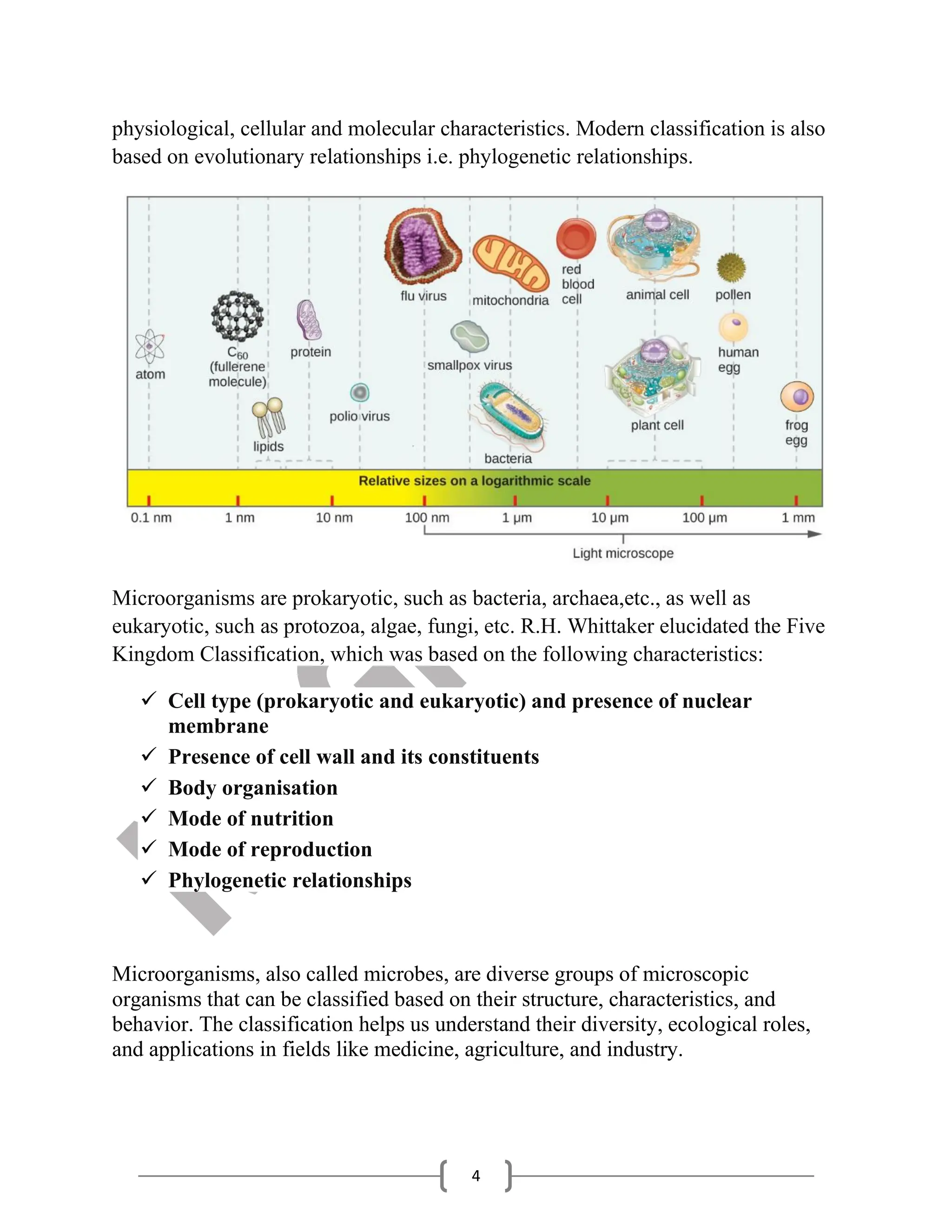
physiological, cellular and molecular characteristics. Modern classification is also
based on evolutionary relationships i.e. phylogenetic relationships.
Microorganisms are prokaryotic, such as bacteria, archaea,etc., as well as
eukaryotic, such as protozoa, algae, fungi, etc. R.H. Whittaker elucidated the Five
Kingdom Classification, which was based on the following characteristics:
✓ Cell type (prokaryotic and eukaryotic) and presence of nuclear
membrane
✓ Presence of cell wall and its constituents
✓ Body organisation
✓ Mode of nutrition
✓ Mode of reproduction
✓ Phylogenetic relationships
Microorganisms, also called microbes, are diverse groups of microscopic
organisms that can be classified based on their structure, characteristics, and
behavior. The classification helps us understand their diversity, ecological roles,
and applications in fields like medicine, agriculture, and industry.
5
1. Classification Based on Cellular Organization
Microorganisms can be classified based on their cell structure into two main
categories:
1. Prokaryotes
o Characteristics:
▪ Lack a defined nucleus (no nuclear membrane).
▪ DNA is circular and located in the nucleoid region.
▪ No membrane-bound organelles (e.g., mitochondria,
endoplasmic reticulum).
▪ Smaller in size (usually 0.5 to 5 micrometers).
o Examples: Bacteria, Archaea.
o
2. Eukaryotes
o Characteristics:
▪ Have a well-defined nucleus with a nuclear membrane.
▪ Contain membrane-bound organelles.
▪ Larger in size (usually 10 to 100 micrometers).
o Examples: Fungi, Algae, Protozoa.
o
3. Acellular Microorganisms
o Characteristics:
▪ These do not have a cellular structure.
▪ Include viruses, viroids, and prions.
o Examples: Viruses, Viroids, Prions.
Based on the following characteristics, R. H. Whittaker divided living organisms
into five kingdoms. They are as follows:
1. Monera – Unicellular prokaryotes
2. Protista – Unicellular eukaryotes
3. Fungi – Eukaryotic, heterotrophic (saprophytic/ parasitic) and with a cell
wall (chitin)
4. Plantae – Eukaryotic, autotrophic (photosynthetic) and with a cell wall
(cellulose)
5. Animalia – Eukaryotic, heterotrophic (holozoic/ saprophytic etc.) and
without a cell wall.
6
2. Classification Based on Kingdoms
Historically, microorganisms were classified under the five-kingdom
classification system (Whittaker, 1969), which includes:
1. Monera (Prokaryotae)
o Comprises prokaryotic organisms.
o Subdivided into:
▪ Bacteria: Includes all types of bacteria (e.g., cocci, bacilli,
spirilla).
▪ Archaea: Extremophiles, such as thermophiles and halophiles,
living in extreme environments.
▪
2. Protista
o Eukaryotic microorganisms, primarily unicellular.
o Subdivided into:
▪ Protozoa: Animal-like, motile organisms, e.g., amoeba,
paramecium.
▪ Algae: Plant-like, photosynthetic organisms, e.g., Chlorella,
Euglena.
▪
3. Fungi
o Eukaryotic organisms, mostly multicellular.
o Non-photosynthetic, heterotrophic organisms, which include:
▪ Yeasts: Unicellular fungi, e.g., Saccharomyces.
▪ Molds: Multicellular fungi, e.g., Penicillium, Aspergillus.
▪ Mushrooms: Larger fungi, e.g., Agaricus.
7
4. Plantae
o Multicellular eukaryotes, primarily photosynthetic.
o Includes plants, but some plants are microorganisms, such as mosses
and liverworts.
5. Animalia
o Eukaryotic, multicellular organisms.
o Microorganisms in this kingdom include parasitic animals like
helminths (e.g., tapeworms) and arthropods (e.g., ticks, fleas) that
can act as vectors for diseases.
3. Classification Based on Metabolism
Microorganisms can be classified based on their nutritional and energy sources into
the following categories:
8
1. Phototrophs
o Definition: Organisms that use light as an energy source.
o Types:
▪ Oxygenic Phototrophs: Photosynthetic organisms that release
oxygen (e.g., Cyanobacteria, Algae).
▪ Anoxygenic Phototrophs: Photosynthetic organisms that do
not release oxygen (e.g., Purple and Green sulfur bacteria).
2. Chemotrophs
o Definition: Organisms that obtain energy through chemical reactions.
o Types:
▪ Chemoautotrophs: Use inorganic compounds (e.g., hydrogen
sulfide, ammonia) as a carbon source and energy (e.g.,
nitrifying bacteria).
▪ Chemoheterotrophs: Obtain energy and carbon from organic
compounds (e.g., most bacteria, fungi).
4. Classification Based on Oxygen Requirement
Based on their ability to survive in the presence or absence of oxygen,
microorganisms can be classified as:
1. Aerobes
o Obligate Aerobes: Require oxygen for growth and metabolism (e.g.,
Mycobacterium tuberculosis).
o Facultative Anaerobes: Can grow in both the presence or absence of
oxygen (e.g., Escherichia coli).
2. Anaerobes
o Obligate Anaerobes: Cannot tolerate oxygen and must grow in an
oxygen-free environment (e.g., Clostridium botulinum).
o Aerotolerant Anaerobes: Do not require oxygen but can survive in
its presence (e.g., Lactobacillus).
3. Microaerophiles
o Require low levels of oxygen (5–10%) for growth (e.g., Helicobacter
pylori).
9
5. Classification Based on Shape and Structure
Microorganisms, especially bacteria, can be classified based on their morphology
(shape):
1. Bacteria (Morphological Classification)
o Cocci: Spherical shape (e.g., Streptococcus, Staphylococcus).
o Bacilli: Rod-shaped (e.g., Escherichia coli, Bacillus).
o Spirilla: Spiral-shaped (e.g., Spirillum).
o Vibrios: Comma-shaped (e.g., Vibrio cholerae).
o
2. Fungi
o Yeasts: Unicellular, spherical or oval (e.g., Saccharomyces
cerevisiae).
o Molds: Multicellular, filamentous structures (hyphae) (e.g.,
Penicillium).
3. Algae
o Unicellular Algae: e.g., Chlorella.
o Multicellular Algae: e.g., Brown Algae (Kelps).
4. Protozoa
o Various shapes, usually motile, can be:
▪ Amoeboid (e.g., Amoeba proteus).
▪ Flagellated (e.g., Trypanosoma).
▪ Ciliated (e.g., Paramecium).
6. Classification Based on Reproduction
Microorganisms can also be classified based on their method of reproduction:
1. Asexual Reproduction
o Binary Fission: Common in bacteria (e.g., Escherichia coli).
o Budding: Common in yeasts (e.g., Saccharomyces).
o Spores: Seen in fungi and some bacteria (e.g., Penicillium, Bacillus).
o
2. Sexual Reproduction
o Seen in fungi and some protozoa (e.g., Plasmodium).
10
7. Classification Based on Gram Staining (Bacterial Classification)
Bacteria can be classified based on their response to Gram staining:
1. Gram-Positive Bacteria
o Characteristics: Thick peptidoglycan layer in the cell wall, retains
crystal violet dye.
o Examples: Staphylococcus aureus, Streptococcus pneumoniae.
o
2. Gram-Negative Bacteria
o Characteristics: Thin peptidoglycan layer and an outer membrane, do
not retain crystal violet dye (appears pink after staining).
o Examples: Escherichia coli, Salmonella.

Microbiology, Introduction, History & its Classification for B.Sc. Biotech/Botany Sem-3

  • 1.
    1 Microbiology, Introduction, History& its Classification Definition of Microbiology Microbiology is the scientific discipline that involves the study of microorganisms, which include bacteria, viruses, fungi, algae, protozoa, and archaea. These organisms are often studied in terms of their structure, function, genetic composition, interaction with their environment, and role in both beneficial and harmful processes. Scope of Microbiology Microbiology is a broad field, with several sub-disciplines that focus on specific groups of microorganisms or particular aspects of their biology. The main branches of microbiology include: 1. Bacteriology: The study of bacteria, including their classification, physiology, and pathogenesis. 2. Virology: The study of viruses, their structure, replication, and role in disease. 3. Mycology: The study of fungi, including yeasts, molds, and mushrooms. 4. Phycology (Algae Biology): The study of algae, their diversity, classification, and ecological roles. 5. Protozoology: The study of protozoa, unicellular eukaryotic organisms, and their interactions with hosts and environments. 6. Immunology: The study of the immune system and how it responds to microbial infections. 7. Environmental Microbiology: The study of the role of microorganisms in environmental processes, such as nutrient cycling, pollution control, and bioremediation. 8. Industrial Microbiology: The application of microorganisms in industry for the production of pharmaceuticals, biofuels, food, and beverages. 9. Medical Microbiology: The study of microorganisms that cause diseases in humans and animals and their diagnosis, treatment, and prevention.
  • 2.
    2 Importance of Microbiology Microorganismsare critical to the functioning of ecosystems and human society in many ways. Some of the key areas where microbiology plays an essential role include: 1. Health and Medicine: o Pathogenesis: Many diseases are caused by pathogenic microorganisms, such as bacteria, viruses, and fungi. Understanding these pathogens is key to diagnosing, treating, and preventing infections. o Antibiotics and Vaccines: Microbiology has led to the development of antibiotics and vaccines that have saved millions of lives. o Microbial Genetics: Study of microbial genetics aids in understanding genetic diseases and developing new therapeutic approaches, including gene therapy. 2. Agriculture: o Soil Fertility: Microorganisms like nitrogen-fixing bacteria contribute to soil fertility, improving crop yields. o Biopesticides: Certain microbes can act as natural pest control agents. o Plant Diseases: Microorganisms are involved in both promoting and inhibiting plant growth, and understanding plant pathology is vital for effective crop management. 3. Food Industry: o Fermentation: Microorganisms are used in the fermentation process to produce foods and beverages like bread, cheese, yogurt, beer, and wine. o Food Safety: Microbiology is crucial for understanding foodborne pathogens and ensuring safe food production and consumption. 4. Environmental and Industrial Applications: o Bioremediation: Microorganisms can break down harmful pollutants and toxins, cleaning up contaminated environments. o Waste Treatment: Microorganisms are used in wastewater treatment plants to decompose organic waste. o Biofuel Production: Microbes like algae and bacteria can be used to produce biofuels as alternative energy sources.
  • 3.
    3 5. Ecological Roles: oDecomposition: Microorganisms are key players in the decomposition of dead organic matter, recycling nutrients and maintaining the balance of ecosystems. o Symbiosis: Many microorganisms form mutualistic relationships with plants, animals, and other organisms, contributing to various biological processes. Historical Development of Microbiology The field of microbiology has evolved over centuries, with key milestones: 1. Antonie van Leeuwenhoek (1674): First to observe microorganisms under a microscope and describe bacteria and protozoa. 2. Louis Pasteur (1857–1864): Developed the germ theory of disease, which proposed that microorganisms are responsible for fermentation and diseases. He also developed pasteurization to prevent spoilage in food and beverages. 3. Robert Koch (1876): Established Koch's postulates, which are used to link specific microorganisms to particular diseases. He also discovered the causative agents of tuberculosis and cholera. 4. Alexander Fleming (1928): Discovered penicillin, the first antibiotic, which revolutionized medicine and the treatment of bacterial infections. 5. Modern Microbiology: With advances in molecular biology, genomics, and biotechnology, microbiology continues to advance, allowing for the development of new diagnostic tools, vaccines, and treatments. Classification of Microorganisms Classification is the process by which organisms are grouped into various categories based on morphological and physiological characteristics. There have been various attempts to classify organisms based on their morphological,
  • 4.
    4 physiological, cellular andmolecular characteristics. Modern classification is also based on evolutionary relationships i.e. phylogenetic relationships. Microorganisms are prokaryotic, such as bacteria, archaea,etc., as well as eukaryotic, such as protozoa, algae, fungi, etc. R.H. Whittaker elucidated the Five Kingdom Classification, which was based on the following characteristics: ✓ Cell type (prokaryotic and eukaryotic) and presence of nuclear membrane ✓ Presence of cell wall and its constituents ✓ Body organisation ✓ Mode of nutrition ✓ Mode of reproduction ✓ Phylogenetic relationships Microorganisms, also called microbes, are diverse groups of microscopic organisms that can be classified based on their structure, characteristics, and behavior. The classification helps us understand their diversity, ecological roles, and applications in fields like medicine, agriculture, and industry.
  • 5.
    5 1. Classification Basedon Cellular Organization Microorganisms can be classified based on their cell structure into two main categories: 1. Prokaryotes o Characteristics: ▪ Lack a defined nucleus (no nuclear membrane). ▪ DNA is circular and located in the nucleoid region. ▪ No membrane-bound organelles (e.g., mitochondria, endoplasmic reticulum). ▪ Smaller in size (usually 0.5 to 5 micrometers). o Examples: Bacteria, Archaea. o 2. Eukaryotes o Characteristics: ▪ Have a well-defined nucleus with a nuclear membrane. ▪ Contain membrane-bound organelles. ▪ Larger in size (usually 10 to 100 micrometers). o Examples: Fungi, Algae, Protozoa. o 3. Acellular Microorganisms o Characteristics: ▪ These do not have a cellular structure. ▪ Include viruses, viroids, and prions. o Examples: Viruses, Viroids, Prions. Based on the following characteristics, R. H. Whittaker divided living organisms into five kingdoms. They are as follows: 1. Monera – Unicellular prokaryotes 2. Protista – Unicellular eukaryotes 3. Fungi – Eukaryotic, heterotrophic (saprophytic/ parasitic) and with a cell wall (chitin) 4. Plantae – Eukaryotic, autotrophic (photosynthetic) and with a cell wall (cellulose) 5. Animalia – Eukaryotic, heterotrophic (holozoic/ saprophytic etc.) and without a cell wall.
  • 6.
    6 2. Classification Basedon Kingdoms Historically, microorganisms were classified under the five-kingdom classification system (Whittaker, 1969), which includes: 1. Monera (Prokaryotae) o Comprises prokaryotic organisms. o Subdivided into: ▪ Bacteria: Includes all types of bacteria (e.g., cocci, bacilli, spirilla). ▪ Archaea: Extremophiles, such as thermophiles and halophiles, living in extreme environments. ▪ 2. Protista o Eukaryotic microorganisms, primarily unicellular. o Subdivided into: ▪ Protozoa: Animal-like, motile organisms, e.g., amoeba, paramecium. ▪ Algae: Plant-like, photosynthetic organisms, e.g., Chlorella, Euglena. ▪ 3. Fungi o Eukaryotic organisms, mostly multicellular. o Non-photosynthetic, heterotrophic organisms, which include: ▪ Yeasts: Unicellular fungi, e.g., Saccharomyces. ▪ Molds: Multicellular fungi, e.g., Penicillium, Aspergillus. ▪ Mushrooms: Larger fungi, e.g., Agaricus.
  • 7.
    7 4. Plantae o Multicellulareukaryotes, primarily photosynthetic. o Includes plants, but some plants are microorganisms, such as mosses and liverworts. 5. Animalia o Eukaryotic, multicellular organisms. o Microorganisms in this kingdom include parasitic animals like helminths (e.g., tapeworms) and arthropods (e.g., ticks, fleas) that can act as vectors for diseases. 3. Classification Based on Metabolism Microorganisms can be classified based on their nutritional and energy sources into the following categories:
  • 8.
    8 1. Phototrophs o Definition:Organisms that use light as an energy source. o Types: ▪ Oxygenic Phototrophs: Photosynthetic organisms that release oxygen (e.g., Cyanobacteria, Algae). ▪ Anoxygenic Phototrophs: Photosynthetic organisms that do not release oxygen (e.g., Purple and Green sulfur bacteria). 2. Chemotrophs o Definition: Organisms that obtain energy through chemical reactions. o Types: ▪ Chemoautotrophs: Use inorganic compounds (e.g., hydrogen sulfide, ammonia) as a carbon source and energy (e.g., nitrifying bacteria). ▪ Chemoheterotrophs: Obtain energy and carbon from organic compounds (e.g., most bacteria, fungi). 4. Classification Based on Oxygen Requirement Based on their ability to survive in the presence or absence of oxygen, microorganisms can be classified as: 1. Aerobes o Obligate Aerobes: Require oxygen for growth and metabolism (e.g., Mycobacterium tuberculosis). o Facultative Anaerobes: Can grow in both the presence or absence of oxygen (e.g., Escherichia coli). 2. Anaerobes o Obligate Anaerobes: Cannot tolerate oxygen and must grow in an oxygen-free environment (e.g., Clostridium botulinum). o Aerotolerant Anaerobes: Do not require oxygen but can survive in its presence (e.g., Lactobacillus). 3. Microaerophiles o Require low levels of oxygen (5–10%) for growth (e.g., Helicobacter pylori).
  • 9.
    9 5. Classification Basedon Shape and Structure Microorganisms, especially bacteria, can be classified based on their morphology (shape): 1. Bacteria (Morphological Classification) o Cocci: Spherical shape (e.g., Streptococcus, Staphylococcus). o Bacilli: Rod-shaped (e.g., Escherichia coli, Bacillus). o Spirilla: Spiral-shaped (e.g., Spirillum). o Vibrios: Comma-shaped (e.g., Vibrio cholerae). o 2. Fungi o Yeasts: Unicellular, spherical or oval (e.g., Saccharomyces cerevisiae). o Molds: Multicellular, filamentous structures (hyphae) (e.g., Penicillium). 3. Algae o Unicellular Algae: e.g., Chlorella. o Multicellular Algae: e.g., Brown Algae (Kelps). 4. Protozoa o Various shapes, usually motile, can be: ▪ Amoeboid (e.g., Amoeba proteus). ▪ Flagellated (e.g., Trypanosoma). ▪ Ciliated (e.g., Paramecium). 6. Classification Based on Reproduction Microorganisms can also be classified based on their method of reproduction: 1. Asexual Reproduction o Binary Fission: Common in bacteria (e.g., Escherichia coli). o Budding: Common in yeasts (e.g., Saccharomyces). o Spores: Seen in fungi and some bacteria (e.g., Penicillium, Bacillus). o 2. Sexual Reproduction o Seen in fungi and some protozoa (e.g., Plasmodium).
  • 10.
    10 7. Classification Basedon Gram Staining (Bacterial Classification) Bacteria can be classified based on their response to Gram staining: 1. Gram-Positive Bacteria o Characteristics: Thick peptidoglycan layer in the cell wall, retains crystal violet dye. o Examples: Staphylococcus aureus, Streptococcus pneumoniae. o 2. Gram-Negative Bacteria o Characteristics: Thin peptidoglycan layer and an outer membrane, do not retain crystal violet dye (appears pink after staining). o Examples: Escherichia coli, Salmonella.