Microbial Taxonomy
Microbial Classification and
Taxonomy
 Taxonomy? Refer Pg 389; 17.2
 Science of biological classification
 Consists of three separate but interrelated
parts
classification – arrangement of organisms
into groups (taxa, sing.taxon)
nomenclature – assignment of names to
taxa
identification – determination of taxon to
which an isolate belongs
Natural Classification
Natural Classification arranges organisms into
groups whose members share many
characteristics
 First such classification in 18th century developed
by Linnaeus based on anatomical characteristics
 this approach to classification does not
necessarily provide information on evolutionary
relatedness in microbes
 E.g classification of humans as mammals –milk
producing, hair, self regulating temp. etc.
Polyphasic Taxonomy
 Polyphasic Taxonomy is used to determine
the genus and species of a newly
discovered procaryote
 incorporates information from phenetic
(phenotypic) and phylogenetic analysis
Phenetic Classification
 groups organisms together based on
mutual similarity of phenotypes
 can reveal evolutionary relationships, but
not dependent on phylogenetic analysis
 E.g because motility and flagella are
always associated in particular organisms,
it is reasonable to suppose that flagella is
involved in some types of motility
Phylogenetic Classification
 Phylogenetic, also called phyletic classification
systems
 Phylogeny is based on evolutionary development
of a species
 usually based on direct comparison of genetic
material and gene products
 this approach is widely accepted
 large databases exist for rRNA sequences
Taxonomic Ranks and Names
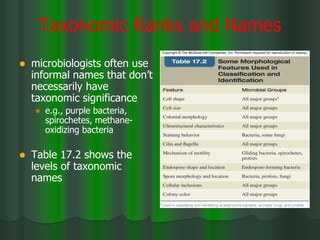
 microbiologists often use
informal names that don’t
necessarily have
taxonomic significance
 e.g., purple bacteria,
spirochetes, methane-
oxidizing bacteria
 Table 17.2 shows the
levels of taxonomic
names
Defining Procaryotic Species
The basic taxonomic group in microbial
taxonomy is the species.
 Cannot use definition based on interbreeding
because procaryotes are asexual.
 A prokaryotic species is collection of strains
that share many stable properties and differ
significantly from other groups of strains.
 Also suggested as a definition of species as a
collection of organisms that share the same
sequences in their core housekeeping genes
(genes required to code for products needed
by cells)-bases on sequence data.
Figure 17.6 Hiearchical arrangement in Taxonomy
Strains
 Descended from a single, pure microbial
culture
 Strains vary from each other in many
ways
 Biovars – differ biochemically and
physiologically
 Morphovars – differ morphologically
 Serovars – differ in antigenic properties
Type Strain
 Usually one of first strains of a species
studied
 Often most fully characterized
 Not necessarily most representative
member of species
Genus
 Genus- well-defined group of one or more
strains
 Clearly separate from other genera
 Often disagreement among taxonomists
about the assignment of a specific species
to a genus
Binomial System of Nomenclature
Binomial system was devised by Carolus Linnaeus
 Each organism has two names
 genus name – italicized and capitalized (e.g., Escherichia)
 species epithet – italicized but not capitalized (e.g., coli)
 can be abbreviated after first use (e.g., E. coli)
 a new procaryotic species cannot be recognized until it
has been published in the International Journal of
Systematic and Evolutionary Microbiology
Techniques for Determining Microbial
Taxonomy and Phylogeny
Classical characteristics
 morphological
 physiological
 metabolic
 ecological
 genetic
Molecular characteristics
 nucleic acid base composition
 nucleic acid hybridization
 nucleic acid sequencing
 genomic fingerprinting
 amino acid sequencing
Ecological Characteristics
 Life-cycle patterns
 Symbiotic relationships
 Ability to cause disease
 Habitat preferences
 Growth requirements
Genetic Analysis
Genetic Analysis
 Study of chromosomal gene exchange by
transformation and conjugation
 plasmids can be used for the analysis of
phenotypic traits
Nucleic Acid Base Composition
 Determine the G + C content
Where G=Guanine, C=Cytosine, A=adenine
and T=Thymine ( nucleotide are the DNA
base)
 The G+ C content is often estimated by
determining the melting temperature (Tm)
of the DNA
 Higher G + C gives a higher melting
temperature
100%
TACG
CG
C)(GMol% 



Nucleic Acid Hybridization
 measure of sequence homology
( molecular relatedness)
 common procedure for hybridisation:
 bind nonradioactive DNA to nitrocellulose filter
 incubate filter with radioactive single-stranded DNA
 The quantity of radioactivity bound to the filter
reflects the amount of hybridisation between the 2
DNA and thus similarity of the 2 sequences.
…Nucleic Acid Hybridization
 measure amount of radioactive DNA attached
to filter.
 The degree of similarity is expressed as the %
of experimental DNA radioactivity retained on
the filter as compared to other sps. of the
same genus under the same conditions.
 Usually less than 5 % difference in melting
point ( T m ) is considered as members of
same sps.
Nucleic Acid Sequencing
 most powerful and direct method for
comparing genomes
 sequences of 16S (procaryotes) and 18S
(eucaryotes) ribosomal RNA (rRNA) are
used most often in phylogenetic studies
 complete chromosomes can now be
sequenced and compared
…Nucleic Acid Sequencing
Comparative Analysis of 16S rRNA Sequences:
 Oligonucleotide signature sequences are short conserved
sequences specific for a phylogenetically defined group
of organisms
 either complete or, more often, specific rRNA fragments
can be compared
 when comparing rRNA sequences between 2 organisms,
their relatedness is represented by an association
coefficient or Sab value
 the higher the Sab value, the more closely related the
organisms
Use of DNA Sequences to
Determine Species Identity
DNA sequences can also be used to determine
species strains in addition to genus
 It requires analysis of genes that evolve more
quickly than rRNA encoding genes
 Multilocus sequence typing (MLST), the
sequencing and comparison of 5 to 7
housekeeping genes instead of single gene is
done.
 This is to prevent misleading results from
analysis of one gene.
Genomic Fingerprinting
 Genomic Finger Printing also used for microbial
classification and determination of phylogenetic
relationships
 Genomic Finger Printing does not involve
nucleotide sequencing
 Can be used because of multicopies of highly
conserved and repetitive DNA sequences present
in most gram-negative and some gram-positive
bacteria
 Multicopies can be obtained by Polymerase chain
reaction using restriction enzymes
…Genomic Fingerprinting
 uses restriction enzymes (endonucleases)
that recognize specific nucleotide
sequences
 Restriction Enzyme cuts DNA at specific
sites
 Restriction fragments are compared by Gel
Electrophoresis.
…Genomic Fingerprinting
 Repetitive sequences amplified by the polymerase chain
reaction
 amplified fragments run on agarose gel, with each lane
of gel corresponding to one microbial isolate
 pattern of bands analyzed by Gel Document system
 comparison of bands is called restriction fragment length
polymorphism (RFLP)
 It allows for identification to species, subspecies and
often allows strain level identification
 PCR has a widespread application
Figure 17.9 Genomic Finger Printing
Amino Acid Sequencing
 the amino acid sequence of a protein is a reflection of
the mRNA sequence and therefore of the gene which
encodes that protein
 amino acid sequencing of proteins such as cytochromes,
histones and heat-shock proteins has provided relevant
taxonomic and phylogenetic information
 cannot be used for all proteins
 compare protein mass spectra
Assessing Microbial Phylogeny
 evolutionary relationships represented
using phylogenetic trees
 A phylogentic tree is a graph which
connects nodes and branches
Phylogenetic Trees
Figure 17.11
a. Unrooted tree –
b. Rooted treehas
node that
serves as
common
ancestor
The Major Divisions of Life
Currently held that there are three domains
of life
 Domain Bacteria
 Domain Archaea
 Domain Eucarya
 scientists do not all agree how these
domains should be arranged in the “Tree
of Life”

Microbial taxonomy

  • 1.
  • 2.
    Microbial Classification and Taxonomy Taxonomy? Refer Pg 389; 17.2  Science of biological classification  Consists of three separate but interrelated parts classification – arrangement of organisms into groups (taxa, sing.taxon) nomenclature – assignment of names to taxa identification – determination of taxon to which an isolate belongs
  • 3.
    Natural Classification Natural Classificationarranges organisms into groups whose members share many characteristics  First such classification in 18th century developed by Linnaeus based on anatomical characteristics  this approach to classification does not necessarily provide information on evolutionary relatedness in microbes  E.g classification of humans as mammals –milk producing, hair, self regulating temp. etc.
  • 4.
    Polyphasic Taxonomy  PolyphasicTaxonomy is used to determine the genus and species of a newly discovered procaryote  incorporates information from phenetic (phenotypic) and phylogenetic analysis
  • 5.
    Phenetic Classification  groupsorganisms together based on mutual similarity of phenotypes  can reveal evolutionary relationships, but not dependent on phylogenetic analysis  E.g because motility and flagella are always associated in particular organisms, it is reasonable to suppose that flagella is involved in some types of motility
  • 6.
    Phylogenetic Classification  Phylogenetic,also called phyletic classification systems  Phylogeny is based on evolutionary development of a species  usually based on direct comparison of genetic material and gene products  this approach is widely accepted  large databases exist for rRNA sequences
  • 7.
    Taxonomic Ranks andNames  microbiologists often use informal names that don’t necessarily have taxonomic significance  e.g., purple bacteria, spirochetes, methane- oxidizing bacteria  Table 17.2 shows the levels of taxonomic names
  • 8.
    Defining Procaryotic Species Thebasic taxonomic group in microbial taxonomy is the species.  Cannot use definition based on interbreeding because procaryotes are asexual.  A prokaryotic species is collection of strains that share many stable properties and differ significantly from other groups of strains.  Also suggested as a definition of species as a collection of organisms that share the same sequences in their core housekeeping genes (genes required to code for products needed by cells)-bases on sequence data.
  • 9.
    Figure 17.6 Hiearchicalarrangement in Taxonomy
  • 10.
    Strains  Descended froma single, pure microbial culture  Strains vary from each other in many ways  Biovars – differ biochemically and physiologically  Morphovars – differ morphologically  Serovars – differ in antigenic properties
  • 11.
    Type Strain  Usuallyone of first strains of a species studied  Often most fully characterized  Not necessarily most representative member of species
  • 12.
    Genus  Genus- well-definedgroup of one or more strains  Clearly separate from other genera  Often disagreement among taxonomists about the assignment of a specific species to a genus
  • 13.
    Binomial System ofNomenclature Binomial system was devised by Carolus Linnaeus  Each organism has two names  genus name – italicized and capitalized (e.g., Escherichia)  species epithet – italicized but not capitalized (e.g., coli)  can be abbreviated after first use (e.g., E. coli)  a new procaryotic species cannot be recognized until it has been published in the International Journal of Systematic and Evolutionary Microbiology
  • 14.
    Techniques for DeterminingMicrobial Taxonomy and Phylogeny Classical characteristics  morphological  physiological  metabolic  ecological  genetic Molecular characteristics  nucleic acid base composition  nucleic acid hybridization  nucleic acid sequencing  genomic fingerprinting  amino acid sequencing
  • 15.
    Ecological Characteristics  Life-cyclepatterns  Symbiotic relationships  Ability to cause disease  Habitat preferences  Growth requirements
  • 16.
    Genetic Analysis Genetic Analysis Study of chromosomal gene exchange by transformation and conjugation  plasmids can be used for the analysis of phenotypic traits
  • 17.
    Nucleic Acid BaseComposition  Determine the G + C content Where G=Guanine, C=Cytosine, A=adenine and T=Thymine ( nucleotide are the DNA base)  The G+ C content is often estimated by determining the melting temperature (Tm) of the DNA  Higher G + C gives a higher melting temperature 100% TACG CG C)(GMol%    
  • 18.
    Nucleic Acid Hybridization NucleicAcid Hybridization  measure of sequence homology ( molecular relatedness)  common procedure for hybridisation:  bind nonradioactive DNA to nitrocellulose filter  incubate filter with radioactive single-stranded DNA  The quantity of radioactivity bound to the filter reflects the amount of hybridisation between the 2 DNA and thus similarity of the 2 sequences.
  • 19.
    …Nucleic Acid Hybridization measure amount of radioactive DNA attached to filter.  The degree of similarity is expressed as the % of experimental DNA radioactivity retained on the filter as compared to other sps. of the same genus under the same conditions.  Usually less than 5 % difference in melting point ( T m ) is considered as members of same sps.
  • 20.
    Nucleic Acid Sequencing NucleicAcid Sequencing  most powerful and direct method for comparing genomes  sequences of 16S (procaryotes) and 18S (eucaryotes) ribosomal RNA (rRNA) are used most often in phylogenetic studies  complete chromosomes can now be sequenced and compared
  • 21.
    …Nucleic Acid Sequencing ComparativeAnalysis of 16S rRNA Sequences:  Oligonucleotide signature sequences are short conserved sequences specific for a phylogenetically defined group of organisms  either complete or, more often, specific rRNA fragments can be compared  when comparing rRNA sequences between 2 organisms, their relatedness is represented by an association coefficient or Sab value  the higher the Sab value, the more closely related the organisms
  • 22.
    Use of DNASequences to Determine Species Identity DNA sequences can also be used to determine species strains in addition to genus  It requires analysis of genes that evolve more quickly than rRNA encoding genes  Multilocus sequence typing (MLST), the sequencing and comparison of 5 to 7 housekeeping genes instead of single gene is done.  This is to prevent misleading results from analysis of one gene.
  • 23.
    Genomic Fingerprinting  GenomicFinger Printing also used for microbial classification and determination of phylogenetic relationships  Genomic Finger Printing does not involve nucleotide sequencing  Can be used because of multicopies of highly conserved and repetitive DNA sequences present in most gram-negative and some gram-positive bacteria  Multicopies can be obtained by Polymerase chain reaction using restriction enzymes
  • 24.
    …Genomic Fingerprinting  usesrestriction enzymes (endonucleases) that recognize specific nucleotide sequences  Restriction Enzyme cuts DNA at specific sites  Restriction fragments are compared by Gel Electrophoresis.
  • 25.
    …Genomic Fingerprinting  Repetitivesequences amplified by the polymerase chain reaction  amplified fragments run on agarose gel, with each lane of gel corresponding to one microbial isolate  pattern of bands analyzed by Gel Document system  comparison of bands is called restriction fragment length polymorphism (RFLP)  It allows for identification to species, subspecies and often allows strain level identification  PCR has a widespread application
  • 26.
    Figure 17.9 GenomicFinger Printing
  • 27.
    Amino Acid Sequencing the amino acid sequence of a protein is a reflection of the mRNA sequence and therefore of the gene which encodes that protein  amino acid sequencing of proteins such as cytochromes, histones and heat-shock proteins has provided relevant taxonomic and phylogenetic information  cannot be used for all proteins  compare protein mass spectra
  • 28.
    Assessing Microbial Phylogeny evolutionary relationships represented using phylogenetic trees  A phylogentic tree is a graph which connects nodes and branches
  • 29.
    Phylogenetic Trees Figure 17.11 a.Unrooted tree – b. Rooted treehas node that serves as common ancestor
  • 30.
    The Major Divisionsof Life Currently held that there are three domains of life  Domain Bacteria  Domain Archaea  Domain Eucarya  scientists do not all agree how these domains should be arranged in the “Tree of Life”