Classification of Microorganisms  Prepared by Rajesh M.Patel Assistant Professor, Department of Pharmaceutical Biotechnology, Ganpat University. Email:rajmit_120@yahoomail.com
Contents of the chapter Terminology Taxonmomy: Introduction and History Classification Nomenclature Taxonmic methods for classification of microorganisms Intuitive method Genetic methods % G+C content Nucleic acid hybridization DNA chip technique Numerical classification methodss
Terminology Taxonomy Classification of living organisms into groups Phylogenetic Classification System: Groups reflect genetic similarity and evolutionary relatedness Phenetic Classification System: Groups do not necessarily reflect genetic similarity or evolutionary relatedness. Instead, groups are based on convenient, observable characteristics.
Terminology Species: A collection of microbial strains that share many properties and differ significantly from other groups of strains Strain: a population of organisms  descended from a  single organism or pure culture isolate. OR a culture derived from a single parent that differs in structure or metabolism from other cultures of that species
Terminology Type strain: One of the first strain among the species, studied and fully characterised than other strains. Biovars  procaryotic variant strains characterized by biochemical or physiological differences Morphovars  procaryotic variant strains characterized by morpholigical characteristics Serovars  procaryotic variant strains characterized by distinctive antigenic properties
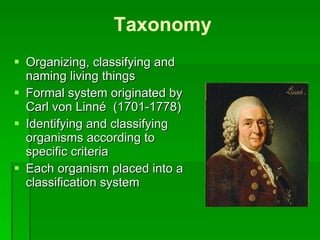
Taxonomy Organizing, classifying and naming living things Formal system originated by Carl von Linn é  (1701-1778)  Identifying and classifying organisms according to specific criteria  Each organism placed into a classification system
Taxonomy Taxa: order or arrangement N omos: law Nemein: to distribute or govern The branch of biology dealing with the classification of life.
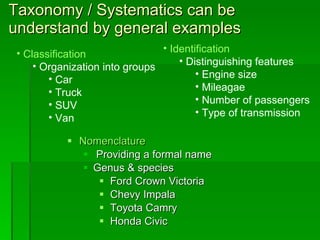
Taxonomy / Systematics can be understand by general examples Nomenclature   Providing a formal name Genus & species Ford Crown Victoria Chevy Impala Toyota Camry Honda Civic Classification  Organization into groups Car Truck SUV Van Identification   Distinguishing features Engine size Mileagae Number of passengers Type of transmission
Taxonomy: History 1700s 2 kingdoms: plant and animal 1800s 3 kingdoms: plant, animal, and protista 1950-1990s 5 kingdoms: plant, animal, protista, fungi, monera Present: 6 kingdoms: eubacteria, archaebacteria, protista, animal, plant, fungi Taxonomy consists of 3 parts Classification Identification Nomenclature
Classification Arrangement into groups based on mutual similarity or evolutionary relatedness Ordering of organisms into groups.
Classification Natural classification:  arranges organisms into groups whose members share many characteristics and reflects as much as possible the biological nature of organisms. Linnaeus developed the first natural classification, based largely on anatomical characteristics. E.g. classification of humans as mammals denotes that they have hair, self-regulating body temperature,and milk-producing mammary glands in the female. Polyphasic classification
Taxonomy Domain K ingdom P hylum C lass O rder F amily G enus s pecies
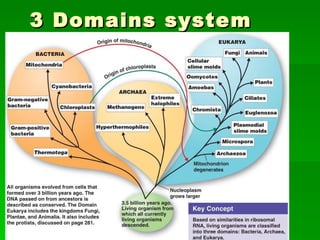
3 Domains Eubacteria   true bacteria, peptidoglycan Archaea   odd bacteria that live in extreme environments, high salt, heat, etc. (usually called extremophiles) Eukarya have a nucleus & organelles (humans, animals, plants)
3 Domains system
 
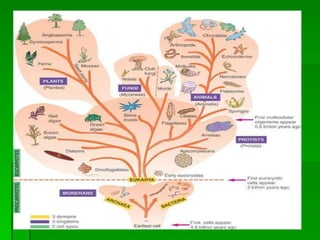
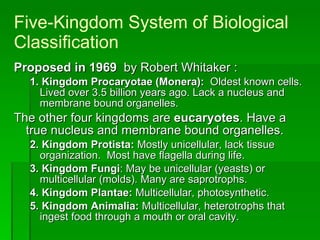
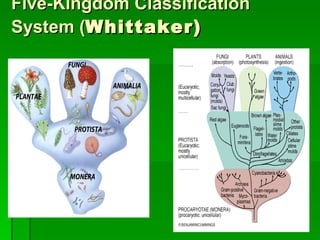
Five-Kingdom System of Biological Classification Proposed in   1969   by Robert Whitaker : 1.   Kingdom Procaryotae (Monera):   Oldest known cells. Lived over 3.5 billion years ago. Lack a nucleus and membrane bound organelles. The other four kingdoms are  eucaryotes . Have a true nucleus and membrane bound organelles. 2. Kingdom Protista:  Mostly unicellular, lack tissue organization.  Most have flagella during life. 3. Kingdom Fungi : May be unicellular (yeasts) or multicellular (molds). Many are saprotrophs.  4. Kingdom Plantae:  Multicellular, photosynthetic. 5. Kingdom Animalia:  Multicellular, heterotrophs that ingest food through a mouth or oral cavity.
Five-Kingdom Classification System ( Whittaker)
 
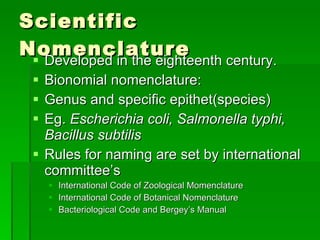
Scientific Nomenclature Developed in the eighteenth century. Bionomial nomenclature: Genus and specific epithet(species) Eg.  Escherichia coli, Salmonella typhi, Bacillus subtilis Rules for naming are set by international committee’s International Code of Zoological Momenclature International Code of Botanical Nomenclature Bacteriological Code and Bergey’s Manual
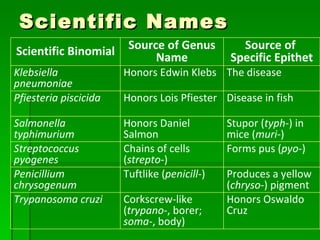
Scientific Names Scientific Binomial Source of Genus Name Source of  Specific Epithet Klebsiella pneumoniae Honors Edwin Klebs The disease Pfiesteria piscicida Honors Lois Pfiester Disease in fish Salmonella typhimurium Honors Daniel Salmon Stupor ( typh -) in mice ( muri -) Streptococcus pyogenes Chains of cells ( strepto -) Forms pus ( pyo -) Penicillium chrysogenum Tuftlike ( penicill -) Produces a yellow ( chryso -) pigment Trypanosoma cruzi Corkscrew-like ( trypano -, borer;  soma -, body) Honors Oswaldo Cruz
Bergey’s Manual of Systematic Bacteriology First edition published in 1923
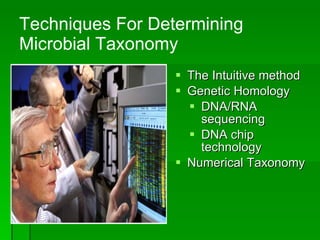
Techniques For Determining Microbial Taxonomy The Intuitive method Genetic Homology DNA/RNA sequencing DNA chip technology Numerical Taxonomy
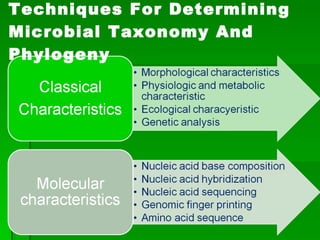
Techniques For Determining Microbial Taxonomy And Phylogeny
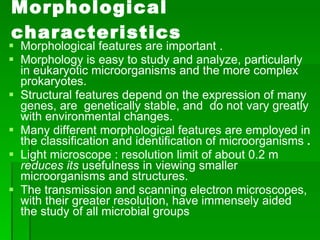
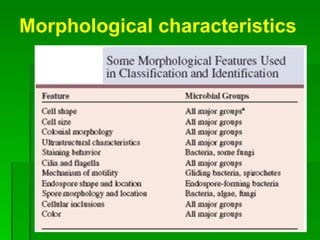
Morphological features are important .  Morphology is easy to study and analyze, particularly in eukaryotic microorganisms and the more complex prokaryotes. Structural features depend on the expression of many genes, are  genetically stable, and  do not vary greatly with environmental changes.  Many different morphological features are employed in the classification and identification of microorganisms  . Light microscope : resolution limit of about 0.2 m  reduces its  usefulness in viewing smaller microorganisms and structures.  The transmission and scanning electron microscopes, with their greater resolution, have immensely aided the study of all microbial groups Morphological characteristics
Morphological characteristics
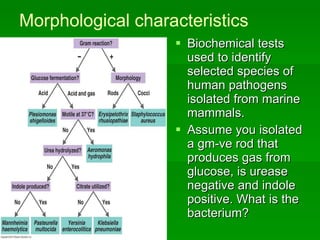
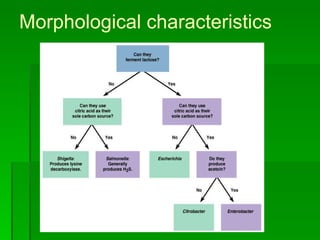
Morphological characteristics Differential staining:  Gram staining, acid-fast staining Biochemical tests:  Determines presence of bacterial enzymes
Morphological characteristics Biochemical tests used to identify selected species of human pathogens isolated from marine mammals. Assume you isolated a gm-ve rod that produces gas from glucose, is urease negative and indole positive. What is the bacterium?
Morphological characteristics
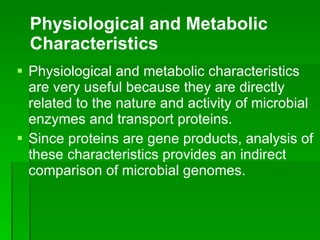
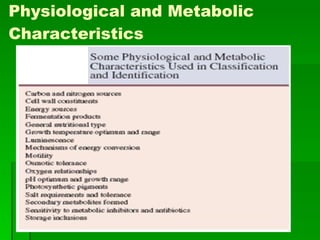
Physiological and metabolic characteristics are very useful because they are directly related to the nature and activity of microbial enzymes and transport proteins.  Since proteins are gene products, analysis of these characteristics provides an indirect comparison of microbial genomes. Physiological and Metabolic Characteristics
Physiological and Metabolic Characteristics
Ecological properties: affect the relation of microorganisms to their environment.  Taxonomically valuable because even very closely related microorganisms can differ considerably with respect to ecological characteristics.  Microorganisms living in various parts of the human body markedly differ from one another and from those growing in freshwater and marine environments.  Some examples of taxonomically important ecological properties are life cycle patterns; the nature of symbiotic relationships; the ability to cause disease in a particular host; and habitat preferences such as requirements for temperature, pH, oxygen, and osmotic concentration. Ecological Characteristics
The Intuitive method It is rely on the study of the properties of the organisms by taxonomists for several years which decides to represent one or more species or genera. Demerit:  The characteristics of an organism that is important to one person may not be so important to another. Different taxonomists arrive at very different groupings.
Nucleic acid base composition DNA contains four purine and pyrimidine bases: A, G, C, T.  (G+C)/(A+T) ratio or G+C content, % of G+C in DNA, reflects the base. Mol % (G+C)= [(G+C)/(G+C+A+T)]*100 Estimated by determining the melting temperature of the DNA Higher G + C gives a higher melting temperature Methods to determine base composition 1.HPLC: Hydrolyse the DNA & Analyse with HPLC 2.Melting temperature (T m ): double stranded DNA, A=T, G = C, High G +C = high melting point.
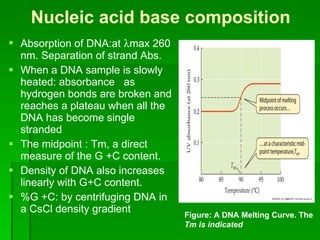
Nucleic acid base composition Absorption of DNA:at   max 260 nm. Separation of strand Abs. When a DNA sample is slowly heated: absorbance  as hydrogen bonds are broken and reaches a plateau when all the DNA has become single stranded  The midpoint : Tm, a direct measure of the G +C content. Density of DNA also increases linearly with G+C content. %G +C: by centrifuging DNA in a CsCl density gradient Figure: A DNA Melting Curve. The  Tm is indicated
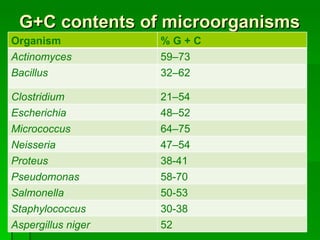
Nucleic Acid Base Composition The G+C content of DNA from animals and higher plants : average 40%, ranges between 30 to 50%.  Prokaryotic G+C content : 25 to 80%.  If two organisms differ in their G + C content by >10%, : different base sequences. The G + C content of strains within a particular species is constant.  Very different base sequences can be constructed from the same proportions of AT and GC base pairs.  .
Nucleic Acid Base Composition Only if two microorganisms also are alike phenotypically does their similar G + C content suggest close relatedness.
G+C contents of microorganisms Organism % G + C Actinomyces 59–73 Bacillus 32–62 Clostridium 21–54 Escherichia 48–52 Micrococcus 64–75 Neisseria 47–54 Proteus 38-41 Pseudomonas 58-70 Salmonella 50-53 Staphylococcus 30-38 Aspergillus niger 52
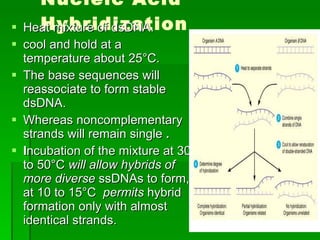
Nucleic Acid Hybridization By mixing ssDNA from two different species and determining the percentage of the DNA that can form dsDNA hybrids The greater the percent hybridization, the closer the species
Nucleic Acid Hybridization Heat mixture of dsDNA. cool and hold at a  temperature about 25°C. The base sequences will reassociate to form stable dsDNA.  Whereas noncomplementary strands will remain single  . I ncubation of the mixture at 30 to 50°C  will allow hybrids of more diverse  ssDNAs to form, at 10 to 15°C  permits  hybrid formation only with almost identical strands.
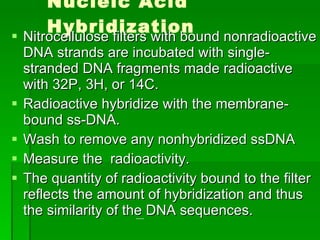
Nucleic Acid Hybridization Nitrocellulose filters with bound nonradioactive DNA strands are incubated with single-stranded DNA fragments made radioactive with 32P, 3H, or 14C.  Radioactive hybridize with the membrane-bound ss-DNA. Wash to remove any nonhybridized ssDNA  Measure the  radioactivity.  The quantity of radioactivity bound to the filter reflects the amount of hybridization and thus the similarity of the DNA sequences.
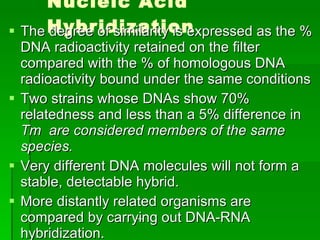
Nucleic Acid Hybridization The degree of similarity is expressed as the %  DNA radioactivity retained on the filter compared with the % of homologous DNA radioactivity bound under the same conditions Two strains whose DNAs show 70% relatedness and less than a 5% difference in  Tm  are considered members of the same species. Very different DNA molecules will not form a stable, detectable hybrid.  More distantly related organisms are compared by carrying out DNA-RNA hybridization.
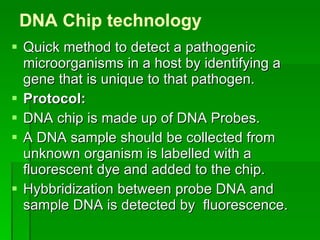
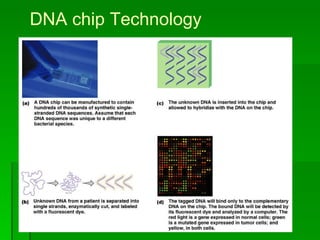
DNA Chip technology Quick method to detect a pathogenic microorganisms in a host by identifying a gene that is unique to that pathogen. Protocol: DNA chip is made up of DNA Probes. A DNA sample should be collected from unknown organism is labelled with a fluorescent dye and added to the chip. Hybbridization between probe DNA and sample DNA is detected by  fluorescence.
DNA chip Technology
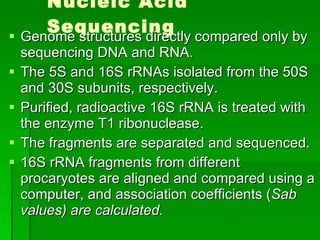
Nucleic Acid Sequencing Genome structures directly compared only by sequencing DNA and RNA. The 5S and 16S rRNAs isolated from the 50S and 30S subunits, respectively. Purified, radioactive 16S rRNA is treated with the enzyme T1 ribonuclease.  The fragments are separated and sequenced.  16S rRNA fragments from different procaryotes are aligned and compared using a computer, and association coefficients ( Sab values) are calculated.
Nucleic Acid Sequencing Complete  rRNAs  sequencing First, RNA is isolated and purified.  Then, revers transcriptase is used to make  cDNA.  Next, the PCR amplifies the cDNA.  Finally, the cDNA is sequenced and the rRNA sequence deduced from the results.
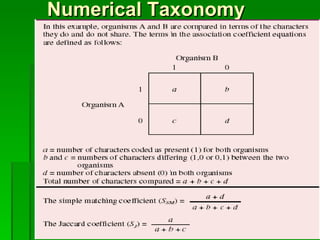
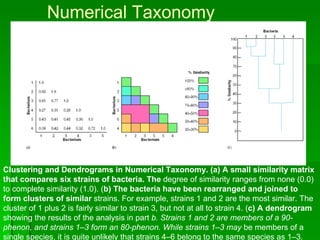
Numerical Taxonomy Peter H. A. Sneath and Robert Sokal have defined  Numerical taxonomy: “the grouping by numerical methods on the basis of their character states.”  Information about organisms is converted into numerical form and compared by means of a computer.  Each characteristics given equal weight. At least 50 and preferably several hundred characteristics compared.  Determine  the presence or absence of selected characters in the group of organisms. Calculate simple matching coefficient ( SSM),  Jaccard coefficient.
Numerical Taxonomy
Numerical Taxonomy The simple matching coefficients, or other association coefficients are then arranged to form a similarity matrix. The results of numerical taxonomic analysis are often summarized with a treelike diagram called a dendrogram. Organisms with great similarity are grouped together and separated from dissimilar organisms  such groups of organisms are called  phenons. Phenons formed at about 80% similarity often are equivalent to species.
Numerical Taxonomy Clustering and Dendrograms in Numerical Taxonomy. (a) A small similarity matrix that compares six strains of bacteria. The  degree of similarity ranges from none (0.0) to complete similarity (1.0). ( b) The bacteria have been rearranged and joined to form clusters of similar  strains. For example, strains 1 and 2 are the most similar. The cluster of 1 plus 2 is fairly similar to strain 3, but not at all to strain 4. ( c) A dendrogram  showing the results of the analysis in part  b. Strains 1 and 2 are members of a 90-phenon, and strains 1–3 form an 80-phenon. While strains 1–3 may  be members of a single species, it is quite unlikely that strains 4–6 belong to the same species as 1–3.
THANK YOU

Classification of microorganisms lecture note by rm patel

  • 1.
    Classification of Microorganisms Prepared by Rajesh M.Patel Assistant Professor, Department of Pharmaceutical Biotechnology, Ganpat University. Email:rajmit_120@yahoomail.com
  • 2.
    Contents of thechapter Terminology Taxonmomy: Introduction and History Classification Nomenclature Taxonmic methods for classification of microorganisms Intuitive method Genetic methods % G+C content Nucleic acid hybridization DNA chip technique Numerical classification methodss
  • 3.
    Terminology Taxonomy Classificationof living organisms into groups Phylogenetic Classification System: Groups reflect genetic similarity and evolutionary relatedness Phenetic Classification System: Groups do not necessarily reflect genetic similarity or evolutionary relatedness. Instead, groups are based on convenient, observable characteristics.
  • 4.
    Terminology Species: Acollection of microbial strains that share many properties and differ significantly from other groups of strains Strain: a population of organisms descended from a single organism or pure culture isolate. OR a culture derived from a single parent that differs in structure or metabolism from other cultures of that species
  • 5.
    Terminology Type strain:One of the first strain among the species, studied and fully characterised than other strains. Biovars procaryotic variant strains characterized by biochemical or physiological differences Morphovars procaryotic variant strains characterized by morpholigical characteristics Serovars procaryotic variant strains characterized by distinctive antigenic properties
  • 6.
    Taxonomy Organizing, classifyingand naming living things Formal system originated by Carl von Linn é (1701-1778) Identifying and classifying organisms according to specific criteria Each organism placed into a classification system
  • 7.
    Taxonomy Taxa: orderor arrangement N omos: law Nemein: to distribute or govern The branch of biology dealing with the classification of life.
  • 8.
    Taxonomy / Systematicscan be understand by general examples Nomenclature Providing a formal name Genus & species Ford Crown Victoria Chevy Impala Toyota Camry Honda Civic Classification Organization into groups Car Truck SUV Van Identification Distinguishing features Engine size Mileagae Number of passengers Type of transmission
  • 9.
    Taxonomy: History 1700s2 kingdoms: plant and animal 1800s 3 kingdoms: plant, animal, and protista 1950-1990s 5 kingdoms: plant, animal, protista, fungi, monera Present: 6 kingdoms: eubacteria, archaebacteria, protista, animal, plant, fungi Taxonomy consists of 3 parts Classification Identification Nomenclature
  • 10.
    Classification Arrangement intogroups based on mutual similarity or evolutionary relatedness Ordering of organisms into groups.
  • 11.
    Classification Natural classification: arranges organisms into groups whose members share many characteristics and reflects as much as possible the biological nature of organisms. Linnaeus developed the first natural classification, based largely on anatomical characteristics. E.g. classification of humans as mammals denotes that they have hair, self-regulating body temperature,and milk-producing mammary glands in the female. Polyphasic classification
  • 12.
    Taxonomy Domain Kingdom P hylum C lass O rder F amily G enus s pecies
  • 13.
    3 Domains Eubacteria true bacteria, peptidoglycan Archaea odd bacteria that live in extreme environments, high salt, heat, etc. (usually called extremophiles) Eukarya have a nucleus & organelles (humans, animals, plants)
  • 14.
  • 15.
  • 16.
    Five-Kingdom System ofBiological Classification Proposed in 1969 by Robert Whitaker : 1. Kingdom Procaryotae (Monera): Oldest known cells. Lived over 3.5 billion years ago. Lack a nucleus and membrane bound organelles. The other four kingdoms are eucaryotes . Have a true nucleus and membrane bound organelles. 2. Kingdom Protista: Mostly unicellular, lack tissue organization. Most have flagella during life. 3. Kingdom Fungi : May be unicellular (yeasts) or multicellular (molds). Many are saprotrophs. 4. Kingdom Plantae: Multicellular, photosynthetic. 5. Kingdom Animalia: Multicellular, heterotrophs that ingest food through a mouth or oral cavity.
  • 17.
  • 18.
  • 19.
    Scientific Nomenclature Developedin the eighteenth century. Bionomial nomenclature: Genus and specific epithet(species) Eg. Escherichia coli, Salmonella typhi, Bacillus subtilis Rules for naming are set by international committee’s International Code of Zoological Momenclature International Code of Botanical Nomenclature Bacteriological Code and Bergey’s Manual
  • 20.
    Scientific Names ScientificBinomial Source of Genus Name Source of Specific Epithet Klebsiella pneumoniae Honors Edwin Klebs The disease Pfiesteria piscicida Honors Lois Pfiester Disease in fish Salmonella typhimurium Honors Daniel Salmon Stupor ( typh -) in mice ( muri -) Streptococcus pyogenes Chains of cells ( strepto -) Forms pus ( pyo -) Penicillium chrysogenum Tuftlike ( penicill -) Produces a yellow ( chryso -) pigment Trypanosoma cruzi Corkscrew-like ( trypano -, borer; soma -, body) Honors Oswaldo Cruz
  • 21.
    Bergey’s Manual ofSystematic Bacteriology First edition published in 1923
  • 22.
    Techniques For DeterminingMicrobial Taxonomy The Intuitive method Genetic Homology DNA/RNA sequencing DNA chip technology Numerical Taxonomy
  • 23.
    Techniques For DeterminingMicrobial Taxonomy And Phylogeny
  • 24.
    Morphological features areimportant . Morphology is easy to study and analyze, particularly in eukaryotic microorganisms and the more complex prokaryotes. Structural features depend on the expression of many genes, are genetically stable, and do not vary greatly with environmental changes. Many different morphological features are employed in the classification and identification of microorganisms . Light microscope : resolution limit of about 0.2 m reduces its usefulness in viewing smaller microorganisms and structures. The transmission and scanning electron microscopes, with their greater resolution, have immensely aided the study of all microbial groups Morphological characteristics
  • 25.
  • 26.
    Morphological characteristics Differentialstaining: Gram staining, acid-fast staining Biochemical tests: Determines presence of bacterial enzymes
  • 27.
    Morphological characteristics Biochemicaltests used to identify selected species of human pathogens isolated from marine mammals. Assume you isolated a gm-ve rod that produces gas from glucose, is urease negative and indole positive. What is the bacterium?
  • 28.
  • 29.
    Physiological and metaboliccharacteristics are very useful because they are directly related to the nature and activity of microbial enzymes and transport proteins. Since proteins are gene products, analysis of these characteristics provides an indirect comparison of microbial genomes. Physiological and Metabolic Characteristics
  • 30.
  • 31.
    Ecological properties: affectthe relation of microorganisms to their environment. Taxonomically valuable because even very closely related microorganisms can differ considerably with respect to ecological characteristics. Microorganisms living in various parts of the human body markedly differ from one another and from those growing in freshwater and marine environments. Some examples of taxonomically important ecological properties are life cycle patterns; the nature of symbiotic relationships; the ability to cause disease in a particular host; and habitat preferences such as requirements for temperature, pH, oxygen, and osmotic concentration. Ecological Characteristics
  • 32.
    The Intuitive methodIt is rely on the study of the properties of the organisms by taxonomists for several years which decides to represent one or more species or genera. Demerit: The characteristics of an organism that is important to one person may not be so important to another. Different taxonomists arrive at very different groupings.
  • 33.
    Nucleic acid basecomposition DNA contains four purine and pyrimidine bases: A, G, C, T. (G+C)/(A+T) ratio or G+C content, % of G+C in DNA, reflects the base. Mol % (G+C)= [(G+C)/(G+C+A+T)]*100 Estimated by determining the melting temperature of the DNA Higher G + C gives a higher melting temperature Methods to determine base composition 1.HPLC: Hydrolyse the DNA & Analyse with HPLC 2.Melting temperature (T m ): double stranded DNA, A=T, G = C, High G +C = high melting point.
  • 34.
    Nucleic acid basecomposition Absorption of DNA:at  max 260 nm. Separation of strand Abs. When a DNA sample is slowly heated: absorbance as hydrogen bonds are broken and reaches a plateau when all the DNA has become single stranded The midpoint : Tm, a direct measure of the G +C content. Density of DNA also increases linearly with G+C content. %G +C: by centrifuging DNA in a CsCl density gradient Figure: A DNA Melting Curve. The Tm is indicated
  • 35.
    Nucleic Acid BaseComposition The G+C content of DNA from animals and higher plants : average 40%, ranges between 30 to 50%. Prokaryotic G+C content : 25 to 80%. If two organisms differ in their G + C content by >10%, : different base sequences. The G + C content of strains within a particular species is constant. Very different base sequences can be constructed from the same proportions of AT and GC base pairs. .
  • 36.
    Nucleic Acid BaseComposition Only if two microorganisms also are alike phenotypically does their similar G + C content suggest close relatedness.
  • 37.
    G+C contents ofmicroorganisms Organism % G + C Actinomyces 59–73 Bacillus 32–62 Clostridium 21–54 Escherichia 48–52 Micrococcus 64–75 Neisseria 47–54 Proteus 38-41 Pseudomonas 58-70 Salmonella 50-53 Staphylococcus 30-38 Aspergillus niger 52
  • 38.
    Nucleic Acid HybridizationBy mixing ssDNA from two different species and determining the percentage of the DNA that can form dsDNA hybrids The greater the percent hybridization, the closer the species
  • 39.
    Nucleic Acid HybridizationHeat mixture of dsDNA. cool and hold at a temperature about 25°C. The base sequences will reassociate to form stable dsDNA. Whereas noncomplementary strands will remain single . I ncubation of the mixture at 30 to 50°C will allow hybrids of more diverse ssDNAs to form, at 10 to 15°C permits hybrid formation only with almost identical strands.
  • 40.
    Nucleic Acid HybridizationNitrocellulose filters with bound nonradioactive DNA strands are incubated with single-stranded DNA fragments made radioactive with 32P, 3H, or 14C. Radioactive hybridize with the membrane-bound ss-DNA. Wash to remove any nonhybridized ssDNA Measure the radioactivity. The quantity of radioactivity bound to the filter reflects the amount of hybridization and thus the similarity of the DNA sequences.
  • 41.
    Nucleic Acid HybridizationThe degree of similarity is expressed as the % DNA radioactivity retained on the filter compared with the % of homologous DNA radioactivity bound under the same conditions Two strains whose DNAs show 70% relatedness and less than a 5% difference in Tm are considered members of the same species. Very different DNA molecules will not form a stable, detectable hybrid. More distantly related organisms are compared by carrying out DNA-RNA hybridization.
  • 42.
    DNA Chip technologyQuick method to detect a pathogenic microorganisms in a host by identifying a gene that is unique to that pathogen. Protocol: DNA chip is made up of DNA Probes. A DNA sample should be collected from unknown organism is labelled with a fluorescent dye and added to the chip. Hybbridization between probe DNA and sample DNA is detected by fluorescence.
  • 43.
  • 44.
    Nucleic Acid SequencingGenome structures directly compared only by sequencing DNA and RNA. The 5S and 16S rRNAs isolated from the 50S and 30S subunits, respectively. Purified, radioactive 16S rRNA is treated with the enzyme T1 ribonuclease. The fragments are separated and sequenced. 16S rRNA fragments from different procaryotes are aligned and compared using a computer, and association coefficients ( Sab values) are calculated.
  • 45.
    Nucleic Acid SequencingComplete rRNAs sequencing First, RNA is isolated and purified. Then, revers transcriptase is used to make cDNA. Next, the PCR amplifies the cDNA. Finally, the cDNA is sequenced and the rRNA sequence deduced from the results.
  • 46.
    Numerical Taxonomy PeterH. A. Sneath and Robert Sokal have defined Numerical taxonomy: “the grouping by numerical methods on the basis of their character states.” Information about organisms is converted into numerical form and compared by means of a computer. Each characteristics given equal weight. At least 50 and preferably several hundred characteristics compared. Determine the presence or absence of selected characters in the group of organisms. Calculate simple matching coefficient ( SSM), Jaccard coefficient.
  • 47.
  • 48.
    Numerical Taxonomy Thesimple matching coefficients, or other association coefficients are then arranged to form a similarity matrix. The results of numerical taxonomic analysis are often summarized with a treelike diagram called a dendrogram. Organisms with great similarity are grouped together and separated from dissimilar organisms such groups of organisms are called phenons. Phenons formed at about 80% similarity often are equivalent to species.
  • 49.
    Numerical Taxonomy Clusteringand Dendrograms in Numerical Taxonomy. (a) A small similarity matrix that compares six strains of bacteria. The degree of similarity ranges from none (0.0) to complete similarity (1.0). ( b) The bacteria have been rearranged and joined to form clusters of similar strains. For example, strains 1 and 2 are the most similar. The cluster of 1 plus 2 is fairly similar to strain 3, but not at all to strain 4. ( c) A dendrogram showing the results of the analysis in part b. Strains 1 and 2 are members of a 90-phenon, and strains 1–3 form an 80-phenon. While strains 1–3 may be members of a single species, it is quite unlikely that strains 4–6 belong to the same species as 1–3.
  • 50.