Microbial Taxonomy Classification Systems Levels of Classification Definition of “Species” Nomenclature Useful Properties in Microbial Classification Microbial Phylogeny
Classification Systems Taxonomy: Classification of living organisms into groups Phylogenetic Classification System: Groups reflect genetic similarity and evolutionary relatedness Phenetic Classification System: Groups do not necessarily reflect genetic similarity or evolutionary relatedness. Instead, groups are based on convenient, observable characteristics.
Levels of Classification Taxon:  A group or “level” of classification Hierarchical; broad divisions are divided up into smaller divisions: Kingdom (Not used by most bacteriologists) Phylum (Called “Division” by botanists) Class Order Family Genus (plural: Genera) Species (Both singular & plural)
Definition of “Species” The “basic unit” of taxonomy, representing a specific, recognized type of organism For sexually reproducing organisms, a fundamental definition of “species” has been reproductive compatibility This definition fails for many microbial species (including bacteria), because they do not reproduce sexually
Definition of “Species” Definition of “species” in microbiology: Classic definition: A collection of microbial strains that share many properties and differ significantly from other groups of strains Species are identified by comparison with known “type strains”: well-characterized pure cultures; references for the identification of unknowns There are several collections of type strains, including the American Type Culture Collection (ATCC)
Definition of “Species” Definition of “species” in microbiology (cont.): Strain: A population of microbes descended from a single individual or pure culture Different strains represent genetic variability within a species Biovars: Strains that differ in biochemical or physiological differences Morphovars: Strains that vary in morphology Serovars: Stains that vary in their antigenic properties
Nomenclature Scientific name (Systematic Name)  Binomial System of Nomenclature Genus name + species name  Italicized or underlined  Genus name is capitalized and may be abbreviated  Species name is never abbreviated A genus name may be used alone to indicate a genus group; a species name is never used alone eg:  Bacillus subtilis          B. subtilis
Nomenclature Common or descriptive names  (trivial names) Names for organisms that may be in common usage, but are not taxonomic names eg: tubercle bacillus          ( Mycobacterium tuberculosis ) meningococcus    ( Neiserria meningitidis ) Group A streptococcus  ( Streptococcus pyogenes )
Useful Properties in Classification Colony morphology Cell shape & arrangement Cell wall structure (Gram staining) Special cellular structures Biochemical characteristics
Useful Properties in Classification Serological Tests Use group specific antiserum isolated from the plasma of animals that have been sensitized to the organism The antiserum contains antibody proteins that react with antigens on the unknown organism. The reaction can be detected by examining agglutination or by using sera labeled with colorimetric or fluorescent labels
Useful Properties in Classification Serological Tests (cont.) Advantages: Highly specific Does not usually require the organism to be isolated into pure culture Can be used to identify organisms that can’t be grown on medium
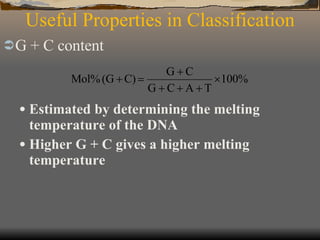
Useful Properties in Classification G + C content Estimated by determining the melting temperature of the DNA Higher G + C gives a higher melting temperature
Useful Properties in Classification Nucleic acid hybridization By mixing ssDNA from two different species and determining the percentage of the DNA that can form dsDNA hybrids The greater the percent hybridization, the closer the species
Useful Properties in Classification Nucleic acid sequencing Genes for specific enzymes The nucleic acid sequence for the complete genome of several species is now available 5S and 16S rRNA (ribosomal RNA) sequences; comparison of these sequences has been extensively used to determine the phylogenetic relationships of microbial groups
Microbial Phylogeny Bergey’s Manual of Systematic Bacteriology In 1927, David Bergey & colleagues published  Bergey’s Manual of Determinative Bacteriology , a manual that grouped bacteria into phenetic groups, used in identification of unknowns. It is now in its 9th edition. In 1984, a more detailed work entitled  Bergey’s Manual of Systematic Bacteriology  was published, still primarily phenetic in its classification.
Microbial Phylogeny Bergey’s Manual of Systematic Bacteriology Publication of the second edition of  Bergey’s Manual of Systematic Bacteriology  was begun in 2001.  The 2nd edition gives the most up-to-date phylogenic classification of prokaryotic organisms, including both eubacteria and archaea.  When it is completed, it will consist of 5 volumes. The classification in  Bergey’s Manual  is accepted by most microbiologists as the best consensus for prokaryotic taxonomy.
Microbial Phylogeny Domains Based on the research of Woese and others in the 1980s and 1990s, most biologists divide all living organisms into 3 domains: Domain  Archaea Domain  Bacteria Domain  Eucarya rRNA sequence data suggests that  Archaea  &  Eucarya  may share a more recent common ancestor with each other than with  Bacteria Diagram
Microbial Phylogeny Domains (cont.) Many microbiologists reject the “kingdom” designation.  Each domain is divided into phyla, phyla into classes. etc. There is often great metabolic and ecological diversity among the members of a group, perhaps reflecting parallel evolution of such things as fermentation pathways, photosynthetic pathways, etc.
Microbial Phylogeny Phylogeny of domain  Archaea Based primarily on rRNA sequence data, domain  Archaea  is divided into two phyla: Phylum  Crenarchaeota Originally containing thermophylic and hyperthermophilic sulfur-metabolizing archaea Recently discovered  Crenarchaeota  are inhibited by sulfur & grow at lower temperatures Phylum  Euryarchaeota Contains primarily methanogenic archaea, halophilic archaea, and thermophilic, sulfur-reducing archaea
Microbial Phylogeny Phylogeny of domain  Bacteria The 2nd edition of  Bergey’s Manual of Systematic Bacteriology  divides domain  Bacteria  into 23 phyla. Nine of the more notable phyla are described here. Phylum  Aquiflexa The earliest “deepest” branch of the  Bacteria Contains genera  Aquiflex  and  Hydrogenobacter  that can obtain energy from hydrogen via chemolithotrophic pathways
Microbial Phylogeny Phylogeny of domain  Bacteria  (cont.)   Phylum  Cyanobacteria Oxygenic photosynthetic bacteria Phylum  Chlorobi The “green sulfur bacteria” Anoxygenic photosynthesis Includes genus  Chlorobium
Microbial Phylogeny Phylogeny of domain  Bacteria  (cont.)   Phylum  Proteobacteria The largest group of gram-negative bacteria Extremely complex group, with over 400 genera and 1300 named species All major nutritional types are represented: phototrophy, heterotrophy, and several types of chemolithotrophy Sometimes called the “purple bacteria,” although very few are purple; the term refers to a hypothetical purple photosynthetic bacterium from which the group is believed to have evolved
Microbial Phylogeny Phylogeny of domain  Bacteria  (cont.)   Phylum  Proteobacteria  (cont.) Divided into 5 classes:  Alphaproteobacteria ,  Betaproteobacteria ,  Gammaproteobacteria ,  Deltaproteobacteria ,  Epsilonproteobacteria
Microbial Phylogeny Phylogeny of domain  Bacteria  (cont.)   Phylum  Proteobacteria  (cont.) Significant groups and genera include: Photosynthetic genera such as  Rhodospirillum  (a purple non-sulfur bacterium) and  Chromatium  (a purple sulfur bacterium) Sulfur chemolithotrophs, genera  Thiobacillus  and  Beggiatoa Nitrogen chemolithotrophs (nitrifying bacteria), genera  Nitrobacter  and  Nitrosomonas Other chemolithotrophs, genera  Alcaligenes, Methylobacilllus, Burkholderia
Microbial Phylogeny Phylogeny of domain  Bacteria  (cont.)   Phylum  Proteobacteria  (cont.) Significant groups and genera include: The family  Enterobacteriaceae , the “gram-negative enteric bacteria,” which includes genera  Escherichia, Proteus, Enterobacter, Klebsiella, Salmonella, Shigella, Serratia,  and others The family  Pseudomonadaceae , which includes genus  Pseudomonas  and related genera Other medically important  Proteobacteria  include genera  Haemophilus ,  Vibrio, Camphylobacter, Helicobacter, Rickessia, Brucella
Microbial Phylogeny Phylogeny of domain  Bacteria  (cont.)   Phylum  Firmicutes “ Low G + C gram-positive” bacteria  Divided into 3 classes Class I – Clostridia; includes genera  Clostridium  and  Desulfotomaculatum,  and others Class II –  Mollicutes ; bacteria in this class cannot make peptidoglycan and lack cell walls; includes genera  Mycoplasma, Ureaplasma,  and others Class III – Bacilli; includes genera  Bacillus, Lactobacillus, Streptococcus, Lactococcus, Geobacillus, Enterococcus, Listeria, Staphylococcus , and others
Microbial Phylogeny Phylogeny of domain  Bacteria  (cont.)   Phylum  Actinobacteria “ High G + C gram-positive” bacteria Includes genera  Actinomyces, Streptomyces, Corynebacterium, Micrococcus, Mycobacterium, Propionibacterium Phylum  Chlamidiae Small phylum containing the genus  Chlamydia
Microbial Phylogeny Phylogeny of domain  Bacteria  (cont.)   Phylum  Spirochaetes The spirochaetes Characterized by flexible, helical cells with a modified outer membrane (the outer sheath) and modified flagella (axial filaments) located within the outer sheath Important pathogenic genera include  Treponema, Borrelia,  and  Leptospira Phylum  Bacteroidetes Includes genera  Bacteroides,   Flavobacterium, Flexibacter,  and  Cytophyga ;  Flexibacter  and  Cytophyga  are motile by means of “gliding motility”
Microbial Phylogeny Phylogeny of domain  Eucarya The domain  Eucarya  is divided into four kingdoms by most biologists: Kingdom  Protista , including the protozoa and algae Kingdom  Fungi , the fungi (molds, yeast, and fleshy fungi) Kingdom  Animalia , the multicellular animals Kingdom  Plantae , the multicellular plants

Microtaxonomy

  • 1.
    Microbial Taxonomy ClassificationSystems Levels of Classification Definition of “Species” Nomenclature Useful Properties in Microbial Classification Microbial Phylogeny
  • 2.
    Classification Systems Taxonomy:Classification of living organisms into groups Phylogenetic Classification System: Groups reflect genetic similarity and evolutionary relatedness Phenetic Classification System: Groups do not necessarily reflect genetic similarity or evolutionary relatedness. Instead, groups are based on convenient, observable characteristics.
  • 3.
    Levels of ClassificationTaxon: A group or “level” of classification Hierarchical; broad divisions are divided up into smaller divisions: Kingdom (Not used by most bacteriologists) Phylum (Called “Division” by botanists) Class Order Family Genus (plural: Genera) Species (Both singular & plural)
  • 4.
    Definition of “Species”The “basic unit” of taxonomy, representing a specific, recognized type of organism For sexually reproducing organisms, a fundamental definition of “species” has been reproductive compatibility This definition fails for many microbial species (including bacteria), because they do not reproduce sexually
  • 5.
    Definition of “Species”Definition of “species” in microbiology: Classic definition: A collection of microbial strains that share many properties and differ significantly from other groups of strains Species are identified by comparison with known “type strains”: well-characterized pure cultures; references for the identification of unknowns There are several collections of type strains, including the American Type Culture Collection (ATCC)
  • 6.
    Definition of “Species”Definition of “species” in microbiology (cont.): Strain: A population of microbes descended from a single individual or pure culture Different strains represent genetic variability within a species Biovars: Strains that differ in biochemical or physiological differences Morphovars: Strains that vary in morphology Serovars: Stains that vary in their antigenic properties
  • 7.
    Nomenclature Scientific name(Systematic Name) Binomial System of Nomenclature Genus name + species name Italicized or underlined Genus name is capitalized and may be abbreviated Species name is never abbreviated A genus name may be used alone to indicate a genus group; a species name is never used alone eg: Bacillus subtilis        B. subtilis
  • 8.
    Nomenclature Common ordescriptive names (trivial names) Names for organisms that may be in common usage, but are not taxonomic names eg: tubercle bacillus         ( Mycobacterium tuberculosis ) meningococcus ( Neiserria meningitidis ) Group A streptococcus ( Streptococcus pyogenes )
  • 9.
    Useful Properties inClassification Colony morphology Cell shape & arrangement Cell wall structure (Gram staining) Special cellular structures Biochemical characteristics
  • 10.
    Useful Properties inClassification Serological Tests Use group specific antiserum isolated from the plasma of animals that have been sensitized to the organism The antiserum contains antibody proteins that react with antigens on the unknown organism. The reaction can be detected by examining agglutination or by using sera labeled with colorimetric or fluorescent labels
  • 11.
    Useful Properties inClassification Serological Tests (cont.) Advantages: Highly specific Does not usually require the organism to be isolated into pure culture Can be used to identify organisms that can’t be grown on medium
  • 12.
    Useful Properties inClassification G + C content Estimated by determining the melting temperature of the DNA Higher G + C gives a higher melting temperature
  • 13.
    Useful Properties inClassification Nucleic acid hybridization By mixing ssDNA from two different species and determining the percentage of the DNA that can form dsDNA hybrids The greater the percent hybridization, the closer the species
  • 14.
    Useful Properties inClassification Nucleic acid sequencing Genes for specific enzymes The nucleic acid sequence for the complete genome of several species is now available 5S and 16S rRNA (ribosomal RNA) sequences; comparison of these sequences has been extensively used to determine the phylogenetic relationships of microbial groups
  • 15.
    Microbial Phylogeny Bergey’sManual of Systematic Bacteriology In 1927, David Bergey & colleagues published Bergey’s Manual of Determinative Bacteriology , a manual that grouped bacteria into phenetic groups, used in identification of unknowns. It is now in its 9th edition. In 1984, a more detailed work entitled Bergey’s Manual of Systematic Bacteriology was published, still primarily phenetic in its classification.
  • 16.
    Microbial Phylogeny Bergey’sManual of Systematic Bacteriology Publication of the second edition of Bergey’s Manual of Systematic Bacteriology was begun in 2001. The 2nd edition gives the most up-to-date phylogenic classification of prokaryotic organisms, including both eubacteria and archaea. When it is completed, it will consist of 5 volumes. The classification in Bergey’s Manual is accepted by most microbiologists as the best consensus for prokaryotic taxonomy.
  • 17.
    Microbial Phylogeny DomainsBased on the research of Woese and others in the 1980s and 1990s, most biologists divide all living organisms into 3 domains: Domain Archaea Domain Bacteria Domain Eucarya rRNA sequence data suggests that Archaea & Eucarya may share a more recent common ancestor with each other than with Bacteria Diagram
  • 18.
    Microbial Phylogeny Domains(cont.) Many microbiologists reject the “kingdom” designation. Each domain is divided into phyla, phyla into classes. etc. There is often great metabolic and ecological diversity among the members of a group, perhaps reflecting parallel evolution of such things as fermentation pathways, photosynthetic pathways, etc.
  • 19.
    Microbial Phylogeny Phylogenyof domain Archaea Based primarily on rRNA sequence data, domain Archaea is divided into two phyla: Phylum Crenarchaeota Originally containing thermophylic and hyperthermophilic sulfur-metabolizing archaea Recently discovered Crenarchaeota are inhibited by sulfur & grow at lower temperatures Phylum Euryarchaeota Contains primarily methanogenic archaea, halophilic archaea, and thermophilic, sulfur-reducing archaea
  • 20.
    Microbial Phylogeny Phylogenyof domain Bacteria The 2nd edition of Bergey’s Manual of Systematic Bacteriology divides domain Bacteria into 23 phyla. Nine of the more notable phyla are described here. Phylum Aquiflexa The earliest “deepest” branch of the Bacteria Contains genera Aquiflex and Hydrogenobacter that can obtain energy from hydrogen via chemolithotrophic pathways
  • 21.
    Microbial Phylogeny Phylogenyof domain Bacteria (cont.) Phylum Cyanobacteria Oxygenic photosynthetic bacteria Phylum Chlorobi The “green sulfur bacteria” Anoxygenic photosynthesis Includes genus Chlorobium
  • 22.
    Microbial Phylogeny Phylogenyof domain Bacteria (cont.) Phylum Proteobacteria The largest group of gram-negative bacteria Extremely complex group, with over 400 genera and 1300 named species All major nutritional types are represented: phototrophy, heterotrophy, and several types of chemolithotrophy Sometimes called the “purple bacteria,” although very few are purple; the term refers to a hypothetical purple photosynthetic bacterium from which the group is believed to have evolved
  • 23.
    Microbial Phylogeny Phylogenyof domain Bacteria (cont.) Phylum Proteobacteria (cont.) Divided into 5 classes: Alphaproteobacteria , Betaproteobacteria , Gammaproteobacteria , Deltaproteobacteria , Epsilonproteobacteria
  • 24.
    Microbial Phylogeny Phylogenyof domain Bacteria (cont.) Phylum Proteobacteria (cont.) Significant groups and genera include: Photosynthetic genera such as Rhodospirillum (a purple non-sulfur bacterium) and Chromatium (a purple sulfur bacterium) Sulfur chemolithotrophs, genera Thiobacillus and Beggiatoa Nitrogen chemolithotrophs (nitrifying bacteria), genera Nitrobacter and Nitrosomonas Other chemolithotrophs, genera Alcaligenes, Methylobacilllus, Burkholderia
  • 25.
    Microbial Phylogeny Phylogenyof domain Bacteria (cont.) Phylum Proteobacteria (cont.) Significant groups and genera include: The family Enterobacteriaceae , the “gram-negative enteric bacteria,” which includes genera Escherichia, Proteus, Enterobacter, Klebsiella, Salmonella, Shigella, Serratia, and others The family Pseudomonadaceae , which includes genus Pseudomonas and related genera Other medically important Proteobacteria include genera Haemophilus , Vibrio, Camphylobacter, Helicobacter, Rickessia, Brucella
  • 26.
    Microbial Phylogeny Phylogenyof domain Bacteria (cont.) Phylum Firmicutes “ Low G + C gram-positive” bacteria Divided into 3 classes Class I – Clostridia; includes genera Clostridium and Desulfotomaculatum, and others Class II – Mollicutes ; bacteria in this class cannot make peptidoglycan and lack cell walls; includes genera Mycoplasma, Ureaplasma, and others Class III – Bacilli; includes genera Bacillus, Lactobacillus, Streptococcus, Lactococcus, Geobacillus, Enterococcus, Listeria, Staphylococcus , and others
  • 27.
    Microbial Phylogeny Phylogenyof domain Bacteria (cont.) Phylum Actinobacteria “ High G + C gram-positive” bacteria Includes genera Actinomyces, Streptomyces, Corynebacterium, Micrococcus, Mycobacterium, Propionibacterium Phylum Chlamidiae Small phylum containing the genus Chlamydia
  • 28.
    Microbial Phylogeny Phylogenyof domain Bacteria (cont.) Phylum Spirochaetes The spirochaetes Characterized by flexible, helical cells with a modified outer membrane (the outer sheath) and modified flagella (axial filaments) located within the outer sheath Important pathogenic genera include Treponema, Borrelia, and Leptospira Phylum Bacteroidetes Includes genera Bacteroides, Flavobacterium, Flexibacter, and Cytophyga ; Flexibacter and Cytophyga are motile by means of “gliding motility”
  • 29.
    Microbial Phylogeny Phylogenyof domain Eucarya The domain Eucarya is divided into four kingdoms by most biologists: Kingdom Protista , including the protozoa and algae Kingdom Fungi , the fungi (molds, yeast, and fleshy fungi) Kingdom Animalia , the multicellular animals Kingdom Plantae , the multicellular plants