1/26/10
1
Microbial Diversity
Yuzhen Ye (yye@indiana.edu)
I609 Bioinformatics Seminar I (Spring 2010)
School of Informatics and Computing
Indiana University
Contents
  Microbial diversity
–  Morphological, structural, metabolic, genetic
  Microbial organisms classifications
–  Definition of microbial species
  Why we care about microbial diversity
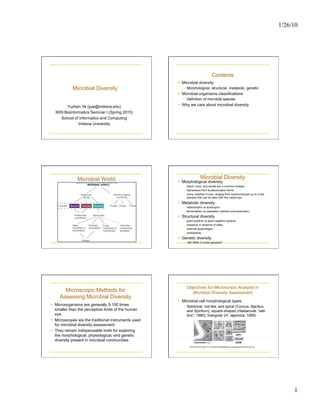
Microbial World Microbial Diversity
  Morphological diversity:
–  bacilli, cocci, and spirals are 3 common shapes
–  filamentous form & pleiomorphic forms
–  many varieties of size, ranging from submicroscopic up to a few
bacteria that can be seen with the naked eye.
  Metabolic diversity:
–  heterotrophs vs autotrophs
–  fermentation vs respiration (aerobic and anaerobic).
  Structural diversity
–  gram-positive vs gram-negative bacteria
–  presence or absence of walls
–  external appendages
–  endospores
  Genetic diversity
–  16S rRNA or entire genome?
Microscopic Methods for
Assessing Microbial Diversity
  Microorganisms are generally 5-100 times
smaller than the perceptive limits of the human
eye
  Microscopes are the traditional instruments used
for microbial diversity assessment
  They remain indispensable tools for exploring
the morphological, physiological, and genetic
diversity present in microbial communities
Objectives for Microscopic Analysis in
Microbial Diversity Assessment
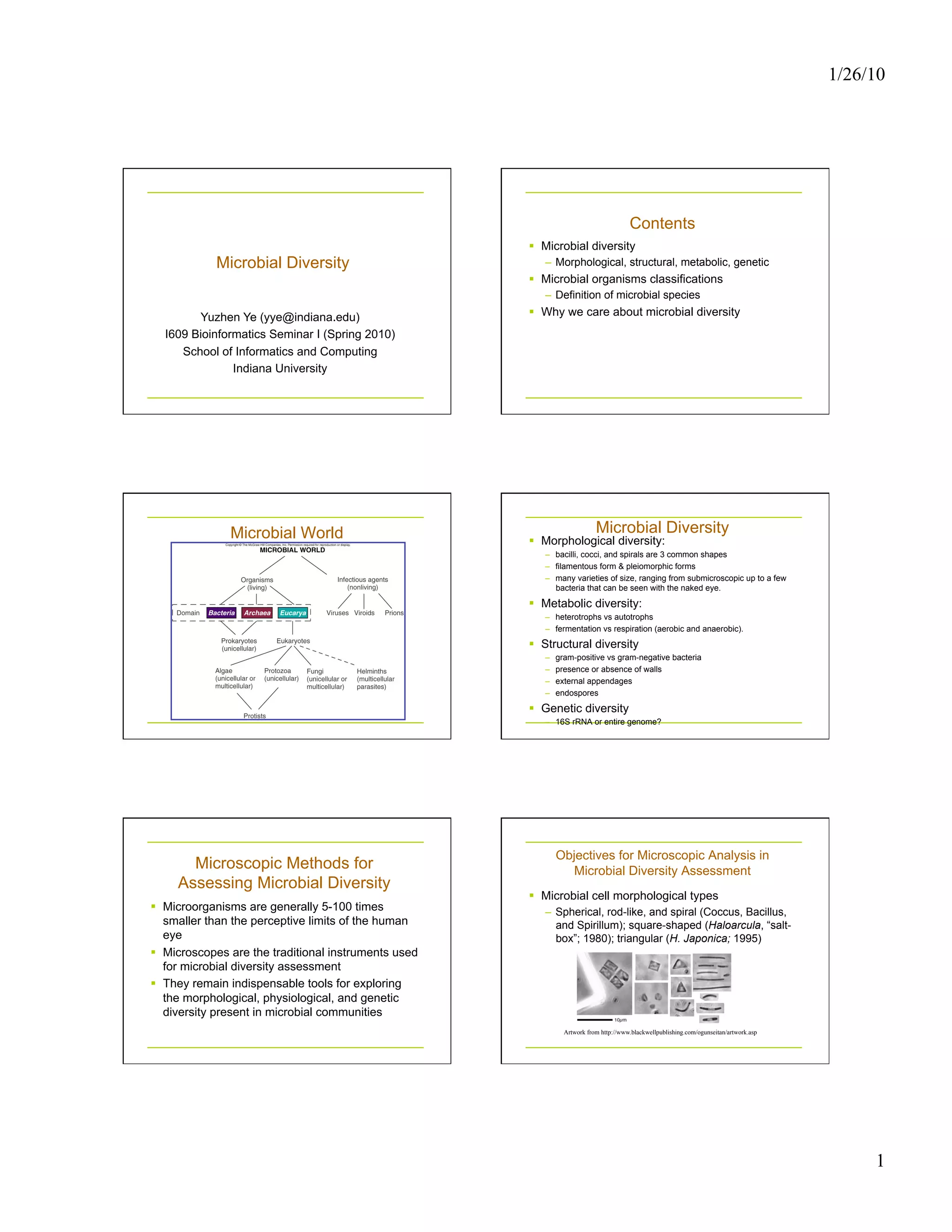
  Microbial cell morphological types
–  Spherical, rod-like, and spiral (Coccus, Bacillus,
and Spirillum); square-shaped (Haloarcula, “salt-
box”; 1980); triangular (H. Japonica; 1995)
Artwork from http://www.blackwellpublishing.com/ogunseitan/artwork.asp
1/26/10
2
Metabolic Classification of Life
Image from: http://www.blackwellpublishing.com/ogunseitan/artwork.asp
Autotrophs
Heterotrophs
Phototrophs
Chemotrophs
Cyanobacteria
Blue-green algae; obtain energy through photosynthesis
Molecular and Genomic Methods
  Molecules used for diversity estimate
–  Proteins
–  DNA
–  Fatty acids (lipids)
–  Carbohydrates
Signature Lipid Biomarkers
  Branched chain fatty acids with 9-20 atoms are
particularly useful in differentiating phylogenetic groups.
  PLFA (phospholipid fatty acids) taxonomic markers
–  Monoenoic PLFAs indicates Gram-negative bacteria and
cyanobacteria
–  Terminally branched chain fatty acids (TBCFA) are
characteristic of Gram-positive bacteria.
  Lipids in Archaea represents a distinctive feature of this
group of microbes, and they are involved in their survival
in extreme environments.
Protein Profiles
  Protein-based phylogenetic reconstruction is
likely to produce more robust measurements of
diversity than other non-coding sequences
  Traditionally focus on several phylogenetically
conserved molecules, cytochromes, protein
elongation factors, ATPases, etc
  31 phylogenetic markers defined by Ciccarelli et
al. Ref: Science, 311(5765):1283-1287, 2006)
16s rRNA
  rRNA: Ribosome RNA; S in 16S represents
Svedberg units
  Ribosome is composed of two subunits, named
based on how fast they sediment when subject
to centrifugation
–  prokaryotic 70S 50S (5S, 23S) 30S (16S)
–  eukaryotic 80S 60S (5S, 5.8S, 28S) 40S (18S)
1/26/10
3
16s rRNA Secondary Structure
Tree of 16s rRNA → Tree of Life?
rRNA is the most conserved
gene. For this reason, genes
that encode the rRNA (rDNA)
are sequenced to identify an
organism's taxonomic group,
calculate related groups, and
estimate rates of species
divergence
“Gold standard” (?)
1985 Lane et al. Rapid Determination of 16S Ribosomal RNA Sequences for Phylogenetic Analyses
1990 Woese et al. Towards a Natural System of Organisms: Proposal for the Domains Archaea,
Bacteria, and Eucarya
“What is a bacterial species?”
  On the genetic level, it is well accepted that two isolates
are part of the same species if their 16S rRNA genes
share at least 98% identity (or 97%?)
  “while many people had felt that genomics would clarify
the species concept in prokaryotes, it has actually done
the exact opposite and made it harder to define” (W. Ford
Doolittle)
–  recombination and gene transfer between a variety of
prokaryotic organisms
  The concept of a bacterial species appears to take
different forms depending on the scientific perspective
–  Escherichia coli and Shigella species are significantly
different based on genomic and clinical examinations
–  But they are the same species based on 16sRNA
The Concept of Species
  Reproductive isolation (however, morphology is
always the first pass method)
  Species we can be sure about; all higher
taxonomic levels we can argue about
  Common ancestor (for the genome as a set):
Phylogenies
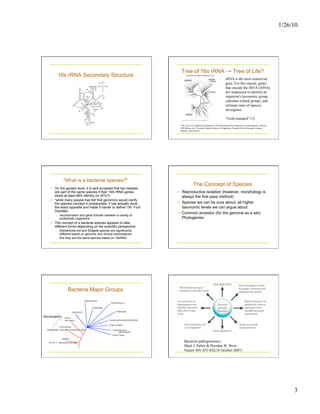
Bacteria Major Groups
thermophilic
(85-95o C. optimal growth temp)
(thermophilic, anaerobic, fermentative rods)
(phototrophs)
(proteobacteria)
Bacterial pathogenomics
Mark J. Pallen & Brendan W. Wren
Nature 449, 835-842(18 October 2007)
1/26/10
4
Applications of 16S rRNA
Sequencing
  Bacterial identification
  Study of the community structure (regarding
species diversity/distribution) of an
environmental community
  Sequencing of 16S rRNA hyper-variable regions
(instead of entire sequences) for identification of
species
–  454 sequencers (can not cover entire 16S rRNA
sequences, which are ~1500 nt).
Microbial Diversity and Geography
  Biogeochemical interactions
–  biogeochemical cycle is a circuit or pathway by
which a chemical element or molecule moves
through both biotic ("bio-") and abiotic ("geo-")
compartments of an ecosystem
  The “biocartography” collaborative project
–  Develop a geographically referenced database
containing microbiological and geochemical data
that can be used to support predictive models of
biogeochemical interactions, and to improve
access to biotechnologically important organisms
Microbial Diversity and Global
Environmental Issues
  Of what use is microbial diversity?
–  Biodiversity <-> environmental parameters
–  Using assessments of microbial diversity to detect
environmental change
–  Use such knowledge in the best service of
ecosystem restoration
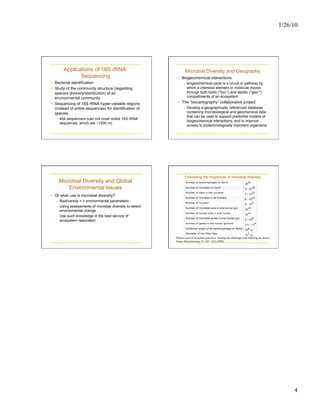
Estimating the magnitude of microbial diversity
Fifteen years of microbial genomics: meeting the challenges and fulfilling the dream
Nature Biotechnology 27, 627 - 632 (2009)

Microbe diversity-handout

  • 1.
    1/26/10 1 Microbial Diversity Yuzhen Ye(yye@indiana.edu) I609 Bioinformatics Seminar I (Spring 2010) School of Informatics and Computing Indiana University Contents   Microbial diversity –  Morphological, structural, metabolic, genetic   Microbial organisms classifications –  Definition of microbial species   Why we care about microbial diversity Microbial World Microbial Diversity   Morphological diversity: –  bacilli, cocci, and spirals are 3 common shapes –  filamentous form & pleiomorphic forms –  many varieties of size, ranging from submicroscopic up to a few bacteria that can be seen with the naked eye.   Metabolic diversity: –  heterotrophs vs autotrophs –  fermentation vs respiration (aerobic and anaerobic).   Structural diversity –  gram-positive vs gram-negative bacteria –  presence or absence of walls –  external appendages –  endospores   Genetic diversity –  16S rRNA or entire genome? Microscopic Methods for Assessing Microbial Diversity   Microorganisms are generally 5-100 times smaller than the perceptive limits of the human eye   Microscopes are the traditional instruments used for microbial diversity assessment   They remain indispensable tools for exploring the morphological, physiological, and genetic diversity present in microbial communities Objectives for Microscopic Analysis in Microbial Diversity Assessment   Microbial cell morphological types –  Spherical, rod-like, and spiral (Coccus, Bacillus, and Spirillum); square-shaped (Haloarcula, “salt- box”; 1980); triangular (H. Japonica; 1995) Artwork from http://www.blackwellpublishing.com/ogunseitan/artwork.asp
  • 2.
    1/26/10 2 Metabolic Classification ofLife Image from: http://www.blackwellpublishing.com/ogunseitan/artwork.asp Autotrophs Heterotrophs Phototrophs Chemotrophs Cyanobacteria Blue-green algae; obtain energy through photosynthesis Molecular and Genomic Methods   Molecules used for diversity estimate –  Proteins –  DNA –  Fatty acids (lipids) –  Carbohydrates Signature Lipid Biomarkers   Branched chain fatty acids with 9-20 atoms are particularly useful in differentiating phylogenetic groups.   PLFA (phospholipid fatty acids) taxonomic markers –  Monoenoic PLFAs indicates Gram-negative bacteria and cyanobacteria –  Terminally branched chain fatty acids (TBCFA) are characteristic of Gram-positive bacteria.   Lipids in Archaea represents a distinctive feature of this group of microbes, and they are involved in their survival in extreme environments. Protein Profiles   Protein-based phylogenetic reconstruction is likely to produce more robust measurements of diversity than other non-coding sequences   Traditionally focus on several phylogenetically conserved molecules, cytochromes, protein elongation factors, ATPases, etc   31 phylogenetic markers defined by Ciccarelli et al. Ref: Science, 311(5765):1283-1287, 2006) 16s rRNA   rRNA: Ribosome RNA; S in 16S represents Svedberg units   Ribosome is composed of two subunits, named based on how fast they sediment when subject to centrifugation –  prokaryotic 70S 50S (5S, 23S) 30S (16S) –  eukaryotic 80S 60S (5S, 5.8S, 28S) 40S (18S)
  • 3.
    1/26/10 3 16s rRNA SecondaryStructure Tree of 16s rRNA → Tree of Life? rRNA is the most conserved gene. For this reason, genes that encode the rRNA (rDNA) are sequenced to identify an organism's taxonomic group, calculate related groups, and estimate rates of species divergence “Gold standard” (?) 1985 Lane et al. Rapid Determination of 16S Ribosomal RNA Sequences for Phylogenetic Analyses 1990 Woese et al. Towards a Natural System of Organisms: Proposal for the Domains Archaea, Bacteria, and Eucarya “What is a bacterial species?”   On the genetic level, it is well accepted that two isolates are part of the same species if their 16S rRNA genes share at least 98% identity (or 97%?)   “while many people had felt that genomics would clarify the species concept in prokaryotes, it has actually done the exact opposite and made it harder to define” (W. Ford Doolittle) –  recombination and gene transfer between a variety of prokaryotic organisms   The concept of a bacterial species appears to take different forms depending on the scientific perspective –  Escherichia coli and Shigella species are significantly different based on genomic and clinical examinations –  But they are the same species based on 16sRNA The Concept of Species   Reproductive isolation (however, morphology is always the first pass method)   Species we can be sure about; all higher taxonomic levels we can argue about   Common ancestor (for the genome as a set): Phylogenies Bacteria Major Groups thermophilic (85-95o C. optimal growth temp) (thermophilic, anaerobic, fermentative rods) (phototrophs) (proteobacteria) Bacterial pathogenomics Mark J. Pallen & Brendan W. Wren Nature 449, 835-842(18 October 2007)
  • 4.
    1/26/10 4 Applications of 16SrRNA Sequencing   Bacterial identification   Study of the community structure (regarding species diversity/distribution) of an environmental community   Sequencing of 16S rRNA hyper-variable regions (instead of entire sequences) for identification of species –  454 sequencers (can not cover entire 16S rRNA sequences, which are ~1500 nt). Microbial Diversity and Geography   Biogeochemical interactions –  biogeochemical cycle is a circuit or pathway by which a chemical element or molecule moves through both biotic ("bio-") and abiotic ("geo-") compartments of an ecosystem   The “biocartography” collaborative project –  Develop a geographically referenced database containing microbiological and geochemical data that can be used to support predictive models of biogeochemical interactions, and to improve access to biotechnologically important organisms Microbial Diversity and Global Environmental Issues   Of what use is microbial diversity? –  Biodiversity <-> environmental parameters –  Using assessments of microbial diversity to detect environmental change –  Use such knowledge in the best service of ecosystem restoration Estimating the magnitude of microbial diversity Fifteen years of microbial genomics: meeting the challenges and fulfilling the dream Nature Biotechnology 27, 627 - 632 (2009)