Dr. Muhammad Khurram
B. Pharm., Ph. D.
Classification of Microorganisms
Objectives of this session..
 Taxonomy and its basis.
 How the organisms are named?
 Classifications basis in Prokaryotes
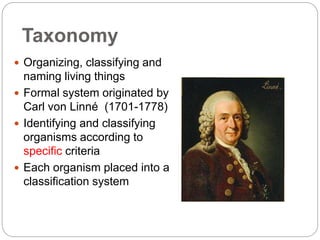
Taxonomy
 Organizing, classifying and
naming living things
 Formal system originated by
Carl von Linné (1701-1778)
 Identifying and classifying
organisms according to
specific criteria
 Each organism placed into a
classification system
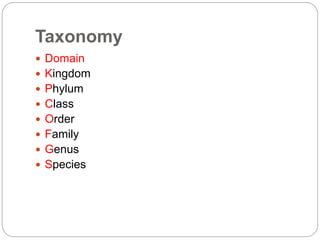
Taxonomy
 Domain
 Kingdom
 Phylum
 Class
 Order
 Family
 Genus
 Species
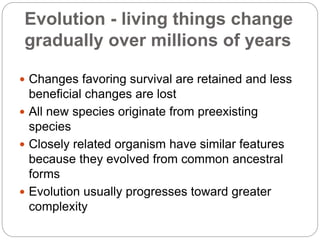
Evolution - living things change
gradually over millions of years
 Changes favoring survival are retained and less
beneficial changes are lost
 All new species originate from preexisting
species
 Closely related organism have similar features
because they evolved from common ancestral
forms
 Evolution usually progresses toward greater
complexity
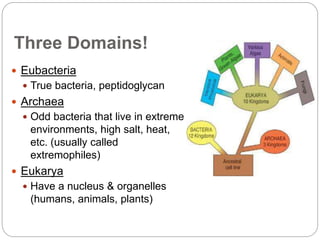
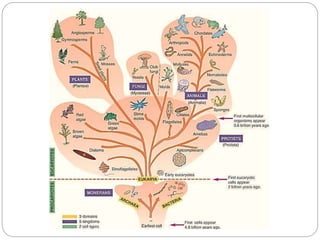
Three Domains!
 Eubacteria
 True bacteria, peptidoglycan
 Archaea
 Odd bacteria that live in extreme
environments, high salt, heat,
etc. (usually called
extremophiles)
 Eukarya
 Have a nucleus & organelles
(humans, animals, plants)
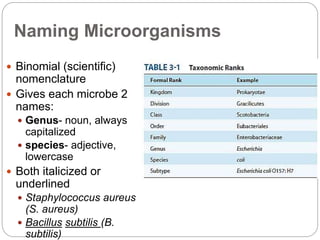
Naming Microorganisms
 Binomial (scientific)
nomenclature
 Gives each microbe 2
names:
 Genus- noun, always
capitalized
 species- adjective,
lowercase
 Both italicized or
underlined
 Staphylococcus aureus
(S. aureus)
 Bacillus subtilis (B.
subtilis)
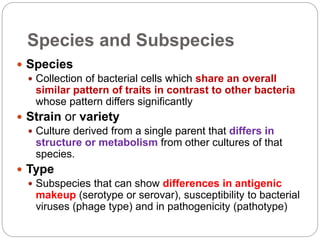
Species and Subspecies
 Species
 Collection of bacterial cells which share an overall
similar pattern of traits in contrast to other bacteria
whose pattern differs significantly
 Strain or variety
 Culture derived from a single parent that differs in
structure or metabolism from other cultures of that
species.
 Type
 Subspecies that can show differences in antigenic
makeup (serotype or serovar), susceptibility to bacterial
viruses (phage type) and in pathogenicity (pathotype)
Classification Basis in the
Prokaryotes
1. Growth on media
2. Microscopic morphology
3. Macroscopic morphology – colony
appearance
4. Biochemical characteristics
5. Serological analysis
6. Genetic and molecular analysis
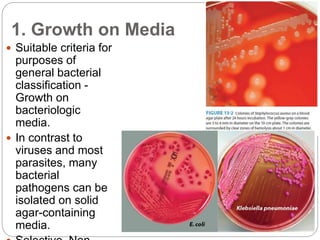
1. Growth on Media
 Suitable criteria for
purposes of
general bacterial
classification -
Growth on
bacteriologic
media.
 In contrast to
viruses and most
parasites, many
bacterial
pathogens can be
isolated on solid
agar-containing
media.
2. Microscopic morphology
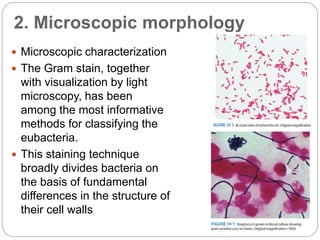
 Microscopic characterization
 The Gram stain, together
with visualization by light
microscopy, has been
among the most informative
methods for classifying the
eubacteria.
 This staining technique
broadly divides bacteria on
the basis of fundamental
differences in the structure of
their cell walls
3. Macroscopic
morphology – colony
appearance
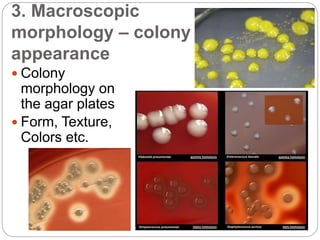
 Colony
morphology on
the agar plates
 Form, Texture,
Colors etc.
4. Biochemical Tests
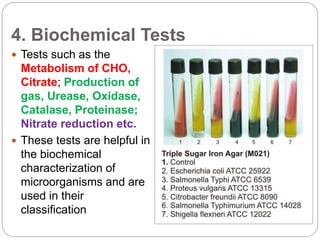
 Tests such as the
Metabolism of CHO,
Citrate; Production of
gas, Urease, Oxidase,
Catalase, Proteinase;
Nitrate reduction etc.
 These tests are helpful in
the biochemical
characterization of
microorganisms and are
used in their
classification
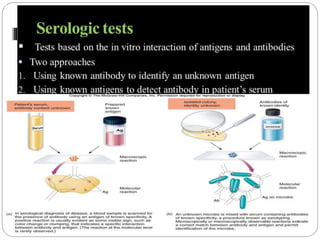
5. Serological analysis
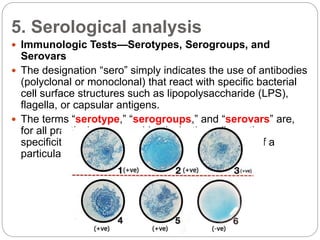
 Immunologic Tests—Serotypes, Serogroups, and
Serovars
 The designation “sero” simply indicates the use of antibodies
(polyclonal or monoclonal) that react with specific bacterial
cell surface structures such as lipopolysaccharide (LPS),
flagella, or capsular antigens.
 The terms “serotype,” “serogroups,” and “serovars” are,
for all practical purposes, identical—they all use the
specificity of these antibodies to subdivide strains of a
particular bacterial species.
6. Genetic and molecular
analysis
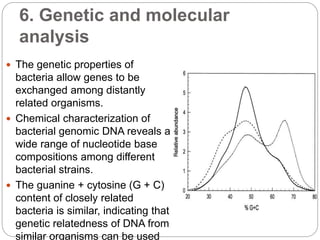
 The genetic properties of
bacteria allow genes to be
exchanged among distantly
related organisms.
 Chemical characterization of
bacterial genomic DNA reveals a
wide range of nucleotide base
compositions among different
bacterial strains.
 The guanine + cytosine (G + C)
content of closely related
bacteria is similar, indicating that
genetic relatedness of DNA from
similar organisms can be used
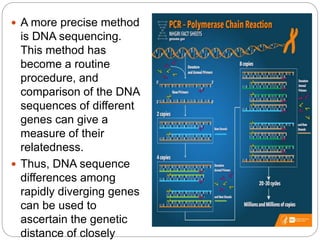
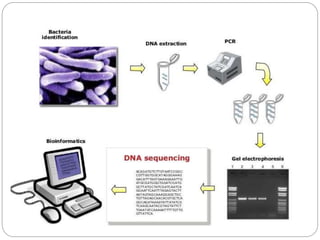
 A more precise method
is DNA sequencing.
This method has
become a routine
procedure, and
comparison of the DNA
sequences of different
genes can give a
measure of their
relatedness.
 Thus, DNA sequence
differences among
rapidly diverging genes
can be used to
ascertain the genetic
distance of closely
Nucleic acid based Taxonomy!
 Since 1975, developments in nucleic acid
isolation, amplification, and sequencing spurred
the evolution of nucleic acid–based subtyping
systems.
 These include Plasmid profile analysis;
Restriction Endonuclease analysis;
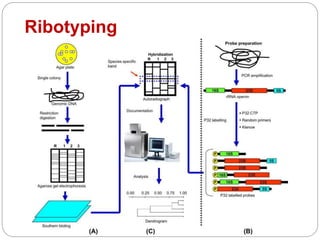
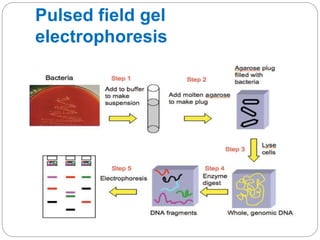
Ribotyping; Pulsed field gel electrophoresis;
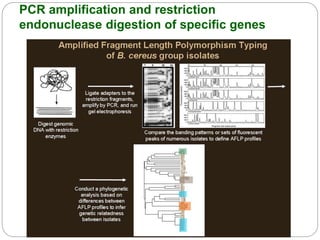
PCR amplification and restriction
endonuclease digestion of specific genes; and
Nucleic acid sequence analysis etc.
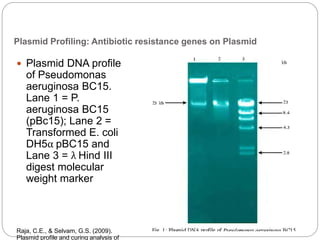
Plasmid Profiling: Antibiotic resistance genes on Plasmid
 Plasmid DNA profile
of Pseudomonas
aeruginosa BC15.
Lane 1 = P.
aeruginosa BC15
(pBc15); Lane 2 =
Transformed E. coli
DH5α pBC15 and
Lane 3 = λ Hind III
digest molecular
weight marker
Raja, C.E., & Selvam, G.S. (2009).
Plasmid profile and curing analysis of
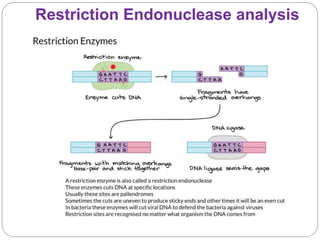
Restriction Endonuclease analysis
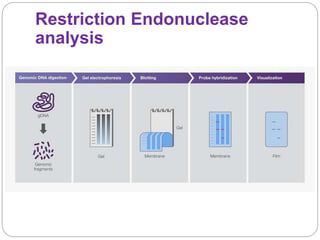
Restriction Endonuclease
analysis
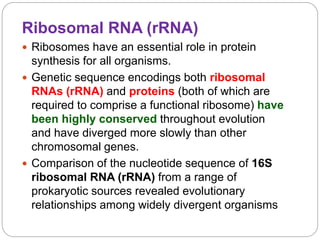
Ribosomal RNA (rRNA)
 Ribosomes have an essential role in protein
synthesis for all organisms.
 Genetic sequence encodings both ribosomal
RNAs (rRNA) and proteins (both of which are
required to comprise a functional ribosome) have
been highly conserved throughout evolution
and have diverged more slowly than other
chromosomal genes.
 Comparison of the nucleotide sequence of 16S
ribosomal RNA (rRNA) from a range of
prokaryotic sources revealed evolutionary
relationships among widely divergent organisms
Ribotyping
Pulsed field gel
electrophoresis
PCR amplification and restriction
endonuclease digestion of specific genes
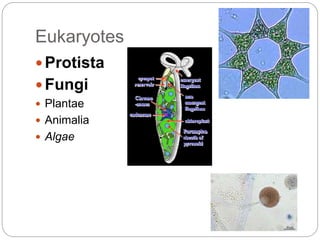
Eukaryotes
 Protista
 Fungi
 Plantae
 Animalia
 Algae

Classification of microorganisms

  • 1.
    Dr. Muhammad Khurram B.Pharm., Ph. D. Classification of Microorganisms
  • 2.
    Objectives of thissession..  Taxonomy and its basis.  How the organisms are named?  Classifications basis in Prokaryotes
  • 3.
    Taxonomy  Organizing, classifyingand naming living things  Formal system originated by Carl von Linné (1701-1778)  Identifying and classifying organisms according to specific criteria  Each organism placed into a classification system
  • 4.
    Taxonomy  Domain  Kingdom Phylum  Class  Order  Family  Genus  Species
  • 5.
    Evolution - livingthings change gradually over millions of years  Changes favoring survival are retained and less beneficial changes are lost  All new species originate from preexisting species  Closely related organism have similar features because they evolved from common ancestral forms  Evolution usually progresses toward greater complexity
  • 6.
    Three Domains!  Eubacteria True bacteria, peptidoglycan  Archaea  Odd bacteria that live in extreme environments, high salt, heat, etc. (usually called extremophiles)  Eukarya  Have a nucleus & organelles (humans, animals, plants)
  • 8.
    Naming Microorganisms  Binomial(scientific) nomenclature  Gives each microbe 2 names:  Genus- noun, always capitalized  species- adjective, lowercase  Both italicized or underlined  Staphylococcus aureus (S. aureus)  Bacillus subtilis (B. subtilis)
  • 9.
    Species and Subspecies Species  Collection of bacterial cells which share an overall similar pattern of traits in contrast to other bacteria whose pattern differs significantly  Strain or variety  Culture derived from a single parent that differs in structure or metabolism from other cultures of that species.  Type  Subspecies that can show differences in antigenic makeup (serotype or serovar), susceptibility to bacterial viruses (phage type) and in pathogenicity (pathotype)
  • 10.
    Classification Basis inthe Prokaryotes 1. Growth on media 2. Microscopic morphology 3. Macroscopic morphology – colony appearance 4. Biochemical characteristics 5. Serological analysis 6. Genetic and molecular analysis
  • 11.
    1. Growth onMedia  Suitable criteria for purposes of general bacterial classification - Growth on bacteriologic media.  In contrast to viruses and most parasites, many bacterial pathogens can be isolated on solid agar-containing media.
  • 12.
    2. Microscopic morphology Microscopic characterization  The Gram stain, together with visualization by light microscopy, has been among the most informative methods for classifying the eubacteria.  This staining technique broadly divides bacteria on the basis of fundamental differences in the structure of their cell walls
  • 13.
    3. Macroscopic morphology –colony appearance  Colony morphology on the agar plates  Form, Texture, Colors etc.
  • 14.
    4. Biochemical Tests Tests such as the Metabolism of CHO, Citrate; Production of gas, Urease, Oxidase, Catalase, Proteinase; Nitrate reduction etc.  These tests are helpful in the biochemical characterization of microorganisms and are used in their classification
  • 15.
    5. Serological analysis Immunologic Tests—Serotypes, Serogroups, and Serovars  The designation “sero” simply indicates the use of antibodies (polyclonal or monoclonal) that react with specific bacterial cell surface structures such as lipopolysaccharide (LPS), flagella, or capsular antigens.  The terms “serotype,” “serogroups,” and “serovars” are, for all practical purposes, identical—they all use the specificity of these antibodies to subdivide strains of a particular bacterial species.
  • 17.
    6. Genetic andmolecular analysis  The genetic properties of bacteria allow genes to be exchanged among distantly related organisms.  Chemical characterization of bacterial genomic DNA reveals a wide range of nucleotide base compositions among different bacterial strains.  The guanine + cytosine (G + C) content of closely related bacteria is similar, indicating that genetic relatedness of DNA from similar organisms can be used
  • 18.
     A moreprecise method is DNA sequencing. This method has become a routine procedure, and comparison of the DNA sequences of different genes can give a measure of their relatedness.  Thus, DNA sequence differences among rapidly diverging genes can be used to ascertain the genetic distance of closely
  • 20.
    Nucleic acid basedTaxonomy!  Since 1975, developments in nucleic acid isolation, amplification, and sequencing spurred the evolution of nucleic acid–based subtyping systems.  These include Plasmid profile analysis; Restriction Endonuclease analysis; Ribotyping; Pulsed field gel electrophoresis; PCR amplification and restriction endonuclease digestion of specific genes; and Nucleic acid sequence analysis etc.
  • 21.
    Plasmid Profiling: Antibioticresistance genes on Plasmid  Plasmid DNA profile of Pseudomonas aeruginosa BC15. Lane 1 = P. aeruginosa BC15 (pBc15); Lane 2 = Transformed E. coli DH5α pBC15 and Lane 3 = λ Hind III digest molecular weight marker Raja, C.E., & Selvam, G.S. (2009). Plasmid profile and curing analysis of
  • 22.
  • 23.
  • 24.
    Ribosomal RNA (rRNA) Ribosomes have an essential role in protein synthesis for all organisms.  Genetic sequence encodings both ribosomal RNAs (rRNA) and proteins (both of which are required to comprise a functional ribosome) have been highly conserved throughout evolution and have diverged more slowly than other chromosomal genes.  Comparison of the nucleotide sequence of 16S ribosomal RNA (rRNA) from a range of prokaryotic sources revealed evolutionary relationships among widely divergent organisms
  • 25.
  • 26.
  • 27.
    PCR amplification andrestriction endonuclease digestion of specific genes
  • 28.
    Eukaryotes  Protista  Fungi Plantae  Animalia  Algae