Macro & Micro Sociology
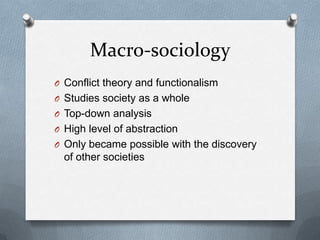
Macro-sociologyConflict theory and functionalismStudies society as a wholeTop-down analysisHigh level of abstractionOnly became possible with the discovery of other societies
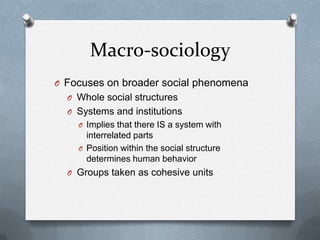
Macro-sociologyFocuses on broader social phenomenaWhole social structuresSystems and institutionsImplies that there IS a system with interrelated partsPosition within the social structure determines human behaviorGroups taken as cohesive units
Empire“We have witnessed an irresistible and irreversible globalization of economic and cultural exchanges.  Along with the global market and global circuits of production has emerged a global order, a new logic and structure of rule – in short, a new form of sovereignty.  Empire is the political subject that effectively regulates these global exchanges, the sovereign power that governs the world.”
Empire“The concept of Empire is characterized fundamentally by a lack of boundaries: Empire’s rule has no limits.”“The rule of Empire operates on all registers of the social order extending down to the depths of the social world.  Empire not only manages a territory and a population but also creates the very world it inhabits.  It not only regulates human interactions but also seeks directly to rule over human nature.”
Micro-sociologySymbolic interactionismStudy of society at its “smallest”How things work at the one-on-one, person-to-person levelHow and why people make decisions from moment to momentTaking into account both their individual needs and their social circumstances
Micro-sociologyFocuses on the interactions of individuals and the context of those interactionsHuman behavior is based on individuals’ interpretation of a situation and the meaning they give itFocuses on the actions of individuals in groupsHow the group affects us, our values, beliefs and behaviors
The Cheese and the Worms“In the past historians could be accused of wanting to know only about ‘the great deeds of kings,’ but today this is certainly no longer true.  More and more they are turning toward what their predecessors passed over in silence, discarded, or simply ignored.  ‘Who build Thebes of the seven gates”’  Bertold Brecht’s ‘literate worker’ was already asking.  The sources tell us nothing about these anonymous masons, but the question retains all its significance.”
The Cheese and the Worms“This book relates the story of a miller of the Friuli, DomenicoScandella, called Menocchio, who was burned at the stake by order of the Holy Office after a life passed in almost complete obscurity.  The records of his two trials, held fifteen years apart, offer a rich picture of his thoughts and feelings, of his imaginings and aspirations.  Other documents give us information about his economic activities and the lives of his children.  We even have pages in his own hand and a partial list of what he read (he was, in fact, able to read and write).”
The Cheese and the Worms“Only through the concept of ‘primitive culture’ have we come to recognize that those who were once paternalistically described as ‘the common people in civilized society’ in fact possessed a culture of their own…f only verbally we have now gone beyond not only the antiquated conception of folklore as the mere collecting of curious facts but also the attitude that saw in the ideas, beliefs, and world views of the lower classes nothing but an incoherent fragmentary mass of theories that has been originally worked out by the dominant classes perhaps many centuries before.”

Micro macro

  • 1.
    Macro & MicroSociology
  • 2.
    Macro-sociologyConflict theory andfunctionalismStudies society as a wholeTop-down analysisHigh level of abstractionOnly became possible with the discovery of other societies
  • 3.
    Macro-sociologyFocuses on broadersocial phenomenaWhole social structuresSystems and institutionsImplies that there IS a system with interrelated partsPosition within the social structure determines human behaviorGroups taken as cohesive units
  • 4.
    Empire“We have witnessedan irresistible and irreversible globalization of economic and cultural exchanges. Along with the global market and global circuits of production has emerged a global order, a new logic and structure of rule – in short, a new form of sovereignty. Empire is the political subject that effectively regulates these global exchanges, the sovereign power that governs the world.”
  • 5.
    Empire“The concept ofEmpire is characterized fundamentally by a lack of boundaries: Empire’s rule has no limits.”“The rule of Empire operates on all registers of the social order extending down to the depths of the social world. Empire not only manages a territory and a population but also creates the very world it inhabits. It not only regulates human interactions but also seeks directly to rule over human nature.”
  • 6.
    Micro-sociologySymbolic interactionismStudy ofsociety at its “smallest”How things work at the one-on-one, person-to-person levelHow and why people make decisions from moment to momentTaking into account both their individual needs and their social circumstances
  • 7.
    Micro-sociologyFocuses on theinteractions of individuals and the context of those interactionsHuman behavior is based on individuals’ interpretation of a situation and the meaning they give itFocuses on the actions of individuals in groupsHow the group affects us, our values, beliefs and behaviors
  • 8.
    The Cheese andthe Worms“In the past historians could be accused of wanting to know only about ‘the great deeds of kings,’ but today this is certainly no longer true. More and more they are turning toward what their predecessors passed over in silence, discarded, or simply ignored. ‘Who build Thebes of the seven gates”’ Bertold Brecht’s ‘literate worker’ was already asking. The sources tell us nothing about these anonymous masons, but the question retains all its significance.”
  • 9.
    The Cheese andthe Worms“This book relates the story of a miller of the Friuli, DomenicoScandella, called Menocchio, who was burned at the stake by order of the Holy Office after a life passed in almost complete obscurity. The records of his two trials, held fifteen years apart, offer a rich picture of his thoughts and feelings, of his imaginings and aspirations. Other documents give us information about his economic activities and the lives of his children. We even have pages in his own hand and a partial list of what he read (he was, in fact, able to read and write).”
  • 10.
    The Cheese andthe Worms“Only through the concept of ‘primitive culture’ have we come to recognize that those who were once paternalistically described as ‘the common people in civilized society’ in fact possessed a culture of their own…f only verbally we have now gone beyond not only the antiquated conception of folklore as the mere collecting of curious facts but also the attitude that saw in the ideas, beliefs, and world views of the lower classes nothing but an incoherent fragmentary mass of theories that has been originally worked out by the dominant classes perhaps many centuries before.”