Social Structure & Groups
Social StructureSocial structureSociety is organized in a way that makes human behavior and relationships predictableHuman behavior is socially patterned
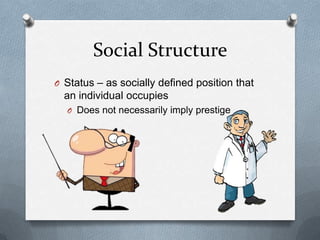
Social StructureStatus – as socially defined position that an individual occupiesDoes not necessarily imply prestige
Social StructureAscribed statusObtained involuntarily or without effort on the part of the individualAchieved statusA status that you choose voluntarily or attain through effort or ability
Social StructureMaster statusA particular status that stands out among all others you occupy and shapes both how you and other people view you
Social StructureRoles – set of expectations and behaviors associated with your status in a given group or societyPrescribed role – what society suggest we doRole perception – individual’s understanding of their roleRole performance – what an individual actually does
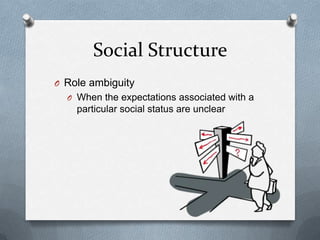
Social StructureRole ambiguityWhen the expectations associated with a particular social status are unclear
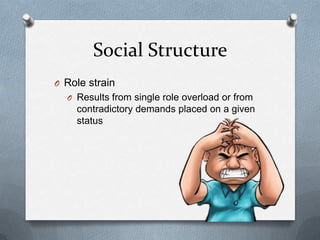
Social StructureRole strainResults from single role overload or from contradictory demands placed on a given status
Social StructureRole conflictWhen the demands or expectations associated with two or more statuses interfere with each other or are incompatibleRole confusionDifficulty determining which role to play
Social StructureZimbardo’s prison experimentStandford 1971Prisoner’s and guards in a mock prisonEven affected Zimbardo as the Prison SuperintendentOnly lasted 6 days
Social GroupsWe are influenced by the groups we currently belong to and those we identify with, but also by those we associated with in the pastGroup – two or more people who have something in commonDefinition is not universal“Group” can be many things
Social GroupsStatistical groupsFormed not by the group members themselves but by sociologists and statisticiansCategorical groupA number of people who share a common characteristic
Social GroupsLimited social groupsInteract minimallyMembers are generally not concerned with the feelings and attitudes of othersAggregate – group consisting of a collection of people who are together in one place and socialize very littleAssociational/organization – people who join together in some organized way to pursue a common interest
Social GroupsSocial groupsInvolves some type of interaction, a sense of belonging, or membership, shared interests or agreements on values, norms and goals, and a structure (definable, recognizable arrangement of parts)
Social GroupsPrimary groupsSmall, informal groups of people who interact in a personal, direct and intimate wayMost important thing in shaping our personalityMembers are emotionally attached“We”
Social GroupsSecondary groupsGroups whose members interact in an impersonal manner, have few emotional ties, and come together for a specific practical purposeMost of our time is spent in these groups
Social GroupsDyadTwo peopleEach has a responsibility to interactMaintain individualityTriadThree peopleIf one person drops out, the group can still surviveThreat of a dyad forming and isolating the third member
Social GroupsIn-groupSocial category to which persons feel they belong and in which the members have a consciousness and awareness of kindOut-groupsA group to which we feel we do not belong“Us from them”In-group stereotypes out-groupsPerceived threat from the out-group strengthens in-group solidarity

Structure and groups

  • 1.
  • 3.
    Social StructureSocial structureSocietyis organized in a way that makes human behavior and relationships predictableHuman behavior is socially patterned
  • 4.
    Social StructureStatus –as socially defined position that an individual occupiesDoes not necessarily imply prestige
  • 5.
    Social StructureAscribed statusObtainedinvoluntarily or without effort on the part of the individualAchieved statusA status that you choose voluntarily or attain through effort or ability
  • 6.
    Social StructureMaster statusAparticular status that stands out among all others you occupy and shapes both how you and other people view you
  • 7.
    Social StructureRoles –set of expectations and behaviors associated with your status in a given group or societyPrescribed role – what society suggest we doRole perception – individual’s understanding of their roleRole performance – what an individual actually does
  • 8.
    Social StructureRole ambiguityWhenthe expectations associated with a particular social status are unclear
  • 9.
    Social StructureRole strainResultsfrom single role overload or from contradictory demands placed on a given status
  • 10.
    Social StructureRole conflictWhenthe demands or expectations associated with two or more statuses interfere with each other or are incompatibleRole confusionDifficulty determining which role to play
  • 11.
    Social StructureZimbardo’s prisonexperimentStandford 1971Prisoner’s and guards in a mock prisonEven affected Zimbardo as the Prison SuperintendentOnly lasted 6 days
  • 13.
    Social GroupsWe areinfluenced by the groups we currently belong to and those we identify with, but also by those we associated with in the pastGroup – two or more people who have something in commonDefinition is not universal“Group” can be many things
  • 14.
    Social GroupsStatistical groupsFormednot by the group members themselves but by sociologists and statisticiansCategorical groupA number of people who share a common characteristic
  • 15.
    Social GroupsLimited socialgroupsInteract minimallyMembers are generally not concerned with the feelings and attitudes of othersAggregate – group consisting of a collection of people who are together in one place and socialize very littleAssociational/organization – people who join together in some organized way to pursue a common interest
  • 16.
    Social GroupsSocial groupsInvolvessome type of interaction, a sense of belonging, or membership, shared interests or agreements on values, norms and goals, and a structure (definable, recognizable arrangement of parts)
  • 17.
    Social GroupsPrimary groupsSmall,informal groups of people who interact in a personal, direct and intimate wayMost important thing in shaping our personalityMembers are emotionally attached“We”
  • 18.
    Social GroupsSecondary groupsGroupswhose members interact in an impersonal manner, have few emotional ties, and come together for a specific practical purposeMost of our time is spent in these groups
  • 19.
    Social GroupsDyadTwo peopleEachhas a responsibility to interactMaintain individualityTriadThree peopleIf one person drops out, the group can still surviveThreat of a dyad forming and isolating the third member
  • 20.
    Social GroupsIn-groupSocial categoryto which persons feel they belong and in which the members have a consciousness and awareness of kindOut-groupsA group to which we feel we do not belong“Us from them”In-group stereotypes out-groupsPerceived threat from the out-group strengthens in-group solidarity

Editor's Notes

  • #12 http://www.youtube.com/watch?v=Z0jYx8nwjFQ