Determine the basic sociological
foundations of education which
would help us become socially
aware of our responsibilities not
only to ourselves but to our society
as well.
Sociology and the
Socialization Process
What do we mean by
“Sociology”?
What is Sociology?
The term “Sociology” is
derived from the Latin
“Socius” which means “social
or being with others”; and
the Greek “logos” which
means “study”.
Therefore, the term
“Sociology” basically means
the “study of social beings”.
In other words, “Sociology is
the science of society and
the social interactions
taking place within it.”
SOCIALIZATION
Socialization is the process
whereby an individual learns to
appreciate the meaning and
values that exist in the culture at
large and eventually internalizes
such beliefs and values as guides
for human conduct.
SOCIALIZATION
STRUCTURAL
PERSPECTIVE
INTERPERSONAL
PERSPECTIVE
STRUCTURAL PERSPECTIVE
Socialization is viewed from
the very structure or
positions with corresponding
roles that are made available by
the members of a particular
social unit.
Society
SCHOOL
FAMILY
CHURCH
OTHERS
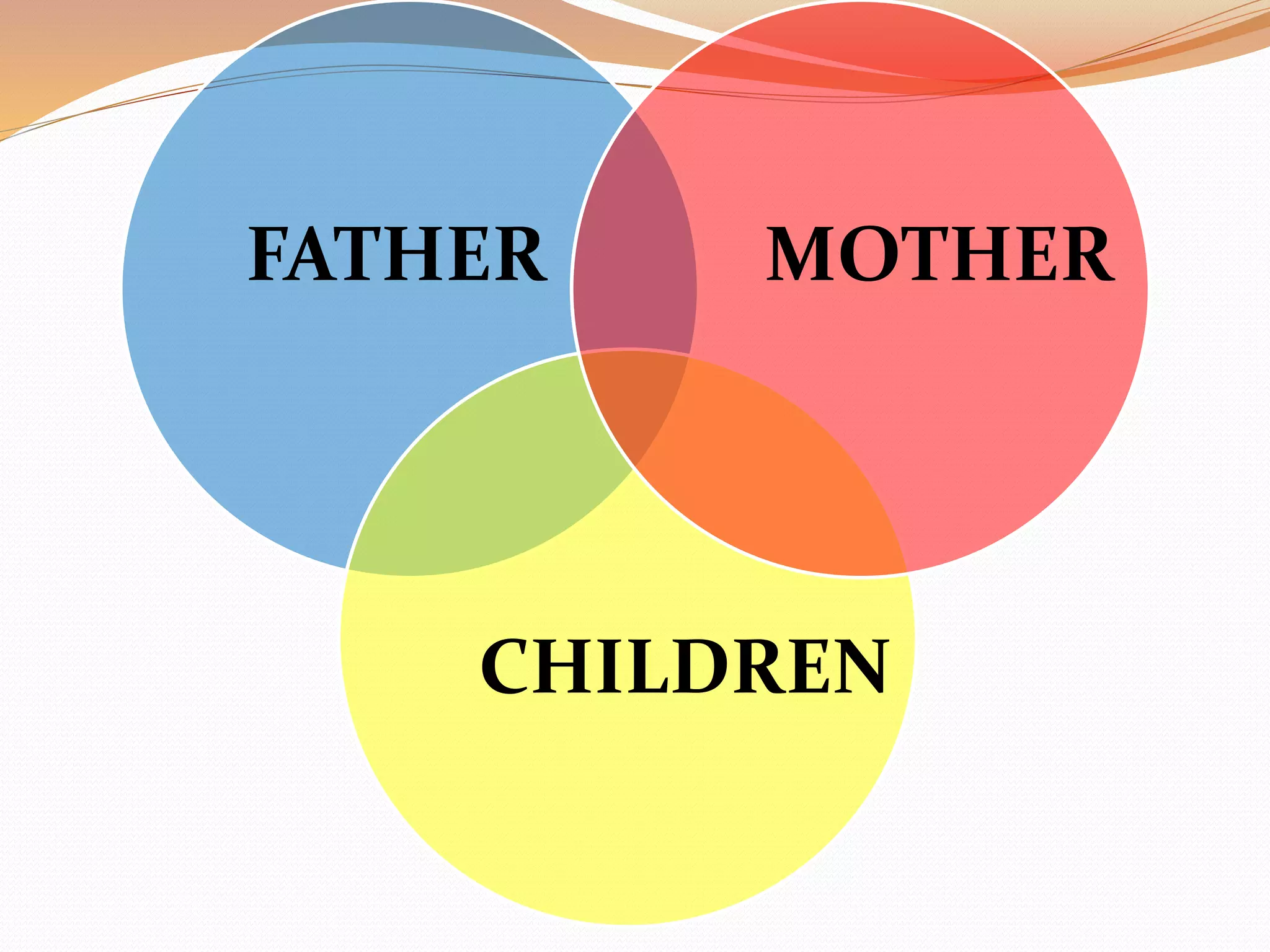
MOTHERFATHER
CHILDREN
THE STRUCTURAL
PERSPECTIVE
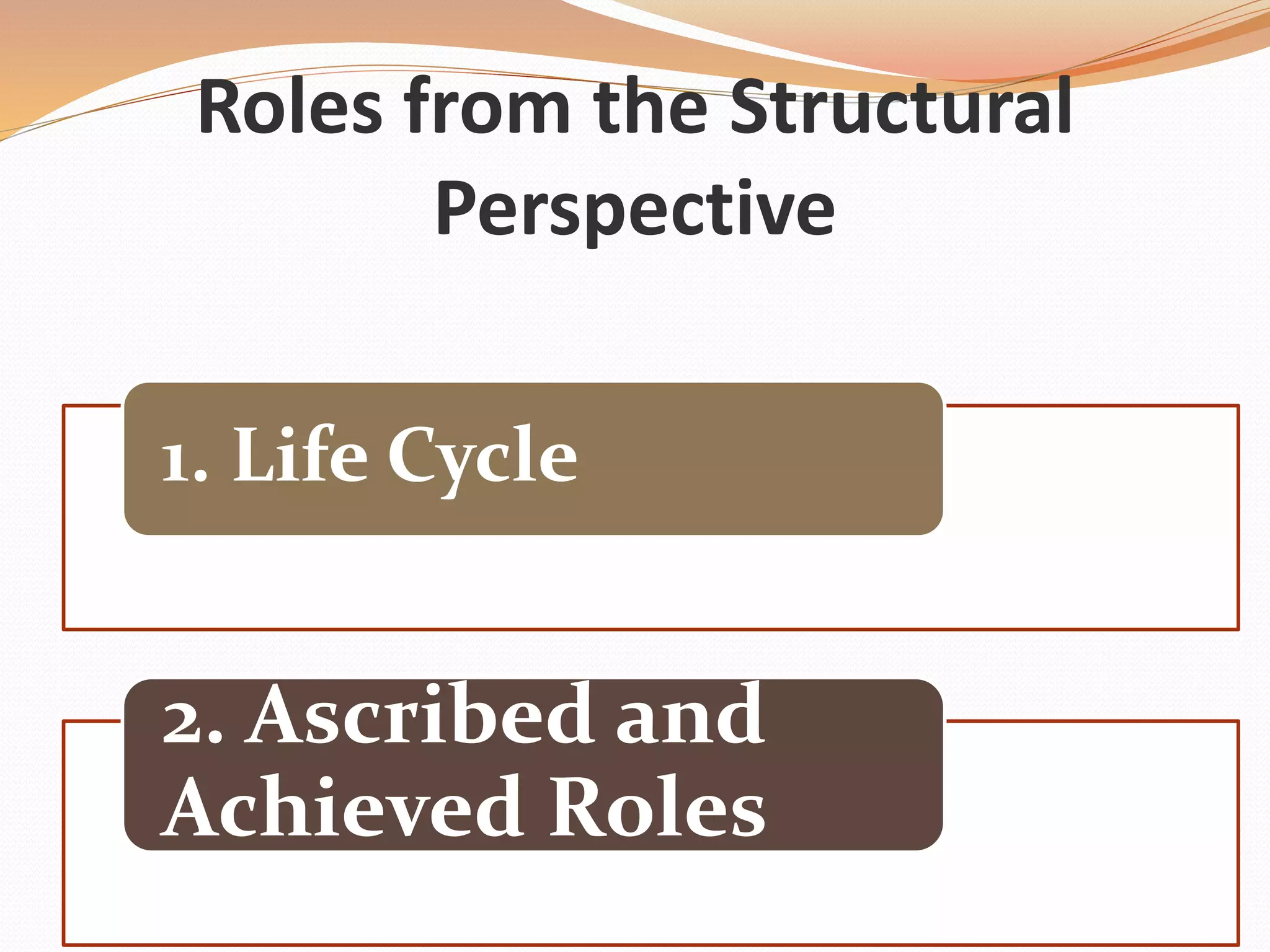
Roles from the Structural
Perspective
1. Life Cycle
2. Ascribed and
Achieved Roles
These are recognized roles
attached to every cycle or
stage of life that we go
through.
Life Cycle
Ascribed roles– those that
come with positions that are
attributed to individuals by
society, and these roles are
played according to society’s
expectations.
Ascribed Roles
Achieved roles– those that
we attain because we desire
to do so and because we are
capable of them.
Achieved Roles
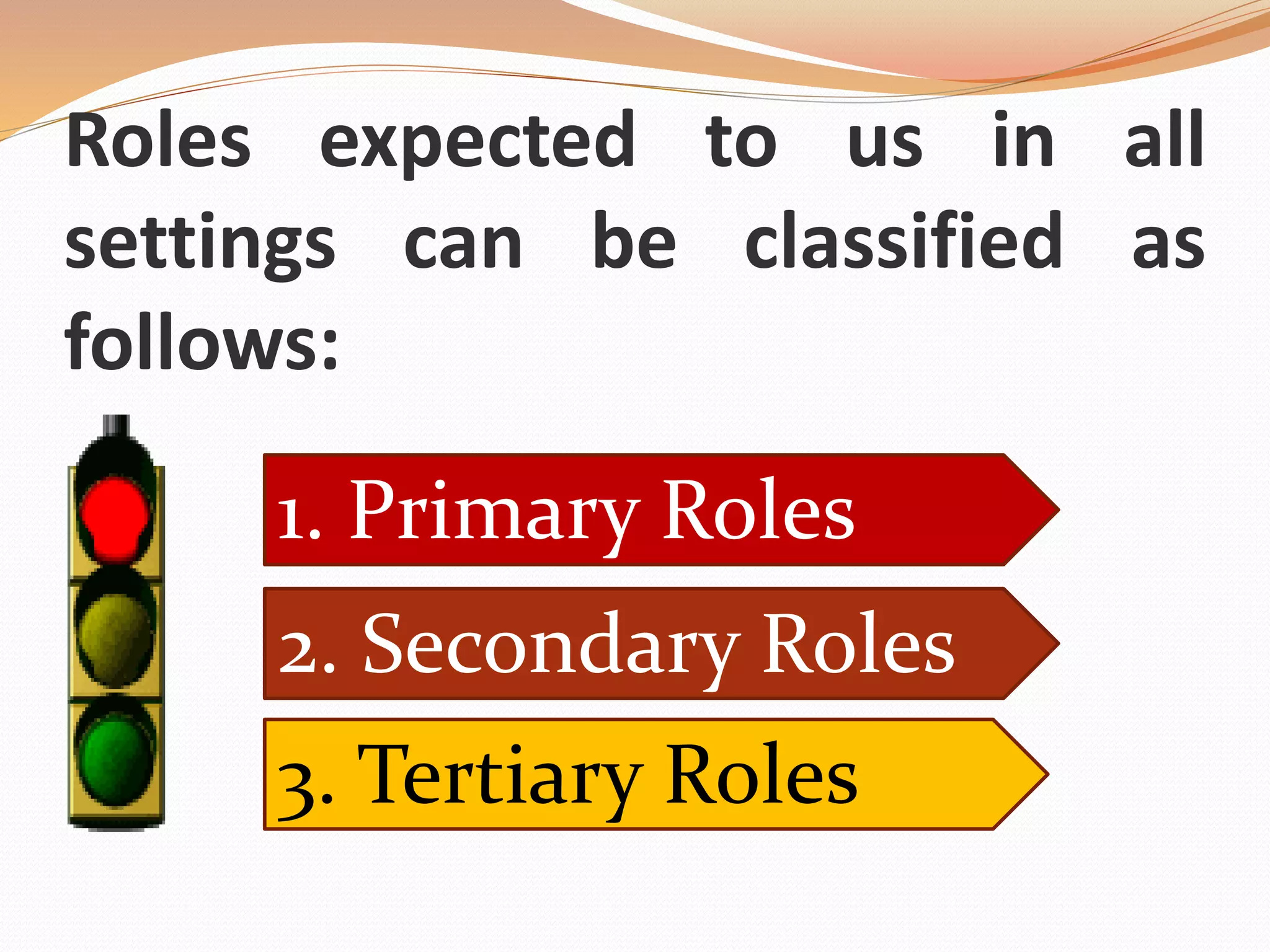
Roles expected to us in all
settings can be classified as
follows:
1. Primary Roles
2. Secondary Roles
3. Tertiary Roles
These are the roles we play all
the time, such as sex role.
1. Primary Roles
These refer to roles that are
played in some, but not all
settings, and which form a
large and important part of
what we learn.
2. Secondary Roles
These are the roles that are
played only in one setting.
3. Tertiary Roles
1. Socialization, from the
structural viewpoint, is
undergone by an individual,
in the positions and roles that
correspond to such, that are
attribute by the social unit(s).
2. Man exposed to a life cycle
of positions and roles which
implies that socialization is a
lifetime process.
3. Roles vary according to
positions, just as positions
may vary. Socialization,
therefore, is a process of
adaptation.
THE INTERPERSONAL
PERSPECTIVE
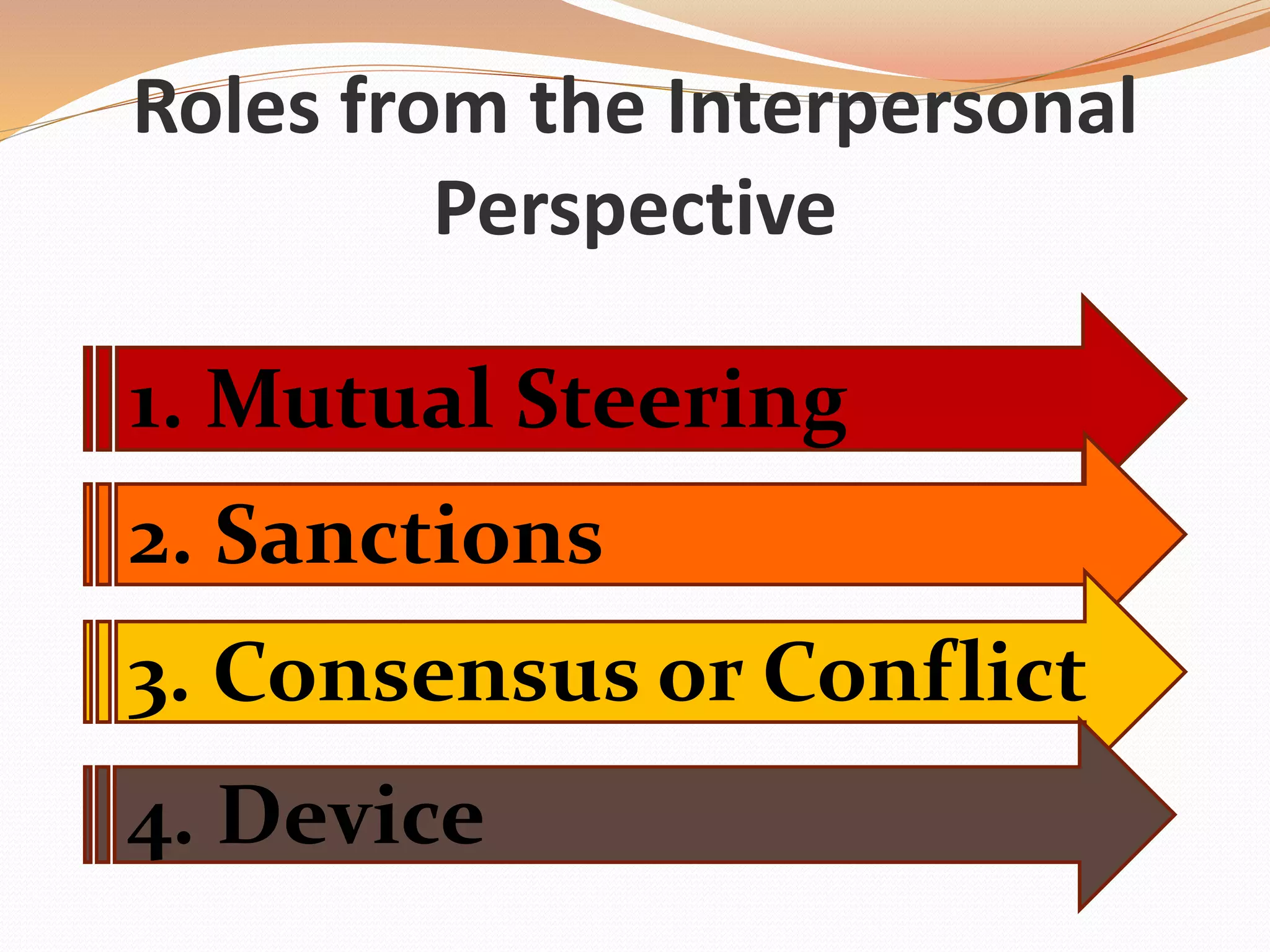
Roles from the Interpersonal
Perspective
1. Mutual Steering
2. Sanctions
3. Consensus or Conflict
4. Device
This is the process of giving
and soliciting feedback
between two or more
individuals, for the purpose
of stimulating each or one
another.
1. Mutual Steering
These are measures applied
to guarantee that an
individual behaves according
to expectations.
2. Sanctions
SANCTIONS
PUNISHMENTSREWARDS
PHYSICAL
MATERIAL
IMMATERIAL
Consensus refers to the way
of upholding a system of
values and behaviors in
agreement with others.
3.1 Consensus
Conflict refers to the
situation in which there is a
disagreement between or
among people.
3.2 Conflict
This refers to individuals who
never behave according to
expectations of others, or to
all those whose behaviors fall
outside of the social norms.
4. Device
SOCIALIZATION INTO
SOCIETY
Socialization can be
considered as a molding and
as a creating process, in
which the culture of the
group is transmitted to the
infant, and in which the
thoughts, inner feelings and
behaviors of the growing
individual gradually develop
on the basis of that culture or
set of values of the group to
which he belongs.
The General Pattern of the
Individual’s Socialization into
Society
1. He learns to appreciate
shared beliefs, meanings and
values that exists and he uses
these as guides for his own
conduct.
2. As he grows older, he takes
on roles and learns to behave
according to expectations of
the group or groups to which
he belongs. This process of
playing his roles is facilitated
by his interactions with
others.
3. As he learns how to play
his roles in accordance with
other’s expectations, he also
becomes more skillful in

interacting with other
people, thus learning not

only the ways of his
immediate culture but of a
larger society.
Sociological foundation of education

Sociological foundation of education