Association
Made by Agamani Saha
Association
Association means pursuing ends . Men have diverse needs , desires and
interests and ends , which demand their satisfaction . They have three ways of
fulfilling their ends :-
• Firstly , they may act independently , each in his own way without bothering about
others.
• Secondly , men may seek their ends through conflicts with one another.
• Thirdly , men may try to fulfil their ends through co-operation and mutual
assistance . This co-operative pursuit has a reference to ‘association’ . It is
spontaneous.
2
DEFINITIONS
We define an association , then, as a group organized for the pursuit of an interest or
group of interests in common.
Definitions:-
• An association is “an organization deliberately formed for the collective pursuit of
some interest or a set of interests , which its member share.” (R.M. MacIver)
• An association is “a group of social beings related to one another by the fact that
they possess or have instituted in common an organisation with a view of securing
a specific end or specific ends.” (Morris Ginsberg)
3
EXAMPLES
• Political Associations – The Bharatiya Janata Party , The Congress
Party , etc
• Religious Associations – The Vishwa Hindu Parishad , The
Ramakrishna Mission , The Arya Samaj , etc.
• Student’s Association – The Akhil Bharatiya Vidyarthi Parishad, Delhi
University Student’s Association , etc.
• Labourer’s Association – Bharatiya Mazdoor Sangha , The Hindu
Mazdoor Pachayat
4
EXAMPLES
• Professional Associations – Karnataka State College
Teacher’s Association , Indian Medical Association ,
etc.
• Economic Associations/Business Organizations –
Business Corporation , Hotel Owner’s Association
• International Associations – The Rotary Club , The
Lion’s Club
5
Main Characteristics
of Association
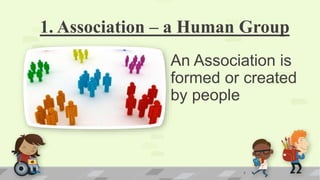
1. Association – a Human Group
An Association is
formed or created
by people
7
2. Common Interest or Interests
It consists of those
individuals who
have more or less
than same interest.
8
3. Co-operative Spirit
An association is
based on the co-
operative spirit of its
members.
9
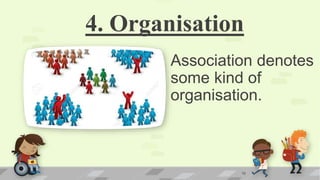
4. Organisation
Association denotes
some kind of
organisation.
10
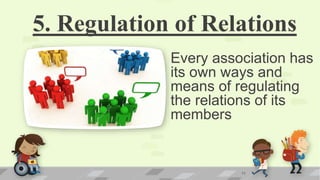
5. Regulation of Relations
Every association has
its own ways and
means of regulating
the relations of its
members
11
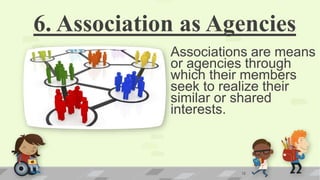
6. Association as Agencies
Associations are means
or agencies through
which their members
seek to realize their
similar or shared
interests.
12
7. Durability of Association
An Association may
be permanent or
temporary.
13
8. Different Entity
An Association
has a different
entity
14
9. Comparative Permanence
Goals of association
have consistency . That
is why every
association has a
comparative
permanence.
15
10. Transmission of Ideas
Proff. Giddings :-
Associations act as
agents of
transmission of ideas
among members
16
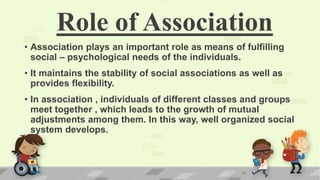
Role of Association
• Association plays an important role as means of fulfilling
social – psychological needs of the individuals.
• It maintains the stability of social associations as well as
provides flexibility.
• In association , individuals of different classes and groups
meet together , which leads to the growth of mutual
adjustments among them. In this way, well organized social
system develops.
17
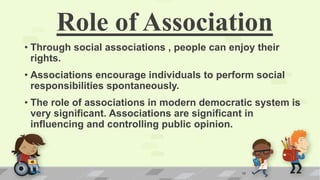
Role of Association
• Through social associations , people can enjoy their
rights.
• Associations encourage individuals to perform social
responsibilities spontaneously.
• The role of associations in modern democratic system is
very significant. Associations are significant in
influencing and controlling public opinion.
18
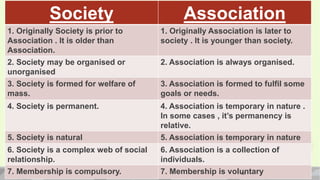
Differences between
Association and Society
Society Association
1. Originally Society is prior to
Association . It is older than
Association.
1. Originally Association is later to
society . It is younger than society.
2. Society may be organised or
unorganised
2. Association is always organised.
3. Society is formed for welfare of
mass.
3. Association is formed to fulfil some
goals or needs.
4. Society is permanent. 4. Association is temporary in nature .
In some cases , it’s permanency is
relative.
5. Society is natural 5. Association is temporary in nature
6. Society is a complex web of social
relationship.
6. Association is a collection of
individuals.
7. Membership is compulsory. 7. Membership is voluntary20
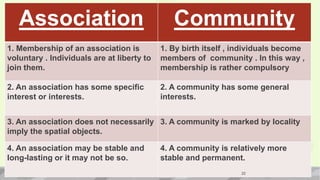
Differences between
Association and Community
Association Community
1. Membership of an association is
voluntary . Individuals are at liberty to
join them.
1. By birth itself , individuals become
members of community . In this way ,
membership is rather compulsory
2. An association has some specific
interest or interests.
2. A community has some general
interests.
3. An association does not necessarily
imply the spatial objects.
3. A community is marked by locality
4. An association may be stable and
long-lasting or it may not be so.
4. A community is relatively more
stable and permanent.
22
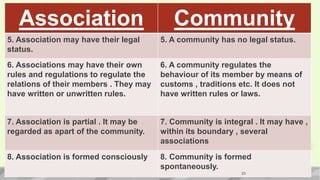
Association Community
5. Association may have their legal
status.
5. A community has no legal status.
6. Associations may have their own
rules and regulations to regulate the
relations of their members . They may
have written or unwritten rules.
6. A community regulates the
behaviour of its member by means of
customs , traditions etc. It does not
have written rules or laws.
7. Association is partial . It may be
regarded as apart of the community.
7. Community is integral . It may have ,
within its boundary , several
associations
8. Association is formed consciously 8. Community is formed
spontaneously.
23
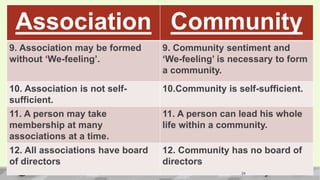
Association Community
9. Association may be formed
without ‘We-feeling’.
9. Community sentiment and
‘We-feeling’ is necessary to form
a community.
10. Association is not self-
sufficient.
10.Community is self-sufficient.
11. A person may take
membership at many
associations at a time.
11. A person can lead his whole
life within a community.
12. All associations have board
of directors
12. Community has no board of
directors
24
Differences between
Association and Institution
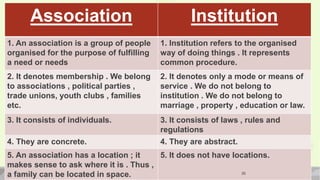
Association Institution
1. An association is a group of people
organised for the purpose of fulfilling
a need or needs
1. Institution refers to the organised
way of doing things . It represents
common procedure.
2. It denotes membership . We belong
to associations , political parties ,
trade unions, youth clubs , families
etc.
2. It denotes only a mode or means of
service . We do not belong to
institution . We do not belong to
marriage , property , education or law.
3. It consists of individuals. 3. It consists of laws , rules and
regulations
4. They are concrete. 4. They are abstract.
5. An association has a location ; it
makes sense to ask where it is . Thus ,
a family can be located in space.
5. It does not have locations.
26
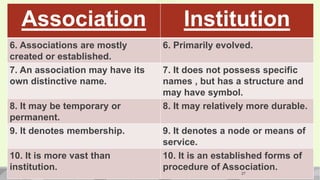
Association Institution
6. Associations are mostly
created or established.
6. Primarily evolved.
7. An association may have its
own distinctive name.
7. It does not possess specific
names , but has a structure and
may have symbol.
8. It may be temporary or
permanent.
8. It may relatively more durable.
9. It denotes membership. 9. It denotes a node or means of
service.
10. It is more vast than
institution.
10. It is an established forms of
procedure of Association.
27
Association Institution
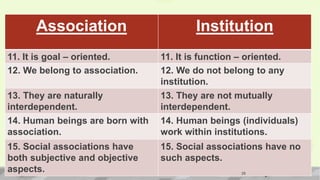
11. It is goal – oriented. 11. It is function – oriented.
12. We belong to association. 12. We do not belong to any
institution.
13. They are naturally
interdependent.
13. They are not mutually
interdependent.
14. Human beings are born with
association.
14. Human beings (individuals)
work within institutions.
15. Social associations have
both subjective and objective
aspects.
15. Social associations have no
such aspects.
28
Association

Association

  • 1.
  • 2.
    Association Association means pursuingends . Men have diverse needs , desires and interests and ends , which demand their satisfaction . They have three ways of fulfilling their ends :- • Firstly , they may act independently , each in his own way without bothering about others. • Secondly , men may seek their ends through conflicts with one another. • Thirdly , men may try to fulfil their ends through co-operation and mutual assistance . This co-operative pursuit has a reference to ‘association’ . It is spontaneous. 2
  • 3.
    DEFINITIONS We define anassociation , then, as a group organized for the pursuit of an interest or group of interests in common. Definitions:- • An association is “an organization deliberately formed for the collective pursuit of some interest or a set of interests , which its member share.” (R.M. MacIver) • An association is “a group of social beings related to one another by the fact that they possess or have instituted in common an organisation with a view of securing a specific end or specific ends.” (Morris Ginsberg) 3
  • 4.
    EXAMPLES • Political Associations– The Bharatiya Janata Party , The Congress Party , etc • Religious Associations – The Vishwa Hindu Parishad , The Ramakrishna Mission , The Arya Samaj , etc. • Student’s Association – The Akhil Bharatiya Vidyarthi Parishad, Delhi University Student’s Association , etc. • Labourer’s Association – Bharatiya Mazdoor Sangha , The Hindu Mazdoor Pachayat 4
  • 5.
    EXAMPLES • Professional Associations– Karnataka State College Teacher’s Association , Indian Medical Association , etc. • Economic Associations/Business Organizations – Business Corporation , Hotel Owner’s Association • International Associations – The Rotary Club , The Lion’s Club 5
  • 6.
  • 7.
    1. Association –a Human Group An Association is formed or created by people 7
  • 8.
    2. Common Interestor Interests It consists of those individuals who have more or less than same interest. 8
  • 9.
    3. Co-operative Spirit Anassociation is based on the co- operative spirit of its members. 9
  • 10.
  • 11.
    5. Regulation ofRelations Every association has its own ways and means of regulating the relations of its members 11
  • 12.
    6. Association asAgencies Associations are means or agencies through which their members seek to realize their similar or shared interests. 12
  • 13.
    7. Durability ofAssociation An Association may be permanent or temporary. 13
  • 14.
    8. Different Entity AnAssociation has a different entity 14
  • 15.
    9. Comparative Permanence Goalsof association have consistency . That is why every association has a comparative permanence. 15
  • 16.
    10. Transmission ofIdeas Proff. Giddings :- Associations act as agents of transmission of ideas among members 16
  • 17.
    Role of Association •Association plays an important role as means of fulfilling social – psychological needs of the individuals. • It maintains the stability of social associations as well as provides flexibility. • In association , individuals of different classes and groups meet together , which leads to the growth of mutual adjustments among them. In this way, well organized social system develops. 17
  • 18.
    Role of Association •Through social associations , people can enjoy their rights. • Associations encourage individuals to perform social responsibilities spontaneously. • The role of associations in modern democratic system is very significant. Associations are significant in influencing and controlling public opinion. 18
  • 19.
  • 20.
    Society Association 1. OriginallySociety is prior to Association . It is older than Association. 1. Originally Association is later to society . It is younger than society. 2. Society may be organised or unorganised 2. Association is always organised. 3. Society is formed for welfare of mass. 3. Association is formed to fulfil some goals or needs. 4. Society is permanent. 4. Association is temporary in nature . In some cases , it’s permanency is relative. 5. Society is natural 5. Association is temporary in nature 6. Society is a complex web of social relationship. 6. Association is a collection of individuals. 7. Membership is compulsory. 7. Membership is voluntary20
  • 21.
  • 22.
    Association Community 1. Membershipof an association is voluntary . Individuals are at liberty to join them. 1. By birth itself , individuals become members of community . In this way , membership is rather compulsory 2. An association has some specific interest or interests. 2. A community has some general interests. 3. An association does not necessarily imply the spatial objects. 3. A community is marked by locality 4. An association may be stable and long-lasting or it may not be so. 4. A community is relatively more stable and permanent. 22
  • 23.
    Association Community 5. Associationmay have their legal status. 5. A community has no legal status. 6. Associations may have their own rules and regulations to regulate the relations of their members . They may have written or unwritten rules. 6. A community regulates the behaviour of its member by means of customs , traditions etc. It does not have written rules or laws. 7. Association is partial . It may be regarded as apart of the community. 7. Community is integral . It may have , within its boundary , several associations 8. Association is formed consciously 8. Community is formed spontaneously. 23
  • 24.
    Association Community 9. Associationmay be formed without ‘We-feeling’. 9. Community sentiment and ‘We-feeling’ is necessary to form a community. 10. Association is not self- sufficient. 10.Community is self-sufficient. 11. A person may take membership at many associations at a time. 11. A person can lead his whole life within a community. 12. All associations have board of directors 12. Community has no board of directors 24
  • 25.
  • 26.
    Association Institution 1. Anassociation is a group of people organised for the purpose of fulfilling a need or needs 1. Institution refers to the organised way of doing things . It represents common procedure. 2. It denotes membership . We belong to associations , political parties , trade unions, youth clubs , families etc. 2. It denotes only a mode or means of service . We do not belong to institution . We do not belong to marriage , property , education or law. 3. It consists of individuals. 3. It consists of laws , rules and regulations 4. They are concrete. 4. They are abstract. 5. An association has a location ; it makes sense to ask where it is . Thus , a family can be located in space. 5. It does not have locations. 26
  • 27.
    Association Institution 6. Associationsare mostly created or established. 6. Primarily evolved. 7. An association may have its own distinctive name. 7. It does not possess specific names , but has a structure and may have symbol. 8. It may be temporary or permanent. 8. It may relatively more durable. 9. It denotes membership. 9. It denotes a node or means of service. 10. It is more vast than institution. 10. It is an established forms of procedure of Association. 27
  • 28.
    Association Institution 11. Itis goal – oriented. 11. It is function – oriented. 12. We belong to association. 12. We do not belong to any institution. 13. They are naturally interdependent. 13. They are not mutually interdependent. 14. Human beings are born with association. 14. Human beings (individuals) work within institutions. 15. Social associations have both subjective and objective aspects. 15. Social associations have no such aspects. 28