Welcome 
Core Course II 
Psychology Of Learning And 
Human Development
MORAL DEVELOPMENT 
by 
JEAN PIAGET
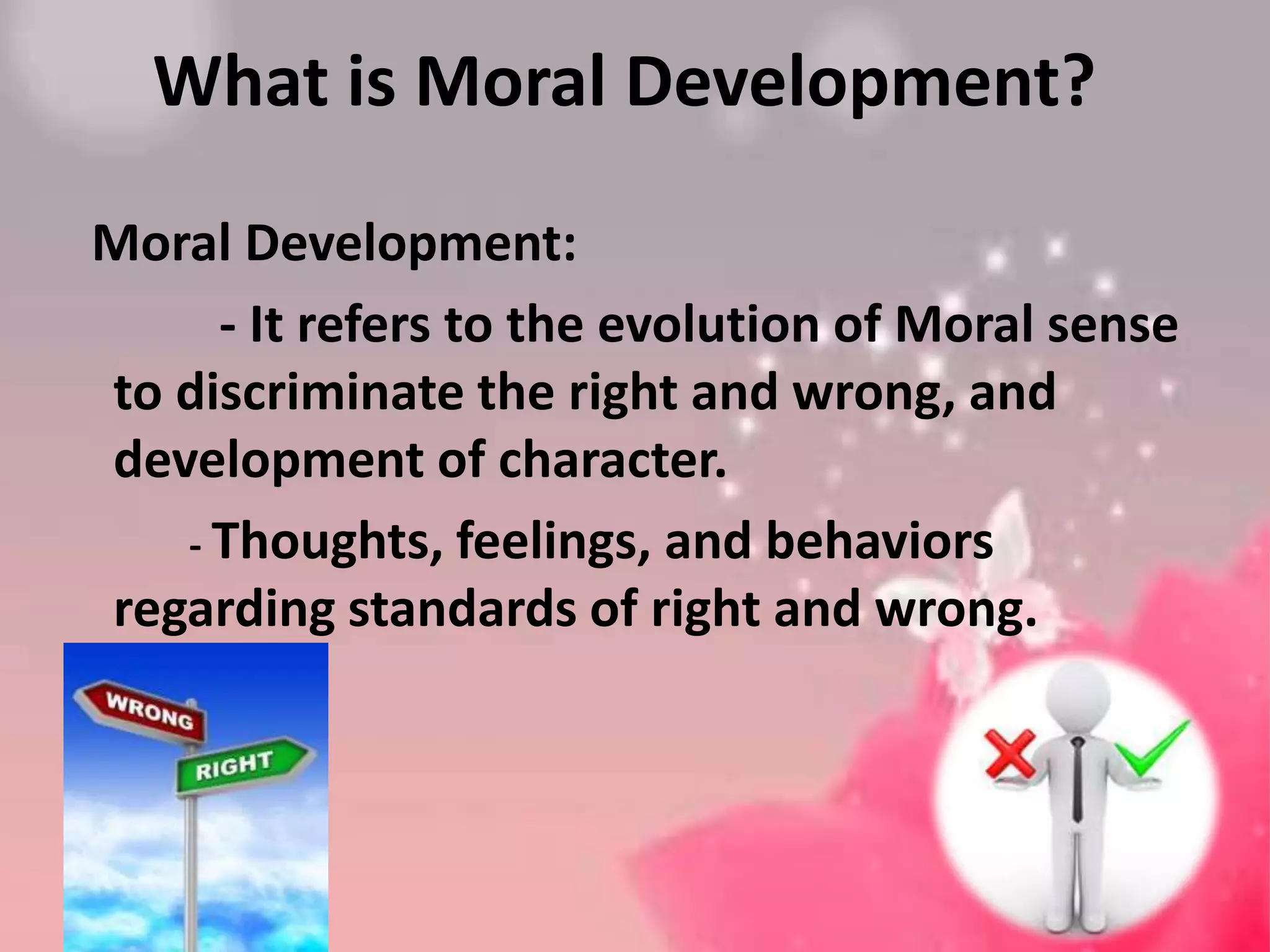
What is Moral Development? 
Moral Development: 
- It refers to the evolution of Moral sense 
to discriminate the right and wrong, and 
development of character. 
- Thoughts, feelings, and behaviors 
regarding standards of right and wrong.
JEAN PIAGET 
• A Swiss developmental psychologist and 
philosopher 
• Period: August 1896 – September 1980 
• Fields: Developmental Psychology, Epistemology. 
• He is the first psychologist in the field of human 
Developmental psychology and also he 
influenced Lawrence Kohlberg.
Piaget’s Moral Development 
Jean Piaget was one of the first Psychologist to 
Specifically outline a Theory of Moral Development. 
According to Jean Piaget, The Child is Someone who 
constructs his own moral world view, Who forms ideas 
about Right and Wrong, Fair and Unfair that are not the 
direct product of adult teaching. Piaget believed that 
Children make moral judgments based on their own 
observations of the world.
MORAL REALISM & MORAL RELATIVISM 
Young Children are more realists 
who interpret the moral rules and look at 
the material side of the actions and their 
magnitude, ignoring the intentions of the 
acts. 
Only about 11- 12 year, do children 
become capable of moral relativism i.e. 
evaluating acts on the basis of intention 
behind them rather than the magnitude.
There are distinct our stages of Moral 
Development 
ANOMY 
HETERONOMY 
- AUTHORITY 
HETERONOMY 
- RCIPROCITY 
AUTONOMY
ANOMY STAGE 
AGE : From Birth to Five Years.
Anomy Stage 
• This Stage is a stage without Law. The child 
does not know whether the behavior is Moral 
or immoral. 
• Age : the first five years of birth. 
• His each and every behavior is not guided by 
moral standards.
HETERONOMY - AUTHORITY 
AGE: 5 - 8 years
Heteronomy - Authority 
• Children Follow strict rules and are 
completely obedient to authority. 
•Children in this stage can also judge how 
wrong a particular action is by its immediate 
consequence; punishment is seen as an 
automatic response to breaking a rule. 
•Age: 5-8 years
HETERONOMY - RECIPROCITY 
AGE : 9 -13 years
Heteronomy - Reciprocity 
• This stage is regulated by reciprocity which 
implies, “We should not do to others what will 
be offensive to us”. 
• Age: 9 – 13 
• The Moral development in most of us get fixed 
at this stage and may not progress ahead.
AUTONOMY STAGE 
AGE : 13 -18 years
Autonomy Stage 
Children Learn how to critically evaluate 
rules and apply them based on co-operation 
and respect with others. They 
begin to learn to take the perspective of 
others in this stage. 
Intention is also an important concept of 
this stage 
Age:13 – 18 years.
Gender and Moral Development 
Piaget did compare the stages of morality 
between the two sexes, noting both parallels and 
some differences. Both have stages of moral 
heteronomy and autonomy. 
He actually saw girls’ moral understanding as in 
some ways actually more advanced than boys’.
Conclusion 
Jean piaget is the first Human developmental 
psychologist to define Moral development. 
He influenced Lawrence Kohlberg who later 
gave a Explained theory on Moral 
development.
moral development

moral development

  • 1.
    Welcome Core CourseII Psychology Of Learning And Human Development
  • 2.
  • 3.
    What is MoralDevelopment? Moral Development: - It refers to the evolution of Moral sense to discriminate the right and wrong, and development of character. - Thoughts, feelings, and behaviors regarding standards of right and wrong.
  • 4.
    JEAN PIAGET •A Swiss developmental psychologist and philosopher • Period: August 1896 – September 1980 • Fields: Developmental Psychology, Epistemology. • He is the first psychologist in the field of human Developmental psychology and also he influenced Lawrence Kohlberg.
  • 5.
    Piaget’s Moral Development Jean Piaget was one of the first Psychologist to Specifically outline a Theory of Moral Development. According to Jean Piaget, The Child is Someone who constructs his own moral world view, Who forms ideas about Right and Wrong, Fair and Unfair that are not the direct product of adult teaching. Piaget believed that Children make moral judgments based on their own observations of the world.
  • 6.
    MORAL REALISM &MORAL RELATIVISM Young Children are more realists who interpret the moral rules and look at the material side of the actions and their magnitude, ignoring the intentions of the acts. Only about 11- 12 year, do children become capable of moral relativism i.e. evaluating acts on the basis of intention behind them rather than the magnitude.
  • 7.
    There are distinctour stages of Moral Development ANOMY HETERONOMY - AUTHORITY HETERONOMY - RCIPROCITY AUTONOMY
  • 8.
    ANOMY STAGE AGE: From Birth to Five Years.
  • 9.
    Anomy Stage •This Stage is a stage without Law. The child does not know whether the behavior is Moral or immoral. • Age : the first five years of birth. • His each and every behavior is not guided by moral standards.
  • 10.
    HETERONOMY - AUTHORITY AGE: 5 - 8 years
  • 11.
    Heteronomy - Authority • Children Follow strict rules and are completely obedient to authority. •Children in this stage can also judge how wrong a particular action is by its immediate consequence; punishment is seen as an automatic response to breaking a rule. •Age: 5-8 years
  • 12.
    HETERONOMY - RECIPROCITY AGE : 9 -13 years
  • 13.
    Heteronomy - Reciprocity • This stage is regulated by reciprocity which implies, “We should not do to others what will be offensive to us”. • Age: 9 – 13 • The Moral development in most of us get fixed at this stage and may not progress ahead.
  • 14.
    AUTONOMY STAGE AGE: 13 -18 years
  • 15.
    Autonomy Stage ChildrenLearn how to critically evaluate rules and apply them based on co-operation and respect with others. They begin to learn to take the perspective of others in this stage. Intention is also an important concept of this stage Age:13 – 18 years.
  • 16.
    Gender and MoralDevelopment Piaget did compare the stages of morality between the two sexes, noting both parallels and some differences. Both have stages of moral heteronomy and autonomy. He actually saw girls’ moral understanding as in some ways actually more advanced than boys’.
  • 17.
    Conclusion Jean piagetis the first Human developmental psychologist to define Moral development. He influenced Lawrence Kohlberg who later gave a Explained theory on Moral development.