Community
Evolution and
DevelopmentSociology of Development
May
2019
Community Evolution and
Development
Submitted to,
Ms. Mashal Niazi
Prepared by,
Sonia Niaz (BSOF16M014)
Waseem Iqbal (BSOF16M017)
Anum Riaz (BSOF16M018)
M. Sami-ur-Rehman (BSOF16M019)
Department of Sociology (UOS)
3
When did Life Begins on the
Planet?
ADD A FOOTER
 That is no longer true to say anything about the life on earth with
confidence.
 Life is old.
 The dinosaurs are perhaps the most famous extinct creatures, and they
had their beginnings 250 million years ago. But life dates back much
further.
 The oldest known fossils are around 3.5 billion years old.
 In August 2016 researchers found what appear to be fossilized microbes
dating back 3.7 billion years.
 While our ancestors have been around for about six million years, the
modern form of humans only evolved about 200,000 years ago.
4
What is Evolution?
ADD A FOOTER
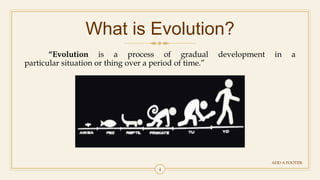
“Evolution is a process of gradual development in a
particular situation or thing over a period of time.”
5
Community Evolution
ADD A FOOTER
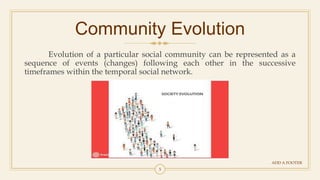
Evolution of a particular social community can be represented as a
sequence of events (changes) following each other in the successive
timeframes within the temporal social network.
6
Defining Community
ADD A FOOTER
Oxford Dictionary:
“A group of people living in the same place or having a particular
characteristic in common.”
A community has three basic claims:
1. A community is a group of people who interact with one another.
2. This interaction is typically viewed as occurring within a bounded
geographic territory.
3. The community’s members often share common values, beliefs, or
behaviors.
7
Defining Society
ADD A FOOTER
“A society is a group of people with common territory, interaction,
and culture.”
• Individual is the basic component of society.
• The interaction of individuals with each other gives birth to group which
leads to a society.
• The players in football or other games came together is not a society, but
just an aggregate of people.
• Within the society there are patterns and groupings on the basis of
likeness and differences.
• "Likeness" creates a chain of relations among the individuals having
similarity in one or more conditions' like same profession, same residence,
same caste, family and kinship, college, age, sex etc.
8
Community Development
ADD A FOOTER
Definition:
“Community development is a process where community members
come together to take collective action and generate solutions to common
problems.”
Community wellbeing involves.
Economic betterment.
Social wellbeing.
Environmental stabilization.
Cultural development.
9
Human Development
ADD A FOOTER
 Human development is defined as the process of enlarging people's
freedoms and opportunities and improving their well-being.
 Human development is about the real freedom ordinary people have
to decide who to be, what to do, and how to live.
Human beings develop in 4 different aspects of growth. The areas
are all inter-connected, so when one is affected it may influence the others.
1. Physical Human Development: Physical development is the process that starts in
human infancy and continues into late adolescent concentrating on gross and fine motor skills as
well as puberty. Physical development involves developing control over the body, particularly
muscles and physical coordination.
10
Cont.
ADD A FOOTER
2. Emotional Human Development: Emotional development refers to the ability to
recognize, express, and manage feelings at different stages of life and to have empathy for the
feelings of others.
3. Intellectual Human Development: Intellectual development is all about learning. It
is about how individuals organize their minds, ideas and thoughts to make sense of the world
they live in.
4. Social Development: Social development is the process of social changes that are designed
to improve the living standard of a society, by improving the economic development. It also refers
to the changes in the social order within a society.
Social development also refers to the learnings in the relation with
other people of the society.
11
Human Society and its Evolution
ADD A FOOTER
• Humans generally do not live alone, isolated from each other.
Instead, individuals tend to live in communities with other people related
by ethnicity, nationality, religion, or some other cultural element.
Human Society:
“A human society is a group of people who share a common
lifestyle and organization.”
• The human society has been viewed as a unique and complex society
because of its dynamic features, it is capable of developing and
improving its structures.
• One of the basic components of society is people.
12
Cont.
ADD A FOOTER
• Social evolution (or social development) is a process of growth
of complexity and differentiation of social organization (cooperation
between human beings and coordination of human activities).
• In other words, Social evolution is a process of creation and development
of new, more complex, and more effective forms of social organizations.
It takes place under the influence of ecological, demographic,
technological and economic factors.
13
From Bands to State
ADD A FOOTER
Band: A band society is the simplest form of human society. A bandgenerally consists
of a small kin group, no larger than an extended family or clan; one definition sees
a band as consisting of no more than 100 individuals.
• Not centralized.
• Egalitarian (low inequality).
• Low division of labor.
• Decisions are made collectively.
• Unity is based on customs and traditions
Hunting and Gathering societies.
14
Cont.
ADD A FOOTER
Tribe: A group of bands united for a common purpose. In order to
survive, humans tend to form bigger groups which we call tribes.
• Also egalitarian: power is dispersed throughout the tribe.
• Leaders are first among equals.
• Custom, tradition, ritual, religious belief are the main tools to maintain
social order.
Horticulture and Pastoral societies.
15
Cont.
ADD A FOOTER
Chiefdom: A transitional form on the way from tribe to state.
• A larger society with more developed division of labor, higher productivity,
which means that there is surplus product to use beyond mere subsistence.
• Private property appears, inequality grows, people are more and more divided
by class.
• Power emerges as something separate from society.
• Authority is formalized (institutionalized) in the office of the chief, which can be
filled by different people. The chief has means of compelling members of society
(military force).
• Develops in agricultural societies, which increasingly rely on slave labor.
Appears about 10,000 years ago.
16
Cont.
ADD A FOOTER
State: A highly structured organization of power over a more developed, more
complex, class-divided society.
The state is capable of performing massive tasks:
• Suppressing social revolts,
• Waging wars,
• Organizing construction of fortresses, dams and canals,
• Minting money.
• It has the power to tax and to punish those who break the law.
• The city is the seat of state power.
• First states appear in Egypt, Babylon, Assyria and Persia (Iran), beginning around 5,000
years ago.
17
Cont.
ADD A FOOTER
Development of Cities
Early cities arose in a number of regions, and are thought to have developed
for reasons of agricultural productivity and economic scale.
City: A city is an area in which a large number of people live fairly close together. Cities usually have
their own separate governments and systems for maintaining and providing utilities and transportation.
• Early cities developed in a number of regions, from Mesopotamia to Asia.
• A good environment and strong social organization are two necessities for the formation
of a successful city.
• A good environment includes clean water and a favorable climate for growing crops and
agriculture.
• The very first cities were founded in Mesopotamia after the Neolithic Revolution,
around 7500 BCE.
18
Cont.
ADD A FOOTER
Preindustrial Cities
Preindustrial cities had important political and economic functions
and evolved to become well-defined political units.
• Preindustrial cities were political units, like today’s states. They offered
freedom from rural obligations to lord and community.
• In the early modern era, larger capital cities benefited from new trade
routes and grew even larger.
19
Cont.
ADD A FOOTER
Industrial cities
During the industrial era, cities grew rapidly and became centers of
population growth and production.
• Rapid growth brought urban problems, and industrial-era cities
were rife with dangers to health and safety.
• Poor sanitation and communicable diseases were among the
greatest causes of death among urban working class populations.
• In the 19th century, better sanitation led to improved health
conditions.
20
Types of Societies
ADD A FOOTER
Although humans have established many types of societies
throughout history, sociologists and anthropologists usually refer to six
basic types of societies, each defined by its mode of subsistence and level of
technology but I want to divide them into three main frames.
1. Earliest Societies
2. Developing Societies
3. Advanced Societies
21
Cont.
ADD A FOOTER
Earliest Societies
• Hunting & Gathering Societies
• Pastoral Societies
Developing Societies
• Horticultural Societies
• Agricultural Societies
Advanced Societies
• Industrial Societies
• Post-Industrial Societies
22
Hunting and Gathering
Societies
ADD A FOOTER
• 2 Million to 10000 years ago.
Hunting and gathering societies are the earliest form of society. The
members survive primarily by hunting, trapping, fishing, and gathering edible
plants. The majority of the members' time is spent looking for and gathering food.
Basic Characteristics
• Family is the society's primary institution. Family determines the
distribution of food and how to socialize children.
• These societies are small compared to the others. They generally have
less than 50 members.
• Hunting and gathering societies are nomadic, which means that they
move constantly in order to find food and water.
23
Cont.
ADD A FOOTER
• Members of hunting and gathering societies are mutually
dependent upon each other.
• Although there is an equal division of labor among the members
of hunting and gathering societies, there is a division of labor
based on sex. Men are typically responsible for hunting, and
women are typically gatherers.
• Hunting and gathering societies were also tribe and band based.
Members shared an ancestral heritage and a common set of
traditions and rituals.
24
Cont.
ADD A FOOTER
Educational Basis
• Hunting game
• Mobility and flexibility
• Knowledge of territory
• Knowledge of edible plants
• Food Preparation
• Family loyalty
• Sharing
25
Pastoral Societies
ADD A FOOTER
• Pastoral societies began around 12,000 years ago.
• These societies rely on products obtained through the domestication and
breeding of animals for transportation and food.
• Pastoral societies are common in areas where crops cannot be supported,
for example in North Africa.
• Unlike hunting and gathering societies, pastoral societies only have to
move when the land in which the animals graze is no longer usable.
• Pastoral societies also allow for job specialization, since not everyone is
needed to gather or hunt for food. For example, while some people breed
animals, others are able to produce tools or clothing, which allows for
specialization in these areas.
26
Cont.
ADD A FOOTER
Educational Basis
• Raising animals
• Knowledge of grazing territory
• Knowledge of proper foods for animals
• Knowledge of butchering and cooking
• Knowledge of milking
• Pottery Making
• Tool Making
• Textile Making
27
Horticulture Societies
ADD A FOOTER
• Horticultural societies emerged between 10,000 and 12,000 years ago in
Latin America, Asia, and parts of the Middle East.
• These societies rely on the cultivation of fruits, vegetables, and plants in
order to survive.
• Horticultural societies are often forced to relocate when the resources of
the land are depleted or when the water supplies decrease.
• Horticultural societies occasionally produced a surplus, which permitted
storage as well as the emergence of other professions not related to the
survival of the society.
28
Cont.
ADD A FOOTER
Educational Basis
• Gardening
• Tool Making
• Family Loyalty
• Cooperation
29
Agricultural Societies
ADD A FOOTER
• Agricultural societies rely on the use of technology in order to cultivate
crops in large areas, including wheat, rice, and corn.
• The technological advances led to an increase in food supplies, an increase
in population, and the development of trade centers.
• This period of technological changes is referred to as the Agricultural
Revolution and began around 8500 years ago with the invention of
plow(plough).
30
Cont.
ADD A FOOTER
Agricultural societies developed roughly in this order:
• Animals are used to pull plows.
• Plowing allows for the cultivation of larger areas of land.
• Soil aeration caused by plowing leads to higher crop yields over longer
periods of time.
• High volumes of food production allow people to build permanent homes in
a single location.
• Towns develop, which eventually grow into cities.
• Greater degrees of social stratification appeared in agricultural societies.
31
Cont.
ADD A FOOTER
Educational Basis
• Use of animals and tools to farm
• Innovation and Inventiveness
• Family Loyalty
• Trade
• Civil Understanding
• Respect for Hierarchy
• Literacy for the few
• National Loyalty
32
Feudal Societies
ADD A FOOTER
From the 9th to 15th centuries, feudalism was a form of society based on
ownership of land.
• Unlike today's farmers, vassals under feudalism were bound to
cultivating their lord's land.
• In exchange for military protection, the lords exploited the peasants
into providing food, crops, crafts, homage, and other services to the
owner of the land.
• The caste system of feudalism was often multigenerational; the families
of peasants may have cultivated their lord's land for generations.
• Between the 14th and 16th centuries, a new economic system emerged
that began to replace feudalism which is “Capitalism”.
33
Industrial Societies
ADD A FOOTER
Industrial societies are based on using machines (particularly fuel‐driven
ones) to produce goods.
• Sociologists refer to the period during the 18th century when the
production of goods in mechanized factories began as the Industrial
Revolution.
• The Industrial Revolution appeared first in Britain, and then quickly
spread to the rest of the world.
• As productivity increased, means of transportation improved to better
facilitate the transfer of products from place to place.
• Great wealth was attained by the few who owned factories, and the “masses”
found jobs working in the factories.
• The Industrial Revolution also saw to the development of bureaucratic
forms of organization,
34
Cont.
ADD A FOOTER
Educational Basis
• Factory work
• Civic responsibility
• Workplace responsibility
• Literacy – Reading and Writing
• Numeracy – Arithmetic
• Mechanical Knowledge
• Trade
• Nationalism
35
Post-Industrial Societies
ADD A FOOTER
A post-industrial society is a stage in a society's development
during which the economy transitions from one that primarily provides
goods to one that primarily provides services.
• In other words, the service sector, made up of people such as
nurses, teachers, researchers, social workers, and lawyers,
among others, accounts for more of the economic growth and
wealth than the manufacturing sector, which is made up of
people such as construction workers, textile mill workers, food
manufacturers, and production workers.
• The economic transformation associated with a post-industrial
society subsequently transforms society as a whole.
36
Cont.
ADD A FOOTER
• Post-industrial society is the next evolutionary step from an
industrialized society and is most evident in countries and
regions that were among the first to experience the Industrial
Revolution, such as the United States, western Europe, and Japan.
• The replacement of blue-collar manual laborers with technical
and professional workers such as computer engineers, doctors,
and bankers as the direct production of goods is moved
elsewhere.
• The replacement of practical knowledge with theoretical
knowledge.
37
Cont.
ADD A FOOTER
• Sociologists believe society will become more concerned
with the welfare of all members of society.
• They hope postindustrial society will be less
characterized by social conflict, as everyone works
together to solve society's problems through science.
38
Prehistoric Timeline
ADD A FOOTER
39
Cont.
ADD A FOOTER
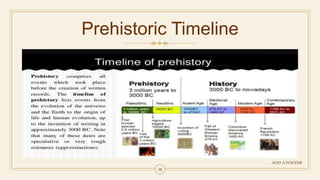
The stone age is an extremely long period of time and it is divided into 3
periods:
1. Paleolithic (Old Stone Age)
2. Mesolithic (Middle Stone Age)
3. Neolithic (New Stone Age)
After that human societies entered into bronze age and the in iron
age. These ages of human societies are historic ages.
40
Spencer and Theory of
Evolution
ADD A FOOTER
• The idea of something changing naturally isn't a new idea, but one that
Charles Darwin explained with his theory of evolution.
• Herbert Spencer, an English sociologist, took Darwin's theory and
applied it to how societies change and evolve over time.
• Spencer took the theory of evolution one step beyond biology and applied
it to say that societies were organisms that progress through changes
similar to that of a living species.
• It was Spencer's philosophy that societies (like organisms) would begin
simple and then progress to a more complex form.
41
Cont.
ADD A FOOTER
Spencer also found similarities between animal organisms and societies in
that both had three main systems.
1. The first system is the regulative system. In animals, that would
be the central nervous system. In societies, it would be a government
that regulates everything.
2. The second system is the sustaining system. For animals, that's the
giving and receiving of nourishment. For societies, that would be
industry - jobs, money, economy and those sorts of things.
3. The third system would be the distribution system. In animals, that
would be the veins and arteries. In societies, it would be roads,
transportation, internet - anything in which information and goods
and services are exchanged.
42
Cont.
ADD A FOOTER
From the analysis of physical evolution Spencer convinced that the
underlying principles of all evolution are two:
1. Movement from- simple to complex.
2. Movement from homogeneous to heterogeneous.
• From the analysis of biological evolution spencer utilized the principle,
that those creatures survive in the struggle for existence who are able to
make effective adjustment with changing circumstances.
• The society is moving from homogeneous to heterogeneous structure.
• Society is also moving from indefinite to definite stage.
43
Cont.
ADD A FOOTER
• Spencer has borrowed the idea from biological evolution that those
cultures survive which are able to adjust themselves with the changing
circumstances.
• If a civilization is unable to make adjustment with the changing
circumstances it caves in and gradually becomes extinct.
Spencer’s theory of social evolution points out to two stages:
1. The movement from simple to compound societies.
2. Change from militant society to industrial society.
44
ADD A FOOTER

Community evolution and development

  • 1.
  • 2.
    Community Evolution and Development Submittedto, Ms. Mashal Niazi Prepared by, Sonia Niaz (BSOF16M014) Waseem Iqbal (BSOF16M017) Anum Riaz (BSOF16M018) M. Sami-ur-Rehman (BSOF16M019) Department of Sociology (UOS)
  • 3.
    3 When did LifeBegins on the Planet? ADD A FOOTER  That is no longer true to say anything about the life on earth with confidence.  Life is old.  The dinosaurs are perhaps the most famous extinct creatures, and they had their beginnings 250 million years ago. But life dates back much further.  The oldest known fossils are around 3.5 billion years old.  In August 2016 researchers found what appear to be fossilized microbes dating back 3.7 billion years.  While our ancestors have been around for about six million years, the modern form of humans only evolved about 200,000 years ago.
  • 4.
    4 What is Evolution? ADDA FOOTER “Evolution is a process of gradual development in a particular situation or thing over a period of time.”
  • 5.
    5 Community Evolution ADD AFOOTER Evolution of a particular social community can be represented as a sequence of events (changes) following each other in the successive timeframes within the temporal social network.
  • 6.
    6 Defining Community ADD AFOOTER Oxford Dictionary: “A group of people living in the same place or having a particular characteristic in common.” A community has three basic claims: 1. A community is a group of people who interact with one another. 2. This interaction is typically viewed as occurring within a bounded geographic territory. 3. The community’s members often share common values, beliefs, or behaviors.
  • 7.
    7 Defining Society ADD AFOOTER “A society is a group of people with common territory, interaction, and culture.” • Individual is the basic component of society. • The interaction of individuals with each other gives birth to group which leads to a society. • The players in football or other games came together is not a society, but just an aggregate of people. • Within the society there are patterns and groupings on the basis of likeness and differences. • "Likeness" creates a chain of relations among the individuals having similarity in one or more conditions' like same profession, same residence, same caste, family and kinship, college, age, sex etc.
  • 8.
    8 Community Development ADD AFOOTER Definition: “Community development is a process where community members come together to take collective action and generate solutions to common problems.” Community wellbeing involves. Economic betterment. Social wellbeing. Environmental stabilization. Cultural development.
  • 9.
    9 Human Development ADD AFOOTER  Human development is defined as the process of enlarging people's freedoms and opportunities and improving their well-being.  Human development is about the real freedom ordinary people have to decide who to be, what to do, and how to live. Human beings develop in 4 different aspects of growth. The areas are all inter-connected, so when one is affected it may influence the others. 1. Physical Human Development: Physical development is the process that starts in human infancy and continues into late adolescent concentrating on gross and fine motor skills as well as puberty. Physical development involves developing control over the body, particularly muscles and physical coordination.
  • 10.
    10 Cont. ADD A FOOTER 2.Emotional Human Development: Emotional development refers to the ability to recognize, express, and manage feelings at different stages of life and to have empathy for the feelings of others. 3. Intellectual Human Development: Intellectual development is all about learning. It is about how individuals organize their minds, ideas and thoughts to make sense of the world they live in. 4. Social Development: Social development is the process of social changes that are designed to improve the living standard of a society, by improving the economic development. It also refers to the changes in the social order within a society. Social development also refers to the learnings in the relation with other people of the society.
  • 11.
    11 Human Society andits Evolution ADD A FOOTER • Humans generally do not live alone, isolated from each other. Instead, individuals tend to live in communities with other people related by ethnicity, nationality, religion, or some other cultural element. Human Society: “A human society is a group of people who share a common lifestyle and organization.” • The human society has been viewed as a unique and complex society because of its dynamic features, it is capable of developing and improving its structures. • One of the basic components of society is people.
  • 12.
    12 Cont. ADD A FOOTER •Social evolution (or social development) is a process of growth of complexity and differentiation of social organization (cooperation between human beings and coordination of human activities). • In other words, Social evolution is a process of creation and development of new, more complex, and more effective forms of social organizations. It takes place under the influence of ecological, demographic, technological and economic factors.
  • 13.
    13 From Bands toState ADD A FOOTER Band: A band society is the simplest form of human society. A bandgenerally consists of a small kin group, no larger than an extended family or clan; one definition sees a band as consisting of no more than 100 individuals. • Not centralized. • Egalitarian (low inequality). • Low division of labor. • Decisions are made collectively. • Unity is based on customs and traditions Hunting and Gathering societies.
  • 14.
    14 Cont. ADD A FOOTER Tribe:A group of bands united for a common purpose. In order to survive, humans tend to form bigger groups which we call tribes. • Also egalitarian: power is dispersed throughout the tribe. • Leaders are first among equals. • Custom, tradition, ritual, religious belief are the main tools to maintain social order. Horticulture and Pastoral societies.
  • 15.
    15 Cont. ADD A FOOTER Chiefdom:A transitional form on the way from tribe to state. • A larger society with more developed division of labor, higher productivity, which means that there is surplus product to use beyond mere subsistence. • Private property appears, inequality grows, people are more and more divided by class. • Power emerges as something separate from society. • Authority is formalized (institutionalized) in the office of the chief, which can be filled by different people. The chief has means of compelling members of society (military force). • Develops in agricultural societies, which increasingly rely on slave labor. Appears about 10,000 years ago.
  • 16.
    16 Cont. ADD A FOOTER State:A highly structured organization of power over a more developed, more complex, class-divided society. The state is capable of performing massive tasks: • Suppressing social revolts, • Waging wars, • Organizing construction of fortresses, dams and canals, • Minting money. • It has the power to tax and to punish those who break the law. • The city is the seat of state power. • First states appear in Egypt, Babylon, Assyria and Persia (Iran), beginning around 5,000 years ago.
  • 17.
    17 Cont. ADD A FOOTER Developmentof Cities Early cities arose in a number of regions, and are thought to have developed for reasons of agricultural productivity and economic scale. City: A city is an area in which a large number of people live fairly close together. Cities usually have their own separate governments and systems for maintaining and providing utilities and transportation. • Early cities developed in a number of regions, from Mesopotamia to Asia. • A good environment and strong social organization are two necessities for the formation of a successful city. • A good environment includes clean water and a favorable climate for growing crops and agriculture. • The very first cities were founded in Mesopotamia after the Neolithic Revolution, around 7500 BCE.
  • 18.
    18 Cont. ADD A FOOTER PreindustrialCities Preindustrial cities had important political and economic functions and evolved to become well-defined political units. • Preindustrial cities were political units, like today’s states. They offered freedom from rural obligations to lord and community. • In the early modern era, larger capital cities benefited from new trade routes and grew even larger.
  • 19.
    19 Cont. ADD A FOOTER Industrialcities During the industrial era, cities grew rapidly and became centers of population growth and production. • Rapid growth brought urban problems, and industrial-era cities were rife with dangers to health and safety. • Poor sanitation and communicable diseases were among the greatest causes of death among urban working class populations. • In the 19th century, better sanitation led to improved health conditions.
  • 20.
    20 Types of Societies ADDA FOOTER Although humans have established many types of societies throughout history, sociologists and anthropologists usually refer to six basic types of societies, each defined by its mode of subsistence and level of technology but I want to divide them into three main frames. 1. Earliest Societies 2. Developing Societies 3. Advanced Societies
  • 21.
    21 Cont. ADD A FOOTER EarliestSocieties • Hunting & Gathering Societies • Pastoral Societies Developing Societies • Horticultural Societies • Agricultural Societies Advanced Societies • Industrial Societies • Post-Industrial Societies
  • 22.
    22 Hunting and Gathering Societies ADDA FOOTER • 2 Million to 10000 years ago. Hunting and gathering societies are the earliest form of society. The members survive primarily by hunting, trapping, fishing, and gathering edible plants. The majority of the members' time is spent looking for and gathering food. Basic Characteristics • Family is the society's primary institution. Family determines the distribution of food and how to socialize children. • These societies are small compared to the others. They generally have less than 50 members. • Hunting and gathering societies are nomadic, which means that they move constantly in order to find food and water.
  • 23.
    23 Cont. ADD A FOOTER •Members of hunting and gathering societies are mutually dependent upon each other. • Although there is an equal division of labor among the members of hunting and gathering societies, there is a division of labor based on sex. Men are typically responsible for hunting, and women are typically gatherers. • Hunting and gathering societies were also tribe and band based. Members shared an ancestral heritage and a common set of traditions and rituals.
  • 24.
    24 Cont. ADD A FOOTER EducationalBasis • Hunting game • Mobility and flexibility • Knowledge of territory • Knowledge of edible plants • Food Preparation • Family loyalty • Sharing
  • 25.
    25 Pastoral Societies ADD AFOOTER • Pastoral societies began around 12,000 years ago. • These societies rely on products obtained through the domestication and breeding of animals for transportation and food. • Pastoral societies are common in areas where crops cannot be supported, for example in North Africa. • Unlike hunting and gathering societies, pastoral societies only have to move when the land in which the animals graze is no longer usable. • Pastoral societies also allow for job specialization, since not everyone is needed to gather or hunt for food. For example, while some people breed animals, others are able to produce tools or clothing, which allows for specialization in these areas.
  • 26.
    26 Cont. ADD A FOOTER EducationalBasis • Raising animals • Knowledge of grazing territory • Knowledge of proper foods for animals • Knowledge of butchering and cooking • Knowledge of milking • Pottery Making • Tool Making • Textile Making
  • 27.
    27 Horticulture Societies ADD AFOOTER • Horticultural societies emerged between 10,000 and 12,000 years ago in Latin America, Asia, and parts of the Middle East. • These societies rely on the cultivation of fruits, vegetables, and plants in order to survive. • Horticultural societies are often forced to relocate when the resources of the land are depleted or when the water supplies decrease. • Horticultural societies occasionally produced a surplus, which permitted storage as well as the emergence of other professions not related to the survival of the society.
  • 28.
    28 Cont. ADD A FOOTER EducationalBasis • Gardening • Tool Making • Family Loyalty • Cooperation
  • 29.
    29 Agricultural Societies ADD AFOOTER • Agricultural societies rely on the use of technology in order to cultivate crops in large areas, including wheat, rice, and corn. • The technological advances led to an increase in food supplies, an increase in population, and the development of trade centers. • This period of technological changes is referred to as the Agricultural Revolution and began around 8500 years ago with the invention of plow(plough).
  • 30.
    30 Cont. ADD A FOOTER Agriculturalsocieties developed roughly in this order: • Animals are used to pull plows. • Plowing allows for the cultivation of larger areas of land. • Soil aeration caused by plowing leads to higher crop yields over longer periods of time. • High volumes of food production allow people to build permanent homes in a single location. • Towns develop, which eventually grow into cities. • Greater degrees of social stratification appeared in agricultural societies.
  • 31.
    31 Cont. ADD A FOOTER EducationalBasis • Use of animals and tools to farm • Innovation and Inventiveness • Family Loyalty • Trade • Civil Understanding • Respect for Hierarchy • Literacy for the few • National Loyalty
  • 32.
    32 Feudal Societies ADD AFOOTER From the 9th to 15th centuries, feudalism was a form of society based on ownership of land. • Unlike today's farmers, vassals under feudalism were bound to cultivating their lord's land. • In exchange for military protection, the lords exploited the peasants into providing food, crops, crafts, homage, and other services to the owner of the land. • The caste system of feudalism was often multigenerational; the families of peasants may have cultivated their lord's land for generations. • Between the 14th and 16th centuries, a new economic system emerged that began to replace feudalism which is “Capitalism”.
  • 33.
    33 Industrial Societies ADD AFOOTER Industrial societies are based on using machines (particularly fuel‐driven ones) to produce goods. • Sociologists refer to the period during the 18th century when the production of goods in mechanized factories began as the Industrial Revolution. • The Industrial Revolution appeared first in Britain, and then quickly spread to the rest of the world. • As productivity increased, means of transportation improved to better facilitate the transfer of products from place to place. • Great wealth was attained by the few who owned factories, and the “masses” found jobs working in the factories. • The Industrial Revolution also saw to the development of bureaucratic forms of organization,
  • 34.
    34 Cont. ADD A FOOTER EducationalBasis • Factory work • Civic responsibility • Workplace responsibility • Literacy – Reading and Writing • Numeracy – Arithmetic • Mechanical Knowledge • Trade • Nationalism
  • 35.
    35 Post-Industrial Societies ADD AFOOTER A post-industrial society is a stage in a society's development during which the economy transitions from one that primarily provides goods to one that primarily provides services. • In other words, the service sector, made up of people such as nurses, teachers, researchers, social workers, and lawyers, among others, accounts for more of the economic growth and wealth than the manufacturing sector, which is made up of people such as construction workers, textile mill workers, food manufacturers, and production workers. • The economic transformation associated with a post-industrial society subsequently transforms society as a whole.
  • 36.
    36 Cont. ADD A FOOTER •Post-industrial society is the next evolutionary step from an industrialized society and is most evident in countries and regions that were among the first to experience the Industrial Revolution, such as the United States, western Europe, and Japan. • The replacement of blue-collar manual laborers with technical and professional workers such as computer engineers, doctors, and bankers as the direct production of goods is moved elsewhere. • The replacement of practical knowledge with theoretical knowledge.
  • 37.
    37 Cont. ADD A FOOTER •Sociologists believe society will become more concerned with the welfare of all members of society. • They hope postindustrial society will be less characterized by social conflict, as everyone works together to solve society's problems through science.
  • 38.
  • 39.
    39 Cont. ADD A FOOTER Thestone age is an extremely long period of time and it is divided into 3 periods: 1. Paleolithic (Old Stone Age) 2. Mesolithic (Middle Stone Age) 3. Neolithic (New Stone Age) After that human societies entered into bronze age and the in iron age. These ages of human societies are historic ages.
  • 40.
    40 Spencer and Theoryof Evolution ADD A FOOTER • The idea of something changing naturally isn't a new idea, but one that Charles Darwin explained with his theory of evolution. • Herbert Spencer, an English sociologist, took Darwin's theory and applied it to how societies change and evolve over time. • Spencer took the theory of evolution one step beyond biology and applied it to say that societies were organisms that progress through changes similar to that of a living species. • It was Spencer's philosophy that societies (like organisms) would begin simple and then progress to a more complex form.
  • 41.
    41 Cont. ADD A FOOTER Spenceralso found similarities between animal organisms and societies in that both had three main systems. 1. The first system is the regulative system. In animals, that would be the central nervous system. In societies, it would be a government that regulates everything. 2. The second system is the sustaining system. For animals, that's the giving and receiving of nourishment. For societies, that would be industry - jobs, money, economy and those sorts of things. 3. The third system would be the distribution system. In animals, that would be the veins and arteries. In societies, it would be roads, transportation, internet - anything in which information and goods and services are exchanged.
  • 42.
    42 Cont. ADD A FOOTER Fromthe analysis of physical evolution Spencer convinced that the underlying principles of all evolution are two: 1. Movement from- simple to complex. 2. Movement from homogeneous to heterogeneous. • From the analysis of biological evolution spencer utilized the principle, that those creatures survive in the struggle for existence who are able to make effective adjustment with changing circumstances. • The society is moving from homogeneous to heterogeneous structure. • Society is also moving from indefinite to definite stage.
  • 43.
    43 Cont. ADD A FOOTER •Spencer has borrowed the idea from biological evolution that those cultures survive which are able to adjust themselves with the changing circumstances. • If a civilization is unable to make adjustment with the changing circumstances it caves in and gradually becomes extinct. Spencer’s theory of social evolution points out to two stages: 1. The movement from simple to compound societies. 2. Change from militant society to industrial society.
  • 44.