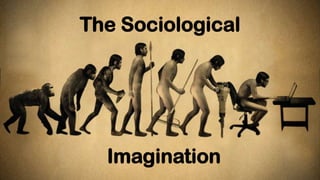
The Sociological


  Imagination
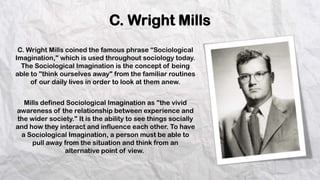
C. Wright Mills
 C. Wright Mills coined the famous phrase “Sociological
Imagination," which is used throughout sociology today.
  The Sociological Imagination is the concept of being
able to "think ourselves away" from the familiar routines
     of our daily lives in order to look at them anew.


  Mills defined Sociological Imagination as "the vivid
awareness of the relationship between experience and
the wider society." It is the ability to see things socially
and how they interact and influence each other. To have
 a Sociological Imagination, a person must be able to
     pull away from the situation and think from an
               alternative point of view.
The Sociological Imagination
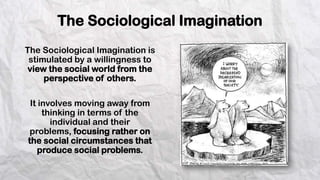
The Sociological Imagination is
 stimulated by a willingness to
 view the social world from the
     perspective of others.

 It involves moving away from
     thinking in terms of the
       individual and their
 problems, focusing rather on
the social circumstances that
    produce social problems.
Private Issues & Public Issues
 There is a strong tendency in liberal democracies towards seeing human behaviour in terms of
                  individual characteristics, abilities, choices and preferences.


  We tend to experience whatever happens in our own lives as unique and private, and also to
            interpret what happens to other people as unique and private to them.
                              These are seen as ‘private troubles’.


Sociologists, on the other hand, are more interested in the relationship between what happens to
 individuals in their lives and the larges processes of social, economic and political change that
                    might be said to lie underneath or behind those happenings.


The discipline of Sociology encourages you to look for the social processes and structures that
  give a generalised pattern to those private troubles and thus turn them into ‘public issues’.
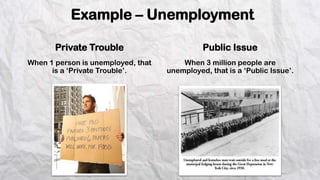
Example – Unemployment

       Private Trouble                        Public Issue
When 1 person is unemployed, that       When 3 million people are
      is a ‘Private Trouble’.       unemployed, that is a ‘Public Issue’.
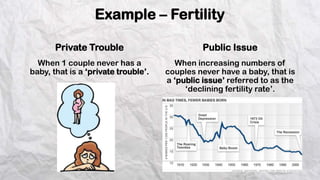
Example – Fertility

       Private Trouble                         Public Issue
  When 1 couple never has a            When increasing numbers of
baby, that is a ‘private trouble’.   couples never have a baby, that is
                                     a ‘public issue’ referred to as the
                                          ‘declining fertility rate’.
The Thinking of The Sociological
                     Imagination
‘Neither the life of an individual nor the history of a society can be understood without understanding
      both, yet men do not usually define the troubles they endure in terms of historical change.


Seldom aware of the intricate connection between the patterns of their own lives and the course of
world history, ordinary men do not usually know what this connection means for the kind of men they
           are becoming and for the kinds of history making in which they might take part.


What they need, is a quality of mind that will help them to see what is going on in the world and what
                                may be happening within themselves.


                  It is this quality that may be called The Sociological Imagination’.


                                            C. Wright MiIls

The sociological imagination

  • 1.
    The Sociological Imagination
  • 2.
    C. Wright Mills C. Wright Mills coined the famous phrase “Sociological Imagination," which is used throughout sociology today. The Sociological Imagination is the concept of being able to "think ourselves away" from the familiar routines of our daily lives in order to look at them anew. Mills defined Sociological Imagination as "the vivid awareness of the relationship between experience and the wider society." It is the ability to see things socially and how they interact and influence each other. To have a Sociological Imagination, a person must be able to pull away from the situation and think from an alternative point of view.
  • 3.
    The Sociological Imagination TheSociological Imagination is stimulated by a willingness to view the social world from the perspective of others. It involves moving away from thinking in terms of the individual and their problems, focusing rather on the social circumstances that produce social problems.
  • 4.
    Private Issues &Public Issues There is a strong tendency in liberal democracies towards seeing human behaviour in terms of individual characteristics, abilities, choices and preferences. We tend to experience whatever happens in our own lives as unique and private, and also to interpret what happens to other people as unique and private to them. These are seen as ‘private troubles’. Sociologists, on the other hand, are more interested in the relationship between what happens to individuals in their lives and the larges processes of social, economic and political change that might be said to lie underneath or behind those happenings. The discipline of Sociology encourages you to look for the social processes and structures that give a generalised pattern to those private troubles and thus turn them into ‘public issues’.
  • 5.
    Example – Unemployment Private Trouble Public Issue When 1 person is unemployed, that When 3 million people are is a ‘Private Trouble’. unemployed, that is a ‘Public Issue’.
  • 6.
    Example – Fertility Private Trouble Public Issue When 1 couple never has a When increasing numbers of baby, that is a ‘private trouble’. couples never have a baby, that is a ‘public issue’ referred to as the ‘declining fertility rate’.
  • 7.
    The Thinking ofThe Sociological Imagination ‘Neither the life of an individual nor the history of a society can be understood without understanding both, yet men do not usually define the troubles they endure in terms of historical change. Seldom aware of the intricate connection between the patterns of their own lives and the course of world history, ordinary men do not usually know what this connection means for the kind of men they are becoming and for the kinds of history making in which they might take part. What they need, is a quality of mind that will help them to see what is going on in the world and what may be happening within themselves. It is this quality that may be called The Sociological Imagination’. C. Wright MiIls