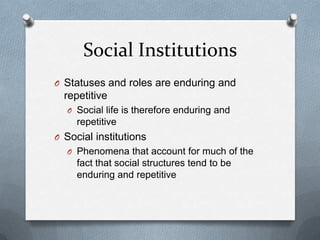
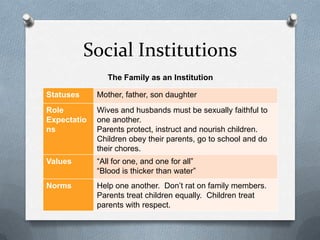
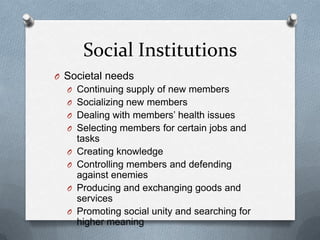
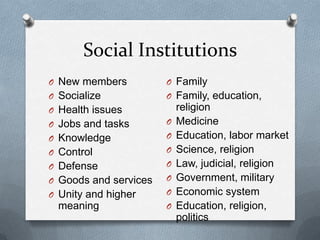
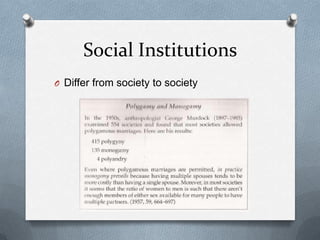
Social institutions are phenomena that account for enduring and repetitive social structures. They develop gradually and unplanned over time to meet important societal needs like providing new members, socializing children, addressing health issues, assigning jobs, creating knowledge, and promoting social unity. Social institutions tend to be conservative and change slowly due to being legitimized as logical and natural. A change in one institution can impact others due to their interdependence. While fulfilling core functions, the specific form of institutions differs between societies.