Exam 2 Review
Social Movements through Stratification
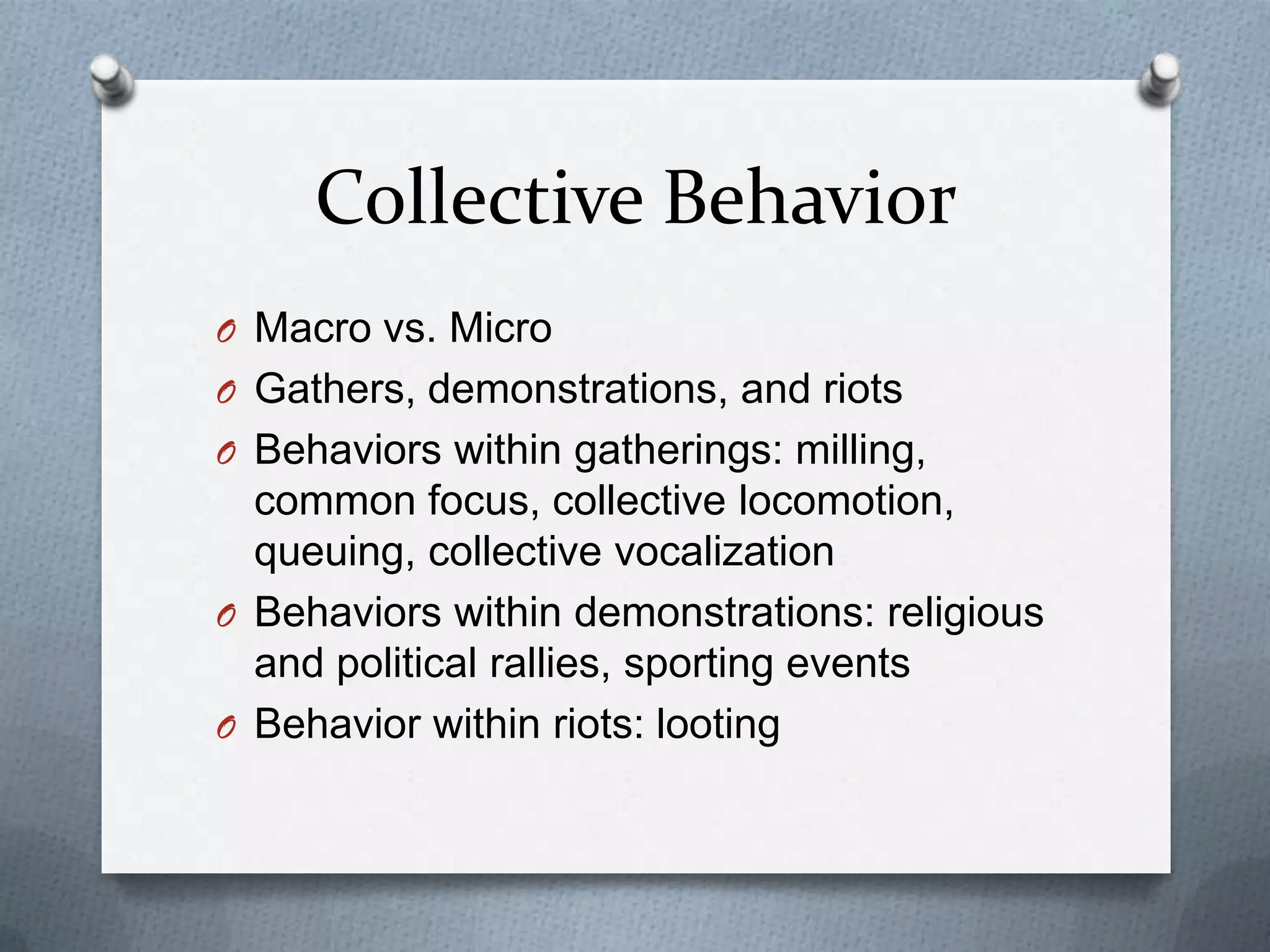
Collective Behavior
O Macro vs. Micro
O Gathers, demonstrations, and riots
O Behaviors within gatherings: milling,
  common focus, collective locomotion,
  queuing, collective vocalization
O Behaviors within demonstrations: religious
  and political rallies, sporting events
O Behavior within riots: looting
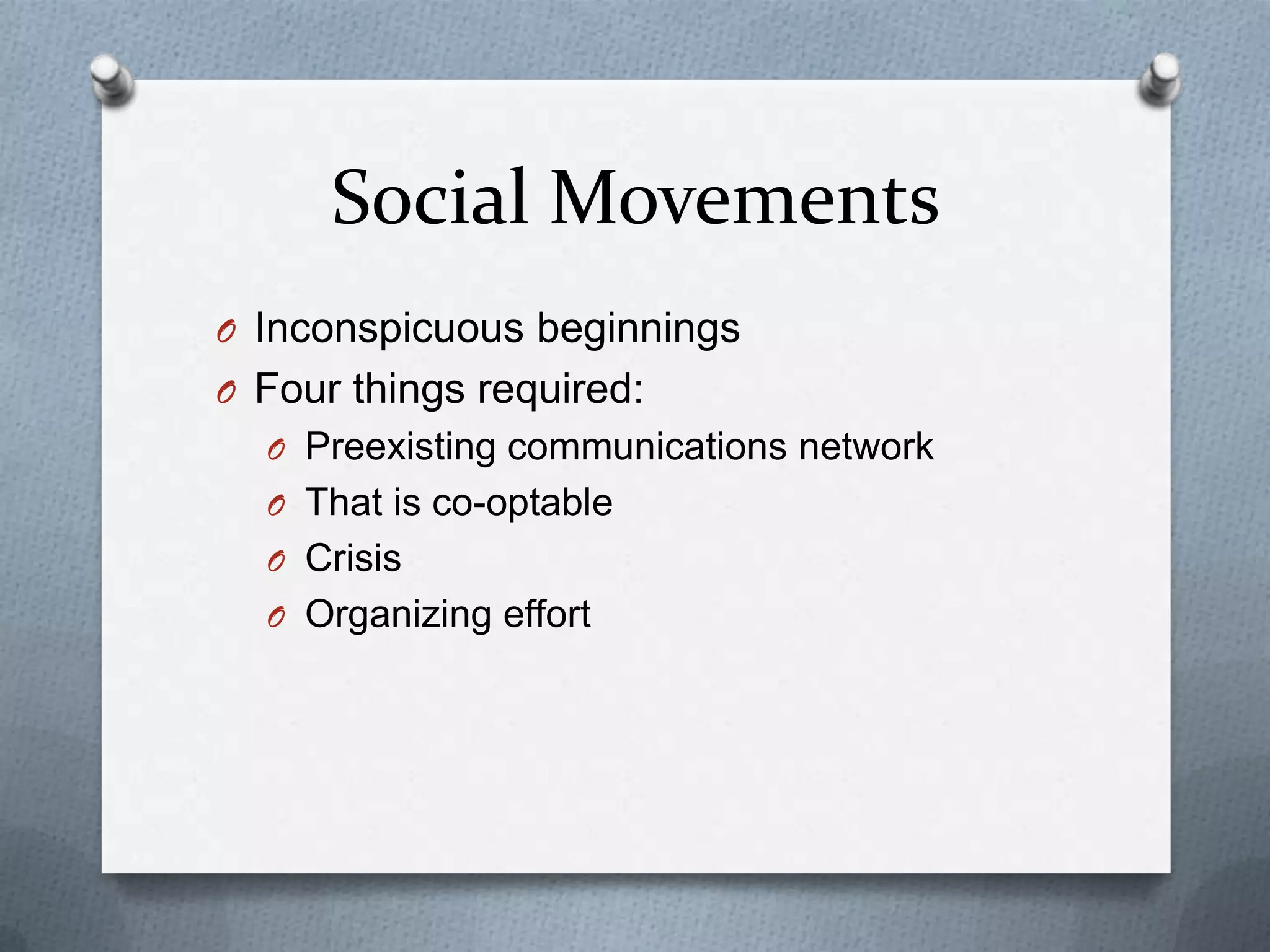
Social Movements
O Inconspicuous beginnings
O Four things required:
  O Preexisting communications network
  O That is co-optable
  O Crisis
  O Organizing effort
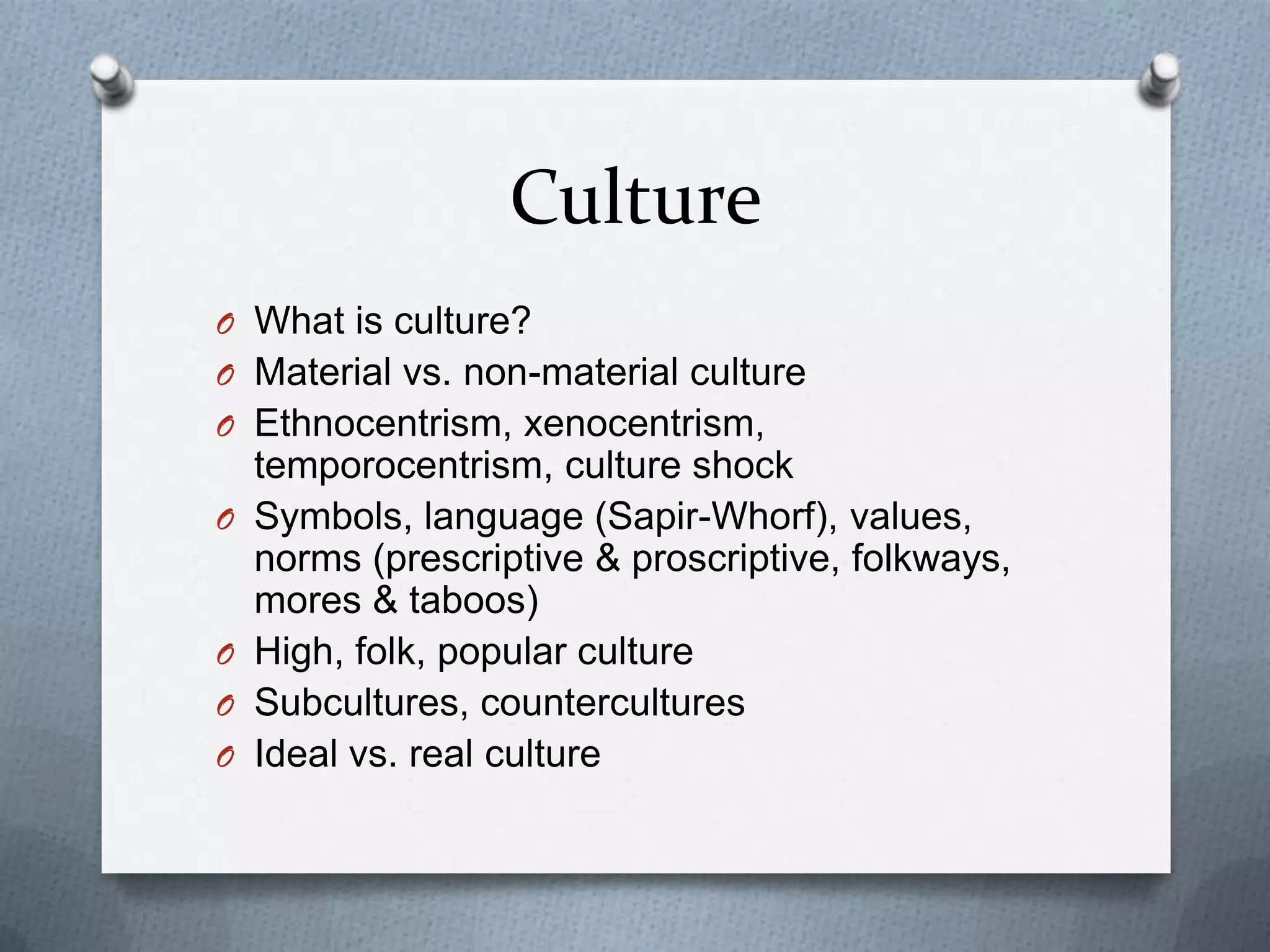
Culture
O What is culture?
O Material vs. non-material culture
O Ethnocentrism, xenocentrism,
    temporocentrism, culture shock
O   Symbols, language (Sapir-Whorf), values,
    norms (prescriptive & proscriptive, folkways,
    mores & taboos)
O   High, folk, popular culture
O   Subcultures, countercultures
O   Ideal vs. real culture
Social Structure
O Status (ascribed and achieved)
  O Master status
O Roles
  O Prescribed role, role perception, role
    performance
  O Role ambiguity, role strain, role conflict,
    role confusion
Social Groups
O Statistical groups, categorical groups,
  limited social groups, social groups
O Primary and secondary groups
O Dyad and Triad
O In-group and out-group
Socialization
O Nature vs. nurture
O Social isolation
O Mead: development of self, role taking, play
    (preparatory, play and game stages),
    generalized other, I & Me
O   Cooley: looking-glass self
O   Goffman: dramaturgical approach,
    maintaining self
O   Major agents of socialization
O   Socialization as adults
Social Institutions
O Society must be self-sufficient
O Societal needs and what institutions fill
  them
O Ideal type
O Generally unplanned (routine), inherently
  conservative, interdependent, bear little
  resemblance from society to society
Deviance and Control
O Deviance, deviants, conformity
O Variations in behavior
O Durkheim
O Positive and negative functions of
  deviance
O Internal and external means of control
O Positive and negative, informal and formal
  sanctions
O Biological, psychoanalytic and sociological
  theories
Deviance and Control
O Merton’s strain theory
O Conflict theory
O Symbolic interaction: cultural
  transmission, differential association,
  social learning theory
O Labeling theory
Stratification
O Open vs. closed systems
O Systems of stratification (caste, estate,
    slave, class)
O   Weber: Class, status, party (power)
O   Socioeconomic status
O   Upper, middle, lower classes
O   Poverty
O   Class consciousness
O   Structural functionalist and conflict theory

Exam2 review

  • 1.
    Exam 2 Review SocialMovements through Stratification
  • 2.
    Collective Behavior O Macrovs. Micro O Gathers, demonstrations, and riots O Behaviors within gatherings: milling, common focus, collective locomotion, queuing, collective vocalization O Behaviors within demonstrations: religious and political rallies, sporting events O Behavior within riots: looting
  • 3.
    Social Movements O Inconspicuousbeginnings O Four things required: O Preexisting communications network O That is co-optable O Crisis O Organizing effort
  • 4.
    Culture O What isculture? O Material vs. non-material culture O Ethnocentrism, xenocentrism, temporocentrism, culture shock O Symbols, language (Sapir-Whorf), values, norms (prescriptive & proscriptive, folkways, mores & taboos) O High, folk, popular culture O Subcultures, countercultures O Ideal vs. real culture
  • 5.
    Social Structure O Status(ascribed and achieved) O Master status O Roles O Prescribed role, role perception, role performance O Role ambiguity, role strain, role conflict, role confusion
  • 6.
    Social Groups O Statisticalgroups, categorical groups, limited social groups, social groups O Primary and secondary groups O Dyad and Triad O In-group and out-group
  • 7.
    Socialization O Nature vs.nurture O Social isolation O Mead: development of self, role taking, play (preparatory, play and game stages), generalized other, I & Me O Cooley: looking-glass self O Goffman: dramaturgical approach, maintaining self O Major agents of socialization O Socialization as adults
  • 8.
    Social Institutions O Societymust be self-sufficient O Societal needs and what institutions fill them O Ideal type O Generally unplanned (routine), inherently conservative, interdependent, bear little resemblance from society to society
  • 9.
    Deviance and Control ODeviance, deviants, conformity O Variations in behavior O Durkheim O Positive and negative functions of deviance O Internal and external means of control O Positive and negative, informal and formal sanctions O Biological, psychoanalytic and sociological theories
  • 10.
    Deviance and Control OMerton’s strain theory O Conflict theory O Symbolic interaction: cultural transmission, differential association, social learning theory O Labeling theory
  • 11.
    Stratification O Open vs.closed systems O Systems of stratification (caste, estate, slave, class) O Weber: Class, status, party (power) O Socioeconomic status O Upper, middle, lower classes O Poverty O Class consciousness O Structural functionalist and conflict theory