Microbiology
Culturing Microbes
Lab 4
The Five “I’s
1. Inoculation: Method of transferring organisms
used to produce a pure culture
2. Isolation: Selection of a single type of colony
on media (CFU) with one single kind of microbe
growing (pure culture/isolated colony)
3. Incubation: Method of growing microbes under
proper conditions
4. Inspection: Observation of characteristics, data
and results
5. Identification: use of data, comparison
correlation, to ID organism to exact species
1. Inoculation: Producing a pure
cultures
• Colony
– macroscopically visible collection of bacteria
originating from a single bacterial cell.
• Colony Forming Units (CFU)
– All the genetically related progeny of a single
cultured organism or cell growing as colony.
• Pure cultures
– a single organism and its reproduced progeny
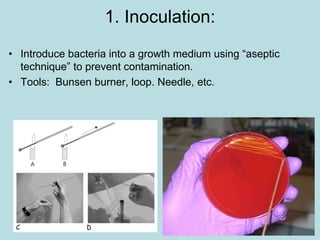
1. Inoculation:
• Introduce bacteria into a growth medium using “aseptic
technique” to prevent contamination.
• Tools: Bunsen burner, loop. Needle, etc.
Inoculation:
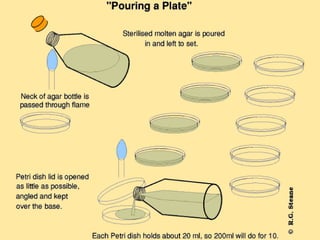
Agar Gel
• Frau Hesse
• Used for preparing solid medium
• Obtained from seaweeds.
• No nutritive value
• Not affected by the growth of the bacteria.
• Melts at 98oC & sets at 42oC
• 2% agar is employed in solid medium
2. Isolation: Producing CFU
• Isolation:
– Growth media/medium:
• Liquid/gel designed to support the growth of microbes, cells or small
plants
– General :
• NA (nutrient agar), TSA (Trypticase soy agar)
– Differential: Have dyes, salts, inhibiting agents
• Mac (selectively isolate Gram- ve & enteric bacilli and differentiate
them based on lactose fermentation.
• EMB (Eosin methylene blue is a selective stain for gram-negative
bacteria)
• SS (Salmonella-Shigella , is a selective and differential medium . It is
used for the isolation, cultivation and differentiation of gram-negative
Pure Cultures
• Pure culture: culture of bacteria in which the
organisms are all genetically identical
– All of the organisms are the same species and
contain the exact same DNA (clones)
– Usually they are all derived from the same original
cell
• Mixed Culture – culture of bacteria in which
the organisms are not genetically identical
– The organisms are different species and/or
contain different DNA
• Pure cultures are necessary to ensure the
integrity of your results
– Different bacteria have different properties and
respond differently to chemicals and other
manipulations
– If your culture is not pure, how can you be sure
your results are accurate?
• Contamination by another type of
microorganism can ruin all of your work
Why are pure cultures important?
What is an “isolated colony?”
• Colony – aka Colony Forming Unit (CFU)
– Small culture of bacteria, on solid media
• all derived from the same original bacterial cell
– They are all genetically identical (therefore, this is
a type of pure culture)
• Isolated colony
– CFU not touching or questionably close to any
other CFU on the plate or slant
– Obtaining isolated CFUs from a culture (mixed or
pure) is the point of the 3 techniques
Types of culture media
1. Based on consistency
a) solid medium
b) liquid medium
c) semi solid medium
Solid media – contains 2% agar
• Colony morphology, pigmentation, hemolysis can
be observed.
• Eg: Nutrient agar, Blood agar
Liquid media – no agar.
• For inoculum preparation, Blood culture, for the
enrichment of pathogens from a mixture.
• Eg: Nutrient broth, Selenite broth
Semi solid medium – 0.5% agar.
• Eg: Motility medium
Types of culture media
II. Based on the constituents/ ingredients
a) simple medium
b) complex medium
c) synthetic or defined medium
d) Special media
Special types of media:
– Enriched - Enrichment
– Selective - Indicator - Differential
– Sugar - Transport - Biochemical reactions
Simple media / basal media
• Eg: Nutrient Broth, Nutrient Agar, Tryptic
Soy Agar
• NB consists of peptone, meat extract, NaCl,
• NB + 2% agar = Nutrient Agar
Complex media
• Media other than basal media
• They have added ingredients
• Provide special nutrients
Synthetic or defined media
• Media prepared from pure chemical
substances and its exact composition is
known
• Eg: peptone water – 1% peptone + 0.5%
NaCl in water
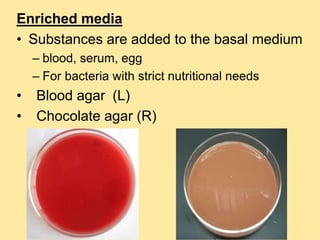
Enriched media
• Substances are added to the basal medium
– blood, serum, egg
– For bacteria with strict nutritional needs
• Blood agar (L)
• Chocolate agar (R)
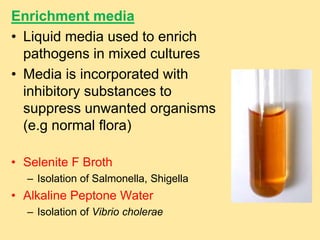
Enrichment media
• Liquid media used to enrich
pathogens in mixed cultures
• Media is incorporated with
inhibitory substances to
suppress unwanted organisms
(e.g normal flora)
• Selenite F Broth
– Isolation of Salmonella, Shigella
• Alkaline Peptone Water
– Isolation of Vibrio cholerae
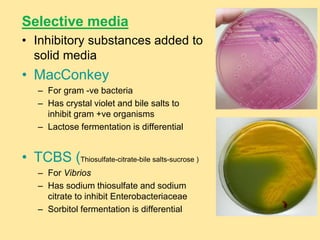
Selective media
• Inhibitory substances added to
solid media
• MacConkey
– For gram -ve bacteria
– Has crystal violet and bile salts to
inhibit gram +ve organisms
– Lactose fermentation is differential
• TCBS (Thiosulfate-citrate-bile salts-sucrose )
– For Vibrios
– Has sodium thiosulfate and sodium
citrate to inhibit Enterobacteriaceae
– Sorbitol fermentation is differential
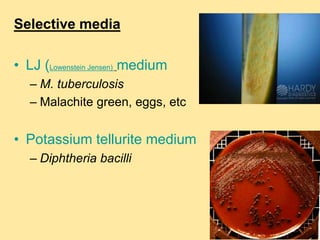
Selective media
• LJ (Lowenstein Jensen) medium
– M. tuberculosis
– Malachite green, eggs, etc
• Potassium tellurite medium
– Diphtheria bacilli
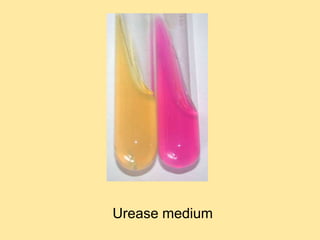
Indicator media
• Contain an indicator which changes its
color when a bacterium grows in them.
– Blood agar
– MacConkey
– Christensen’s urea
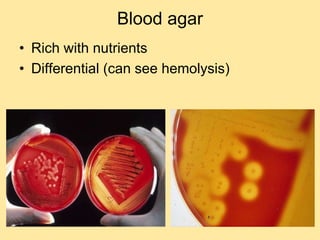
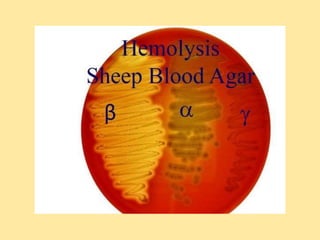
Blood agar
• Rich with nutrients
• Differential (can see hemolysis)
Urease medium
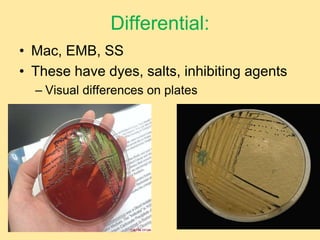
Differential:
• Mac, EMB, SS
• These have dyes, salts, inhibiting agents
– Visual differences on plates
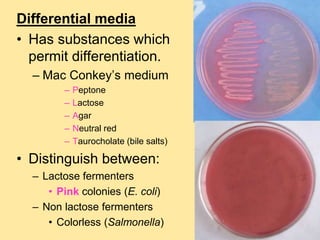
Differential media
• Has substances which
permit differentiation.
– Mac Conkey’s medium
– Peptone
– Lactose
– Agar
– Neutral red
– Taurocholate (bile salts)
• Distinguish between:
– Lactose fermenters
• Pink colonies (E. coli)
– Non lactose fermenters
• Colorless (Salmonella)
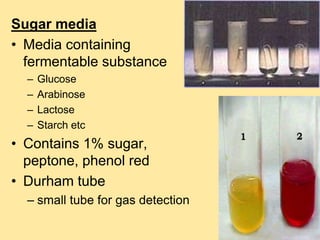
Sugar media
• Media containing
fermentable substance
– Glucose
– Arabinose
– Lactose
– Starch etc
• Contains 1% sugar,
peptone, phenol red
• Durham tube
– small tube for gas detection
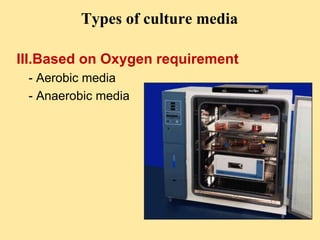
III.Based on Oxygen requirement
- Aerobic media
- Anaerobic media
Types of culture media
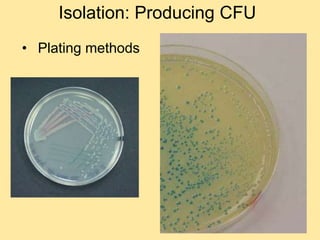
Isolation: Producing CFU
• Plating methods
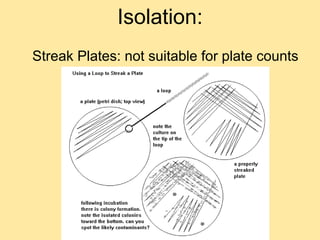
Isolation:
Streak Plates: not suitable for plate counts
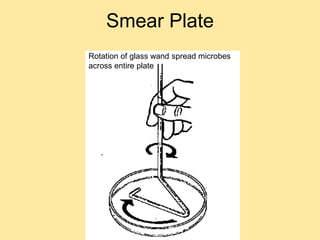
Smear Plate
Rotation of glass wand spread microbes
across entire plate
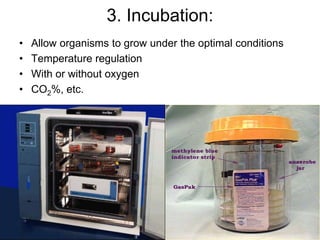
3. Incubation:
• Allow organisms to grow under the optimal conditions
• Temperature regulation
• With or without oxygen
• CO2%, etc.
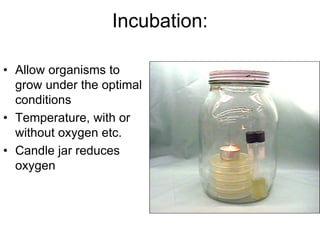
Incubation:
• Allow organisms to
grow under the optimal
conditions
• Temperature, with or
without oxygen etc.
• Candle jar reduces
oxygen
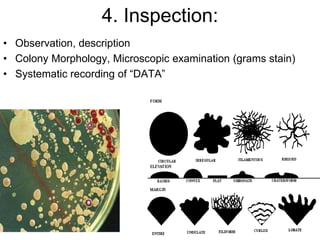
4. Inspection:
• Observation, description
• Colony Morphology, Microscopic examination (grams stain)
• Systematic recording of “DATA”
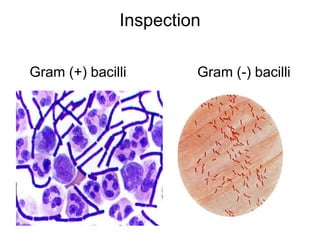
Inspection
Gram (+) bacilli Gram (-) bacilli
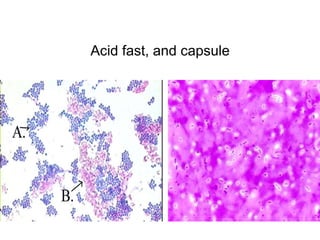
Acid fast, and capsule
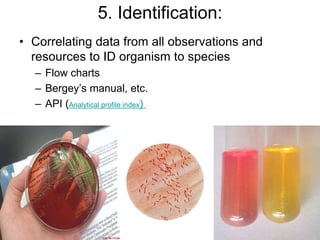
5. Identification:
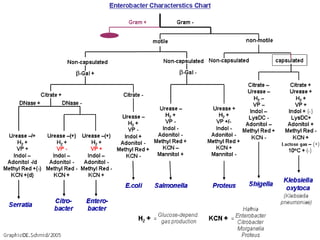
• Correlating data from all observations and
resources to ID organism to species
– Flow charts
– Bergey’s manual, etc.
– API (Analytical profile index)
5. Identification:
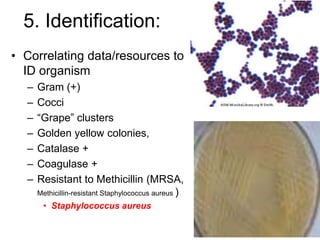
• Correlating data/resources to
ID organism
– Gram (+)
– Cocci
– “Grape” clusters
– Golden yellow colonies,
– Catalase +
– Coagulase +
– Resistant to Methicillin (MRSA,
Methicillin-resistant Staphylococcus aureus )
• Staphylococcus aureus
Today’s Lab
HOW TO OBTAIN PURE CULTURES:
Methods of Bacterial Separation
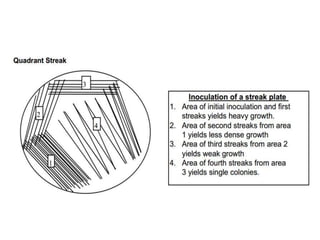
Quadrant Streak Plate:
• Method to dilute inoculum and obtain well-
isolated and discrete colony forming units
• Spread Plate: Method of amounts of
organisms often for the purpose of counting,
using a glass rod
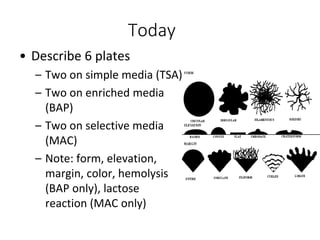
Today
• Describe 6 plates
– Two on simple media (TSA)
– Two on enriched media
(BAP)
– Two on selective media
(MAC)
– Note: form, elevation,
margin, color, hemolysis
(BAP only), lactose
reaction (MAC only)
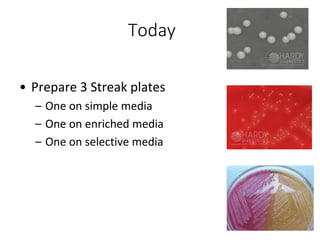
Today
• Prepare 3 Streak plates
– One on simple media
– One on enriched media
– One on selective media
Micro Lab 3 Lecture

Micro Lab 3 Lecture

  • 1.
  • 2.
    The Five “I’s 1.Inoculation: Method of transferring organisms used to produce a pure culture 2. Isolation: Selection of a single type of colony on media (CFU) with one single kind of microbe growing (pure culture/isolated colony) 3. Incubation: Method of growing microbes under proper conditions 4. Inspection: Observation of characteristics, data and results 5. Identification: use of data, comparison correlation, to ID organism to exact species
  • 3.
    1. Inoculation: Producinga pure cultures • Colony – macroscopically visible collection of bacteria originating from a single bacterial cell. • Colony Forming Units (CFU) – All the genetically related progeny of a single cultured organism or cell growing as colony. • Pure cultures – a single organism and its reproduced progeny
  • 4.
    1. Inoculation: • Introducebacteria into a growth medium using “aseptic technique” to prevent contamination. • Tools: Bunsen burner, loop. Needle, etc.
  • 5.
    Inoculation: Agar Gel • FrauHesse • Used for preparing solid medium • Obtained from seaweeds. • No nutritive value • Not affected by the growth of the bacteria. • Melts at 98oC & sets at 42oC • 2% agar is employed in solid medium
  • 6.
    2. Isolation: ProducingCFU • Isolation: – Growth media/medium: • Liquid/gel designed to support the growth of microbes, cells or small plants – General : • NA (nutrient agar), TSA (Trypticase soy agar) – Differential: Have dyes, salts, inhibiting agents • Mac (selectively isolate Gram- ve & enteric bacilli and differentiate them based on lactose fermentation. • EMB (Eosin methylene blue is a selective stain for gram-negative bacteria) • SS (Salmonella-Shigella , is a selective and differential medium . It is used for the isolation, cultivation and differentiation of gram-negative
  • 7.
    Pure Cultures • Pureculture: culture of bacteria in which the organisms are all genetically identical – All of the organisms are the same species and contain the exact same DNA (clones) – Usually they are all derived from the same original cell • Mixed Culture – culture of bacteria in which the organisms are not genetically identical – The organisms are different species and/or contain different DNA
  • 8.
    • Pure culturesare necessary to ensure the integrity of your results – Different bacteria have different properties and respond differently to chemicals and other manipulations – If your culture is not pure, how can you be sure your results are accurate? • Contamination by another type of microorganism can ruin all of your work Why are pure cultures important?
  • 9.
    What is an“isolated colony?” • Colony – aka Colony Forming Unit (CFU) – Small culture of bacteria, on solid media • all derived from the same original bacterial cell – They are all genetically identical (therefore, this is a type of pure culture) • Isolated colony – CFU not touching or questionably close to any other CFU on the plate or slant – Obtaining isolated CFUs from a culture (mixed or pure) is the point of the 3 techniques
  • 10.
    Types of culturemedia 1. Based on consistency a) solid medium b) liquid medium c) semi solid medium
  • 11.
    Solid media –contains 2% agar • Colony morphology, pigmentation, hemolysis can be observed. • Eg: Nutrient agar, Blood agar Liquid media – no agar. • For inoculum preparation, Blood culture, for the enrichment of pathogens from a mixture. • Eg: Nutrient broth, Selenite broth Semi solid medium – 0.5% agar. • Eg: Motility medium
  • 12.
    Types of culturemedia II. Based on the constituents/ ingredients a) simple medium b) complex medium c) synthetic or defined medium d) Special media Special types of media: – Enriched - Enrichment – Selective - Indicator - Differential – Sugar - Transport - Biochemical reactions
  • 13.
    Simple media /basal media • Eg: Nutrient Broth, Nutrient Agar, Tryptic Soy Agar • NB consists of peptone, meat extract, NaCl, • NB + 2% agar = Nutrient Agar
  • 14.
    Complex media • Mediaother than basal media • They have added ingredients • Provide special nutrients Synthetic or defined media • Media prepared from pure chemical substances and its exact composition is known • Eg: peptone water – 1% peptone + 0.5% NaCl in water
  • 15.
    Enriched media • Substancesare added to the basal medium – blood, serum, egg – For bacteria with strict nutritional needs • Blood agar (L) • Chocolate agar (R)
  • 16.
    Enrichment media • Liquidmedia used to enrich pathogens in mixed cultures • Media is incorporated with inhibitory substances to suppress unwanted organisms (e.g normal flora) • Selenite F Broth – Isolation of Salmonella, Shigella • Alkaline Peptone Water – Isolation of Vibrio cholerae
  • 17.
    Selective media • Inhibitorysubstances added to solid media • MacConkey – For gram -ve bacteria – Has crystal violet and bile salts to inhibit gram +ve organisms – Lactose fermentation is differential • TCBS (Thiosulfate-citrate-bile salts-sucrose ) – For Vibrios – Has sodium thiosulfate and sodium citrate to inhibit Enterobacteriaceae – Sorbitol fermentation is differential
  • 18.
    Selective media • LJ(Lowenstein Jensen) medium – M. tuberculosis – Malachite green, eggs, etc • Potassium tellurite medium – Diphtheria bacilli
  • 19.
    Indicator media • Containan indicator which changes its color when a bacterium grows in them. – Blood agar – MacConkey – Christensen’s urea
  • 20.
    Blood agar • Richwith nutrients • Differential (can see hemolysis)
  • 22.
  • 23.
    Differential: • Mac, EMB,SS • These have dyes, salts, inhibiting agents – Visual differences on plates
  • 24.
    Differential media • Hassubstances which permit differentiation. – Mac Conkey’s medium – Peptone – Lactose – Agar – Neutral red – Taurocholate (bile salts) • Distinguish between: – Lactose fermenters • Pink colonies (E. coli) – Non lactose fermenters • Colorless (Salmonella)
  • 25.
    Sugar media • Mediacontaining fermentable substance – Glucose – Arabinose – Lactose – Starch etc • Contains 1% sugar, peptone, phenol red • Durham tube – small tube for gas detection
  • 26.
    III.Based on Oxygenrequirement - Aerobic media - Anaerobic media Types of culture media
  • 27.
  • 28.
    Isolation: Streak Plates: notsuitable for plate counts
  • 29.
    Smear Plate Rotation ofglass wand spread microbes across entire plate
  • 31.
    3. Incubation: • Alloworganisms to grow under the optimal conditions • Temperature regulation • With or without oxygen • CO2%, etc.
  • 32.
    Incubation: • Allow organismsto grow under the optimal conditions • Temperature, with or without oxygen etc. • Candle jar reduces oxygen
  • 33.
    4. Inspection: • Observation,description • Colony Morphology, Microscopic examination (grams stain) • Systematic recording of “DATA”
  • 34.
  • 35.
  • 36.
    5. Identification: • Correlatingdata from all observations and resources to ID organism to species – Flow charts – Bergey’s manual, etc. – API (Analytical profile index)
  • 37.
    5. Identification: • Correlatingdata/resources to ID organism – Gram (+) – Cocci – “Grape” clusters – Golden yellow colonies, – Catalase + – Coagulase + – Resistant to Methicillin (MRSA, Methicillin-resistant Staphylococcus aureus ) • Staphylococcus aureus
  • 39.
  • 40.
    HOW TO OBTAINPURE CULTURES: Methods of Bacterial Separation Quadrant Streak Plate: • Method to dilute inoculum and obtain well- isolated and discrete colony forming units • Spread Plate: Method of amounts of organisms often for the purpose of counting, using a glass rod
  • 41.
    Today • Describe 6plates – Two on simple media (TSA) – Two on enriched media (BAP) – Two on selective media (MAC) – Note: form, elevation, margin, color, hemolysis (BAP only), lactose reaction (MAC only)
  • 42.
    Today • Prepare 3Streak plates – One on simple media – One on enriched media – One on selective media