Copyright © 2011 Wolters Kluwer Health | Lippincott Williams & Wilkins
Chapter 6
Critically Appraising Qualitative
Evidence for Clinical Decision
Making
Copyright © 2011 Wolters Kluwer Health | Lippincott Williams & Wilkins
Qualitative Research and Decision-
Making
• Qualitative research is usually placed near the bottom of
hierarchies of evidence
• However, it is important in regard to clinical questions
that address human responses and meaning
• Recall that patient preferences and values are key
components of EBP
• Qualitative methods have evolved and expanded in
recent years
Copyright © 2011 Wolters Kluwer Health | Lippincott Williams & Wilkins
Question
• Qualitative evidence is most likely to inform which of the
following aspects of the care of patients with cancer?
a. Cancer patients’ perceptions of hope during
chemotherapy treatment
b. Treatment options for chemotherapy-induced nausea
c. Clinicians’ choices of chemotherapeutic agents
d. The relationship between anxiety and nausea in patients
undergoing chemotherapy
Copyright © 2011 Wolters Kluwer Health | Lippincott Williams & Wilkins
Answer
• a. Cancer patients’ perceptions of hope during
chemotherapy treatment
• Rationale: The concept of hope is an aspect of the human
responses and meaning that surround a health
experience. Treatment options and the relationships
between different concepts are likely better addressed by
quantitative evidence.
Copyright © 2011 Wolters Kluwer Health | Lippincott Williams & Wilkins
Qualitative Research Traditions
• Clinicians must appreciate the diversity within the
methodology
• Ethnography - the study of a social group’s culture
through combining participant observation, in-depth
interviews, and the collection of artifacts
− Useful for elucidating
• People’s experiences of health/illness
• Issues of concern to caregivers
• Individuals’ experiences in certain types of settings
Copyright © 2011 Wolters Kluwer Health | Lippincott Williams & Wilkins
Qualitative Research Traditions (cont’d)
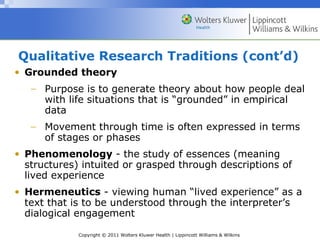
• Grounded theory
− Purpose is to generate theory about how people deal
with life situations that is “grounded” in empirical
data
− Movement through time is often expressed in terms
of stages or phases
• Phenomenology - the study of essences (meaning
structures) intuited or grasped through descriptions of
lived experience
• Hermeneutics - viewing human “lived experience” as a
text that is to be understood through the interpreter’s
dialogical engagement
Copyright © 2011 Wolters Kluwer Health | Lippincott Williams & Wilkins
Question
• Tell whether the following statement is true or false.
• Grounded theory is the most appropriate tradition for a
study that explores women’s coping as they move
through different stages of fertility treatment.
Copyright © 2011 Wolters Kluwer Health | Lippincott Williams & Wilkins
Answer
• True
• Rationale: Grounded theory often focuses on changes in
the human experience as they move through time.
Copyright © 2011 Wolters Kluwer Health | Lippincott Williams & Wilkins
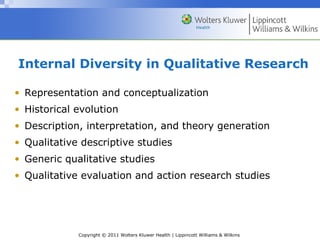
Internal Diversity in Qualitative Research
• Representation and conceptualization
• Historical evolution
• Description, interpretation, and theory generation
• Qualitative descriptive studies
• Generic qualitative studies
• Qualitative evaluation and action research studies
Copyright © 2011 Wolters Kluwer Health | Lippincott Williams & Wilkins
Qualitative Research Techniques
• Observation and field notes
• Interviews and focus groups
• Narrative and content analysis
• Sampling strategies
• Data management and analysis
Copyright © 2011 Wolters Kluwer Health | Lippincott Williams & Wilkins
Appraising Qualitative Studies
• No single set of criteria can serve all qualitative
approaches equally well
• Lincoln and Guba’s (1985) trustworthiness criteria have
broad application
− Credibility
• Demonstrated by accuracy and validity that is
assured through documentation
• Roughly parallel to internal validity in quantitative
appraisal
Copyright © 2011 Wolters Kluwer Health | Lippincott Williams & Wilkins
Appraising Qualitative Studies (cont’d)
Lincoln and Guba
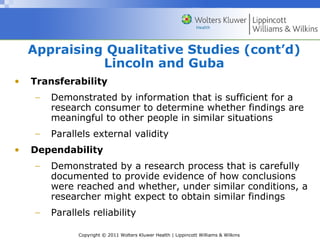
• Transferability
− Demonstrated by information that is sufficient for a
research consumer to determine whether findings are
meaningful to other people in similar situations
− Parallels external validity
• Dependability
− Demonstrated by a research process that is carefully
documented to provide evidence of how conclusions
were reached and whether, under similar conditions, a
researcher might expect to obtain similar findings
− Parallels reliability
Copyright © 2011 Wolters Kluwer Health | Lippincott Williams & Wilkins
• Confirmability
− Demonstrated by providing substantiation that
findings and interpretations are grounded in the data
− Parallels objectivity
• Authenticity criteria (Guba & Lincoln, 1989)
− Less commonly used than Lincoln & Guba’s
trustworthiness criteria
Appraising Qualitative Studies (cont’d)
Lincoln and Guba
Copyright © 2011 Wolters Kluwer Health | Lippincott Williams & Wilkins
Question
• A nurse has examined whether the participants in a
qualitative study on the meaning of dependence among
IV drug users are similar to the clients that the nurse
works with. This nurse has evaluated this study’s:
a. Dependability
b. Confirmability
c. Transferability
d. Credibility
Copyright © 2011 Wolters Kluwer Health | Lippincott Williams & Wilkins
Answer
• c. Transferability
• Rationale: Transferability addresses the question of
whether the findings of a qualitative study are applicable
to other people who are in similar situations.
Copyright © 2011 Wolters Kluwer Health | Lippincott Williams & Wilkins
Synthesizing Qualitative Evidence
• Meta-studies
• Meta-summaries

NUR 3043 Chapter006

  • 1.
    Copyright © 2011Wolters Kluwer Health | Lippincott Williams & Wilkins Chapter 6 Critically Appraising Qualitative Evidence for Clinical Decision Making
  • 2.
    Copyright © 2011Wolters Kluwer Health | Lippincott Williams & Wilkins Qualitative Research and Decision- Making • Qualitative research is usually placed near the bottom of hierarchies of evidence • However, it is important in regard to clinical questions that address human responses and meaning • Recall that patient preferences and values are key components of EBP • Qualitative methods have evolved and expanded in recent years
  • 3.
    Copyright © 2011Wolters Kluwer Health | Lippincott Williams & Wilkins Question • Qualitative evidence is most likely to inform which of the following aspects of the care of patients with cancer? a. Cancer patients’ perceptions of hope during chemotherapy treatment b. Treatment options for chemotherapy-induced nausea c. Clinicians’ choices of chemotherapeutic agents d. The relationship between anxiety and nausea in patients undergoing chemotherapy
  • 4.
    Copyright © 2011Wolters Kluwer Health | Lippincott Williams & Wilkins Answer • a. Cancer patients’ perceptions of hope during chemotherapy treatment • Rationale: The concept of hope is an aspect of the human responses and meaning that surround a health experience. Treatment options and the relationships between different concepts are likely better addressed by quantitative evidence.
  • 5.
    Copyright © 2011Wolters Kluwer Health | Lippincott Williams & Wilkins Qualitative Research Traditions • Clinicians must appreciate the diversity within the methodology • Ethnography - the study of a social group’s culture through combining participant observation, in-depth interviews, and the collection of artifacts − Useful for elucidating • People’s experiences of health/illness • Issues of concern to caregivers • Individuals’ experiences in certain types of settings
  • 6.
    Copyright © 2011Wolters Kluwer Health | Lippincott Williams & Wilkins Qualitative Research Traditions (cont’d) • Grounded theory − Purpose is to generate theory about how people deal with life situations that is “grounded” in empirical data − Movement through time is often expressed in terms of stages or phases • Phenomenology - the study of essences (meaning structures) intuited or grasped through descriptions of lived experience • Hermeneutics - viewing human “lived experience” as a text that is to be understood through the interpreter’s dialogical engagement
  • 7.
    Copyright © 2011Wolters Kluwer Health | Lippincott Williams & Wilkins Question • Tell whether the following statement is true or false. • Grounded theory is the most appropriate tradition for a study that explores women’s coping as they move through different stages of fertility treatment.
  • 8.
    Copyright © 2011Wolters Kluwer Health | Lippincott Williams & Wilkins Answer • True • Rationale: Grounded theory often focuses on changes in the human experience as they move through time.
  • 9.
    Copyright © 2011Wolters Kluwer Health | Lippincott Williams & Wilkins Internal Diversity in Qualitative Research • Representation and conceptualization • Historical evolution • Description, interpretation, and theory generation • Qualitative descriptive studies • Generic qualitative studies • Qualitative evaluation and action research studies
  • 10.
    Copyright © 2011Wolters Kluwer Health | Lippincott Williams & Wilkins Qualitative Research Techniques • Observation and field notes • Interviews and focus groups • Narrative and content analysis • Sampling strategies • Data management and analysis
  • 11.
    Copyright © 2011Wolters Kluwer Health | Lippincott Williams & Wilkins Appraising Qualitative Studies • No single set of criteria can serve all qualitative approaches equally well • Lincoln and Guba’s (1985) trustworthiness criteria have broad application − Credibility • Demonstrated by accuracy and validity that is assured through documentation • Roughly parallel to internal validity in quantitative appraisal
  • 12.
    Copyright © 2011Wolters Kluwer Health | Lippincott Williams & Wilkins Appraising Qualitative Studies (cont’d) Lincoln and Guba • Transferability − Demonstrated by information that is sufficient for a research consumer to determine whether findings are meaningful to other people in similar situations − Parallels external validity • Dependability − Demonstrated by a research process that is carefully documented to provide evidence of how conclusions were reached and whether, under similar conditions, a researcher might expect to obtain similar findings − Parallels reliability
  • 13.
    Copyright © 2011Wolters Kluwer Health | Lippincott Williams & Wilkins • Confirmability − Demonstrated by providing substantiation that findings and interpretations are grounded in the data − Parallels objectivity • Authenticity criteria (Guba & Lincoln, 1989) − Less commonly used than Lincoln & Guba’s trustworthiness criteria Appraising Qualitative Studies (cont’d) Lincoln and Guba
  • 14.
    Copyright © 2011Wolters Kluwer Health | Lippincott Williams & Wilkins Question • A nurse has examined whether the participants in a qualitative study on the meaning of dependence among IV drug users are similar to the clients that the nurse works with. This nurse has evaluated this study’s: a. Dependability b. Confirmability c. Transferability d. Credibility
  • 15.
    Copyright © 2011Wolters Kluwer Health | Lippincott Williams & Wilkins Answer • c. Transferability • Rationale: Transferability addresses the question of whether the findings of a qualitative study are applicable to other people who are in similar situations.
  • 16.
    Copyright © 2011Wolters Kluwer Health | Lippincott Williams & Wilkins Synthesizing Qualitative Evidence • Meta-studies • Meta-summaries